

A gratitude journal is a notebook or app where you regularly write down things you appreciate, from small daily pleasures to big life events. If you want to know how to start a gratitude journal, the short version is simple: pick a format, choose a fixed time, write three to five specific things you are thankful for, and add one sentence about why each mattered.
This guide walks through exactly how to do that. You will find a step-by-step method, a prompt bank you can copy, sample entries, common mistakes, and answers to the questions beginners ask most often. If you are new to journaling in general, you may also like our guide on how to start a journal.
What Is a Gratitude Journal?
A gratitude journal is a focused kind of journal. Instead of recording everything that happens in a day, you deliberately look for what went well, what you received, or what you are glad to have. The goal is not to pretend everything is perfect. It is to train your attention so that good moments get noticed and remembered rather than slipping past.
It differs from a regular diary in one important way. A diary can hold anything: events, worries, plans, rants. A gratitude journal has a single lens, and that narrow lens is what makes it quick to write and easy to keep up.
Gratitude Journal vs Diary vs Reflective Journal
The three formats overlap, but they do different jobs. The table below shows how they compare.
| Feature | Gratitude Journal | Diary | Reflective Journal |
|---|---|---|---|
| Main focus | Appreciation and positives | Daily events and feelings | Learning from experience |
| Typical length | 3 to 10 lines | A paragraph or more | One page or more |
| Time needed | 3 to 5 minutes | 10 to 20 minutes | 15 to 30 minutes |
| Best for | Building a positive habit | Recording life | Personal or professional growth |
| Structure | Lists and short reasons | Free writing | Guided questions |
Why Keep a Gratitude Journal? Benefits Worth Knowing
People usually start a gratitude journal for one of a few reasons: they want to feel calmer, they want a simple daily habit, or they want to notice more of their own life. Research on gratitude practices, including early work by psychologists Robert Emmons and Michael McCullough, has associated regular gratitude writing with better mood and a more optimistic outlook. Results vary from person to person, and a journal is not a substitute for professional mental health care, but the practice is low-risk and low-cost.
In everyday terms, the benefits people report include:
- Better attention to the good. The brain tends to notice problems first. Writing gratitude entries gives the positive side equal airtime.
- A calmer end to the day. A short evening entry gives your mind a gentle place to land before sleep.
- A record you can revisit. On a hard day, reading old entries reminds you that good things keep happening.
- A built-in habit. Because entries are short, a gratitude journal is one of the easiest journaling habits to sustain. See our wider list of the benefits of keeping a daily journal.
- Stronger relationships. Writing about people you appreciate often leads you to thank them in person.
How to Start a Gratitude Journal in 6 Steps
Starting is easier than most people expect. Follow these steps and your first entry will take under five minutes.
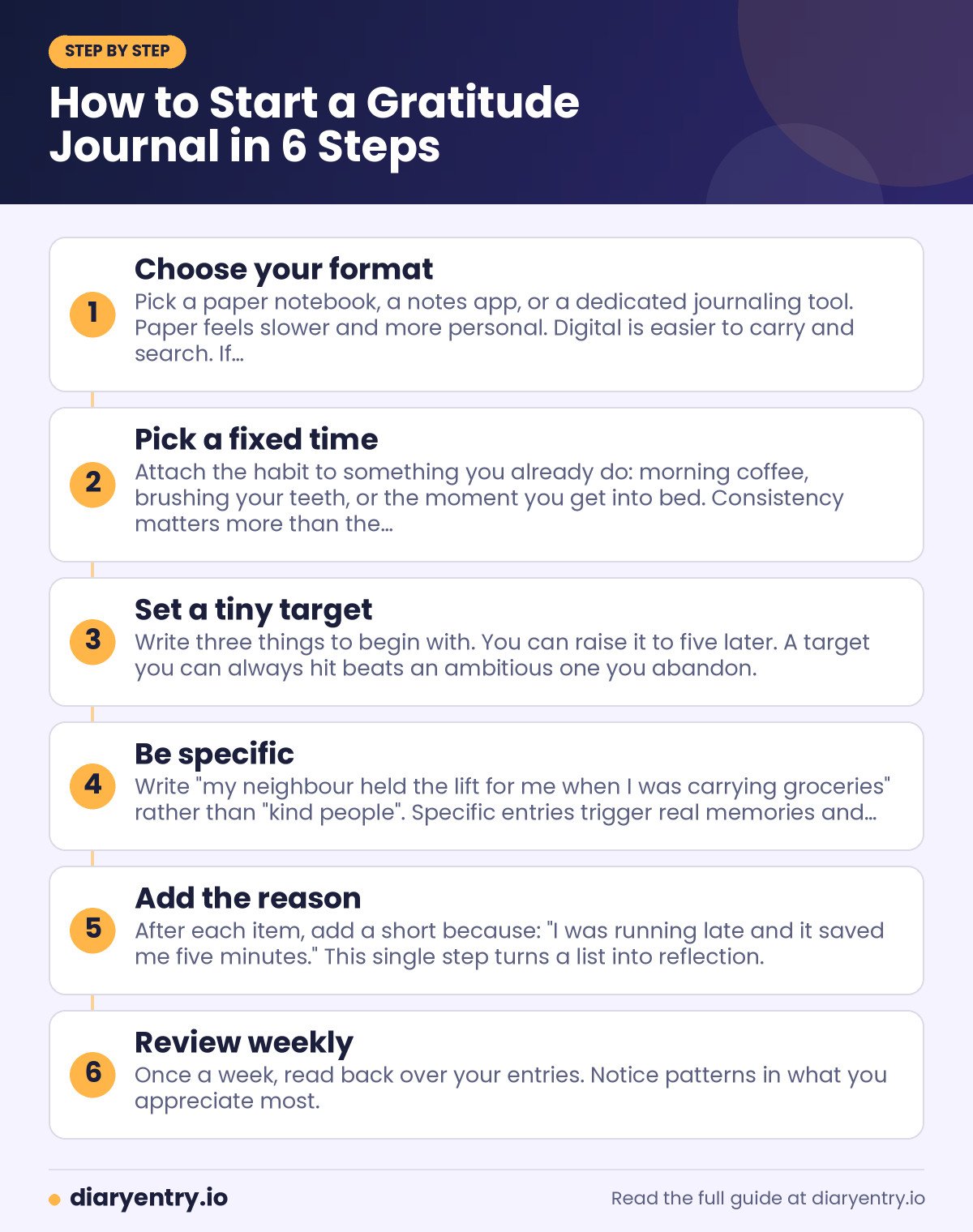
- Choose your format. Pick a paper notebook, a notes app, or a dedicated journaling tool. Paper feels slower and more personal. Digital is easier to carry and search. If you lean digital, our guide to online journaling covers the options.
- Pick a fixed time. Attach the habit to something you already do: morning coffee, brushing your teeth, or the moment you get into bed. Consistency matters more than the exact hour.
- Set a tiny target. Write three things to begin with. You can raise it to five later. A target you can always hit beats an ambitious one you abandon.
- Be specific. Write “my neighbour held the lift for me when I was carrying groceries” rather than “kind people”. Specific entries trigger real memories and feelings.
- Add the reason. After each item, add a short because: “I was running late and it saved me five minutes.” This single step turns a list into reflection.
- Review weekly. Once a week, read back over your entries. Notice patterns in what you appreciate most.
What to Write in Your First Entry
If you are staring at a blank page, use this simple template:
- Today I am grateful for (one specific thing).
- It mattered because (one sentence).
- One person I appreciate today is (name), because (reason).
That is a complete entry. You do not need to write more to count as having journaled.
Gratitude Journal Formats to Choose From
There is no single correct way to keep a gratitude journal. Choose the style that you will actually open each day.
The Three-Line Daily List
Write exactly three items each day. It is fast, forgiving, and ideal for beginners. Add a reason to each if you have time.
The One-Page Freewrite
Set a timer for five minutes and write about one thing you appreciate in full sentences. This suits people who enjoy writing and want depth over quick lists.
The Gratitude Letter Journal
Once a week, write a short letter to someone you appreciate. You do not have to send it, although sending it can make the day for both of you.
The Photo or Digital Gratitude Log
Take one photo a day of something you are grateful for and add a caption. This works well if you think visually or dislike handwriting.
The Combined Mood and Gratitude Page
Pair your entries with a quick check on how you feel. Our mood tracker page shows how to do this, and over time you can see which appreciations lift your mood most.
Gratitude Journal Prompts to Copy
Prompts help on days when nothing comes to mind. Use one per day, or keep this list handy and rotate through it. Younger writers can find more ideas in our journal prompts for teens.
Everyday Prompts
- What small thing made today easier?
- Which meal, drink, or snack did I enjoy most today?
- What is something in my home I am glad to have?
- Who made me smile today, and how?
- What part of my body helped me today?
- What is one thing I learned today?
People and Relationships Prompts
- Who has supported me this week, and how?
- Who is someone I have not thanked recently?
- Which old friend am I glad I met, and why?
- What is a kind thing someone said to me that I still remember?
Work and Study Prompts
- What is one task I handled well this week?
- Which colleague or classmate made my day smoother?
- What skill am I glad I have learned?
- What challenge turned out to teach me something useful?
Difficult Day Prompts
- What is one thing that is still okay today, even if the day was hard?
- Who or what helped me get through the last few hours?
- What is something I can look forward to this week?
- What am I glad is now behind me?
For many more ideas beyond gratitude, browse our list of 50+ great journal prompts.
Sample Gratitude Journal Entries
Seeing real examples makes the practice less abstract. Here are three samples at different lengths.
Example 1: The Quick Three-Line Entry
Monday evening
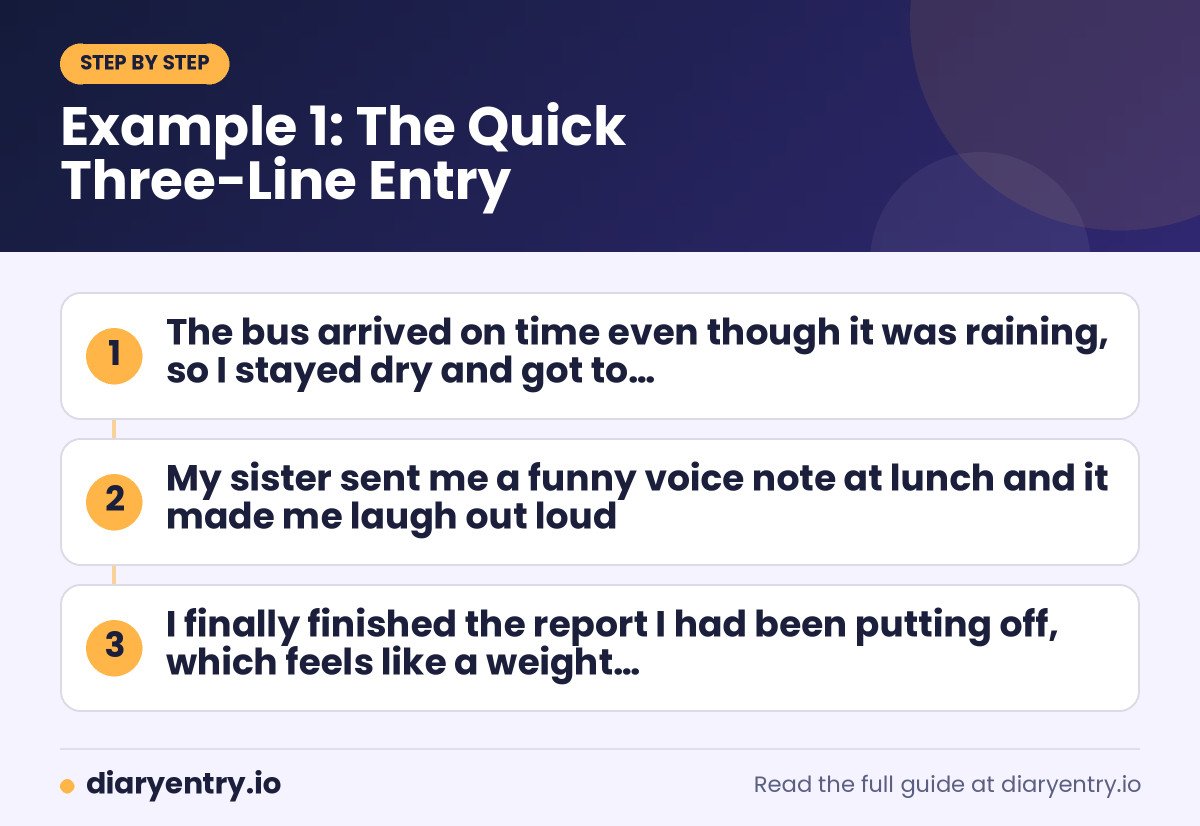
- The bus arrived on time even though it was raining, so I stayed dry and got to work early.
- My sister sent me a funny voice note at lunch and it made me laugh out loud.
- I finally finished the report I had been putting off, which feels like a weight lifted.
Example 2: The Entry With Reasons
Wednesday morning
I am grateful for the quiet twenty minutes I had before the house woke up, because it let me drink my tea slowly and plan my day without rushing. I am also grateful for my manager’s feedback yesterday. It was honest but kind, and it showed me exactly what to improve.
Example 3: The Hard-Day Entry
Friday night
Today was tiring and I felt behind on everything. Still, I am grateful that a friend checked in on me, that I had leftovers for dinner so I did not need to cook, and that tomorrow is Saturday. Writing this down makes the day feel less heavy.
Notice that none of these entries is long or polished. They are honest, specific, and short, and that is exactly what makes them sustainable. You can find more formats in our journal examples.
Common Gratitude Journal Mistakes (and How to Fix Them)
Most people who quit a gratitude journal do so for the same few reasons. Knowing them in advance helps you avoid them.
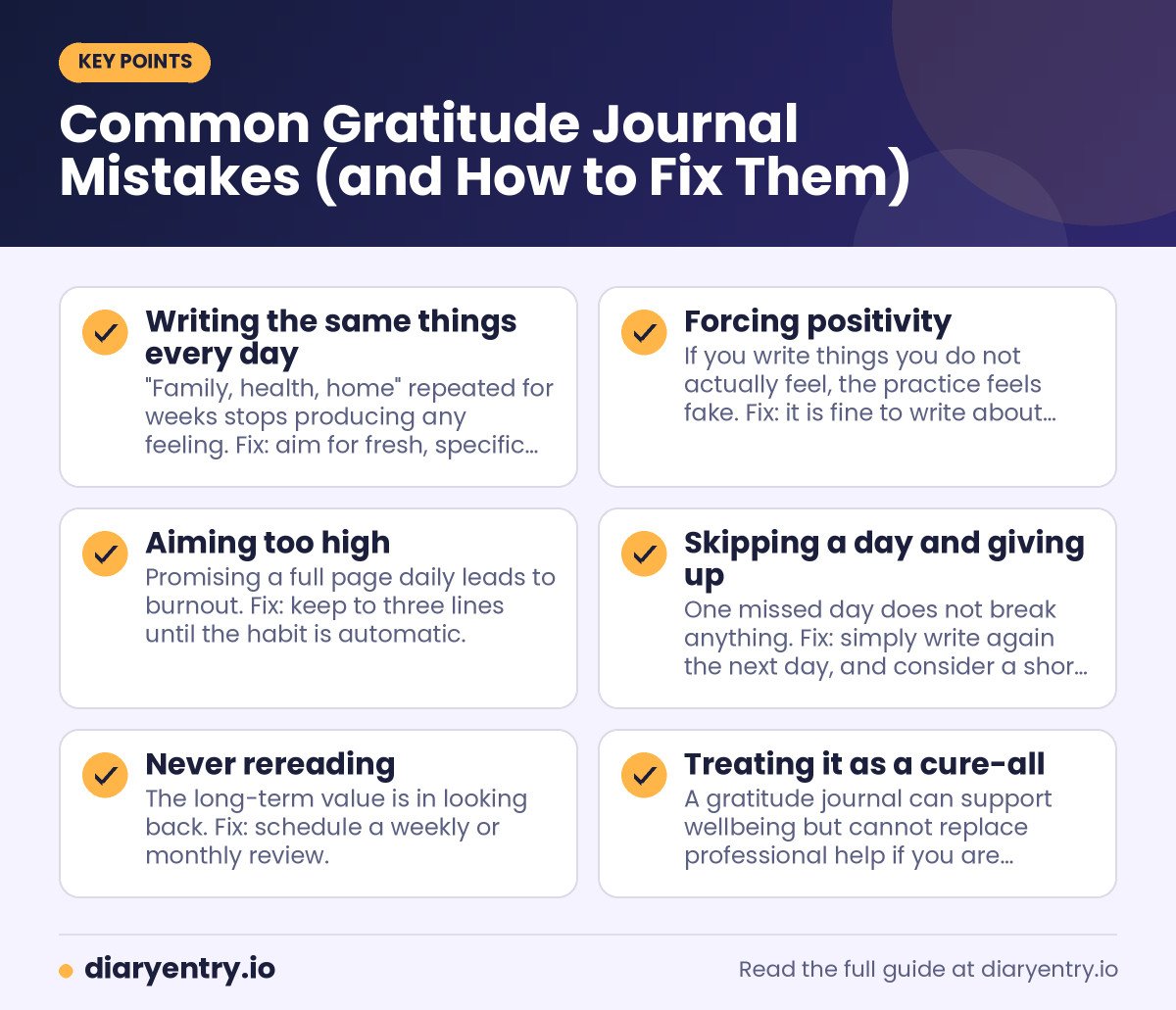
- Writing the same things every day. “Family, health, home” repeated for weeks stops producing any feeling. Fix: aim for fresh, specific moments from that day.
- Forcing positivity. If you write things you do not actually feel, the practice feels fake. Fix: it is fine to write about small, ordinary things, or to note that a day was hard and name one thing that helped.
- Aiming too high. Promising a full page daily leads to burnout. Fix: keep to three lines until the habit is automatic.
- Skipping a day and giving up. One missed day does not break anything. Fix: simply write again the next day, and consider a short catch-up entry covering two days.
- Never rereading. The long-term value is in looking back. Fix: schedule a weekly or monthly review.
- Treating it as a cure-all. A gratitude journal can support wellbeing but cannot replace professional help if you are struggling. If low mood persists, speak with a qualified professional.
How to Make the Habit Stick
Starting a gratitude journal is easy. Continuing for months takes a little design. These methods help.
Anchor It to an Existing Habit
Place your journal next to your toothbrush, your kettle, or your pillow. Write immediately after the existing habit, so the older routine acts as a reminder for the new one.
Make It Visible and Easy
Keep a pen on top of the notebook. If you use an app, put it on your home screen. Every extra step you remove increases your odds of writing.
Use a Four-Week Ramp
A good approach is to build gradually. In week one, write one item a day. In week two, write three. In week three, add a reason to each. In week four, add a weekly review. Our guide on how to build a daily journaling habit in four weeks lays out this kind of ramp in detail.
Share It Lightly
Tell a friend or family member about your gratitude journal. Some people even keep a shared family gratitude jar or a weekly dinner-table round where everyone names one good thing.
Gratitude Journal for Different People
The core method stays the same, but you can adapt it to your situation.
- Students: Focus on small wins, helpful teachers, and moments of understanding something new. Pair it with your study routine.
- Busy professionals: Write at the end of the workday, listing one good interaction, one thing done well, and one thing to look forward to. See also our work diary guide.
- Parents: Capture tiny moments with children, which pass quickly. These entries become treasured keepsakes later.
- Anyone going through a hard time: Keep entries very short and honest. One line is enough.
Paper or Digital: Which Gratitude Journal Is Better?
Both work. The best choice is the one you will use consistently.
- Paper: No distractions, a tactile habit, and easy to personalise with stickers or doodles. The downside is that you cannot search it and it is less portable.
- Digital: Searchable, backed up, and always with you. The downside is notifications and the temptation to wander into other apps.
A hybrid also works: jot quick notes on your phone during the day and copy your favourites into a paper journal at night. For a very short daily format, a five year journal can hold a gratitude line each day.
Gratitude Journal FAQs
How long should I spend on a gratitude journal each day?
Three to five minutes is enough. The aim is a consistent, light habit rather than long sessions.
How many things should I write each day?
Start with three. Many people settle on three to five. Quality and specificity matter more than quantity.
Should I write in the morning or at night?
Either works. Morning entries can set a positive tone for the day, while evening entries help you review what went well and wind down. Our morning journal prompts offer more ideas for the morning. Choose whichever you can keep up reliably.
What if I do not feel grateful on a particular day?
That is normal. Write about something small and neutral, such as a warm drink or a quiet moment. You can also write honestly that the day was hard and name one thing that helped, however minor.
Is a gratitude journal good for mental health?
Studies on gratitude writing have linked it to improved mood for many people, but it is not a treatment. Treat it as a supportive daily habit, and seek professional advice if you have ongoing concerns about your mental health.
Can children keep a gratitude journal?
Yes. Younger children can draw a picture and add a short sentence, while older children can write a few lines. Keep it playful and low-pressure. For ready-made ideas, see our journal prompts for kids.
How long before a gratitude journal works?
There is no fixed timeline, and the effect differs from person to person. Many people notice small shifts in how they pay attention within a few weeks of regular writing, but this is an experience rather than a guarantee.
Conclusion: Start Your Gratitude Journal Today
Learning how to start a gratitude journal comes down to a handful of simple choices: pick a format, set a time, write three specific things, and add a reason. Keep your entries short, honest, and fresh, and review them now and then. Within a few weeks, the habit can become one of the calmest parts of your day.
If you would like guided support in turning journaling into a lasting habit, the 4-Week Diary Entry Course at diaryentry.io walks you through daily writing step by step. Otherwise, grab a notebook tonight and write your first three lines. That is all it takes to begin.