

Storytelling Diary
A storytell diary captures experiences as narratives, focusing on emotion, detail, and the lessons they contain. This format turns everyday moments into meaningful stories and encourages creative self-expression. It’s an ideal practice for those who want to preserve memories with depth and craft a personal archive of life lessons.
Purpose of Storytelling in Diaries
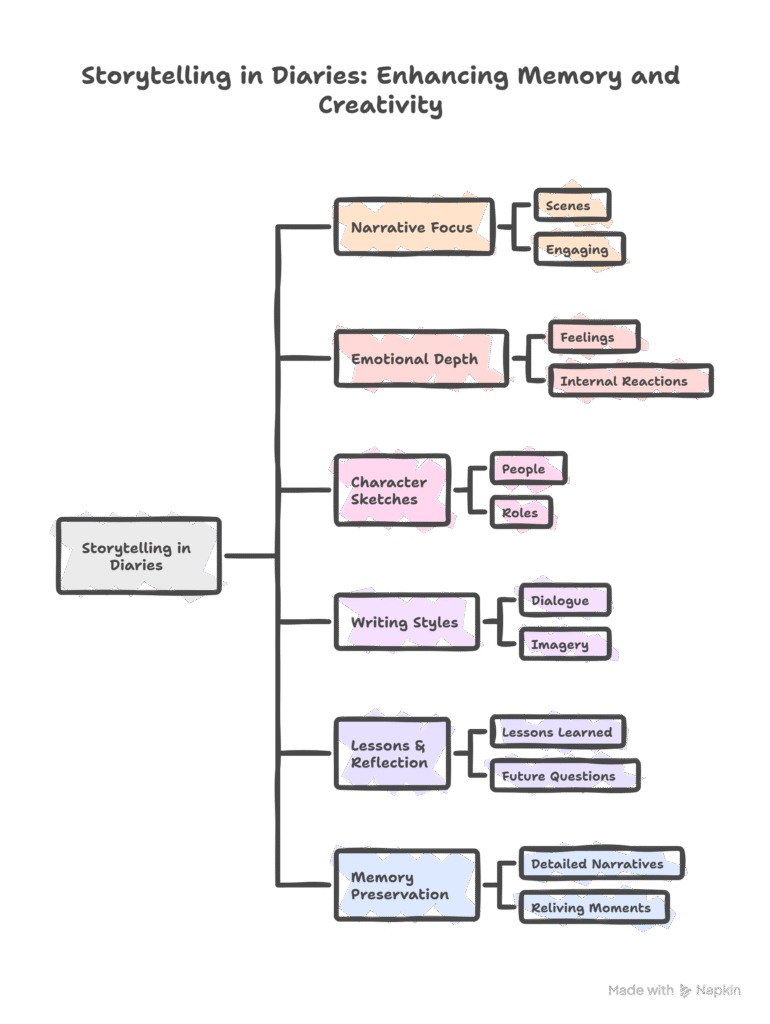
Storytell diaries encourage crafting events into narratives, emphasizing context, characters, and lessons. They enhance memory, creativity, and emotional processing through richer description.
Narrative Focus
- Write entries as scenes with a beginning, middle, and end to make memories vivid and engaging.
Emotional Depth
- Describe feelings and internal reactions to add authenticity and insight.
Character Sketches
- Portray people involved as characters to understand relationships and roles.
Writing Styles
- Experiment with voice—dialogue, imagery, or metaphor—to make entries more artistic.
Lessons & Reflection
- End stories with the lesson learned or a question for future reflection.
Memory Preservation
- Detailed narratives help you relive moments vividly when revisited later.
Creative Prompts
- Use prompts to jumpstart writing: ‘Describe a scent that defined today.’
Sharing & Editing
- Some stories can be refined into essays or personal memoir pieces for sharing.
Therapeutic Expression
- Storytelling helps process emotions and gain perspective on life events.
Legacy Building
- Over time, a storytell diary becomes a legacy of your voice and experiences.
How to Start a Storytell Diary?
Begin by choosing a memorable event and writing it as a scene. Focus on sensory detail and the emotions involved. Commit to one short story a week to build momentum and create a rich personal archive.
Pick a Moment
- Choose a single event or interaction to focus on and describe it with sensory detail.
Set the Scene
- Describe time, place, characters, and the mood to ground the reader in the moment.
Focus on Feeling
- Note your internal reactions and emotions to add depth to the narrative.

End with a Reflection
- Conclude with what you learned or what the moment revealed about yourself.
Revise Later
- Leave the draft for a few days and then edit to sharpen language and detail.
Storytelling Diary Prompts
A storytelling diary turns everyday life into practice for narrative writing. Instead of listing what happened, you shape moments into small scenes with a beginning, a turn and an ending.
- Write the story of how you got your name, or your favourite family tale, as you were told it.
- Tell a story from today in exactly ten sentences. The limit forces you to choose.
- Describe a stranger you saw this week and invent the next hour of their day.
- Retell a recent argument from the other person’s point of view.
- Write about an object you own and the three places it has been.
- Begin a story with the sentence “Nobody told me the door would be unlocked.”
The Building Blocks of a Diary Story
Start in the middle
Skip the long setup. Open on the moment something changed, a raised voice, a missed train, a phone call, and fill in background only where the reader needs it.
Show with detail
Instead of “I was nervous”, write “my hands kept straightening the same napkin”. Specific actions and sensory detail let readers feel the moment without being told.
Give it a turn and an ending
Good stories have a point where something shifts, a decision, a surprise or a realisation. Finish with a line that lands the change instead of explaining it.
A Short Example
The 8:15 bus left without me, so I walked. Halfway down Park Street a man was selling kites from a cycle cart, a hundred of them, tied by their tails like a rainbow that had lost its sky. I had no reason to buy one. I bought a green one anyway. At my desk it leaned against the monitor all day, and for the first time in weeks nobody asked why I was smiling.
Notice how a small, ordinary event becomes a story: a disruption, a vivid image, a choice and a quiet payoff.
Storytelling Diary FAQs
Do my stories have to be true?
No. Mix real events and imagination as you like. Many writers begin with a true moment and invent the rest, which is how fiction often starts.
How long should an entry be?
One strong paragraph is enough. Short, complete stories teach you more than long, unfinished ones.
Can this help my other writing?
Yes. Practising scenes, detail and endings improves emails, essays and blog posts as well as fiction. Combine it with a dream journal for endless story material.
If you want feedback on how you tell your stories, the 4-week diary entry course at Diary Entry offers daily prompts and instructor guidance.
Conclusion
A storytell diary transforms routine experiences into crafted narratives that reveal personal truths. Through deliberate practice, you enhance memory, deepen self-understanding, and develop a unique voice. Over time, your diary becomes a meaningful collection of lessons, emotions, and stories that map your growth.