

My Secret Diary
A secret diary or secret journal is a personal journal in which someone writes down their private thoughts, feelings, experiences, and reflections, usually with the intention that no one else will read it. It is the perfect place to express your emotions without fear of judgment.
Key Traits of a Secret Diary
- Private: It’s not shared with others—meant for the writer’s eyes only.
- Honest: People tend to write openly and truthfully because it’s a safe space.
- Reflective: It helps process emotions, events, or thoughts that may be hard to talk about out loud.
- Emotional Outlet: A way to express stress, happiness, anxiety, dreams, or fears.
- Creative Freedom: Some use it for poems, doodles, or random thoughts without judgment.
How to make a Secret Diary?
Creating a secret diary is easy—and super personal. Here’s a step-by-step guide to help you get started:
Choose Your Diary Format
- Physical: A notebook or journal with a lock or hidden spot.
- Digital: An app, a notes app, or a dedicated website like ours.
- Online Secret Diary: Our platform offers a private, secure space where only you can access your entries.
2. Set the Mood
- Find a quiet, cozy spot.
- Choose a time of day when you can reflect (like before bed).
- Keep your diary easily accessible but safe.
3. Start Writing
There’s no right or wrong way! You can:
- Describe your day
- Vent your feelings
- Write about a dream, a secret, or something special
- Use prompts if you’re stuck (like “Today I felt…” or “I wish…”)
4. Be Honest
It’s your space. Say what you really feel—without worrying about grammar, spelling, or judgment.
5. Keep It Safe
- If physical: Hide it or get a diary with a lock.
- If digital: Use a password or a private platform like ours that values your privacy.
What to Write in a Secret Diary?
A secret diary is your safe space—there are no rules! But if you ever feel stuck, here are some ideas to help you start writing:
Daily Thoughts
- What happened today?
- How did it make you feel?
- Anything surprising, annoying, exciting, or confusing?
Feelings Check-In
- Am I feeling happy, sad, anxious, or excited? Why?
- What’s something I’m not saying out loud but want to?
Big & Small Moments
- Something fun you did
- A dream you had
- A memory you treasure—or wish you could change
Secrets & Confessions
- Crushes or friendships you’re not ready to share with anyone
- Worries or fears you’re carrying
- Goals or dreams that feel too big to say out loud
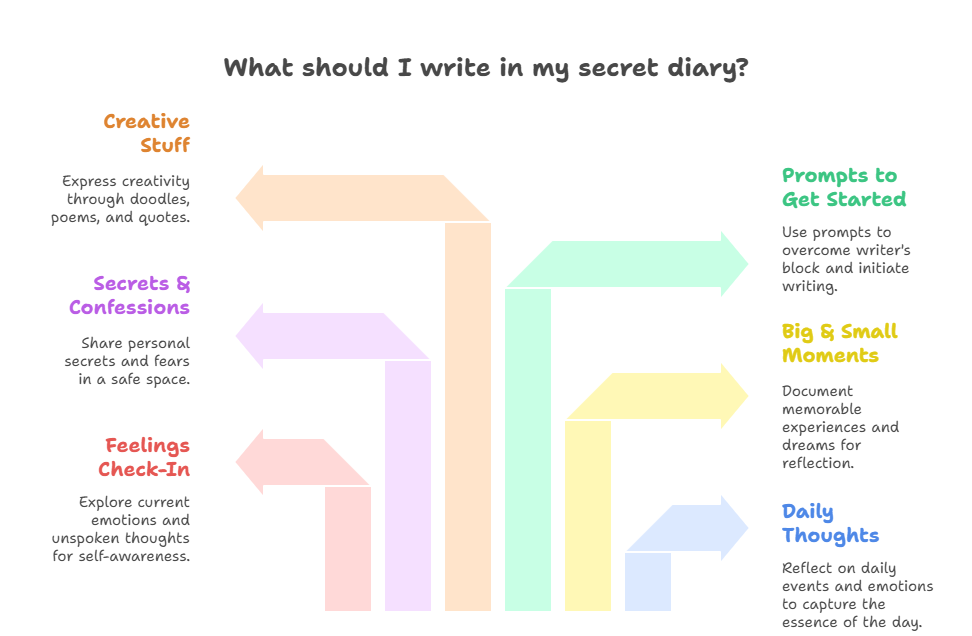
Prompts to Get You Started
- “Today I wish…”
- “The best part of my day was…”
- “If I could talk to my future self, I’d say…”
- “I feel proud of myself for…”
Creative Stuff
Doodles, poems, short stories, quotes you love, or even song lyrics that match your mood.
Some Secret Diary Ideas to write about
Here are some secret diary ideas that are fun, introspective, and perfect for private reflection or self-discovery. You can mix and match depending on your mood or goals:
Emotional Venting
- “What made me feel most alive today?”
- “Something I wish I could say out loud but can’t.”
- “The one thing I’m scared to admit.”
Private Confessions
- “A secret I’ve never told anyone.”
- “Something I regret but learned from.”
- “The real reason I act the way I do around certain people.”
Mind Games & Thought Experiments
- “What if I lived an entirely different life? Describe it.”
- “If I disappeared tomorrow, what would I leave behind?”
- “Write a letter to your 13-year-old self. Don’t hold back.”
Romantic Reflections
- “A past crush I still think about sometimes.”
- “What love really means to me.”
- “My ideal date — not what I say, but what I secretly want.”
Hidden Desires
- “If no one judged me, I would…”
- “Where I would go if I could leave everything behind for a week.”
- “The version of myself I want to become, but rarely show.”
Dreams, Real and Unreal
- “A dream I had that I can’t stop thinking about.”
- “If my life were a novel, what would the plot twist be?”
- “My dream life, no matter how unrealistic.”
Chaos Pages
- “Dump every irrational thought here.”
- “Things that make no sense but I feel strongly about.”
- “Create a fake personality and write from their POV for one page.”
Conclusion
The secret diary should not be restricted to any particular topic or any prompt, as the name depicts, it’s your own personal space to express anything and to write about anything.
How to Keep a Secret Diary Truly Private
A secret diary only works if you feel safe writing honestly. Privacy is partly about physical security and partly about habits.
- Choose a good hiding place: somewhere unremarkable, such as inside a book cover, under a drawer lining or in a box of other notebooks.
- Use a lock or code: a small padlock, or a personal shorthand for names and places that only you understand.
- Protect digital entries: use a password-protected notes app or document, and avoid shared devices and shared cloud accounts.
- Decide in advance: choose what you will do with the diary later, keep it, store it safely or destroy it, so you can write without worrying about the future.
Writing Prompts for a Secret Diary
- What is something I have never told anyone, and why have I kept it to myself?
- Who do I behave differently around, and which version feels most like me?
- What do I want that I am embarrassed to want?
- What would I say to someone I am angry with if there were no consequences?
- What am I proud of that nobody has noticed?
A Sample Secret Diary Entry
Dear Diary, today I smiled in the meeting while thinking about quitting. I have not told anyone how tired I am. Writing it here feels like putting down a heavy bag. Maybe I do not need to quit, only to stop pretending everything is fine. Tomorrow I will ask for a conversation about my workload.
The entry names a private feeling, releases it and ends with one small action. That pattern, say it, understand it, decide one step, is what makes a secret diary quietly powerful.
Secret Diary FAQs
Is a secret diary good for mental health?
Expressive writing is widely used for processing emotions and reducing stress. It supports wellbeing but does not replace professional care if you are struggling.
What if someone finds it?
Plan for it: use a lock, a shorthand and a safe hiding place, and avoid including details that could cause harm if read. Private writing should feel safe, so adapt your approach to your situation.
How often should I write?
Whenever you need it. Many people write a few times a week, with longer entries after strong emotions. See also our dream journal guide for another private writing habit.
To go from occasional entries to a steady practice, explore the 4-week diary entry course at Diary Entry.