

An academic diary is a dated record of your studies: what you learned, what you struggled with, what you need to do next and how your thinking is changing. Students use it to stay organised, researchers use it to track progress, and teachers use it to improve their practice. Keeping one takes only a few minutes a day, yet it can transform how well you remember, plan and reflect.
This guide explains the meaning of an academic diary, the different types, how it differs from a school planner or a research journal, and how to start one today. You will find a template, sample entries for school, university and research, a comparison table and answers to common questions.
What Is an Academic Diary? (Quick Answer)
An academic diary is a regular written record of your learning journey. It combines practical details, such as assignments, deadlines and class notes, with reflection on what you understood, what confused you and how you plan to improve. The term is used in several ways: some people mean a student planner with a calendar, others mean a learning diary used for reflection, and in universities it can also mean a research diary kept during a project or thesis.
What they share is purpose. An academic diary helps you notice patterns in your own learning, which is something a textbook or a timetable cannot do for you. If you are also interested in the school-level version, our guide to the school diary and how to use it covers that in detail.
Types of Academic Diary
The phrase covers a few related formats. Choose the one that matches your stage of study.
Student Planner Diary
This is the classic page-a-day or week-to-view diary that records timetables, homework, exams and deadlines. It focuses on organisation rather than reflection, and it is the most common meaning of “academic diary” in schools and colleges.
Learning Diary
A learning diary records what you studied, how you understood it and where you got stuck. Writing short reflections after lectures or study sessions encourages deeper processing and reveals gaps in understanding early.
Research Diary
Postgraduate students and researchers keep a research diary to log reading, experiments, ideas, supervisor feedback and decisions. It becomes a trail showing how a project developed, which is helpful when writing up a thesis or explaining methods.
Teaching or Reflective Practice Diary
Teachers and trainee teachers record lessons, what worked and what to change. This is closely related to reflective writing; our article on how to write a reflective journal explains the approach in depth, and a ready-made reflective journal template can help you start.
Academic Diary vs Planner vs Research Journal
| Type | Main focus | Who uses it | Typical entry |
|---|---|---|---|
| Student planner | Deadlines and timetable | School and college students | Homework list, exam dates |
| Learning diary | Understanding and reflection | Students at any level | What I learned, what confused me |
| Research diary | Progress and decisions | Postgraduates, researchers | Reading notes, experiment log |
| Teaching diary | Lesson evaluation | Teachers and trainees | What worked, what to change |
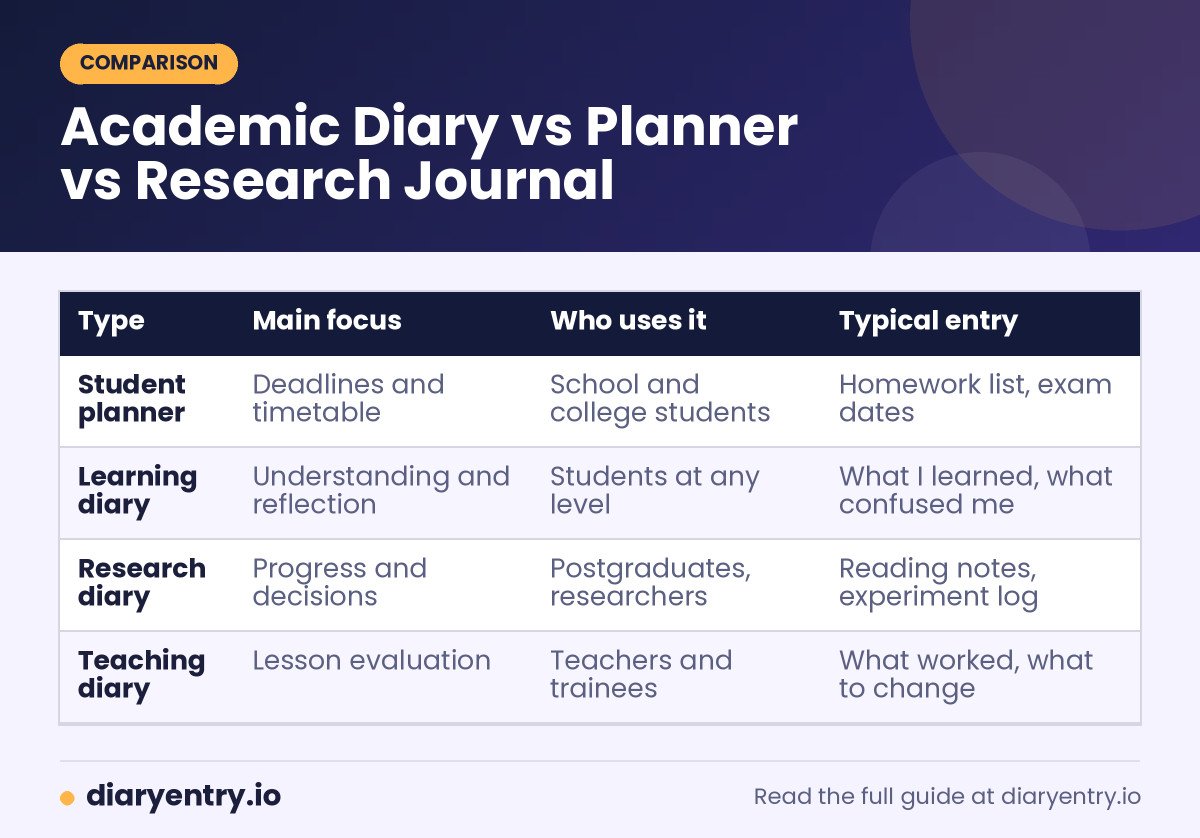
You do not have to choose only one. A strong academic diary often blends a planner section for tasks with a short reflection section for learning.
Why Keep an Academic Diary? 7 Benefits
- Better memory. Writing in your own words after a lesson helps you retrieve information later, because you are actively processing it instead of just rereading.
- Fewer missed deadlines. One trusted place for tasks and due dates prevents last-minute surprises.
- Early warning on weak areas. If the same topic appears in your “confusing” notes three times, you know exactly where to seek help.
- Calmer exam preparation. Your diary becomes a revision map showing what you covered and when.
- Stronger writing. Regular short writing builds fluency that carries into essays and reports.
- Evidence of progress. Looking back over a term shows how far you have come, which supports motivation.
- Useful for applications and portfolios. Specific examples of projects and learning make personal statements and interviews easier.
The key is regularity. A short entry written most days is more valuable than a long entry written occasionally, which is the same principle behind our guide to building a daily journaling habit.
How to Keep an Academic Diary: Step by Step
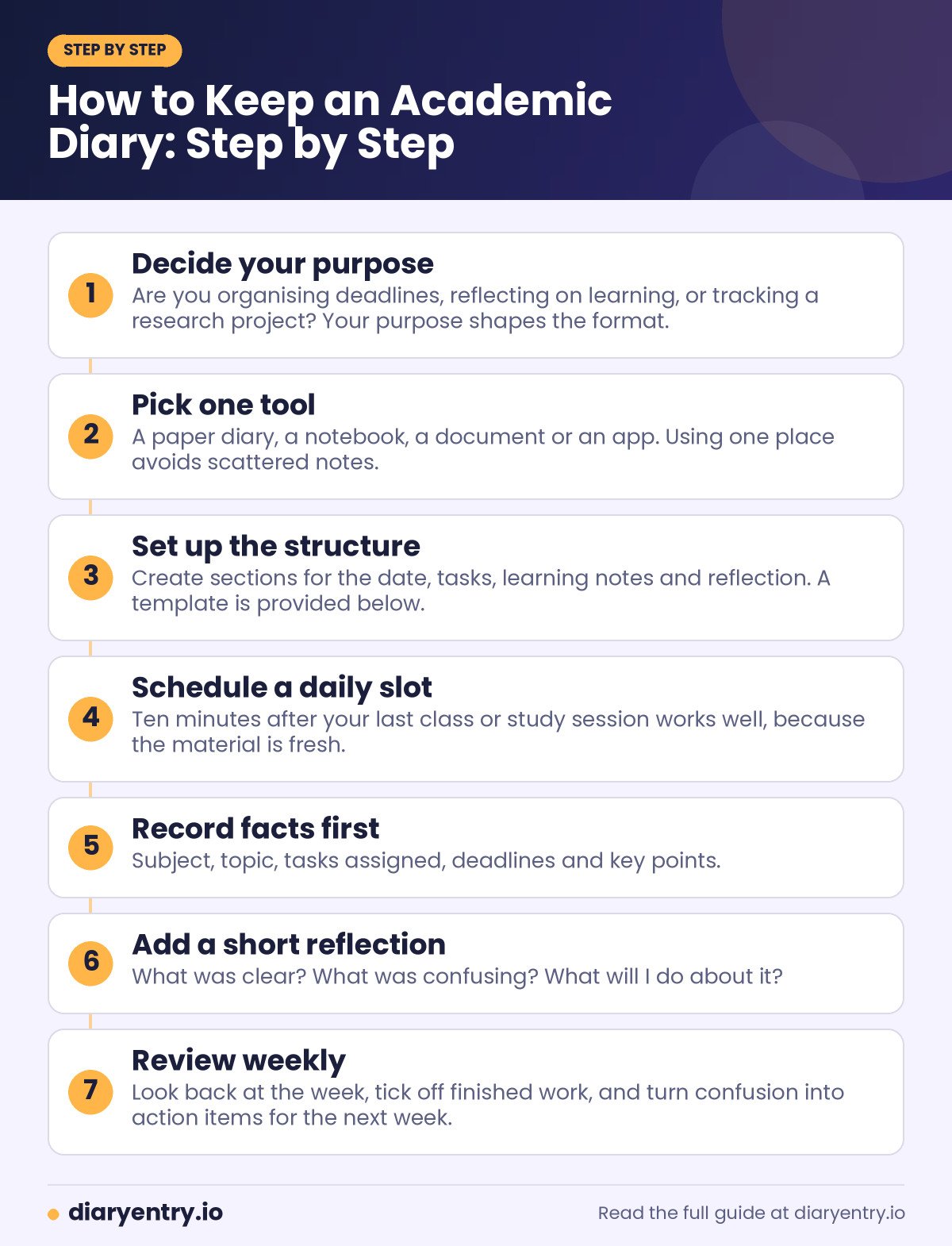
- Decide your purpose. Are you organising deadlines, reflecting on learning, or tracking a research project? Your purpose shapes the format.
- Pick one tool. A paper diary, a notebook, a document or an app. Using one place avoids scattered notes.
- Set up the structure. Create sections for the date, tasks, learning notes and reflection. A template is provided below.
- Schedule a daily slot. Ten minutes after your last class or study session works well, because the material is fresh.
- Record facts first. Subject, topic, tasks assigned, deadlines and key points.
- Add a short reflection. What was clear? What was confusing? What will I do about it?
- Review weekly. Look back at the week, tick off finished work, and turn confusion into action items for the next week.
Academic Diary Template You Can Copy
Use this layout as a starting point and adapt it. More layout ideas are available in our diary template guide.
Daily Academic Diary Template
- Date:
- Classes or study sessions today: Subjects and topics covered.
- Key ideas in my own words: Two or three sentences per subject.
- Tasks and deadlines: Homework, readings, submissions, with due dates.
- What I understood well:
- What confused me: And who or what can help (teacher, classmate, textbook, online lecture).
- Study time logged: Hours or minutes by subject.
- Plan for tomorrow: The first thing to do.
Weekly Reflection Template
- What went well this week:
- Where I fell behind and why:
- Topics to revisit:
- Questions for my teacher or supervisor:
- Goals for next week:
Academic Diary Examples
The following sample entries are fictional. Notice how each combines a few facts with one honest reflection.
Example 1: High School Student
Monday. Maths: quadratic equations by factorising. I can do the easy ones, but I get stuck when the first number is not 1. Science: started the chapter on electricity; I need to learn the circuit symbols. Homework: 10 questions of Exercise 4, due Wednesday; science worksheet due Friday. Confused about: factorising when the leading number is greater than 1. Action: ask Ms Rao tomorrow and try two examples tonight. Study time: 1 hour 20 minutes.
Example 2: University Student
Wednesday. Economics lecture on elasticity. Main idea: elasticity measures how strongly demand responds to a price change. I understand the formula, but I am unsure how to interpret values between 0 and 1. Seminar reading: two articles, 40 pages; finished one. Essay outline due next Friday; need to choose between two questions. Action: email tutor about the question choice and finish reading by Thursday evening.
Example 3: Research Student
Thursday. Read three papers on the survey method I plan to use. One paper raised a limitation about sample size that I had not considered. Met supervisor: agreed to run a small pilot before the main survey, and to share the questionnaire draft by the end of next week. Decision recorded: use an online form instead of paper because the target group is spread across regions. Next step: draft the questionnaire and note the reasons for each question.
Example 4: Trainee Teacher
Friday. Taught a 40-minute lesson on paragraphs. The starter activity worked; students were engaged. The group task ran over time, so the plenary was rushed. Mentor feedback: give clearer timing cues. Change for next time: reduce the task to two stages and use a visible timer.
Paper or Digital Academic Diary?
Both work. Many students switch formats a few times before settling, so treat your first choice as an experiment.
- Paper: Writing by hand can help focus and reduces distractions. It is harder to search and carries the risk of loss.
- Digital notes: Searchable, synced across devices and easy to reorganise. Notifications can be distracting, so consider doing your entry offline.
- Spreadsheet or tracker: Useful for logging study hours, grades and reading lists.
- Combination: Use a paper planner for deadlines and a digital document for reflections and long-term notes.
If you lean towards a digital approach, see our overview of online journaling for tips on choosing tools and protecting privacy.
Tips for Making Your Academic Diary Useful
Write in Your Own Words
Copying the teacher’s slides adds little. Summarise ideas as if you were explaining them to a friend. If you cannot, you have found something to revisit.
Be Honest About Confusion
A diary is private, so it is the safest place to admit what you do not understand. Turn every confusion into a specific action, such as “ask”, “re-read page 52” or “try three more examples”.
Track Time Realistically
Noting how long tasks actually take helps you plan better. If a reading consistently takes twice as long as expected, start earlier next time. If you are balancing study with a job, a work diary can track that side too.
Link Daily Notes to Bigger Goals
Write one goal per term, such as improving essay structure or finishing a literature review, and mention progress in your weekly reflection. Our guide to a goal-setting diary shows how to connect daily entries with longer-term aims.
Review Before Exams and Deadlines
Reading your own notes on what confused you is one of the quickest ways to find what to revise. Highlight topics that appear repeatedly and start your revision there.
Common Academic Diary Mistakes
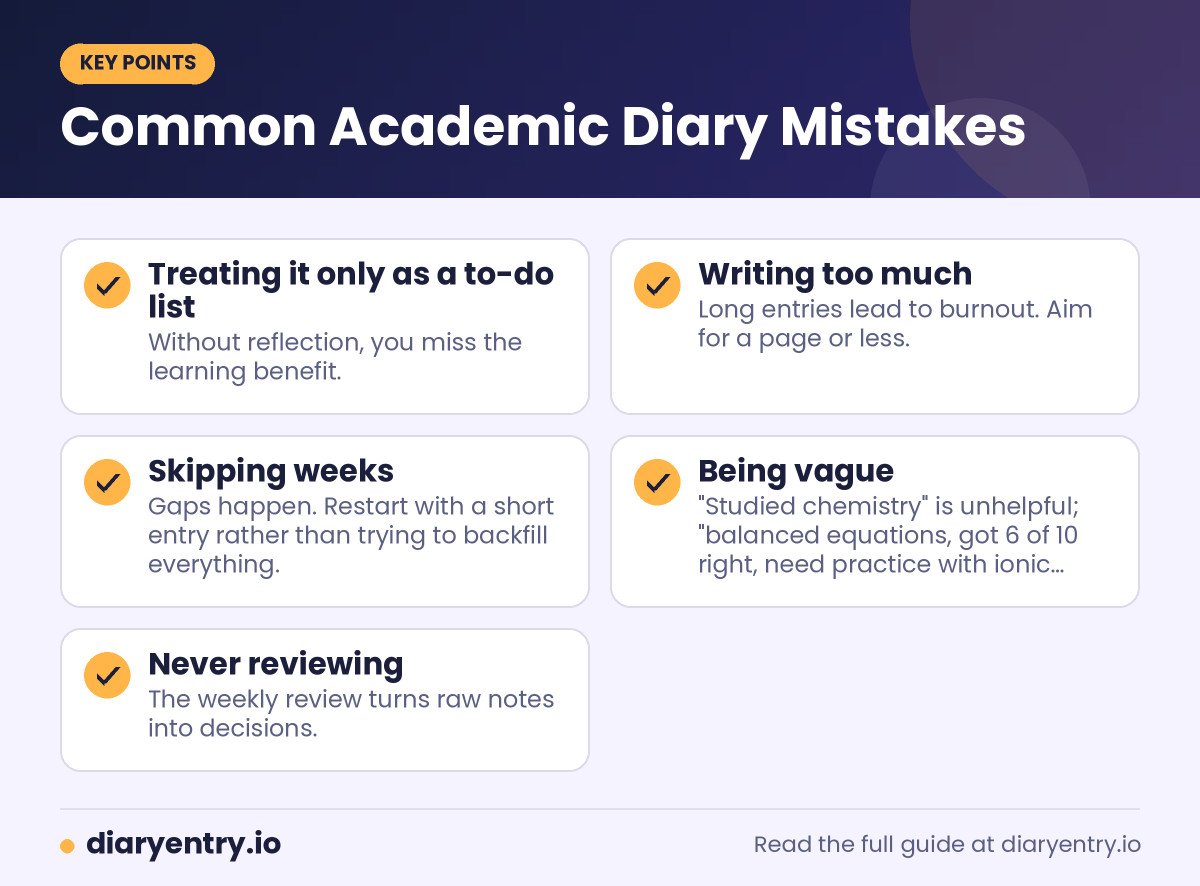
- Treating it only as a to-do list. Without reflection, you miss the learning benefit.
- Writing too much. Long entries lead to burnout. Aim for a page or less.
- Skipping weeks. Gaps happen. Restart with a short entry rather than trying to backfill everything.
- Being vague. “Studied chemistry” is unhelpful; “balanced equations, got 6 of 10 right, need practice with ionic equations” is useful.
- Never reviewing. The weekly review turns raw notes into decisions.
If you struggle to keep going, building the writing habit first can help. The 4-Week Diary Entry Course is designed for exactly that: short daily writing practice that grows into a lasting routine, which you can then apply to your academic diary.
Frequently Asked Questions About the Academic Diary
What is an academic diary?
An academic diary is a regular record of your studies, covering tasks, deadlines, what you learned and what you found difficult. Depending on the context it can be a student planner, a learning diary or a research diary.
What is the difference between an academic diary and a planner?
A planner mainly organises time and tasks. An academic diary can include a planner but also adds reflection on learning, so it helps you understand how you study as well as what you need to do.
How often should I write in my academic diary?
Daily entries of five to ten minutes work best, but even three or four times a week with a weekly review is valuable. Consistency matters more than length.
Is an academic diary the same as a research diary?
Not exactly. A research diary is a type of academic diary focused on a specific project, recording reading, methods, results and decisions. An academic diary is the broader term and also covers everyday study.
What should I write in an academic diary?
Write the date, subjects covered, key ideas in your own words, tasks and deadlines, what you understood, what confused you and a plan for the next day. Add study time if you want to track it. For wording and layout, see our diary entry format guide.
Can an academic diary help with exams?
Yes. It shows what you covered, highlights weak topics and helps you plan revision. Writing explanations in your own words also supports recall, although results vary from person to person.
Conclusion: Start Your Academic Diary This Week
An academic diary is a simple tool with a lasting effect. It keeps your deadlines visible, turns confusion into action and gives you a record of growth that you can be proud of. Choose a format, copy the template, and write your first entry after your next class or study session.
Keep your entries short, honest and specific, and review them each week. For more ideas on what to write and how, explore our guide to writing a diary entry and our collection of journal examples. Your future self will thank you for starting today.