

An informal letter is a personal letter written to someone you know well, such as a friend, cousin, sibling or relative, in a warm and conversational tone. For letters to officials and companies, see our letter writing for Class 10 guide. This guide explains the informal letter format step by step, with a clear layout, a checklist, five complete samples and answers to the questions students ask most.
Quick answer: an informal letter has six parts in this order: sender’s address, date, salutation (such as “Dear Rahul”), body in two or three short paragraphs, a closing phrase (such as “Yours lovingly”), and your name. Use a friendly tone, simple language and contractions where suitable.
What Is an Informal Letter?
An informal letter, also called a personal or friendly letter, is written to people you share a close relationship with. You write it to share news, ask for advice, congratulate someone, invite them to an event, apologise or simply stay in touch.
Unlike a formal letter to an official, a principal or a company, an informal letter does not need a subject line or rigid phrases. The language can be relaxed, and your personality can show. It should still be neat, clear and well organised, especially in exams.
Informal Letter vs Formal Letter: Key Differences
Students often mix the two styles. This table shows the differences at a glance.
| Feature | Informal letter | Formal letter |
|---|---|---|
| Recipient | Friend, relative, family member | Official, principal, editor, company |
| Tone | Warm, friendly, personal | Polite, respectful, professional |
| Language | Simple, conversational; contractions allowed | Standard, precise; no contractions |
| Subject line | Usually not used | Usually required |
| Salutation | Dear Aman, Dear Mom | Dear Sir or Madam |
| Closing | Yours lovingly, Your friend, Love | Yours faithfully, Yours sincerely |
| Receiver’s address | Not needed | Included |
| Structure | Flexible paragraphs | Fixed, formal paragraphs |
Remember this rule of thumb: if you can say “Dear” and then a first name, it is probably informal.
Informal Letter Format: The Six Parts
Learn this layout once and you can use it for any topic. Follow the order every time.
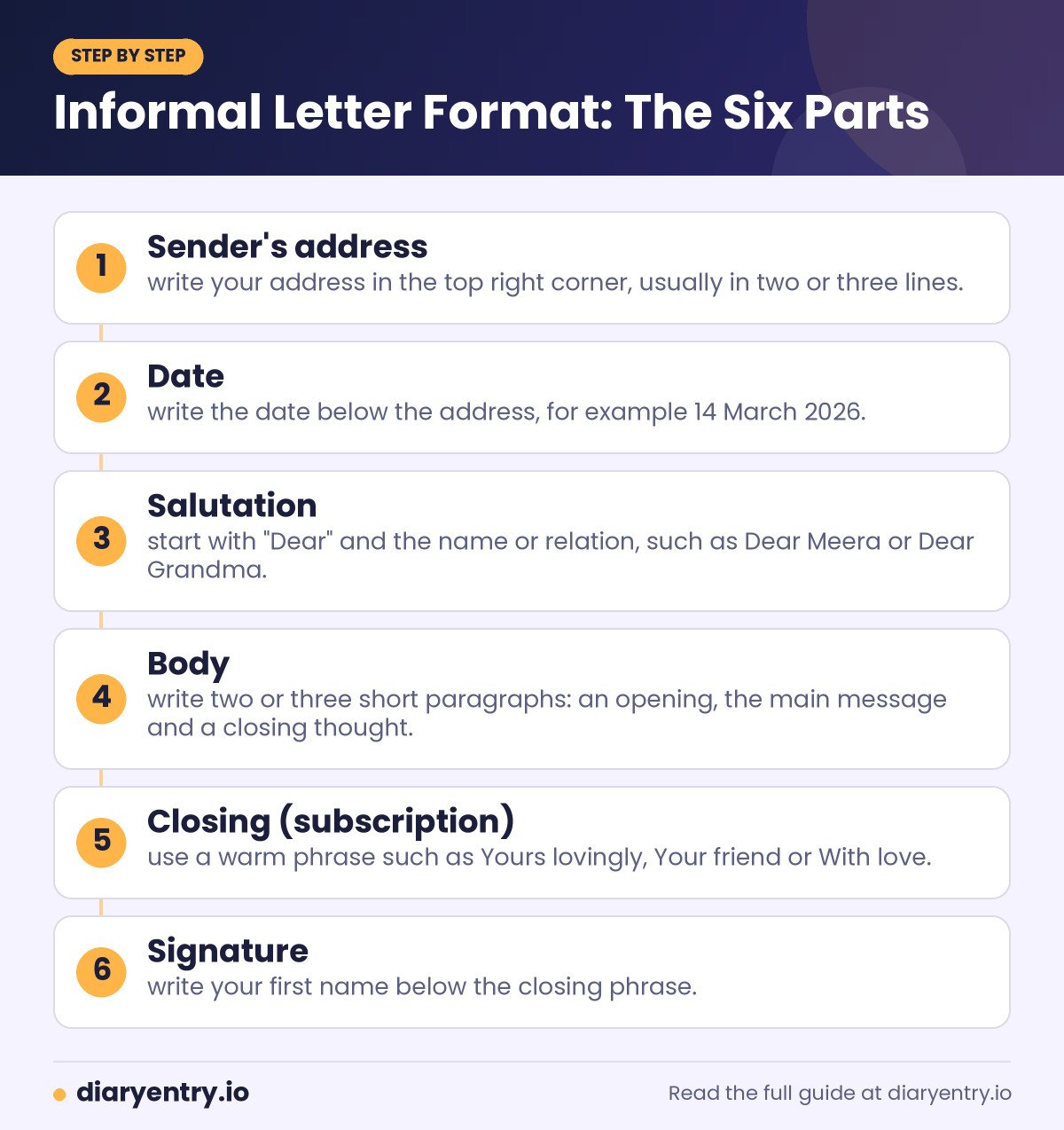
- Sender’s address: write your address in the top right corner, usually in two or three lines.
- Date: write the date below the address, for example 14 March 2026.
- Salutation: start with “Dear” and the name or relation, such as Dear Meera or Dear Grandma.
- Body: write two or three short paragraphs: an opening, the main message and a closing thought.
- Closing (subscription): use a warm phrase such as Yours lovingly, Your friend or With love.
- Signature: write your first name below the closing phrase.
Always check what your syllabus or teacher expects, because some boards ask for specific placement of the address and date. Follow the instructions in your own question paper.
A Simple Template You Can Copy
Use this skeleton and fill in the gaps.
[Your address, line 1]
[Your address, line 2]
[Date]
Dear [Name],
[Opening: greeting and enquiry about the person’s well-being. Mention the reason for writing.]
[Main body: share your news, advice, invitation or request in clear detail.]
[Closing paragraph: end with good wishes, a request to reply and regards to family.]
[Closing phrase],
[Your name]
Notice that the body follows a natural flow: greet, explain, close. Keep paragraphs short so the examiner can follow your ideas easily.
How to Write an Informal Letter Step by Step
Follow this routine in the exam or at home.
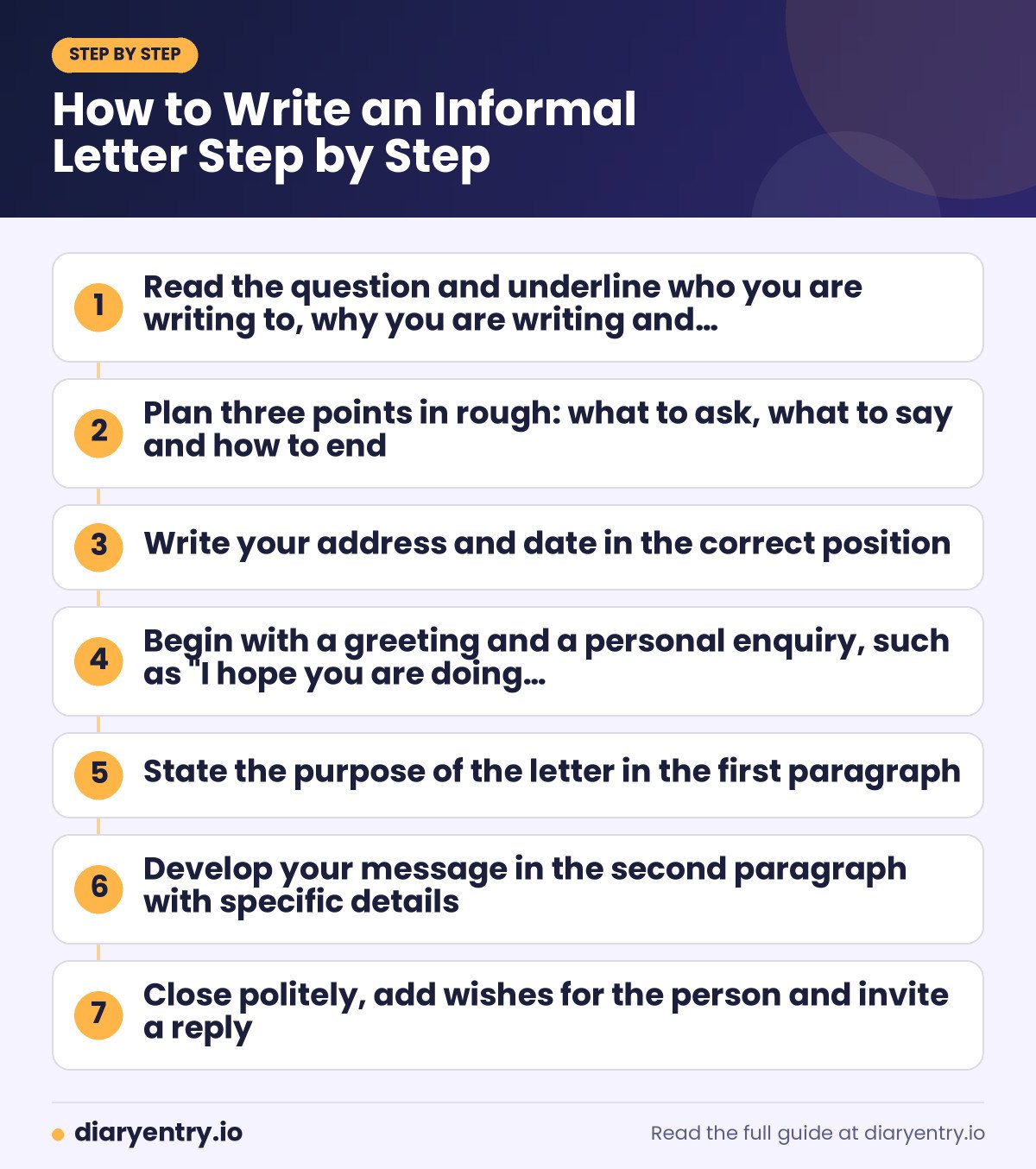
- Read the question and underline who you are writing to, why you are writing and what you must include.
- Plan three points in rough: what to ask, what to say and how to end.
- Write your address and date in the correct position.
- Begin with a greeting and a personal enquiry, such as “I hope you are doing well.”
- State the purpose of the letter in the first paragraph.
- Develop your message in the second paragraph with specific details.
- Close politely, add wishes for the person and invite a reply.
- Check spelling, punctuation and word limit before you finish.
Useful Opening and Closing Lines
Starting and ending are where students lose time. Keep a few lines ready.
- I hope this letter finds you in the best of health and spirits.
- It was lovely to receive your letter, and I was delighted to read your news.
- I am sorry I did not write earlier, but I have been busy with exams.
- I am writing to share some exciting news with you.
- Please write back soon and tell me how everything is going.
- Give my love to everyone at home.
- Looking forward to seeing you soon.
- Take care of yourself and write to me when you can.
Avoid copying the same lines in every letter. Adjust them to the situation so they sound genuine.
Informal Letter Sample 1: Inviting a Friend to a Birthday Party
14 Lake View Road
Pune
12 March 2026
Dear Ananya,
I hope you are well and enjoying your holidays. It feels like ages since we last met, and I miss our long talks after school.
I am writing to invite you to my birthday party on Saturday, 22 March, at my house. We will have lunch at one o’clock, followed by games and a movie in the afternoon. My cousins from Mumbai will also be there, and I would love for you to meet them.
Please come a little early if you can, so we can chat before the others arrive. Do let me know if you can make it. Mom says she is cooking your favourite pasta!
Yours lovingly,
Riya
Informal Letter Sample 2: Congratulating a Friend on Success
27 Green Park
Delhi
5 April 2026
Dear Karan,
I was thrilled to hear that you won the first prize in the inter-school debate. Congratulations! I know how hard you practised, and your success is richly deserved.
I remember how nervous you were before the semi-final, yet you spoke with such confidence. Everyone in class is proud of you, and our teacher mentioned your speech during assembly. I hope you will teach me a few tricks of public speaking when we meet.
Keep up the good work, and give my regards to your parents. Please send me a photograph of the trophy.
Your friend,
Dev
Informal Letter Sample 3: Writing to a Friend About a Holiday
8 Hill Crest
Shimla
18 June 2026
Dear Sana,
How are you? I hope your exams went well. I am writing from my grandparents’ house in the hills, where I am spending the summer break.
The weather here is lovely and cool. Every morning I go for a walk through the pine trees, and in the evening we sit on the veranda drinking tea. Last Sunday we visited a small village temple and had a picnic by the river. I wish you could have been there.
Why don’t you come for a few days next month? My grandparents would be delighted to meet you. Write soon and tell me your plans.
With love,
Tara
Informal Letter Sample 4: Giving Advice to a Younger Sibling
22 Rose Lane
Jaipur
3 September 2026
Dear Aarav,
I got your letter and was sorry to hear that you are finding mathematics difficult this term. Please do not worry. Many students struggle at first, and it is something you can improve with steady practice.
Try to solve a few problems every day instead of waiting until the night before a test. Make a list of formulas and read them aloud. If something is unclear, ask your teacher at once rather than letting doubts pile up. When I was in your class, I found that explaining a problem to a friend helped me understand it better.
I will call you on Sunday, and we can go through the chapters together. Believe in yourself, and take care.
Your loving brother,
Rohan
Informal Letter Sample 5: Apologising to a Friend
41 Palm Avenue
Chennai
10 October 2026
Dear Nisha,
I have been thinking about our argument last week and wanted to write to you. I am truly sorry for what I said. I was upset about my results, and I took it out on you, which was unfair.
You have always been a true friend to me, and I value you more than a small disagreement. If you are willing, I would like to meet after school on Friday and talk things over.
Please forgive me. I hope we can put this behind us.
Yours sincerely,
Maya
Choosing the Right Closing Phrase
The closing phrase should match your relationship with the reader. Here is a quick guide.
- Parents or grandparents: Your loving son/daughter, Yours lovingly.
- Siblings and cousins: Your loving brother/sister, With love.
- Close friends: Your friend, Yours affectionately, Love.
- Friends you know less well: Yours sincerely, Best wishes.
Do not use “Yours faithfully”, which belongs to formal letters.
Common Mistakes in Informal Letters
Examiners notice the same errors again and again. Avoid these.
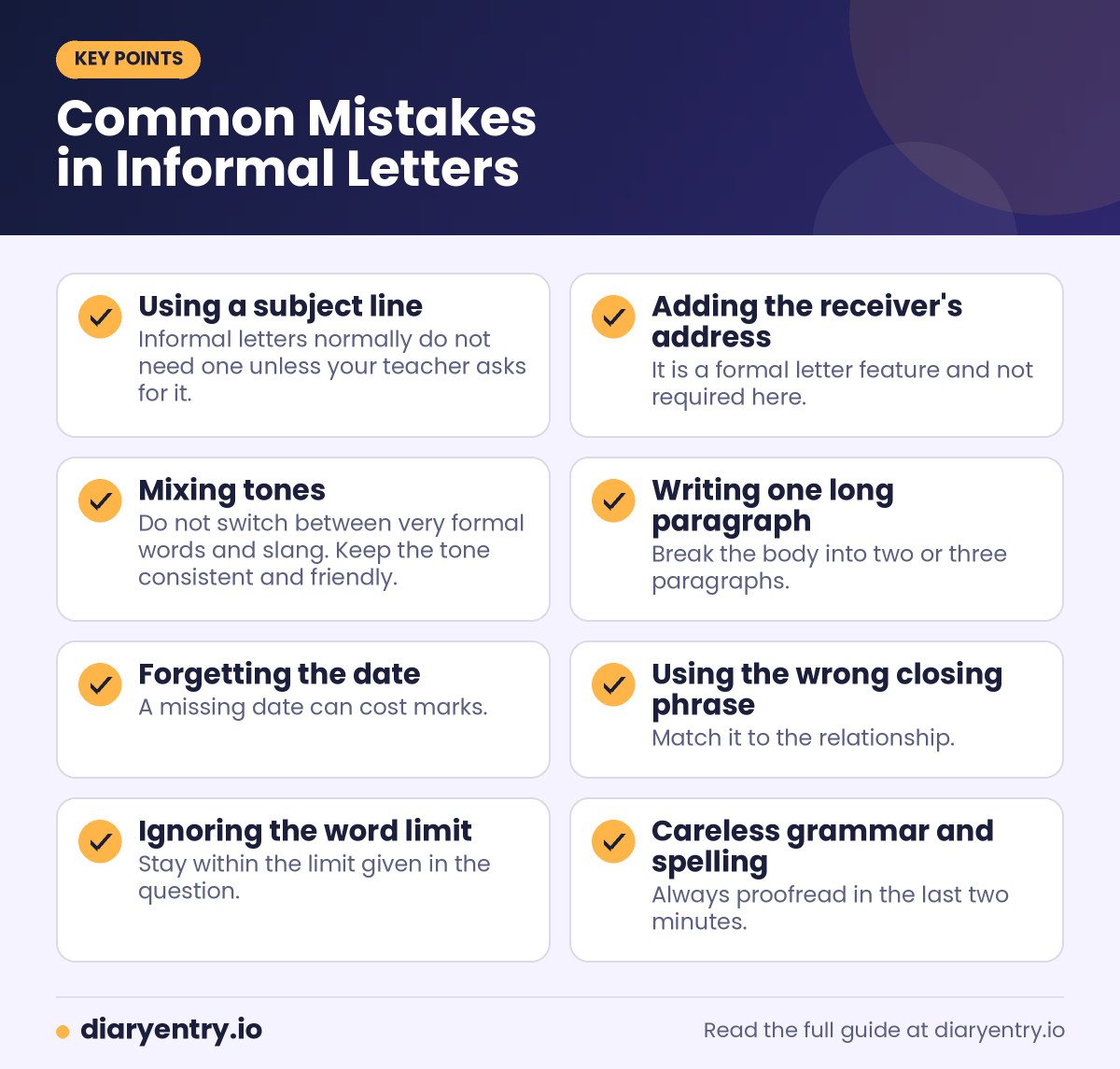
- Using a subject line. Informal letters normally do not need one unless your teacher asks for it.
- Adding the receiver’s address. It is a formal letter feature and not required here.
- Mixing tones. Do not switch between very formal words and slang. Keep the tone consistent and friendly.
- Writing one long paragraph. Break the body into two or three paragraphs.
- Forgetting the date. A missing date can cost marks.
- Using the wrong closing phrase. Match it to the relationship.
- Ignoring the word limit. Stay within the limit given in the question.
- Careless grammar and spelling. Always proofread in the last two minutes.
Tips to Score Well in an Informal Letter
A few habits make your letter stand out.
- Respond to every point in the question, in the order given.
- Add small personal details, such as a memory or a name, to make the letter feel real.
- Use varied sentence length, but keep the language simple.
- Write neatly and leave clean margins.
- Practise writing letters on different themes, such as invitations, congratulations, advice, travel and apologies.
Informal Letter Topics for Practice
Practising different situations builds confidence. Try writing letters on these topics.
- Invite a friend to your sister’s wedding.
- Describe a school trip to a cousin who lives abroad.
- Thank a relative for a birthday gift.
- Advise a friend who wants to give up a hobby.
- Tell a friend about your new school or neighbourhood.
- Write to a friend who has been unwell and cheer them up.
- Describe your favourite festival to a pen friend.
Informal Letters and Diary Entries: How They Differ
Students often confuse the two formats. A letter is addressed to another person and ends with a signature, while a diary entry is a private record addressed to yourself or to “Dear Diary.” A letter usually has a clear purpose, such as inviting or advising, while a diary entry captures your own thoughts and the events of the day.
If you are also preparing for diary writing, our guide on how to write a diary entry explains the format, and the page on diary entry format for Class 6 to 10 offers a ready template and samples. Both pair well with letter practice because they train you to write clearly under time limits.
Build a Writing Habit to Improve Letters
The best way to improve is regular writing. Ten minutes a day is enough. A small daily diary helps you find words for feelings and events, which makes personal letters flow more easily. If you need ideas, browse these diary entry prompts for students and use one each evening. After a week, turn one of your entries into a letter to a friend, and notice how much faster it comes.
Frequently Asked Questions
What is the format of an informal letter?
The format has six parts: sender’s address, date, salutation, body, closing phrase and signature. The tone is friendly and the language is simple. A subject line and receiver’s address are normally not required.
How do you start an informal letter?
Begin with the sender’s address and date, then write “Dear” followed by the person’s name. In the first paragraph, greet the reader and mention why you are writing, for example “I hope you are doing well.”
How do you end an informal letter?
End with a short wish or request to reply, then a warm closing such as “Yours lovingly” or “Your friend,” followed by your first name.
How many paragraphs should an informal letter have?
Two to three short paragraphs are usually enough: an opening, the main message and a closing. Keep paragraphs focused on a single idea.
What is the difference between a formal and an informal letter?
A formal letter is written to officials or organisations in a professional tone and includes a subject line and receiver’s address. An informal letter is written to friends or family in a warm, conversational tone without those features.
Should I use a subject line in an informal letter?
Normally no. A subject line belongs to formal letters. Some teachers or exam papers may ask for one, so follow the instructions you are given.
How long should an informal letter be?
Follow the word limit in your question. Many school tasks ask for about 100 to 150 words, though limits vary by class and board, so check your own paper.
Conclusion: Write Your Informal Letter With Confidence
An informal letter is simply a friendly conversation on paper. Learn the six-part informal letter format, keep your tone warm, organise the body into short paragraphs and close with a phrase that suits your relationship. Practise with the samples and topics above, and proofread before you submit.
With regular practice, you will be able to write a clear, natural informal letter for any situation, in an exam or in real life. Pick one topic from the list today and write your first draft.