

A diary is a private, dated record where you write about your own days: what happened, what you felt and what you want to remember. If you have wondered what is a diary and how it is different from a journal or a planner, this guide explains the meaning, purpose and main types, with simple steps to start your own.
Quick answer: a diary is a personal notebook or digital file in which you write dated entries about your daily life, usually in the first person and for your eyes only.
What Is a Diary? Meaning and Definition
The word “diary” comes from the Latin diarium, which is linked to dies, meaning “day”. That origin explains the idea: a diary is a day-by-day account. Each entry carries a date and records events, thoughts or feelings from that day.
In Hindi, a diary is called डायरी (dayari), so a search such as “डायरी क्या है” is asking for the same meaning described here: a personal book for writing about your daily life.
A diary can be a paper notebook, a notes app or a document on your computer. The format matters less than the habit of writing honestly and regularly.
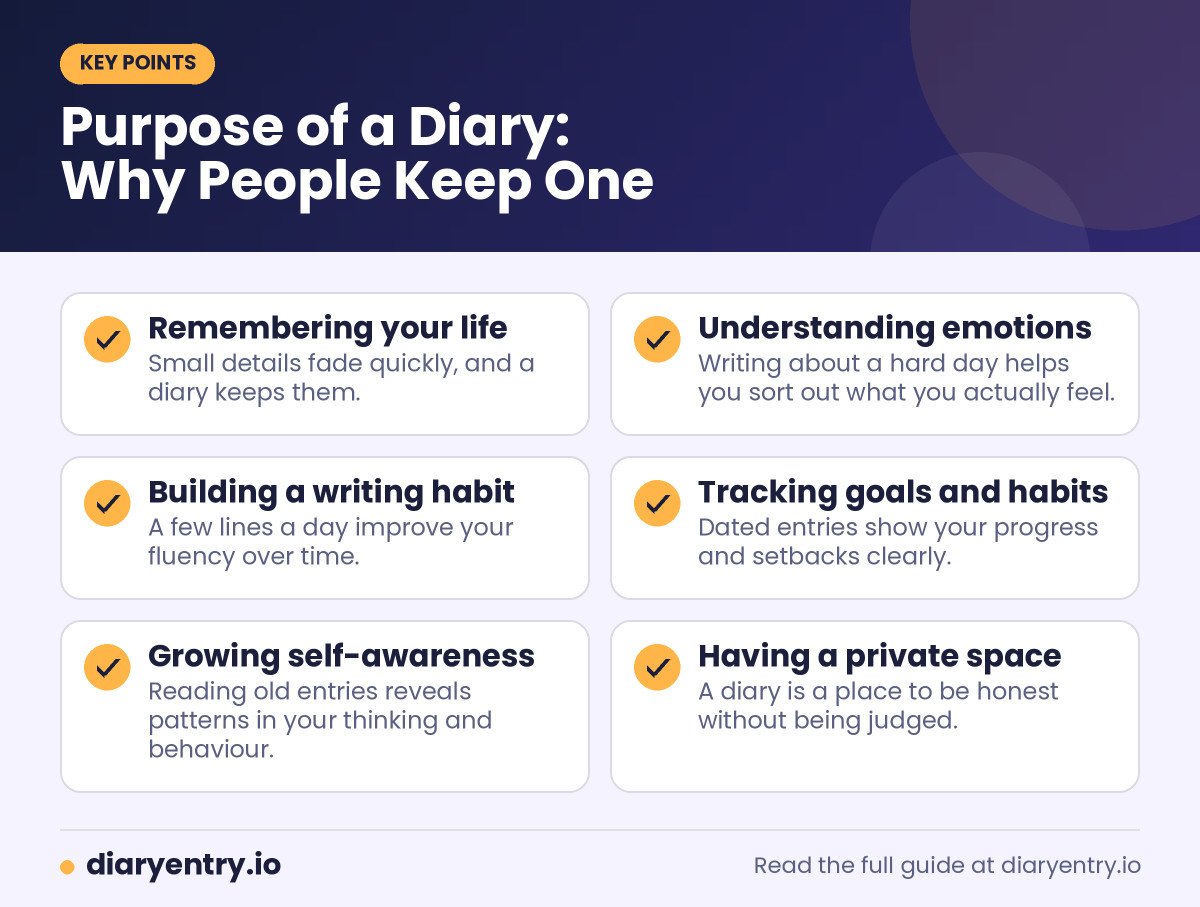
Purpose of a Diary: Why People Keep One
People keep diaries for many reasons. The most common ones are:
- Remembering your life. Small details fade quickly, and a diary keeps them.
- Understanding emotions. Writing about a hard day helps you sort out what you actually feel.
- Building a writing habit. A few lines a day improve your fluency over time.
- Tracking goals and habits. Dated entries show your progress and setbacks clearly.
- Growing self-awareness. Reading old entries reveals patterns in your thinking and behaviour.
- Having a private space. A diary is a place to be honest without being judged.
Key Features of a Diary
Most diaries share a few features, which is also why a diary entry looks different from an essay or a story.
- Dated entries. Every entry starts with the date, and often the day and time.
- First-person voice. You write as “I”, about your own experiences.
- Informal tone. Simple, natural language is fine; there is no need to impress anyone.
- Personal and private. It is written for yourself, not for an audience.
- Regular writing. Entries are usually daily or several times a week.
For the school format, see our guide on what diary entries are and how to write a diary entry.
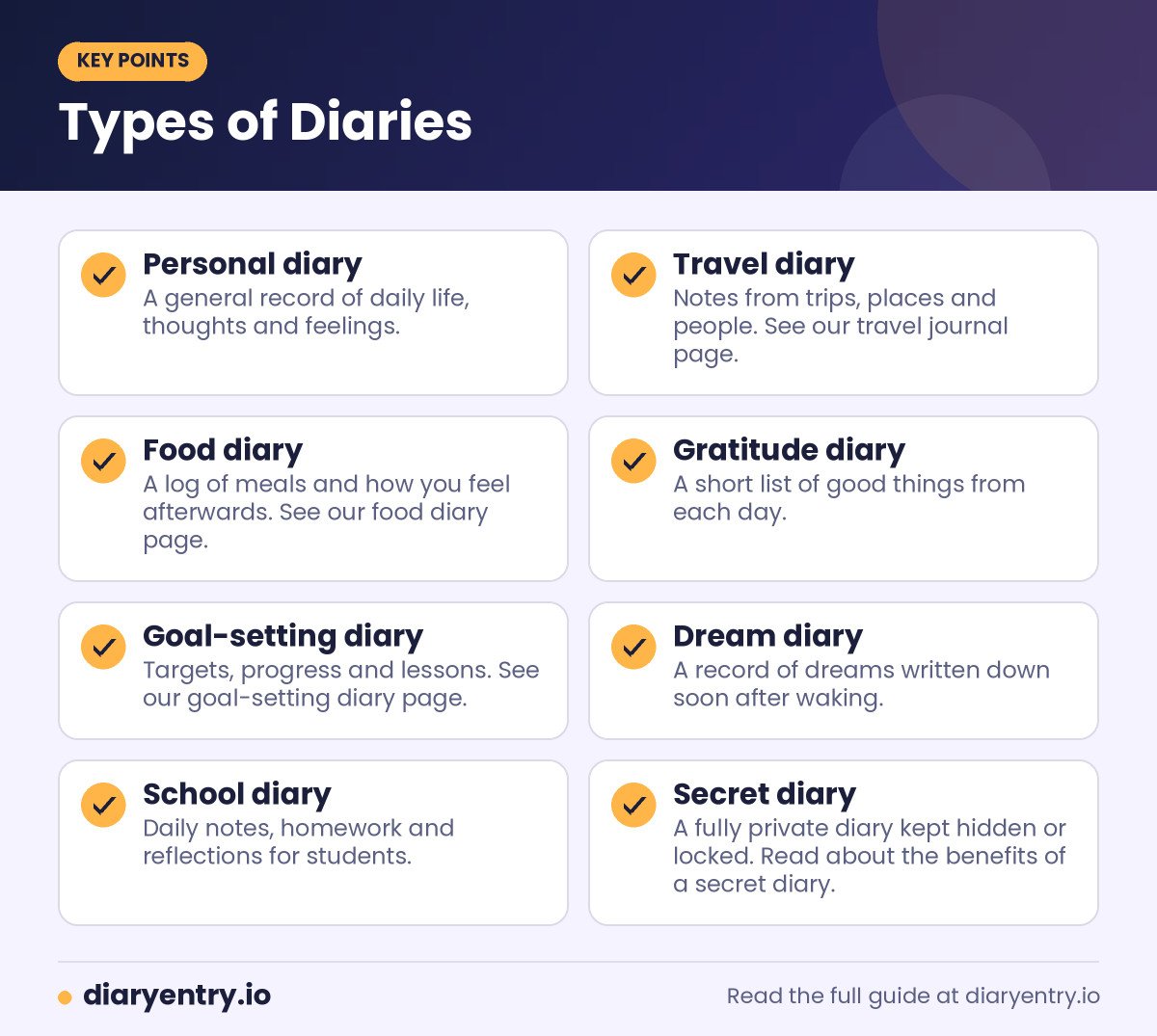
Types of Diaries
A diary does not have to cover everything. Many people choose a type that matches what they want to track. Our full list of types of diaries goes deeper, but these are the most popular:
- Personal diary. A general record of daily life, thoughts and feelings.
- Travel diary. Notes from trips, places and people. See our travel journal page.
- Food diary. A log of meals and how you feel afterwards. See our food diary page.
- Gratitude diary. A short list of good things from each day.
- Goal-setting diary. Targets, progress and lessons. See our goal-setting diary page.
- Dream diary. A record of dreams written down soon after waking.
- School diary. Daily notes, homework and reflections for students. See our school diary guide.
- Secret diary. A fully private diary kept hidden or locked. Read about the benefits of a secret diary.
Diary vs Journal: What Is the Difference?
The two words overlap, and many people use them interchangeably. In general, a diary is a dated record of events and feelings, while a journal is often more reflective, focused on a topic or purpose. Our guide on what a journal is covers the other side in detail.
| Feature | Diary | Journal |
|---|---|---|
| Main focus | What happened each day | Ideas, reflection and growth |
| Style | Informal, personal | Reflective or structured |
| Dates | Always dated | Often dated, not always |
| Topic | Your daily life | Often one theme or goal |
| Typical use | Memories and feelings | Planning, learning, self-analysis |
You do not need to pick one. If you write about your day and reflect on it, you are doing both.
Famous Diaries in History
Diaries have shaped how we understand the past. Samuel Pepys wrote a diary in the 1660s that describes daily life in London, and Anne Frank’s diary, written in the early 1940s, was later published as The Diary of a Young Girl. Both show how ordinary daily writing can become valuable over time.
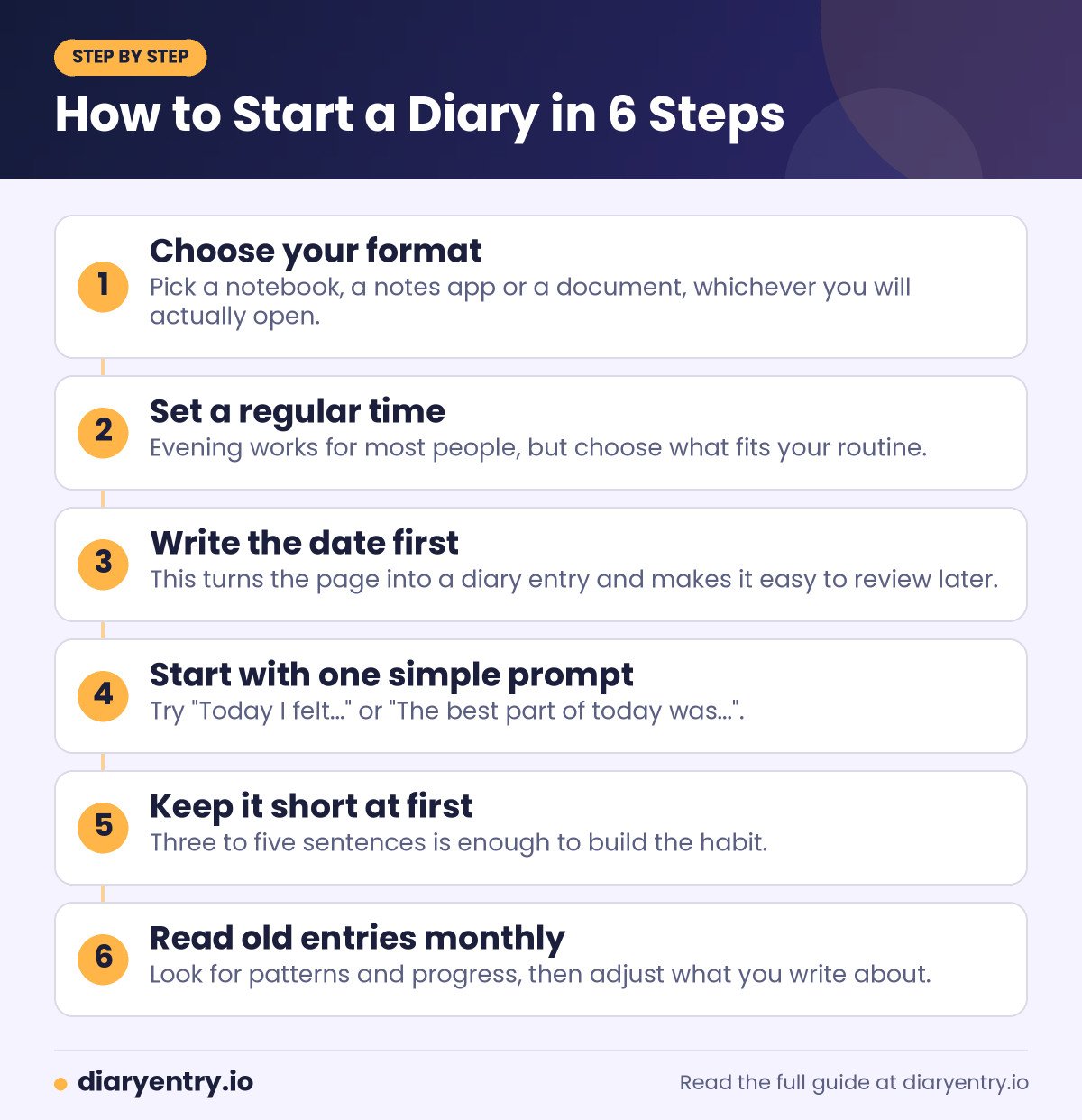
How to Start a Diary in 6 Steps
- Choose your format. Pick a notebook, a notes app or a document, whichever you will actually open.
- Set a regular time. Evening works for most people, but choose what fits your routine.
- Write the date first. This turns the page into a diary entry and makes it easy to review later.
- Start with one simple prompt. Try “Today I felt…” or “The best part of today was…”.
- Keep it short at first. Three to five sentences is enough to build the habit.
- Read old entries monthly. Look for patterns and progress, then adjust what you write about.
For a longer walkthrough, read how to start a diary. If you want guidance and accountability, the 4-Week Diary Entry Course helps you build a daily writing habit step by step.
Frequently Asked Questions About Diaries
What is a diary in simple words?
A diary is a personal book where you write about your day, your thoughts and your feelings, usually with the date at the top.
What is the purpose of keeping a diary?
The main purposes are to remember events, understand emotions, build a writing habit and track personal growth.
Is a diary the same as a journal?
Not exactly. A diary is usually a dated record of daily events and feelings. A journal is often more reflective or topic-focused, but the two overlap a lot.
How often should I write in a diary?
Daily is ideal, but a few times a week works. Choose a rhythm you can keep. A five year journal is a good fit if you want a one-line-a-day rhythm.
Can I keep a diary on my phone?
Yes. A notes app or a diary app works well, as long as you keep it private and write regularly. Our overview of the electronic diary compares the main options.
Final Thoughts on What a Diary Is
A diary is simply a dated, private record of your life in your own words. It can be a daily habit, a place to process feelings or a keepsake of memories. Now that you know what a diary is, pick a format, write today’s date and add your first few sentences.