
Janitor AI is a character chat platform. Instead of asking an assistant to draft an email, you open a conversation with a fictional person, such as a detective, a dragon, a study partner or a rival at school, and the bot stays in character while you talk. It launched in 2023, grew very quickly, and is now one of the best known names in AI roleplay.
Most guides stop at “it is a chatbot for roleplay”. This one goes further. You will learn how a character is actually turned into a prompt, why long chats start to forget things, how to estimate what an external model will cost you with simple arithmetic, what a safe first session looks like, and some uses of the platform that most articles never mention. Every claim about pricing, user numbers and app availability is marked as reported where it could not be confirmed from the company itself, because these details change often.
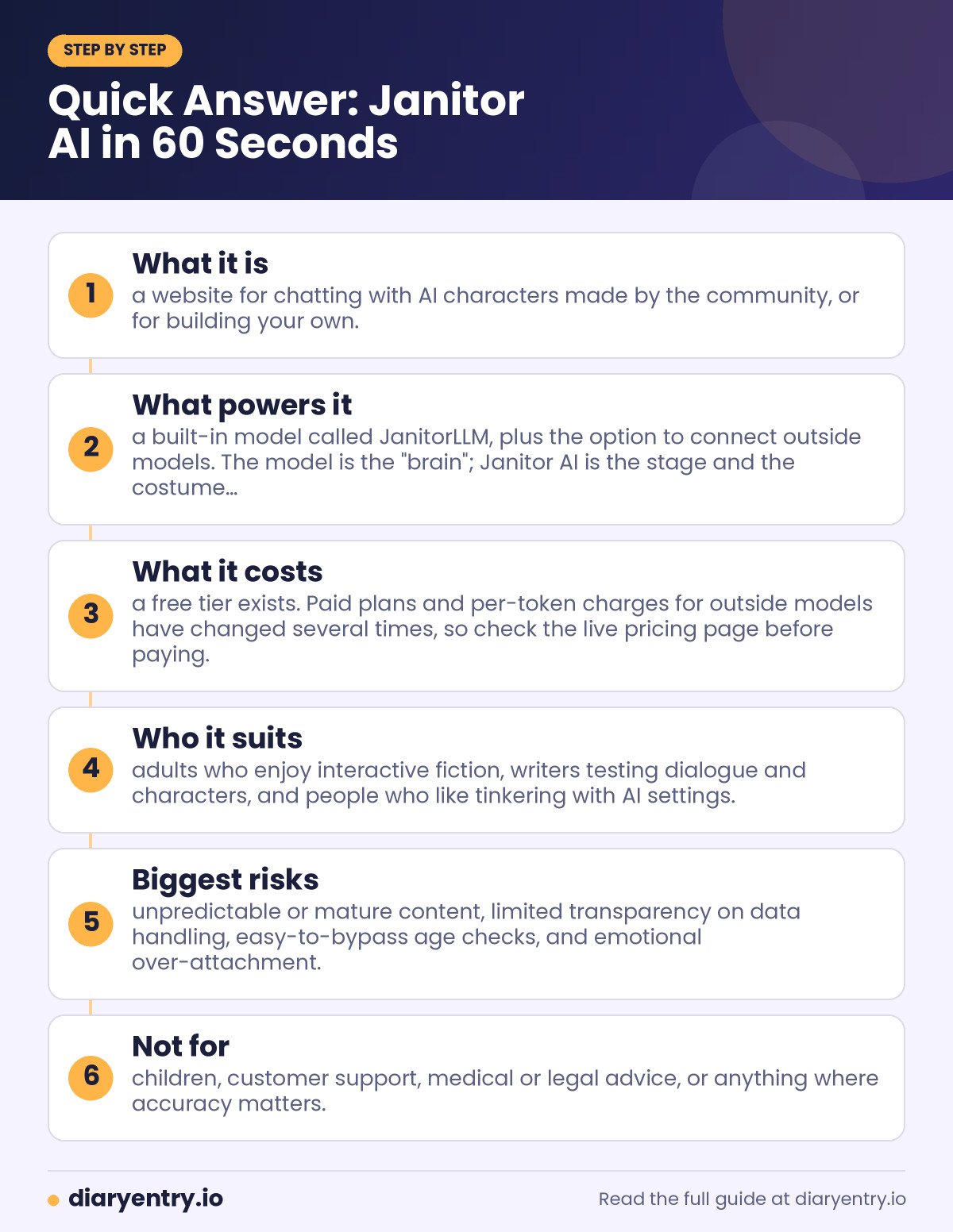
Quick Answer: Janitor AI in 60 Seconds
- What it is: a website for chatting with AI characters made by the community, or for building your own.
- What powers it: a built-in model called JanitorLLM, plus the option to connect outside models. The model is the “brain”; Janitor AI is the stage and the costume department.
- What it costs: a free tier exists. Paid plans and per-token charges for outside models have changed several times, so check the live pricing page before paying.
- Who it suits: adults who enjoy interactive fiction, writers testing dialogue and characters, and people who like tinkering with AI settings.
- Biggest risks: unpredictable or mature content, limited transparency on data handling, easy-to-bypass age checks, and emotional over-attachment.
- Not for: children, customer support, medical or legal advice, or anything where accuracy matters.
What Is Janitor AI?
Janitor AI is a web platform for character-based AI conversation. A general assistant such as ChatGPT, Gemini or Claude is built to be useful: you ask, it answers. Janitor AI is built to be entertaining and immersive: you pick a character, the character has a personality and a scenario, and the conversation unfolds like a shared story.
It helps to think of the platform as three separate layers:
- The character card. A block of written instructions: who the character is, how they talk, what the scene is, and sample lines. This is what makes one bot feel different from another.
- The model. The language model that reads the card and your messages and writes the reply. Quality, speed, creativity and cost all depend on this layer.
- The interface. The website or app: search, tags, chat window, settings, saved chats and profile.
Once you see these layers, many common complaints make sense. A character that “forgot” something is usually a model and context issue. A character that “feels flat” is usually a card issue. A site that “keeps lagging” is an interface and server issue.
Janitor AI at a Glance
| Item | What is reported |
|---|---|
| Type | Character chat and roleplay platform |
| Launched | 2023 |
| Founder | Jan Zoltkowski, as reported by third-party reviews |
| Built-in model | JanitorLLM (beta at the time of most reviews) |
| Outside models | Supported through API keys or a router service, depending on the plan |
| Free tier | Yes, with limits that differ between sources and over time |
| Platforms | Website; mobile apps reported in beta in 2026, but sources disagree |
| Age rule | Not for under-18 users, though sign-up checks are described as weak |
Because several of these rows differ between reviews, treat the table as a map of what to verify rather than a final answer.
The Story: From Viral Launch to a Platform With Rules
The history of Janitor AI is more useful than it sounds, because it explains why the platform works the way it does today. The dates below come from third-party reviews, and the user numbers are unaudited estimates.
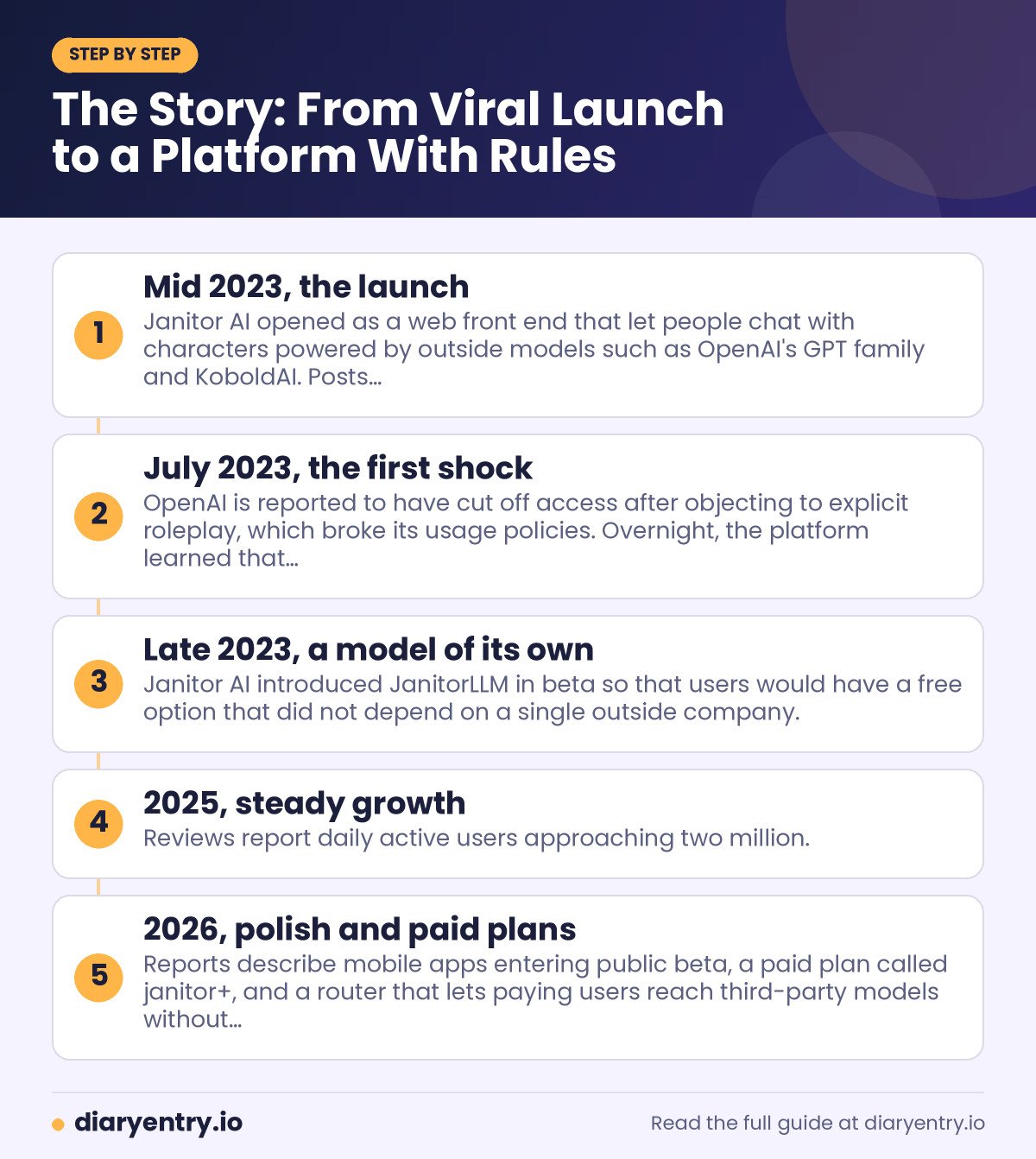
- Mid 2023, the launch. Janitor AI opened as a web front end that let people chat with characters powered by outside models such as OpenAI’s GPT family and KoboldAI. Posts on TikTok and Reddit spread it fast, and reviews report a million users within the first few weeks.
- July 2023, the first shock. OpenAI is reported to have cut off access after objecting to explicit roleplay, which broke its usage policies. Overnight, the platform learned that depending on one outside provider is risky.
- Late 2023, a model of its own. Janitor AI introduced JanitorLLM in beta so that users would have a free option that did not depend on a single outside company.
- 2025, steady growth. Reviews report daily active users approaching two million.
- 2026, polish and paid plans. Reports describe mobile apps entering public beta, a paid plan called janitor+, and a router that lets paying users reach third-party models without pasting their own keys. Total user claims above 15 million circulate, but no audited figure was found.
Why this matters to you: a platform that sits on top of other companies’ models is always one policy change away from a different experience. If you build characters you love, keep a copy of the card text somewhere you control.
How Janitor AI Works Under the Hood
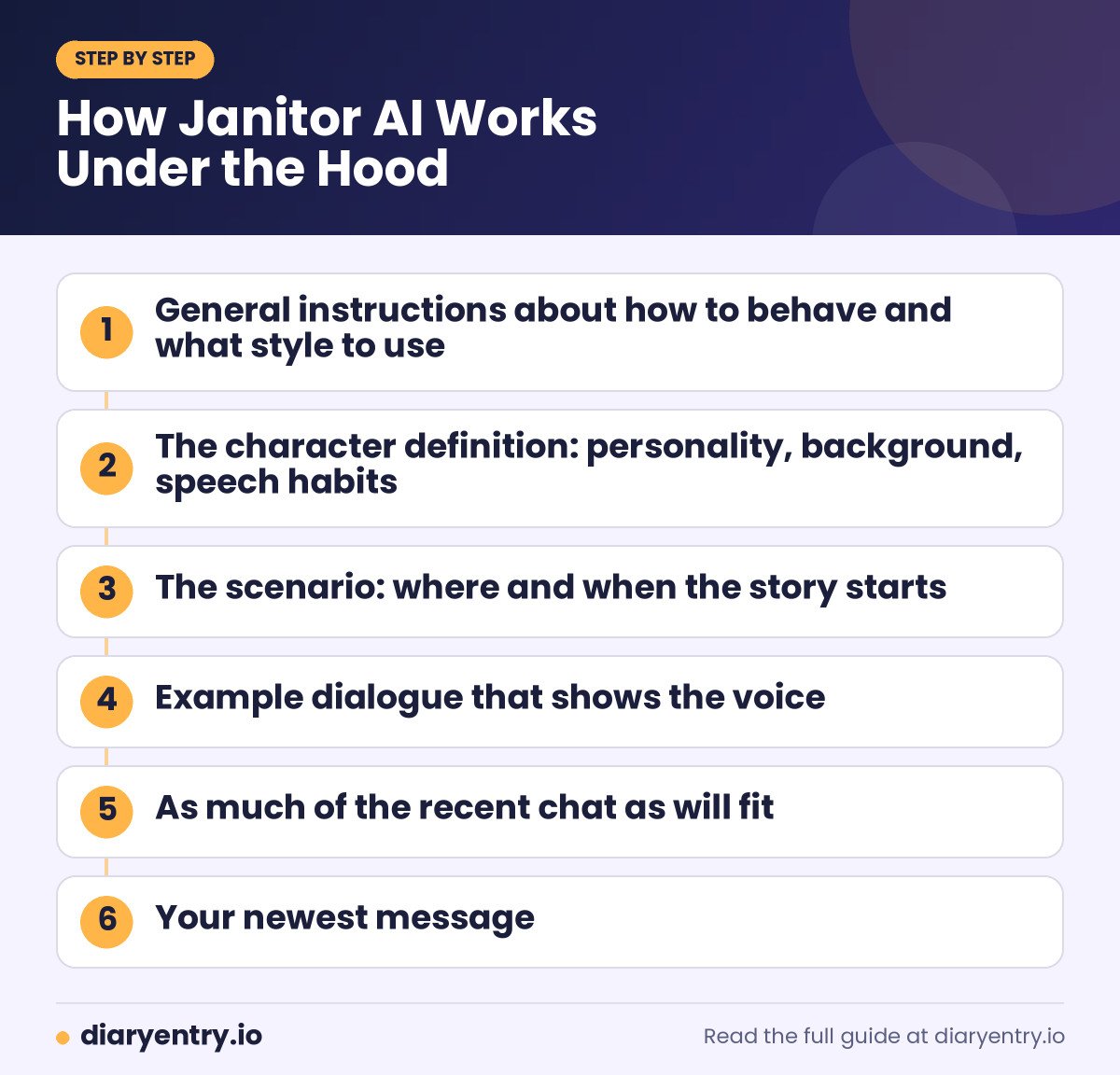
Here is the part most articles skip. A language model does not remember your conversation the way a person does. Every time you press send, the platform builds a fresh package of text and hands the whole thing to the model. That package usually contains, in order:
- General instructions about how to behave and what style to use.
- The character definition: personality, background, speech habits.
- The scenario: where and when the story starts.
- Example dialogue that shows the voice.
- As much of the recent chat as will fit.
- Your newest message.
The model reads all of this and writes the next reply. Then the package is rebuilt for the next turn. This design explains three behaviours that confuse new users:
- Forgetting. There is a limit on how much text fits in the package, called the context window. Once the chat grows past it, the oldest messages fall out and the character can no longer “see” them.
- Cost growth. When you use a paid outside model, you pay for every token in the package each time, not just your new message. Long chats get more expensive per message. The cost section below shows the maths.
- Character drift. If the card is vague or buried under a long chat, the model slides back to a generic voice.
Three Ways to Power a Janitor AI Chat
| Option | How it works | Best for | Watch out for |
|---|---|---|---|
| JanitorLLM | The built-in model, no setup | Beginners and casual chats | Message limits, shorter memory, quality that varies |
| Router (paid plan) | The platform routes your chat to third-party models and bills per use | People who want stronger models without handling keys | Usage billed on top of a subscription; plans change |
| Your own key or local model | You connect a provider key, or a model running on your own computer | Tinkerers who want control over model and data | Setup effort, surprise bills, keys that must never be shared |
Key Features of Janitor AI
Feature lists differ slightly between reviews and change as the platform updates. These are the ones that appear consistently.
- Community character library. Reviews mention tens of thousands of user-made characters, searchable by tags such as fantasy, romance, adventure, anime, slice of life and games.
- Custom character creation. You write the personality, backstory, scenario, opening message and example dialogue, add an avatar, then keep the bot private or share it.
- Model flexibility. Switch between the built-in model and other options, and tune settings such as creativity (often called temperature) and response length.
- Scripts or lorebook-style context. Some reviews describe a way to inject world details only when they are relevant, which saves space in the context window.
- Chat management. Saved chats, bookmarks, swipes (regenerating a reply to see another version) and edit-and-continue tools.
- Content settings. Safe-for-work and mature modes exist, with mature access tied to account settings and age confirmation. Reviews report that mobile apps start in a restricted mode.
- Display options. Streaming text and an immersive view that hides interface clutter.
How to Use Janitor AI: A Safer First Session
The sign-up steps are simple. The habits you set in the first ten minutes matter more.
- Use a separate email address. Create or use an email that is not tied to your bank, work or main social accounts. Reviews note the platform collects little personal data, but a throwaway address keeps any future exposure contained.
- Register on the official site only. Type the address yourself or use the official app store listing. Copycat sites exist for almost every popular AI tool.
- Confirm your age honestly. The service is for adults. If you are under 18, do not use it.
- Start in the safe-for-work setting. Leave mature content off until you understand how the platform behaves.
- Read the character before you chat. Check the tags, the description and any content warnings. Use the 60-second checklist in the safety section below.
- Pick the built-in model first. Do not paste an API key on day one. See how the free experience feels before adding cost and risk.
- Do not share real personal details. Use invented names, places and facts. The character does not need your address, school or workplace.
How to Create a Character That Actually Feels Alive
The creation form looks like a set of boxes to fill. The skill is knowing which box does which job.
The Five Fields That Matter Most
| Field | Its real job | Common mistake |
|---|---|---|
| Personality or definition | Tells the model who the character is and how they behave | A list of adjectives such as “kind, funny, smart” with no behaviour behind them |
| Scenario | Sets where, when and why the chat starts | Leaving it empty, so every chat opens in a blank room |
| First message | Sets the length, tone and format of every later reply | One short line, which trains the bot to reply with one short line |
| Example dialogue | Shows the voice instead of describing it | Skipping it, which is the fastest way to get a generic voice |
| Tags and description | Helps other people judge the bot before chatting | Missing or misleading tags |
Show, Do Not Tell
Compare two ways of describing the same character.
- Telling: “Mira is a grumpy but caring lighthouse keeper.”
- Showing: “Mira answers questions with a shrug first and facts second. She mutters about the weather while quietly leaving tea at the door for stray sailors. She never says she cares; she just refills the lamp oil for strangers.”
The second version gives the model behaviours to imitate. That is why it produces better scenes.
A Worked Example: The Lighthouse Keeper
Here is a compact card you can copy and adapt. It is invented for this guide and safe for work.
- Name: Mira Vale.
- Definition: Mira is a 60-year-old lighthouse keeper who talks in short, dry sentences and rarely volunteers feelings. She knows every ship that passes. She hides her kindness behind chores and complaints. She never breaks character to explain that she is an AI.
- Scenario: A storm has forced the user’s boat to dock at her island. She does not trust visitors but will not let anyone freeze outside.
- First message: A three or four sentence scene that shows the weather, the lamp, Mira’s posture and a gruff first line, so that the bot copies that length.
- Example dialogue: Two short exchanges showing how she deflects a thank-you and how she reacts to a question about her past.
The Token Budget: Why Shorter Cards Often Win
Everything in the card is re-sent on every turn, so a long card permanently eats part of the context window. Some quick, rounded arithmetic makes this concrete. As a rule of thumb, one token is about three quarters of an English word.
- Suppose a model has a context window of about 9,000 tokens, which is the free-tier figure one review reports.
- 9,000 tokens is roughly 6,750 words (9,000 × 0.75).
- At about 250 words per printed page, that is about 27 pages of text in total.
- If your card, scenario and example dialogue use 1,500 tokens, only 7,500 tokens remain for the live conversation (9,000 − 1,500).
- Trim the card to 700 tokens and you gain 800 tokens of memory, which is about 600 more words of chat history, in every single turn.
The takeaway is simple. Put the most important traits first, cut repeated ideas, and use example dialogue for voice instead of long descriptions. A tight 600-token card with a strong sample often beats a 2,000-token biography.
Five Habits of Good Character Writers
- Give each character one contradiction. A gruff person who feeds strays is more memorable than a purely gruff one.
- State what the character wants. A goal drives the plot even when you do not.
- Add a speech habit. Short sentences, a favourite phrase, a formal register, a stutter. Voice is identity.
- Write boundaries in positive terms. “Mira stays in the lighthouse setting” works better than a long list of things she must never do.
- Test, edit, repeat. Run five different openers, note where the voice slips, then fix the card. Treat the first version as a draft.
Keeping Long Chats Coherent
When a story runs for hundreds of messages, the early events fall out of the context window. Three practical fixes help:
- Write a running summary. Every 30 or 40 messages, write a five-line recap of key facts and paste it into the scenario or memory area if the plan allows it.
- Restate key facts in the story. Let a character mention the important detail naturally so it re-enters recent context.
- Start a fresh chapter. Begin a new chat with the summary as the scenario. This often reads better than a bloated old thread.
Is Janitor AI Free? Pricing and the Real Cost of Outside Models
This is the area where sources disagree most, and the company has changed its plans more than once. What follows is what third-party reviews reported in 2026. Confirm every figure on the official site before you pay.
| Plan | Reported price | Reported details |
|---|---|---|
| Free | $0 | Community characters, character creation, the built-in model with limits. Message caps and context size differ between reviews. |
| Older paid plan (called Pro in some reviews) | $9.99 a month or $99.99 a year | Higher limits and priority access at busy times |
| janitor+ | $12.99 a month in one September 2026 review | Larger context, priority during peak load, access to the router, plus a badge. Router usage is billed separately from a wallet balance. |
| Outside provider keys | Set by the provider | Billed per token by the company whose model you use |
One more point from the table: at $99.99 a year, the older plan works out to about $8.33 a month. Twelve months at $9.99 would be $119.88, so the annual option saved roughly $19.89, or about 17 percent. Whether any such discount still exists is something only the live pricing page can tell you. Other trackers list paid tiers anywhere from about $2.99 to $39.99 a month, which is a sign that outdated numbers are circulating.
The Cost Maths Nobody Shows You
Paying per token sounds cheap until you remember that the whole package is re-sent every turn. The numbers below use made-up round prices so you can see the pattern. Replace them with your provider’s real rates.
Assumed example rates (illustrative only): $1 per million input tokens and $4 per million output tokens.
Example 1: A Steady 100-Message Chat
- Each turn sends about 6,000 input tokens (card plus recent history) and receives about 300 output tokens.
- Input: 100 × 6,000 = 600,000 tokens, which costs $0.60 at $1 per million.
- Output: 100 × 300 = 30,000 tokens, which costs $0.12 at $4 per million.
- Total: $0.72 for the whole chat.
- Double the context to 12,000 input tokens per turn and input becomes $1.20, so the total rises to $1.32 even though the replies are the same length.
Lesson: input dominates the bill, because the model re-reads everything each time. Replies are the small part.
Example 2: How a Chat Gets Heavier as It Grows
- Assume a 1,000-token card, and that each exchange (your message plus the reply) adds about 350 tokens of history.
- Turn 1 sends 1,000 input tokens.
- Turn 20 sends 1,000 + 350 × 19 = 7,650 input tokens, which is 7.65 times as much as turn 1.
- Across the first 20 turns, total input is 20 × 1,000 + 350 × (0 + 1 + … + 19) = 20,000 + 350 × 190 = 86,500 tokens, or about $0.09 at $1 per million.
Pennies, in this example. But with a premium model priced many times higher, or a very large context, the same pattern can turn into dollars quickly. Hence the three money rules below.
- Set a spending cap with your provider before connecting any key.
- Keep cards lean and restart long chats with a summary.
- Test with a cheaper model first and switch to a stronger one only for scenes that need it.
What Is Janitor AI Used For? Beyond the Obvious
Most people use Janitor AI for entertainment and interactive fiction, and that is its home turf. It is not a business support tool: it has no ticketing, customer records or reporting. But a character that stays in role and answers back is useful for some practical things too, as long as you treat the output as practice material, not as fact.
- Conversation rehearsal. Build a calm, a sceptical or a difficult character and practise a job interview, a salary request or a hard conversation. You get unlimited low-stakes repetitions.
- Language practice. Write a card that says the character only speaks simple Spanish or French and gently repeats corrections. You get a patient partner at any hour.
- A writers’ room. Interview your own villain, ask your hero why they lied, or test whether two characters sound different. Dialogue problems show up fast when a character talks back.
- Worldbuilding stress tests. Ask a character who lives in your invented city about food, taxes or festivals. Gaps in your world appear as soon as the answers get vague.
- Solo game master. Run a tabletop-style adventure with a narrator character who tracks scenes and offers choices.
- A prompt generator for journaling. Create a character, such as a thoughtful old sailor, whose only job is to ask reflective questions. Take the questions, close the chat and write the answers by hand. Our guides to how to write a diary entry and 50+ journal prompts show what to do with them next, and building a daily journaling habit explains how to keep it going. Never paste real private diary entries into any chatbot.
A note for teachers: historical interview bots are a lovely classroom idea, but Janitor AI is an adults-only platform. For anything involving students, choose a tool that is designed for minors and approved by the school.
A 7-Day Experiment to Find Out If It Is for You
| Day | Task | What to notice |
|---|---|---|
| 1 | Chat for 15 minutes with a safe-for-work character on the built-in model | Does the voice stay consistent? |
| 2 | Read three character cards in full | What makes the best one better? |
| 3 | Build a small private character of your own | Which field was hardest to write? |
| 4 | Chat with it twice with different openers | Where does the voice slip? |
| 5 | Run a long chat and write a summary at message 30 | Does the summary restore coherence? |
| 6 | Use a character for rehearsal or language practice | Was it useful, or just fun? |
| 7 | Review time spent, money spent and mood afterward | Keep, limit or quit? |
Common Problems and Fixes
Reviews report the same handful of issues again and again.
| Symptom | Likely cause | What to try |
|---|---|---|
| “Server busy” or capacity message | Peak-hour load, often US evenings | Wait, retry later, or try a different time of day |
| “Failed to fetch” or network error | Browser, cache or connection | Refresh, clear cache, try another browser or network |
| 429 error | Rate limit on the connected model | Slow down, wait a minute, check provider limits |
| Chat stalls on an outside model | Depleted credits or invalid key | Check your provider balance and key |
| Character forgets earlier events | Context window is full | Add a summary, restate key facts, start a new chapter |
| Replies are short or repetitive | Short first message or low creativity setting | Rewrite the first message longer, edit a reply, or use swipes |
| Character ignores the card | Card too long or contradictory | Shorten it, put key traits first, add example dialogue |
Is Janitor AI Safe? A Practical Safety Guide
Safety here has four parts: what you read, what you share, who can use it, and what it does to your habits. No review found a verified data breach or malware incident on the platform itself, but several flagged limited transparency about data handling, weak age checks and content that can surprise you. Treat it as an entertainment product with real limits.
The 60-Second Character Checklist
Run this before you start any chat with a community bot.
- Read the tags and content warnings. If they hint at themes you do not want, skip it.
- Read the description and scenario. A bot whose opening scene pushes in a direction you dislike will usually keep pushing.
- Check the creator and usage numbers. A well-maintained bot with many chats is a safer bet than an unknown one with no history.
- Look for requests for personal information. A character that asks for your real name, location or contacts should be reported and closed.
- Know your exit. You can leave, delete the chat and report the character at any time.
Privacy: What Happens to Your Chats
- Reviews say the platform collects little personal information, mainly an email address plus usage data such as IP address and browser type.
- Chats and characters are described as private by default, with the option to make a character public.
- If you connect an outside model, that provider may process and keep your messages under its own rules. Deleting your Janitor AI account does not necessarily delete what an outside provider stored.
- Public documentation on retention periods and encryption is described as limited. Read the current privacy policy yourself.
Keys, Proxies and Scams
Community-run proxies and shared keys appear in forums as shortcuts to “free” strong models. They are a common way to leak chats or lose money. Never share your own key, never use a key that someone else hands you, and prefer official routes. Limit what any key can spend.
A Short Guide for Parents
- The platform is for adults, but reviews describe sign-up age checks as easy to get around. Do not rely on them.
- Talk with your child about AI characters before a problem appears, in the same way you would talk about any online community.
- Use device-level controls and app store ratings, and review what apps are installed.
- Offer better alternatives: school-approved tools, supervised creative writing, or a paper diary. Our guide to diary entry prompts for students is a good screen-light place to start.
Emotional Over-Attachment
A character that always answers, never gets tired and never disagrees can feel easier than real people. Reviews mention obsessive use in some cases. Warning signs include losing sleep to keep chatting, preferring the bot to friends, feeling anxious when you cannot log in, or spending more than you planned. A simple rule helps: set a daily time limit, keep real conversations first, and take a full break if the habit starts to feel like a need. If chatting is replacing support you actually need, speak to a trusted person or a professional.
Janitor AI vs Character.AI and Other Options
| Tool | Main use | Models | Moderation | Setup |
|---|---|---|---|---|
| Janitor AI | Detailed character roleplay and story chat | Built-in, router or your own | Lighter, with safe-for-work and mature settings | Easy to start; harder with outside keys |
| Character.AI | Casual character chat with guided creation | Its own models | Stricter, centrally managed | Very simple |
| SpicyChat AI | Mature-leaning roleplay | Mostly external models | Varies by setting | Simple |
| ChatGPT or Claude | General help, writing, analysis | Their own | Strict, with clear policies | Very simple |
| KoboldAI (self-hosted) | Full local control over model and data | Any compatible local model | You decide | Technical, needs capable hardware |
Which One Should You Pick?
- You want the simplest start with firm filters: choose a mainstream platform with strict moderation.
- You want deep customisation and model choice, and you are an adult comfortable with settings: Janitor AI fits.
- You care most about privacy and control: look at a self-hosted setup, accepting the effort.
- You need correct answers, research or business help: use a general assistant, not a roleplay platform.
Pros and Cons of Janitor AI
| Pros | Cons |
|---|---|
| Huge library of community characters | Quality varies a lot from bot to bot |
| Deep control over characters and settings | Server lag and downtime at peak hours are widely reported |
| Free tier and choice of models | Pricing and limits change often and sources disagree |
| Useful for practice, writing and play | Weak age checks and limited data transparency |
| Active creator community | Content can be unpredictable or mature |
A 10-Point Scorecard for Judging Any AI Roleplay Platform
Platforms rise and fall quickly, and today’s favourite may change its rules next year. Instead of trusting a review, including this one, score any platform yourself. Give each question 0 points for no, 1 for partly and 2 for yes. The maximum is 20.
| # | Question |
|---|---|
| 1 | Is the company named, with a clear way to contact it? |
| 2 | Is there a readable privacy policy that explains what is stored and for how long? |
| 3 | Can you delete your account and chats, and does it say what happens to outside providers’ copies? |
| 4 | Are the age rules clear, and are they enforced in some way? |
| 5 | Can you control content settings per chat or per account? |
| 6 | Is there a visible way to report a character or a user? |
| 7 | Are prices shown before you pay, with an easy way to cancel? |
| 8 | Can you export or back up your characters? |
| 9 | Does the platform explain which model is answering you? |
| 10 | Does it publish updates or status notes when things break? |
- 16 to 20: a well-run platform. Use it, with the usual caution.
- 10 to 15: mixed. Use it for low-stakes fun and share nothing personal.
- Below 10: skip it, or look for an alternative.
Try it on Janitor AI and on two competitors. Writing the scores down for three platforms is more informative than any list of features, and it takes about fifteen minutes.
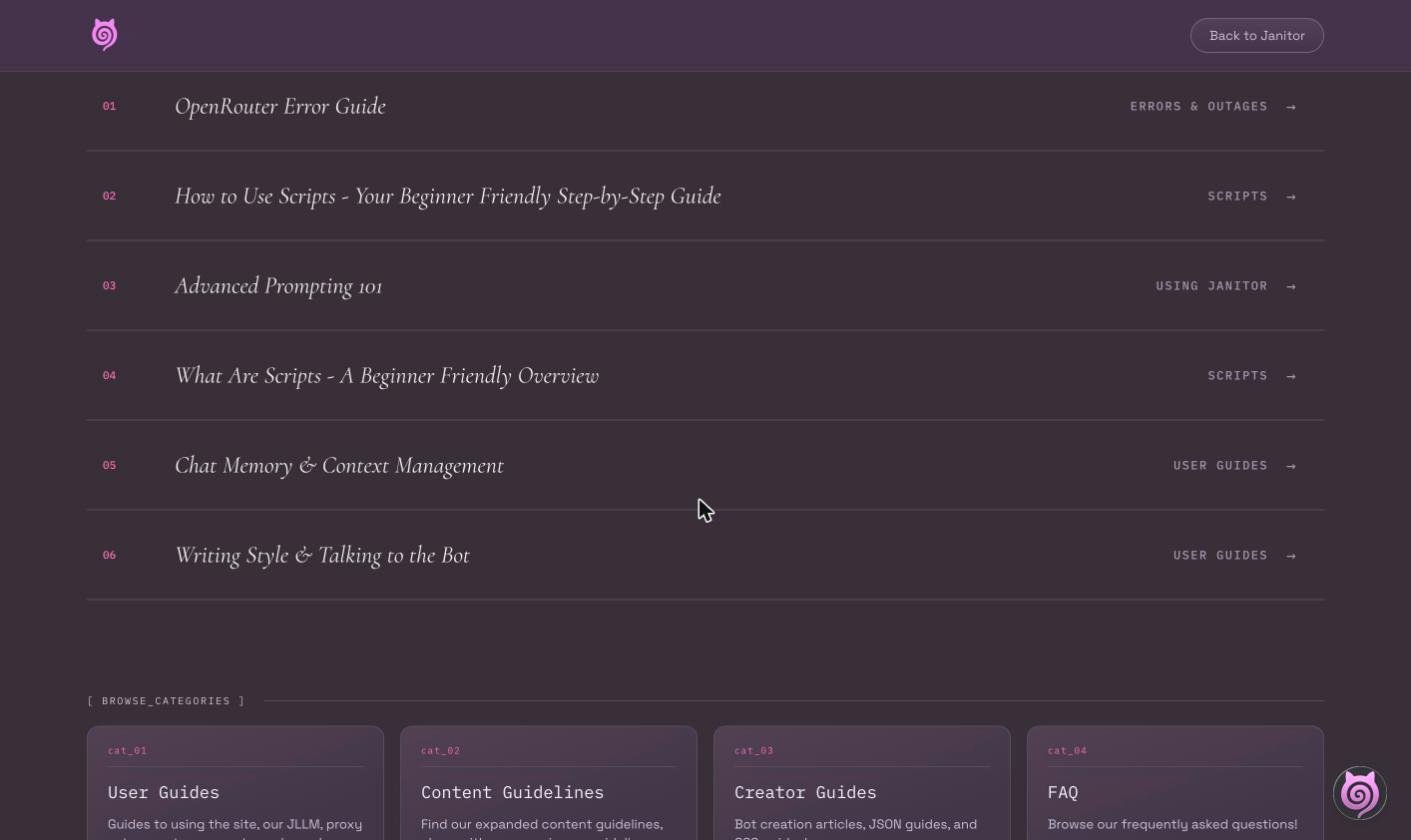
For question 10, here is what a live example looks like. When we checked on 3 November 2026, Janitor AI’s main site was showing a waiting-line page (“You’re in line”) because of high traffic, with links to its iOS and Android apps. Its separate help center was loading normally and lists guides on OpenRouter errors, scripts, advanced prompting, and chat memory and context management. Traffic queues and guide libraries change often, so treat this as a snapshot, not a promise.
Ethics, Copyright and Real People
Because anyone can publish a character, a community like this raises questions that an article about features usually skips. These are general points, not legal advice.
- Bots about real people. Building a character that imitates a real person, especially a private individual such as a classmate, an ex or a colleague, can be hurtful and may break platform rules or local law. Stick to fictional characters.
- Copyrighted characters. Fan-made versions of famous characters are common, but the rights belong to someone else. If you publish a bot, expect that it can be removed, and do not sell it.
- Minors. Never create or request content involving minors in any mature setting. This is a hard line on every responsible platform.
- Shared spaces. Public characters are used by many people. Label themes honestly so others can choose.
- Honesty about AI. If you share a story you wrote with a bot, say so. Readers deserve to know what they are reading.
What Character Cards Teach Everyday Writers
Writing a good card forces you to practise the same skills that make any writing clearer, whether it is an email, an essay or a diary entry.
- Be specific. “Kind” tells the reader nothing. “Leaves tea at the door for strangers” tells them everything.
- Cut the extras. A token budget is a word budget. Keeping only what matters is a transferable edit skill.
- Use examples. One sample line teaches a voice faster than a paragraph of description.
- Think about the reader. The model only knows what you wrote. People are the same: they cannot read your mind.
- Revise. Testing a card and editing it mirrors drafting and rewriting.
If those habits appeal to you, practise them on your own writing. Start with our guide on how to write a diary entry and the daily journaling habit guide. A notebook never needs a context window.
Five Myths About Janitor AI
- Myth: it is a search engine for facts. Fact: it is built for stories, and characters will confidently invent things.
- Myth: it is always free. Fact: the base tier is free, but outside models and paid plans cost money.
- Myth: private means invisible. Fact: private chats still pass through servers and possibly outside providers.
- Myth: a better model fixes a bad character. Fact: a weak card stays weak on any model.
- Myth: the bot remembers you. Fact: it re-reads whatever fits in the context window and nothing more.
Glossary: Terms You Will See
| Term | Plain meaning |
|---|---|
| Token | A chunk of text, about three quarters of a word |
| Context window | How much text the model can read at once |
| API key | A secret password that lets software use a model and bills your account |
| Proxy | A middleman server between you and a model; can be risky if run by strangers |
| Swipe | Regenerate a reply to see a different version |
| Card | The full written definition of a character |
| Lorebook or scripts | World details that load only when relevant |
| Temperature | A setting for how adventurous or predictable replies are |
Janitor AI FAQs
What is Janitor AI in simple words?
It is a website where you chat with AI characters made by other users or by you. The character keeps a personality and a scenario while you talk, like an interactive story.
Is Janitor AI free?
There is a free tier with limits. Paid plans and outside model usage cost extra, and the exact numbers have changed several times, so check the official pricing page.
Do I need an API key?
Not to start. The built-in model needs none. A key is only for connecting an outside model, and you should set a spending cap first.
Is Janitor AI safe?
It can be used more safely with a separate email, no personal details, careful character choice and time limits. Content can still be unpredictable, age checks are described as weak, and data policies are not fully transparent.
Is Janitor AI safe for kids or teens?
No. It is meant for adults. Parents should use device controls and offer age-appropriate alternatives.
Does Janitor AI have a mobile app?
Sources disagree. Some reports describe public beta apps from early 2026 that start in a restricted mode, while others still call it browser-only. Check the official site and your app store.
Why does my character forget things?
The model can only read what fits in the context window. Older messages fall out. Use summaries, restate key facts and keep the card short.
How is it different from Character.AI?
Janitor AI offers more control over characters and models and lighter moderation, while Character.AI is simpler and more tightly filtered. Pick based on how much control and how many guardrails you want.
Can I use it for study or work?
For practice, such as rehearsing a conversation or language drills, yes. For facts, research or customer support, no. Use a general assistant and verify the answers.
Can I make money from characters?
Reviews do not describe an official creator payout system. Check the platform’s current terms before assuming any income.
Conclusion: Treat It Like a Stage, Not a Source
Janitor AI is best understood as a stage for character-driven stories. It rewards people who learn how cards, context and models fit together, and it punishes those who paste in keys, share personal details or expect facts. Start on the built-in model, keep cards lean, set limits for time and money, and run the 7-day experiment before you commit. If the habit it builds is a creative one, such as better dialogue, more practice conversations or sharper writing questions, it is doing something useful. If it starts replacing sleep or people, step back.
This guide is independent and not affiliated with Janitor AI. Details such as pricing, limits and app availability change often, so confirm them on the official site.