

Quick Answer
Determiners are words placed before a noun to show which one, how many or whose it is. Common determiners include articles (a, an, the), demonstratives (this, those), possessives (my, their), quantifiers (some, many, few) and numbers. A determiner opens a noun phrase, so it tells the reader exactly what the noun refers to.
Key Takeaways
- A determiner comes before a noun and specifies it: which one, how many, or whose.
- The main types are articles, demonstratives, possessives, quantifiers, numbers, distributives and interrogatives.
- Determiners are not adjectives: most singular countable nouns cannot stand without one, while adjectives are optional.
- Words like some, many and this can be determiners or pronouns, depending on whether a noun follows.
- Most determiners are chosen by the noun: countable or uncountable, singular or plural.
What Are Determiners?
Determiners are a small group of words that introduce a noun and tell us something essential about it. In the phrase “those three red bags”, the word “those” points to particular bags and “three” tells us how many. Without them, “red bags” feels incomplete in most sentences.
Traditional school grammar often lumps determiners in with adjectives. Modern grammar treats them as their own class, because they behave differently. If you want the wider picture first, our guide to the parts of speech shows where determiners sit among nouns, verbs, adjectives and the rest.
Every determiner answers one of a few simple questions about a noun:
- Which one? (this book, that house, the answer)
- Whose is it? (my pen, their idea)
- How many or how much? (some water, several people, two cups)
- Which of a group? (each student, either road)
Why Determiners Matter
Learners usually notice determiners only when something goes wrong. A sentence like “I bought car yesterday” sounds broken, because a singular countable noun needs a determiner: “I bought a car yesterday” or “I bought my car yesterday”. The fix is one tiny word, but it changes the meaning of the sentence.
Determiners also carry precision. “I read a book” and “I read the book” tell the listener different things. In the first, the book is new information. In the second, both people already know which book is meant. Writers who choose determiners carefully sound clearer and more natural, especially in exam answers, emails and formal letters.
Types of Determiners
English grammar usually sorts determiners into the groups below. Learn the groups first, and the long word lists become much easier to remember.
Articles: a, an and the
Articles are the most common determiners. “A” and “an” are indefinite: they introduce a noun that is not specific, such as “a student” or “an apple”. “The” is definite: it points to a noun both speaker and listener can identify, such as “the apple on the table”.
Use “an” before a vowel sound, not just a vowel letter. We say “an hour” (the h is silent) but “a university” (it starts with a “y” sound). Our guide to types of nouns explains why common countable nouns almost always need an article or another determiner in front of them.
Demonstratives: this, that, these and those
Demonstratives point to something near or far. “This” and “these” refer to things close to the speaker, while “that” and “those” refer to things further away. Singular and plural forms must match the noun.
- This pen works well. (one pen, close)
- Those mountains look beautiful. (several, far away)
Possessive determiners: my, your, his, her, its, our, their
Possessive determiners show who owns something or who it belongs to. They always come before a noun: “my bag”, “her sister”, “their house”. Do not confuse them with possessive pronouns such as mine, yours and theirs, which stand alone: “The bag is mine.”
Another frequent slip is mixing “its” and “it’s”. “Its” is a possessive determiner (“The dog wagged its tail”), while “it’s” is short for “it is” or “it has”.
Quantifiers: some, any, much, many, few, little, several, enough
Quantifiers tell us how much or how many. Choose them according to whether the noun is countable or uncountable.
- Many books, a few friends, several answers (countable)
- Much time, a little sugar, enough water (uncountable)
- Some and any work with both: some apples, some rice
There is a real difference between “few” and “a few”. “Few” is negative (almost none), while “a few” is positive (some, enough). “Little” and “a little” follow the same pattern. If you are comparing amounts, our article on degrees of comparison covers words like more, most, less and least, which can also work as quantifiers.
Numbers: cardinal and ordinal
Cardinal numbers (one, two, three) say how many, and ordinal numbers (first, second, third) say the position in a sequence. Both can act as determiners: “two cups”, “the third chapter”.
Distributives: each, every, either, neither, both, all
Distributive determiners talk about members of a group one at a time or together. “Each” and “every” are followed by a singular noun and a singular verb: “Every student has a diary.” “Both” always takes a plural noun, and “either” and “neither” refer to one of two. If you struggle with the verb that follows them, the rules in our guide to subject verb agreement will help.
Interrogative determiners: which, what and whose
When these words come before a noun in a question, they are determiners: “Which road should we take?”, “What time is it?”, “Whose notebook is this?” If they stand alone (“What happened?”), they are pronouns instead.
Other determiners: such, another, other, certain
Words like “such” (“such a day”), “another” (“another chance”), “other” (“other options”) and “certain” (“a certain person”) also act as determiners, though they are listed less often in school tables.
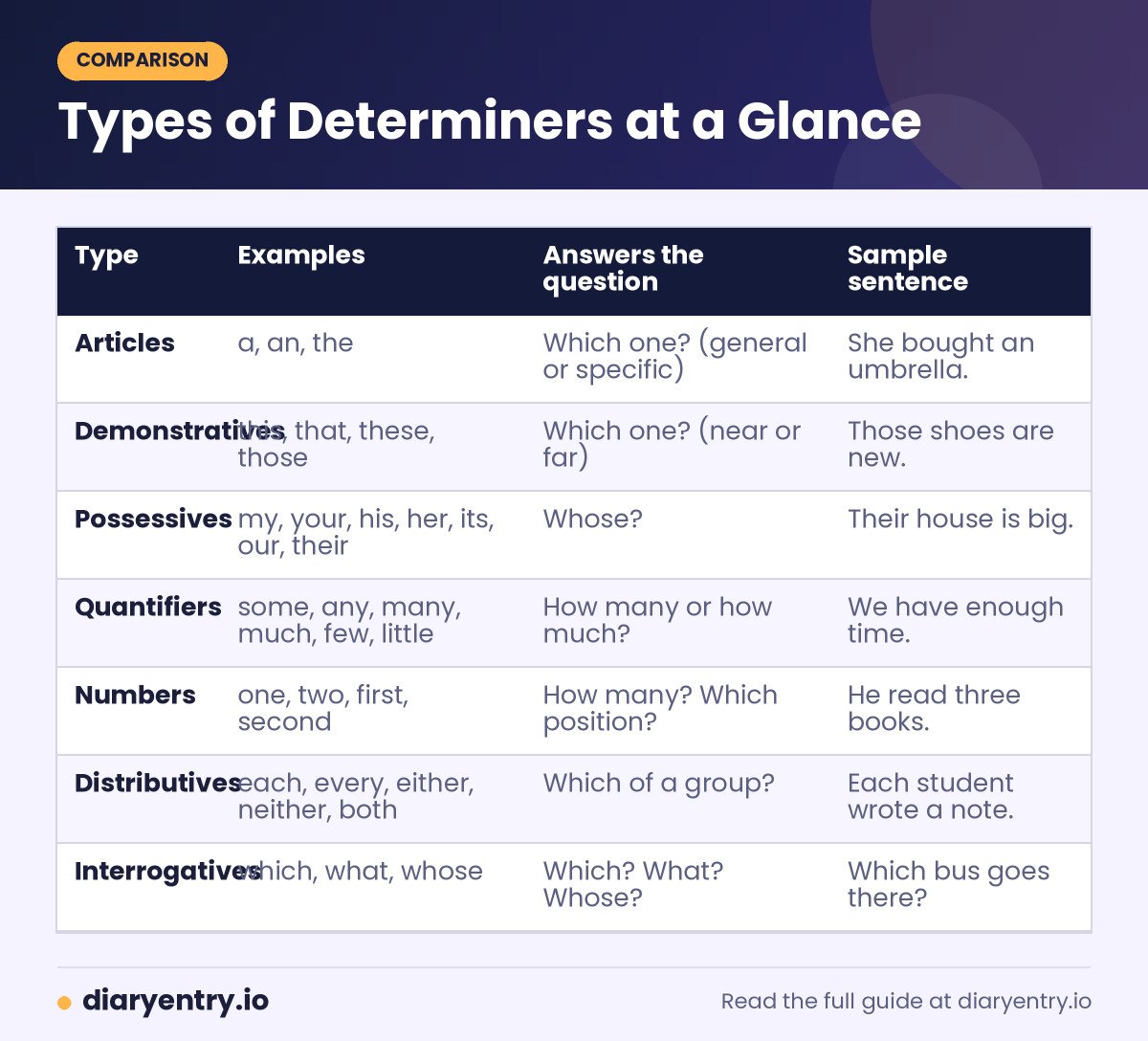
Types of Determiners at a Glance
The table below puts the main groups in one place for quick revision.
| Type | Examples | Answers the question | Sample sentence |
|---|---|---|---|
| Articles | a, an, the | Which one? (general or specific) | She bought an umbrella. |
| Demonstratives | this, that, these, those | Which one? (near or far) | Those shoes are new. |
| Possessives | my, your, his, her, its, our, their | Whose? | Their house is big. |
| Quantifiers | some, any, many, much, few, little | How many or how much? | We have enough time. |
| Numbers | one, two, first, second | How many? Which position? | He read three books. |
| Distributives | each, every, either, neither, both | Which of a group? | Each student wrote a note. |
| Interrogatives | which, what, whose | Which? What? Whose? | Which bus goes there? |
Determiners vs Adjectives
This is one of the most common points of confusion, and one of the most frequently asked questions in English classes. Both come before nouns, so they look similar, but they do different jobs.
An adjective describes a quality of the noun: a tall tree, a quiet room. A determiner specifies or limits the noun: that tree, my room. The two can appear together, and when they do, the determiner comes first: “my quiet room”.
| Feature | Determiner | Adjective |
|---|---|---|
| Main job | Specifies or quantifies the noun | Describes a quality of the noun |
| Needed with singular countable nouns? | Usually yes | No |
| Can be stacked freely? | No, only a few at a time | Yes, several are possible |
| Position | Before adjectives | After determiners, before the noun |
| Examples | the, my, some, three | tall, red, quiet, happy |
A quick test: try putting “very” before the word. You can say “very tall”, but you cannot say “very my” or “very the”. Words that fail this test are usually determiners.
Determiners with Countable and Uncountable Nouns
The noun decides which determiners are available. Countable nouns can be counted (one pen, two pens), while uncountable nouns cannot (water, advice, information). Choosing a mismatched determiner is a very common error.
| Determiner | Singular countable | Plural countable | Uncountable |
|---|---|---|---|
| a, an | Yes (a book) | No | No |
| the | Yes | Yes | Yes |
| this, that | Yes | No | Yes (this water) |
| these, those | No | Yes | No |
| many, few, several | No | Yes | No |
| much, little | No | No | Yes |
| some, any, no, enough | No | Yes | Yes |
| each, every | Yes | No | No |
For example, we say “much advice” but “many suggestions”, and “a little time” but “a few minutes”. Notice that “advice” is uncountable, so “an advice” and “advices” are both wrong.
Determiner Order: Which Comes First?
Sometimes more than one determiner appears in a noun phrase. Grammarians group them by position: predeterminers come first, central determiners next and postdeterminers last.
- Predeterminers: all, both, half, double, such (all the children)
- Central determiners: articles, demonstratives, possessives (the, this, my)
- Postdeterminers: numbers and some quantifiers (two, many, few, several)
Putting them together: “all my brothers” (predeterminer plus central) and “my three brothers” (central plus postdeterminer) are both fine. You cannot place two central determiners side by side. “The my book” and “this the house” are wrong because “the”, “this” and “my” compete for the same slot. If you want to combine ideas, rephrase: “this book of mine” or “one of my books”.
How to Identify a Determiner: A Step-by-Step Method
Use these steps when you meet a tricky word in a sentence.
- Find the noun in the phrase you are studying.
- Look at the word or words directly before it, ignoring adjectives.
- Ask whether the word tells you which one, whose, or how many.
- Check whether the word can stand alone. If it replaces the noun entirely (“I want that”), it is a pronoun in that sentence, not a determiner.
- Confirm with the “very” test. If you cannot say “very” plus the word, it is probably a determiner.

Try it on this sentence: “Some students submitted their final essays.” “Some” tells us how many students, “their” tells us whose essays, and “final” is an adjective describing the essays. So “some” and “their” are determiners, and “final” is not.
Common Mistakes with Determiners
Most errors fall into a few predictable patterns. Watch for these in your own writing.
- Missing determiners: “She is teacher” should be “She is a teacher.”
- Wrong article before a sound: “a hour” should be “an hour” and “an university” should be “a university”.
- Mixing up much and many: “many water” should be “much water” and “much friends” should be “many friends”.
- Using every or each with a plural noun: “every students” should be “every student”.
- Double determiners: “the my friend” should be “my friend” or “a friend of mine”.
- Confusing few and a few: “I have few friends” means almost none, while “I have a few friends” means some.
- Misusing less and fewer: use “fewer” with countable nouns (fewer cars) and “less” with uncountable nouns (less traffic).
Practice: Choose the Correct Determiner
Complete each sentence with the best determiner, then check the answers underneath.
- We have ____ time left, so please hurry. (few / little)
- ____ of the two roads leads to the village. (Either / Every)
- She gave me ____ advice about my career. (some / many)
- ____ student in the class received a certificate. (All / Each)
- I met ____ interesting person at the conference. (a / an)
- Please pass me ____ books on the top shelf. (that / those)

Answers: 1. little, 2. Either, 3. some, 4. Each, 5. an, 6. those.
If any of these were hard, return to the countable and uncountable table above. Most mistakes come from not checking the noun first.
Determiners in Everyday Writing
Determiners are doing quiet but important work in every kind of text. In a formal letter, “this matter” or “the enclosed document” shows the reader exactly what you mean. In a story, “my grandmother’s old house” is more vivid than “a house”, because the possessive adds a personal link. In exam answers, accurate use of articles and quantifiers is often what separates a clean sentence from one with a small but visible error.
A helpful habit is to underline the determiners in a paragraph you have written, then ask whether each one is the most precise choice. For example, “some people think” is weaker than “many people think” or “a few people think”, because each tells the reader something different about how widespread the opinion is.
Frequently Asked Questions
What are determiners in simple words?
Determiners are words that come before a noun and tell you which one, whose, or how many. Examples include a, the, this, my, some and two.
How many types of determiners are there?
Most school grammar lists seven main types: articles, demonstratives, possessives, quantifiers, numbers, distributives and interrogatives. Some books add a few extra groups such as predeterminers and “other” determiners.
What is the difference between a determiner and an adjective?
A determiner specifies or quantifies a noun, while an adjective describes its quality. A singular countable noun usually needs a determiner, but it never needs an adjective.
Are articles determiners?
Yes. A, an and the are the most common determiners, and in many textbooks they are discussed in their own chapter before the wider topic of determiners is introduced.
Can a word be both a determiner and a pronoun?
Yes. When a word comes before a noun, it is a determiner: “That book is mine.” When it stands alone in place of a noun, it is a pronoun: “That is mine.” Words like this, some, many and each behave this way.
Can I use two determiners together?
Sometimes. You can combine a predeterminer with a central determiner, as in “all the students” or “both my parents”, but you cannot place two central determiners together. Phrases like “the my book” are incorrect.
Why do some nouns have no determiner?
Plural and uncountable nouns used in a general sense can appear without one: “Dogs are loyal” and “Water is essential”. Adding “the” makes the statement specific instead: “The dogs next door are loud.”
Conclusion
Determiners are small words with a big job. They tell your reader which noun you mean, whose it is and how much of it there is, and they quietly decide whether a sentence sounds natural. Once you know the seven main types of determiners, and check whether your noun is countable or uncountable, most errors disappear.
A good way to make this stick is to practice in your own writing. Even a few lines in a daily diary give you a safe place to notice how you use words like my, some and the. If you would like structure for that habit, the 4-Week Diary Entry Course is one place to start.