

Quick Answer
Degrees of comparison are the three forms an adjective or adverb takes to compare things: the positive degree (tall), the comparative degree (taller) and the superlative degree (tallest). The positive describes one thing, the comparative compares two, and the superlative picks out the highest or lowest among three or more.
Key Takeaways
- There are three degrees of comparison: positive (tall), comparative (taller) and superlative (tallest).
- Short adjectives usually add -er and -est, while longer adjectives use “more” and “most”.
- Comparatives are followed by “than”, and superlatives are normally preceded by “the”.
- Irregular forms such as good, better, best and bad, worse, worst must be memorised.
- You can change a sentence from one degree to another without changing its meaning, a skill often tested in exams.
What Are Degrees of Comparison?
When you describe a person, place or thing, you often need to say how it compares with another. “Ravi is tall” describes Ravi alone. “Ravi is taller than Sam” compares two people. “Ravi is the tallest boy in the class” compares him with everyone in a group. These three levels are called the degrees of comparison.
Only adjectives and adverbs have degrees of comparison, because they are the words that describe quality, quantity and manner. If you want to see where they sit among the other word classes, read our guide to parts of speech. Nouns and verbs do not change in this way.
The Three Degrees at a Glance
| Degree | Purpose | Adjective example | Adverb example |
|---|---|---|---|
| Positive | Describes one person or thing, or shows equality | She is tall. He is as tall as her. | He runs fast. |
| Comparative | Compares two persons or things | She is taller than her sister. | He runs faster than me. |
| Superlative | Compares one with all others in a group of three or more | She is the tallest girl in the class. | He runs the fastest of all. |

The Positive Degree
The positive degree is the basic form of the adjective or adverb. It shows a quality without comparing anything: “The tea is hot.” “The students listened carefully.”
The positive degree is also used to show that two things are equal, with the pattern “as + adjective + as”: “This bag is as heavy as that one.” For a negative comparison, use “not so … as” or “not as … as”: “This bag is not as heavy as that one.” Notice that the adjective stays in its simple form in this pattern.
The Comparative Degree
The comparative degree compares two things, and it is followed by “than”. Examples: “My house is bigger than yours.” “She speaks more clearly than her brother.” If the comparison is clear from context, you can leave out the second part: “Please speak louder.”
You can strengthen or soften a comparative with words such as much, far, a lot, slightly and a bit: “This route is much shorter.” “She is slightly older than me.” Do not use “very” before a comparative. “Very taller” is wrong, while “much taller” is correct.
The Superlative Degree
The superlative degree shows the highest or lowest level of a quality in a group of three or more. It is normally used with “the” and often with an “in” or “of” phrase: “Everest is the highest mountain in the world.” “This is the most interesting book of the lot.”
Use “in” with places and groups (in the class, in India) and “of” with a plural set (of all, of the three). “The” is dropped only in a few cases, such as “Which is best?” or “She works hardest when she is alone”, where the adverb sentence has no noun after it.
Rules for Forming Comparatives and Superlatives
Rule 1: Short Adjectives Add -er and -est
One-syllable adjectives form the comparative by adding -er and the superlative by adding -est. Examples: tall, taller, tallest; small, smaller, smallest; cold, colder, coldest. If the adjective already ends in -e, add only -r and -st: nice, nicer, nicest; wise, wiser, wisest.
Rule 2: Double the Final Consonant in CVC Words
If a one-syllable adjective ends in a single vowel followed by a single consonant, double the consonant before adding the ending: big, bigger, biggest; hot, hotter, hottest; thin, thinner, thinnest. Do not double it when the word ends in two consonants or two vowels, as in cold, colder or cool, cooler.
Rule 3: Change -y to -i
When an adjective ends in a consonant plus -y, change the y to i before adding -er or -est: happy, happier, happiest; easy, easier, easiest; heavy, heavier, heaviest. This also works for most two-syllable adjectives ending in -y.
Rule 4: Use “More” and “Most” for Long Adjectives
Adjectives with three or more syllables take “more” and “most” instead of endings: beautiful, more beautiful, most beautiful; difficult, more difficult, most difficult; intelligent, more intelligent, most intelligent. Many two-syllable adjectives follow this pattern too, especially those ending in -ful, -less, -ous, -ing or -ed: careful, more careful, most careful.
A few two-syllable adjectives allow both forms, such as clever (cleverer or more clever), simple, narrow and quiet. If you are not sure, “more” and “most” are always understandable, although the -er form sounds more natural for common short words.
Rule 5: Irregular Forms
Some of the most common adjectives and adverbs do not follow any pattern. You need to learn them by heart.
| Positive | Comparative | Superlative |
|---|---|---|
| good / well | better | best |
| bad / badly / ill | worse | worst |
| far | farther / further | farthest / furthest |
| little | less | least |
| much / many | more | most |
| old | older / elder | oldest / eldest |
| late | later / latter | latest / last |
| near | nearer | nearest / next |
Some of these pairs carry different meanings. “Older” refers to age in general, while “elder” and “eldest” are used only for family members: “my elder sister”. “Later” refers to time and “latter” to the second of two things mentioned. “Farther” usually refers to physical distance, while “further” can also mean “additional”: “Do you need further help?”
Rule 6: Adverbs
One-syllable adverbs (fast, hard, late) take -er and -est: fast, faster, fastest. Most adverbs that end in -ly use “more” and “most”: slowly, more slowly, most slowly; carefully, more carefully, most carefully. The adverb “early” is an exception and becomes earlier and earliest.
Using “Than”, “As … As” and “The … The”
Comparisons use specific connecting words, and each has a fixed role. “Than” follows the comparative: “He is taller than I am.” “As … as” shows equality: “He is as tall as I am.” “Not so … as” shows inequality: “He is not so tall as I am.” The pattern “the + comparative, the + comparative” shows two things changing together: “The more you read, the better you write.”
Note that “than” is a conjunction when it introduces a clause (“taller than I am”) and is sometimes used like a preposition in informal speech (“taller than me”). Both are accepted in everyday English, although many exams prefer the clause form. To see how these small connecting words behave, you can review our guides to conjunctions and prepositions.
Changing the Degree of Comparison Without Changing the Meaning
Exams often ask you to rewrite a sentence in another degree while keeping the same meaning. The patterns below show how.
| Positive | Comparative | Superlative |
|---|---|---|
| Very few cities are as large as Delhi. | Delhi is larger than most other cities. | Delhi is one of the largest cities. |
| No other boy in the class is as clever as Arun. | Arun is cleverer than any other boy in the class. | Arun is the cleverest boy in the class. |
| Few mountains are as high as Everest. | Everest is higher than most other mountains. | Everest is the highest mountain. |
| Iron is not so costly as gold. | Gold is costlier than iron. | Gold is the costliest of all metals. |
Notice two things. When you change a comparative into a superlative, you often add the “of all” or “in the class” phrase. When you change a positive sentence that has “no other”, you reverse the order of the two things being compared in the comparative form.
How to Form the Degrees of Comparison: Step by Step
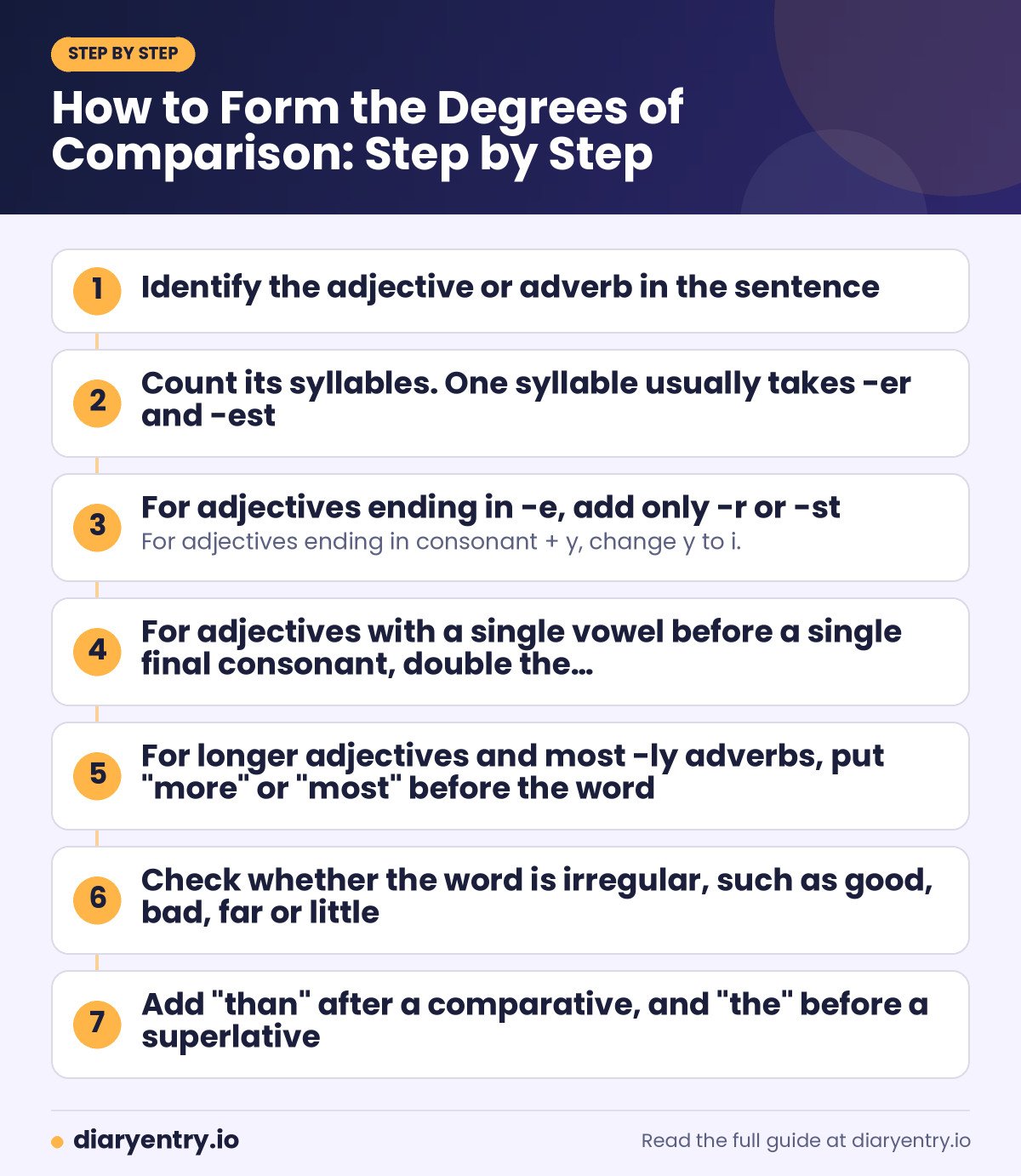
- Identify the adjective or adverb in the sentence.
- Count its syllables. One syllable usually takes -er and -est.
- For adjectives ending in -e, add only -r or -st. For adjectives ending in consonant + y, change y to i.
- For adjectives with a single vowel before a single final consonant, double the consonant.
- For longer adjectives and most -ly adverbs, put “more” or “most” before the word.
- Check whether the word is irregular, such as good, bad, far or little.
- Add “than” after a comparative, and “the” before a superlative.
Common Mistakes With Degrees of Comparison
Using a double comparative. “More better” and “most tallest” are wrong. Use only one form: “better” and “tallest”.
Forgetting “than”. “She is taller from me” is wrong. Write “She is taller than me” or “taller than I am”.
Comparing the wrong things. “The weather in Shimla is colder than Delhi” compares weather with a city. Write “The weather in Shimla is colder than that in Delhi.”
Leaving out “other” or “else”. “Everest is higher than any mountain” suggests that Everest is not a mountain. Write “Everest is higher than any other mountain”.
Using the superlative for two things. “Ravi is the tallest of the two brothers” is wrong in careful writing. Use the comparative: “Ravi is the taller of the two brothers”.
Adding degrees to absolute adjectives. Words such as perfect, unique, dead, empty and round are already at their limit, so “more unique” is considered incorrect in formal writing. Say “almost unique” or “very unusual” instead.
Degrees of Comparison: Solved Examples
| Sentence | Correct form | Reason |
|---|---|---|
| Gold is ___ than silver. (valuable) | more valuable | Long adjective takes “more” |
| This is the ___ day of my life. (happy) | happiest | Change y to i, add -est |
| She sings ___ than her sister. (sweetly) | more sweetly | -ly adverb takes “more” |
| He is the ___ player in the team. (good) | best | Irregular superlative |
| The test was ___ than I expected. (bad) | worse | Irregular comparative |
| My bag is ___ than yours. (big) | bigger | Double the final consonant |
Practice Questions
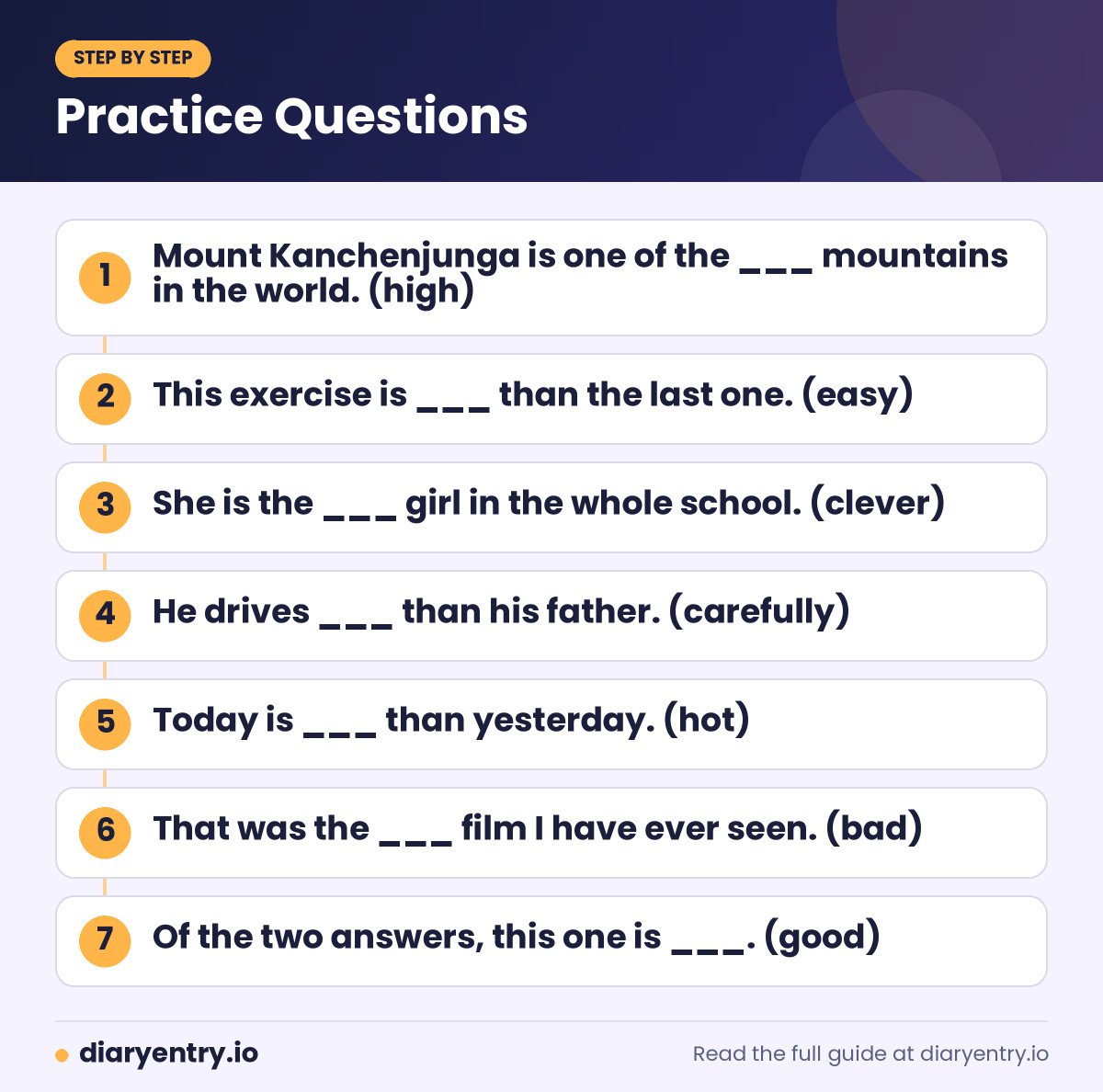
Fill in the blank with the correct degree of the word in brackets.
- Mount Kanchenjunga is one of the ___ mountains in the world. (high)
- This exercise is ___ than the last one. (easy)
- She is the ___ girl in the whole school. (clever)
- He drives ___ than his father. (carefully)
- Today is ___ than yesterday. (hot)
- That was the ___ film I have ever seen. (bad)
- Of the two answers, this one is ___. (good)
- The ___ you practise, the ___ you play. (much, well)
Answers: 1. highest; 2. easier; 3. cleverest (or most clever); 4. more carefully; 5. hotter; 6. worst; 7. better; 8. more, better.
Degrees of Comparison in Real Writing
Comparisons appear in almost every kind of writing, from product reviews to school essays. In descriptive and narrative pieces, they help the reader see how one thing differs from another. In a diary, they help you reflect: “Today was harder than yesterday, but I felt more confident by evening.” That small comparison already says something about growth.
If you want a steady place to practise, the 4-Week Diary Entry Course helps you build a daily writing habit. Using comparisons about your own days is a simple, useful exercise within it.
Tips to Master Degrees of Comparison
- Count the syllables. It is the quickest way to decide between -er/-est and more/most.
- Learn the irregular list. Good, bad, far, little, much and old appear in almost every exam.
- Say the sentence aloud. If “more happy” sounds odd, the correct form is probably “happier”.
- Check what is being compared. Make sure both sides of “than” are the same kind of thing.
- Practise by writing about your day. Use at least two comparisons in each short entry.
Frequently Asked Questions About Degrees of Comparison
What are the three degrees of comparison?
They are the positive degree (tall), the comparative degree (taller) and the superlative degree (tallest). Each one shows a different level of comparison between persons or things.
How do you form the comparative degree?
Add -er to short adjectives (taller), or put “more” before long adjectives (more beautiful). Follow the comparative with “than” when you name the second item.
What is the superlative degree used for?
The superlative shows the highest or lowest level of a quality among three or more things, as in “the tallest boy in the class”. It is usually used with “the”.
What are irregular degrees of comparison?
They are forms that do not follow the -er/-est or more/most rule, such as good, better, best and bad, worse, worst. They must be memorised.
Do adverbs have degrees of comparison?
Yes. One-syllable adverbs add -er and -est (fast, faster, fastest), and most -ly adverbs use more and most (more slowly, most slowly).
Is “more better” correct?
No. “Better” is already a comparative, so adding “more” makes a double comparative. Say “better” or “much better”.
When should I use “farther” and “further”?
Use “farther” for physical distance (“The shop is farther away”) and “further” for extra or additional meaning (“Please read further”). In practice, many writers use “further” for both.
Conclusion
Degrees of comparison let you describe the world with precision. Learn the positive, comparative and superlative forms, remember the syllable rule and the spelling changes, memorise the short list of irregular words, and always check that you are comparing like with like. With regular practice, whether in exercises or in a daily diary, these forms will soon come naturally.