

Quick Answer
Parts of speech are the categories that group English words by the job they do in a sentence. There are eight: noun, pronoun, verb, adjective, adverb, preposition, conjunction, and interjection. Many grammar books also list the article or determiner as a ninth. A word can change its part of speech depending on how it is used.
Key Takeaways
- The eight parts of speech are noun, pronoun, verb, adjective, adverb, preposition, conjunction, and interjection.
- A word’s part of speech depends on its job in the sentence, not on the word alone.
- Nouns and verbs form the core of most sentences, while adjectives and adverbs add detail.
- Prepositions and conjunctions connect words and ideas, and interjections express sudden feeling.
- Knowing the parts of speech makes it easier to fix errors, vary your sentences, and write more clearly.
What Are Parts of Speech?
Parts of speech are the building blocks of grammar. Every word in a sentence belongs to a class, and that class tells us how the word behaves, what it can be combined with, and what it adds to the meaning. Learning the classes gives you a map for reading, writing, and editing.
Take the sentence “The tired children quickly ate their dinner and went to bed.” Here, “children” and “dinner” are nouns, “ate” and “went” are verbs, “tired” is an adjective, “quickly” is an adverb, “and” is a conjunction, “to” is a preposition, and “their” is a possessive determiner. Each word does its own job, and together they make a clear sentence.
The 8 Parts of Speech at a Glance
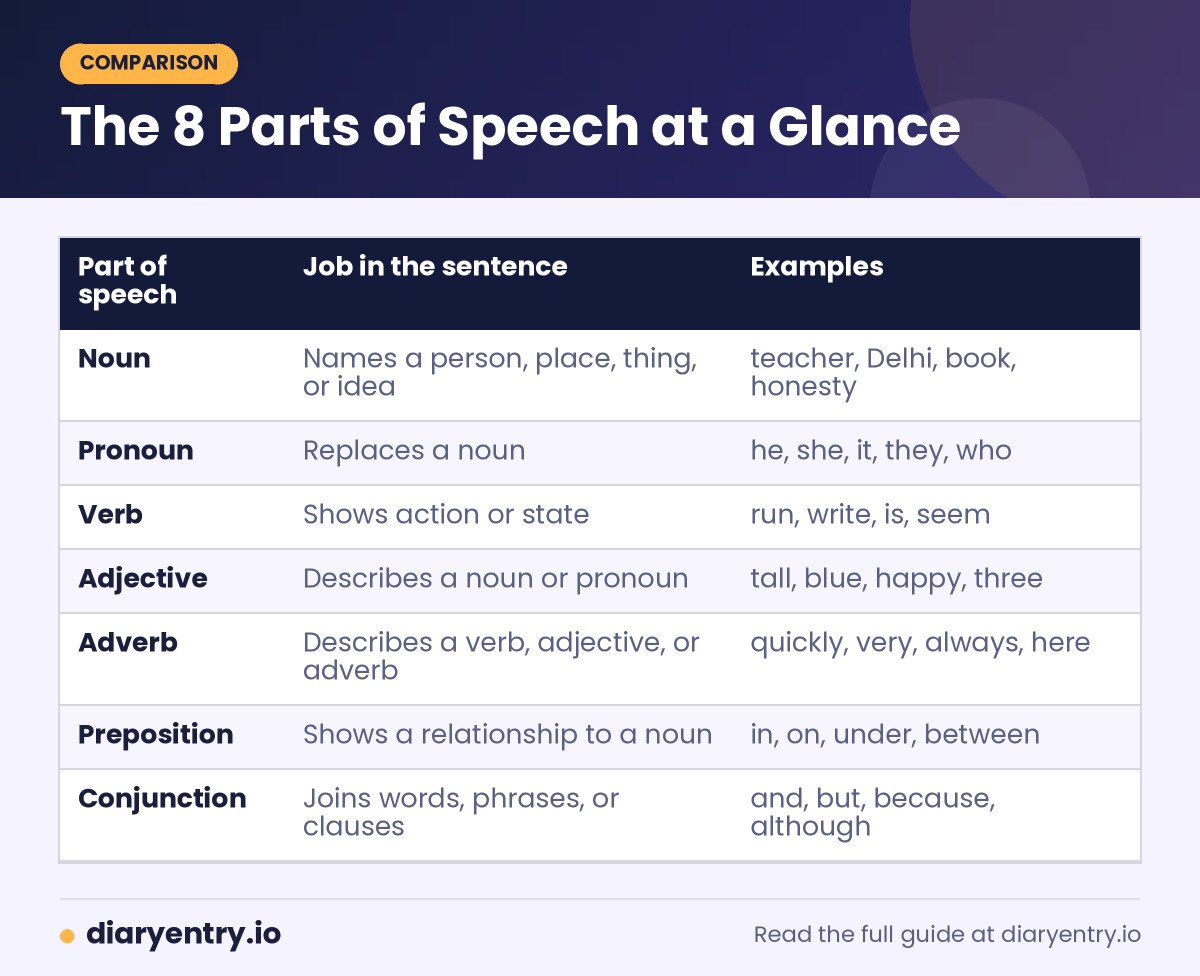
The table below gives a one-line definition and a few examples for each part of speech. The sections that follow explain each one in more detail.
| Part of speech | Job in the sentence | Examples |
|---|---|---|
| Noun | Names a person, place, thing, or idea | teacher, Delhi, book, honesty |
| Pronoun | Replaces a noun | he, she, it, they, who |
| Verb | Shows action or state | run, write, is, seem |
| Adjective | Describes a noun or pronoun | tall, blue, happy, three |
| Adverb | Describes a verb, adjective, or adverb | quickly, very, always, here |
| Preposition | Shows a relationship to a noun | in, on, under, between |
| Conjunction | Joins words, phrases, or clauses | and, but, because, although |
| Interjection | Expresses sudden emotion | wow, oh, alas, hurray |
Nouns
A noun names a person, place, thing, animal, or idea. Nouns can be the subject of a sentence, the object of a verb, or the object of a preposition. Examples: “Riya”, “market”, “table”, “courage”.
Types of nouns
- Common nouns name general things: city, girl, mountain.
- Proper nouns name specific things and begin with a capital letter: Mumbai, Gandhi, Himalayas.
- Collective nouns name groups: team, flock, committee.
- Abstract nouns name ideas and feelings that cannot be touched: freedom, anger, kindness.
- Material nouns name substances: gold, wood, water.
Nouns can also be singular or plural and countable or uncountable. “Book” is countable, so we say “two books”, while “water” is uncountable, so we say “some water”. For a full breakdown, see our guide to types of nouns.
Pronouns
A pronoun takes the place of a noun so that we do not have to repeat it. Instead of “Riya said that Riya was tired”, we say “Riya said that she was tired.” The noun that a pronoun replaces is called its antecedent. For a closer look at each kind, see our guide to the types of pronouns.
Common kinds of pronouns
- Personal: I, you, he, she, it, we, they (and their object forms me, him, her, us, them).
- Possessive: mine, yours, his, hers, ours, theirs.
- Reflexive: myself, yourself, himself, themselves.
- Demonstrative: this, that, these, those.
- Interrogative: who, whom, whose, which, what.
- Relative: who, which, that, whose.
- Indefinite: someone, anyone, everybody, nothing.
A common mistake is to use the subject form where the object form is needed, as in “between you and I”. The correct form is “between you and me”.
Verbs
A verb shows an action, an event, or a state of being. Every complete sentence needs at least one verb. Examples: “The baby laughs”, “I am ready”, and “She has been writing for an hour.”
Main kinds of verbs
- Action verbs: run, write, think, build.
- Linking verbs: be, seem, become, feel. These connect the subject to a description, as in “The soup tastes good.”
- Auxiliary or helping verbs: be, have, do, will, can, may. They work with a main verb to form tenses and questions, and they also build question tags such as “isn’t it?”
- Modal verbs: can, could, may, might, must, should, would. They show ability, possibility, or obligation (see our guide to modals in English grammar).
Verbs also change form to show time, and this is where the tenses come in. Our tenses chart sets out all twelve tenses with formulas and examples.
Adjectives
An adjective describes or limits a noun or pronoun. It answers questions such as which one, what kind, and how many. Examples: “a red kite”, “an honest answer”, “three apples”, and “this book”.
Adjectives can come before a noun (“a bright idea”) or after a linking verb (“the idea is bright”). They can also show degrees of comparison: tall, taller, tallest, or interesting, more interesting, most interesting.
Strong writing uses adjectives with care. One precise adjective, such as “crumbling”, usually works better than a string of vague ones. You can practise this in our guide to descriptive writing.
Adverbs
An adverb describes a verb, an adjective, or another adverb. It tells us how, when, where, how often, or to what degree. Many adverbs end in “ly”, but not all of them do, and some words that end in “ly” are adjectives (“friendly”, “lovely”).
- Manner: She spoke softly.
- Time: We will leave soon.
- Place: Please sit here.
- Frequency: He always arrives early.
- Degree: The soup is very hot.
Compare “He is a fast runner” (adjective) with “He runs fast” (adverb). The same word can be used in both ways, which is why the job in the sentence matters more than the word. For every kind of adverb with examples, see our guide to the types of adverbs.
Prepositions
A preposition shows how a noun or pronoun is related to another word, usually in terms of time, place, or direction. Examples: “on the table”, “after lunch”, “across the river”. A preposition is always followed by an object.
Prepositions are small, but they are used constantly, and learners often struggle with them. For a full explanation of the types and the rules for in, on, and at, see our guide to prepositions.
Conjunctions
A conjunction joins words, phrases, or clauses. There are three main kinds.
- Coordinating conjunctions join equal parts: for, and, nor, but, or, yet, so. Example: “I wanted to go, but it rained.”
- Subordinating conjunctions introduce a dependent clause: because, although, if, when, while, unless. Example: “We stayed in because it rained.”
- Correlative conjunctions work in pairs: either…or, neither…nor, both…and. Example: “She is both clever and kind.”
Conjunctions are what let you build longer, smoother sentences instead of a string of short ones. To see how clauses combine into whole sentences, read our guide to the types of sentences.
Interjections
An interjection expresses a sudden feeling or reaction, such as surprise, joy, pain, or disgust. It usually stands apart from the rest of the sentence and is followed by an exclamation mark or a comma. Examples: “Wow! That was fast.” “Oh, I forgot.” “Alas, the shop is closed.”
Interjections are common in speech and in dialogue, and they should be used sparingly in formal writing.
Articles and Determiners: The Ninth Part of Speech?
The words “a”, “an”, and “the” are called articles. Our guide to articles a, an, the with rules and examples covers when to use each one. In the traditional eight-part list, they are treated as adjectives, but modern grammar often groups them with determiners, which also include words like “this”, “some”, “my”, and “every”. Determiners come before a noun and tell us which one or how many. Whichever system your teacher follows, it helps to know both names.
How One Word Can Be Different Parts of Speech
English words are flexible. The same word can belong to different classes depending on its job. Look at “light” in these sentences.
| Sentence | Part of speech of “light” |
|---|---|
| Please turn on the light. | Noun |
| She will light the lamp. | Verb |
| It is a light bag. | Adjective |
| He packed light for the trip. | Adverb |
This is why you cannot memorise parts of speech from a word list alone. Always look at what the word is doing in the sentence.
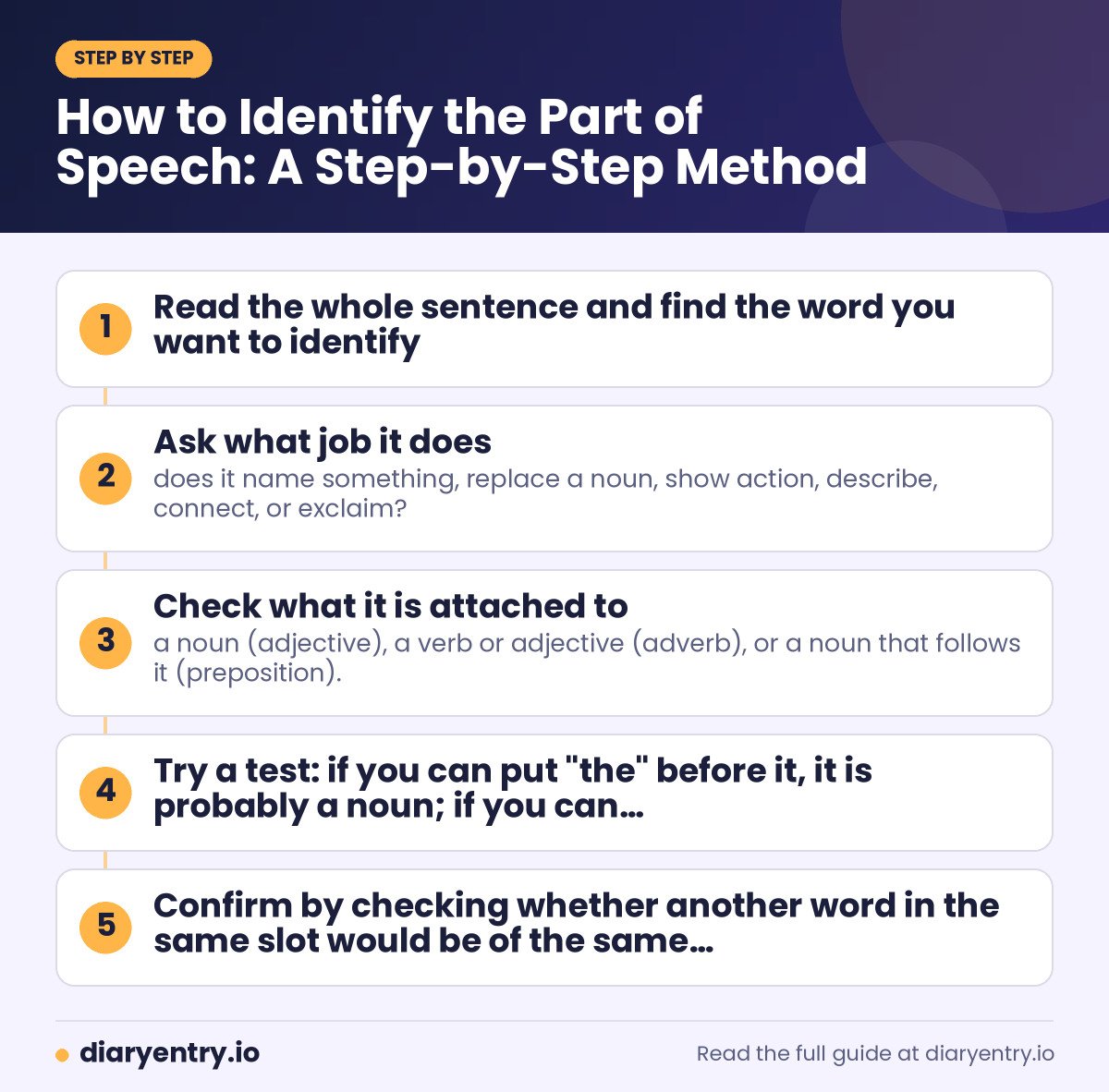
How to Identify the Part of Speech: A Step-by-Step Method
Use this method when you are not sure what a word is.
- Read the whole sentence and find the word you want to identify.
- Ask what job it does: does it name something, replace a noun, show action, describe, connect, or exclaim?
- Check what it is attached to: a noun (adjective), a verb or adjective (adverb), or a noun that follows it (preposition).
- Try a test: if you can put “the” before it, it is probably a noun; if you can change its tense, it is a verb.
- Confirm by checking whether another word in the same slot would be of the same type.
Parts of Speech in Writing
Knowing the parts of speech helps you improve your writing in practical ways. You can spot sentences that are all nouns and verbs and add well-chosen adjectives and adverbs, or you can notice a paragraph that has too many “and” and “but” and vary the connectors. In a well-built paragraph, every part of speech pulls its weight. Our paragraph writing format guide shows how this works in a complete paragraph.
Grammar also supports storytelling. Strong verbs give a story energy, concrete nouns make scenes vivid, and well-placed adverbs control the pace. Our narrative writing guide builds on this idea. And if you would like to put your grammar into daily practice, a short diary entry each day is a good start. The 4-Week Diary Entry Course offers a simple structure for it.
Common Mistakes With Parts of Speech
- Confusing adjectives and adverbs: say “She sings well”, not “She sings good”, and “He drives carefully”, not “He drives careful”.
- Using the wrong pronoun case: “She and I went”, not “Her and me went”.
- Mixing up “its” and “it’s”: “its” is possessive, and “it’s” means “it is” or “it has”.
- Treating “like” as a conjunction in formal writing: write “as if” or “as” instead of “like” when a clause follows.
- Overusing adverbs: a stronger verb often replaces a verb and an adverb, such as “whispered” instead of “said quietly”.
Practice: Identify the Parts of Speech
Name the part of speech of the key words in each sentence, then check the answers.
- The old man walked slowly to the market.
- Wow, she is incredibly talented!
- He stayed home because he was ill.
- They gave her a beautiful gift.
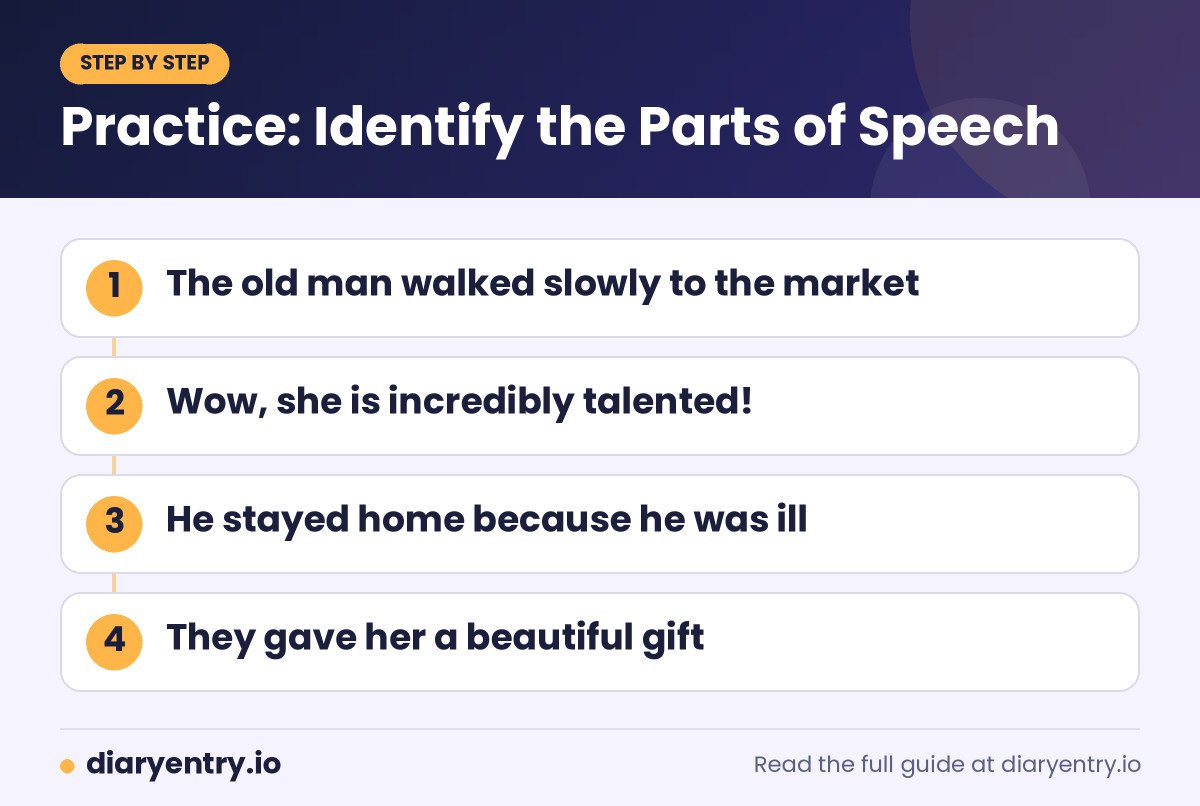
Answers: 1. old (adjective), slowly (adverb), to (preposition). 2. Wow (interjection), incredibly (adverb). 3. because (conjunction), he (pronoun). 4. her (pronoun), beautiful (adjective), gift (noun).
Frequently Asked Questions About Parts of Speech
How many parts of speech are there?
There are eight traditional parts of speech: noun, pronoun, verb, adjective, adverb, preposition, conjunction, and interjection. Some grammar books add articles or determiners as a ninth.
What are the parts of speech with examples?
Noun: teacher. Pronoun: she. Verb: write. Adjective: bright. Adverb: quickly. Preposition: under. Conjunction: because. Interjection: wow.
Can a word be more than one part of speech?
Yes. Many English words change their part of speech depending on how they are used, such as “light”, “run”, and “water”. The job in the sentence decides the class.
What is the difference between an adjective and an adverb?
An adjective describes a noun or pronoun (“a quick answer”), while an adverb describes a verb, an adjective, or another adverb (“she answered quickly”).
Are articles a part of speech?
Articles (“a”, “an”, “the”) are often counted as adjectives in the traditional list, and modern grammar places them among the determiners.
Which parts of speech are most important?
Nouns and verbs are the core, because most sentences need a subject and a verb. The others add detail, link ideas, or show feeling.
How can I learn the parts of speech easily?
Start with the eight classes and a few examples of each. Then practise labelling the words in short sentences, and read and write regularly so that the patterns become familiar.
Conclusion
The parts of speech give you a clear way to understand how sentences work. Once you can tell a noun from a verb, an adjective from an adverb, and a conjunction from a preposition, grammar stops feeling like a list of rules and starts feeling like a toolkit. Practise by labelling a few sentences every day and by paying attention to the job each word does. With time, the parts of speech will become a natural part of the way you read and write.