

Journal prompts for self love are short written questions that help you notice your strengths, speak to yourself more kindly and build a calmer relationship with the person you spend every day with: you. This guide gives you more than 60 prompts, grouped by theme, plus a simple routine, worked examples and fixes for the most common stumbling blocks.
Quick answer: to use journal prompts for self love, pick one prompt, set a timer for five to ten minutes, write without editing, and finish with one kind sentence addressed to yourself. Repeat a few times a week and review your entries monthly.
What Are Journal Prompts for Self Love?
A prompt is a question or sentence starter that gives you a place to begin. A self-love prompt points that question inward and toward kindness: what do I appreciate about myself, how would I speak to a friend in my position, what do I need right now?
Self-love here does not mean vanity or ignoring your flaws. It means treating yourself with the same patience and respect you would offer someone you care about. Writing makes that practical, because you can see your own thoughts on the page and decide whether you would say them to anyone else.
Journaling is not a substitute for professional care. If painful feelings feel heavy or constant, talking to a qualified professional is a good step alongside any writing you do.
Why Writing Works Better Than Just Thinking
Thoughts about yourself tend to loop. A harsh sentence repeats in your head and begins to feel like a fact. Once it is written down, it is just a sentence, and you can question it.
Writing also slows you down. A prompt asks for a specific answer, which pulls you out of vague worry and into concrete detail. Over weeks, a notebook becomes a record of your own good qualities that you can reread on a bad day.
If you are new to the habit itself, our guide on how to start a journal covers materials, timing and the first few entries.
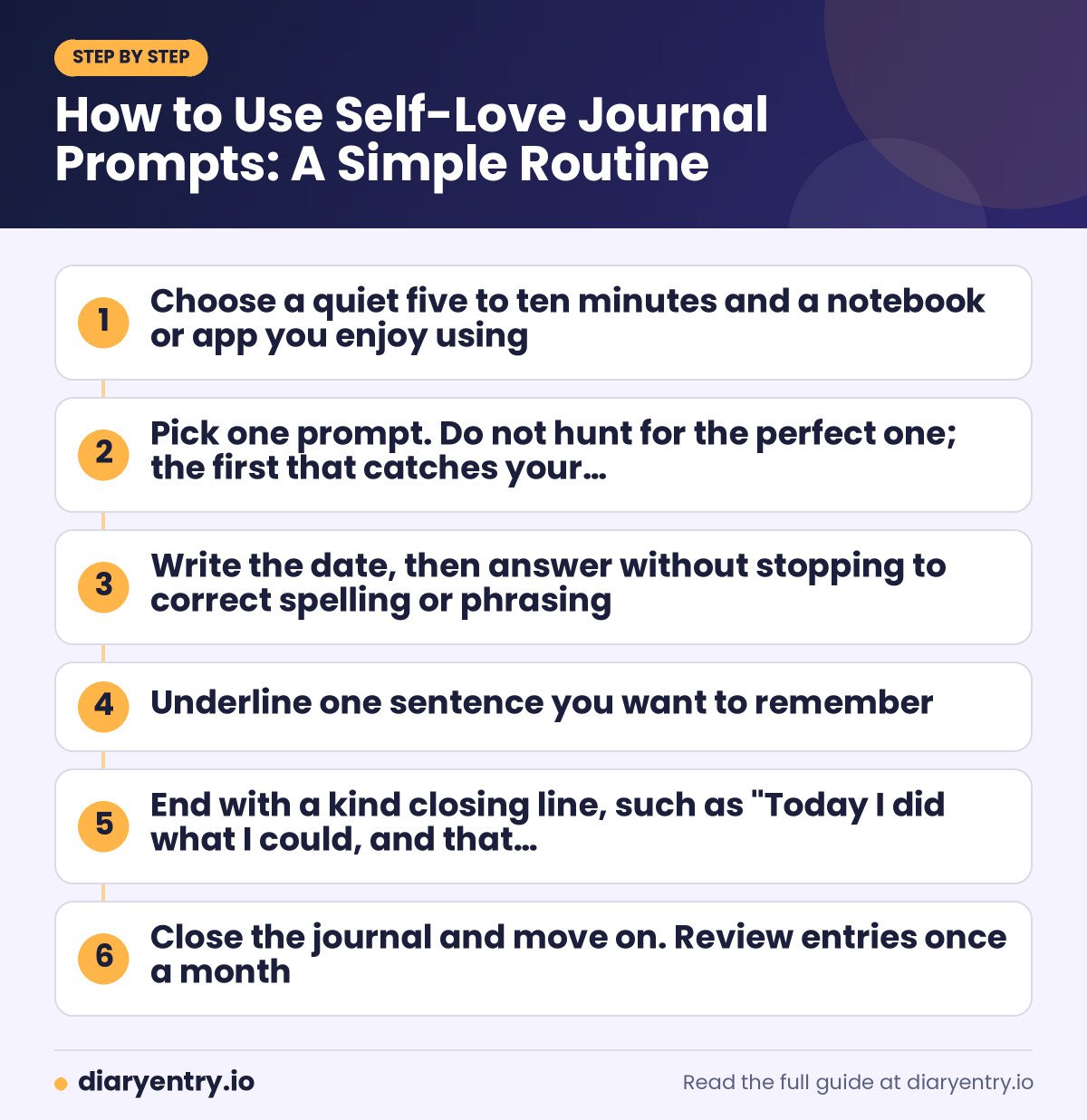
How to Use Self-Love Journal Prompts: A Simple Routine
You do not need a long session. A short, repeatable routine beats an occasional marathon.
- Choose a quiet five to ten minutes and a notebook or app you enjoy using.
- Pick one prompt. Do not hunt for the perfect one; the first that catches your eye is fine.
- Write the date, then answer without stopping to correct spelling or phrasing.
- Underline one sentence you want to remember.
- End with a kind closing line, such as “Today I did what I could, and that counts.”
- Close the journal and move on. Review entries once a month.
A tiny ritual helps. Make tea, light a candle or sit in the same chair each time so your brain links the place with the habit.
Journal Prompts for Self Love: Getting Started
These gentle prompts suit beginners and anyone who feels awkward writing about themselves.
- What is one thing about myself I am grateful for today?
- Which three words would a close friend use to describe me?
- What did I do this week that I am quietly proud of?
- When did I last feel truly comfortable in my own company?
- What do I need to hear right now, and can I say it to myself?
- Which small habit shows that I care about myself?
- What is something I do well that I rarely give myself credit for?
- If I treated myself like someone I love, what would change today?
If you find gratitude easy, the gratitude journal guide pairs well with these starter questions.
Prompts to Quiet Your Inner Critic
Most of us have a voice that points out every mistake. These prompts help you hear it clearly and respond.
- What does my inner critic say most often? Write it word for word.
- Would I say that sentence to a friend? If not, how would I rephrase it?
- Where did I learn to speak to myself this way?
- What is a fairer, more accurate version of that thought?
- Describe a mistake you made. What would you tell a younger person who made the same one?
- What am I expecting of myself that I would never expect of someone else?
- List three things I handled well recently, even if the outcome was imperfect.
Notice how the answers shift once you read your own words back. Often the critic sounds exaggerated on paper.
Prompts for Self-Acceptance and Self-Esteem
Self-esteem grows from evidence, not slogans. These prompts ask you to collect that evidence.
- Which of my qualities have helped me through hard times?
- What have I overcome that I once thought I could not?
- What values do I want to live by, and where do I already live by them?
- Which compliment have I received that I struggled to believe? Why?
- What parts of my personality do I wish I could accept more fully?
- What would it look like to be a good friend to myself this month?
- Which of my quirks do other people seem to enjoy?
Pay attention to the prompts that feel uncomfortable. They usually point at the areas where your attention will help most.
Prompts for Boundaries and Saying No
Respecting yourself includes protecting your time and energy. Use these when you feel stretched thin.
- Where in my life do I say yes when I mean no?
- What do I fear will happen if I set this boundary?
- What is one boundary that would make my week easier?
- Write a calm, kind sentence I could use to decline a request.
- Who drains my energy, and who restores it?
- How do I feel after I rest without guilt?
Prompts for Daily Self-Care
Self-love shows up in ordinary routines. These prompts connect care with action.
- How did I sleep, eat and move today? What does my body need next?
- What is one thing I can do in ten minutes to feel cared for?
- What does a good day look like for me, in detail?
- Which part of my day felt like it belonged to me?
- What can I let go of this evening?
- If tomorrow is busy, how will I look after myself in the middle of it?
Many readers like to pair these with a morning journal prompt routine so that care begins before the day gets loud.
Prompts for Body Image and Self-Compassion
Handle this theme gently, and stop if a prompt feels harmful rather than helpful. The aim is respect for your body, not criticism of it.
- What has my body carried me through this year?
- Which part of my body do I appreciate for what it does, not how it looks?
- What would I say to a loved one who spoke about their body the way I do about mine?
- How do I want to feel in my body, rather than how do I want it to look?
- What clothes or activities make me feel at home in myself?
If body image thoughts are tied to distress around eating or health, please speak with a professional rather than working through them alone in a journal.
Prompts for Letting Go of Comparison
Social media and daily life make comparison easy. These prompts bring the focus back to your own path.
- Whom do I compare myself to most often, and what do I think they have?
- What do I actually know about their life, and what am I guessing?
- What do I have that I once wished for?
- What would success look like if nobody were watching?
- Which of my choices am I proud of that nobody else saw?
Prompts for Forgiving Yourself
Holding on to old mistakes takes energy. These prompts help you set some of it down.
- What am I still blaming myself for?
- What did I know at the time, and what do I know now?
- What did I learn from it, and how have I changed?
- What would forgiveness look like in a small, practical way?
- Write a short letter to your past self. What do you want them to know?
Prompts for Dreams, Joy and the Future
Self-love also looks forward. Use these to remind yourself that your wants matter.
- What did I love doing as a child, and can I bring a little of it back?
- What would I try if I were certain it would be fine to be a beginner?
- Which three things bring me joy, even briefly?
- What do I want my life to feel like in a year?
- What is one small step toward something I want, and when will I take it?
A five year journal can also help you see how your answers change over time, since you write a few lines each day and compare across years.
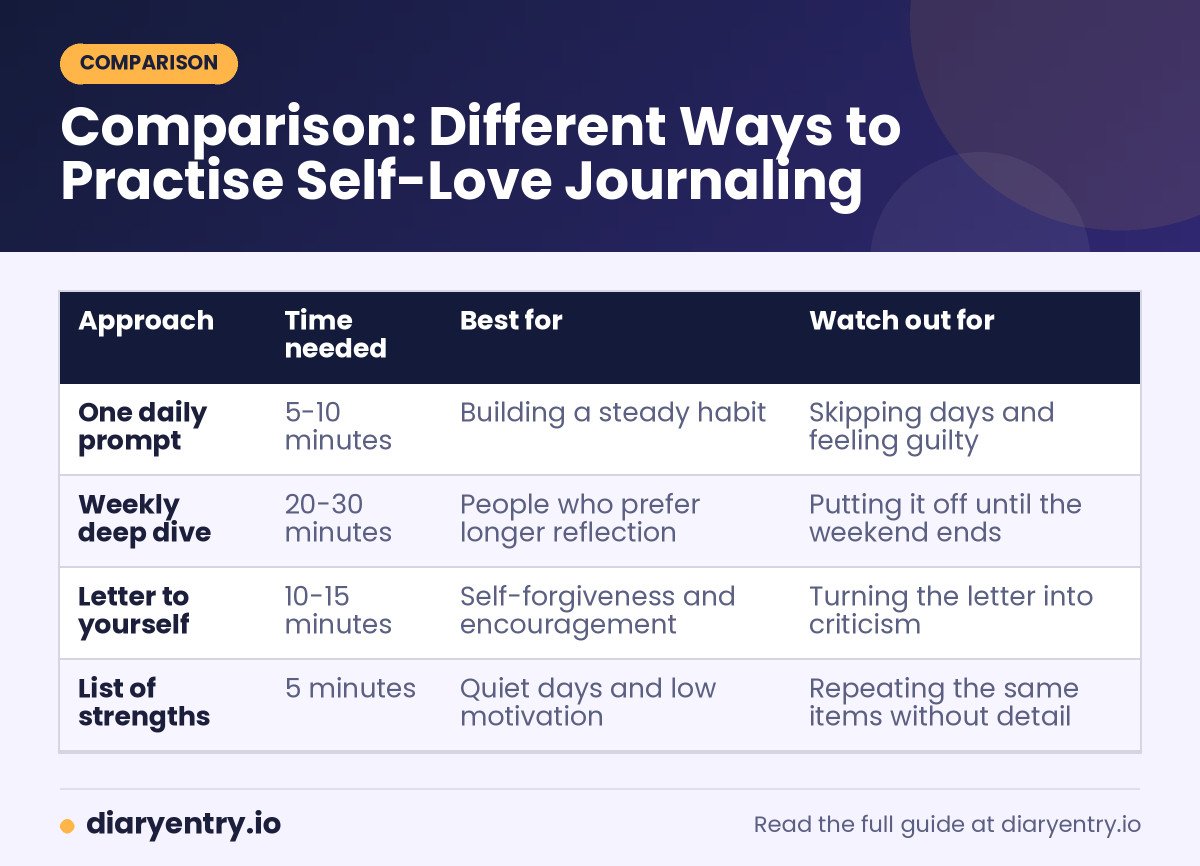
Comparison: Different Ways to Practise Self-Love Journaling
Different formats suit different people. This table compares four common approaches.
| Approach | Time needed | Best for | Watch out for |
|---|---|---|---|
| One daily prompt | 5-10 minutes | Building a steady habit | Skipping days and feeling guilty |
| Weekly deep dive | 20-30 minutes | People who prefer longer reflection | Putting it off until the weekend ends |
| Letter to yourself | 10-15 minutes | Self-forgiveness and encouragement | Turning the letter into criticism |
| List of strengths | 5 minutes | Quiet days and low motivation | Repeating the same items without detail |
There is no correct choice. Start with what feels easiest and change it if it begins to feel like homework.
Worked Example: One Prompt, Three Answers
Seeing a real response helps if you are unsure how personal to be. Take the prompt “What did I do this week that I am quietly proud of?”
A short answer: “I stayed calm in the meeting when someone interrupted me. I did not snap. I waited and then finished my point.”
A reflective answer: “I am proud that I asked for help on Tuesday. A year ago I would have stayed late and said nothing. Asking felt uncomfortable, but my colleague was glad to share the work.”
A kind closing line: “I am learning to look after myself at work, and that is worth noticing.”
None of these answers is dramatic. The goal is honest, specific detail. Notice how the third line speaks to the writer directly, which is the part that builds the self-love habit.
Common Mistakes and How to Fix Them
Most people hit the same few obstacles. Here is how to handle them.
- Writing only positive statements. Forced positivity feels fake. Include the real feeling first, then add a kinder angle.
- Using prompts as a test. There are no right answers. If you cannot answer, write “I do not know yet” and say why.
- Aiming for perfect handwriting or style. Nobody will grade the page. Messy is fine.
- Journaling only when things go wrong. Write on good days too, so you have positive entries to reread.
- Skipping the closing line. The kind sentence at the end is what ties the entry to the theme.
- Quitting after a missed week. Restart with the next prompt and no apology.
Tracking How You Feel Over Time
Self-love grows slowly, and it is hard to see progress day to day. A simple tracker helps. At the end of each entry, rate your mood from one to five and note one word for how you felt about yourself. After a month, scan the ratings and read a few entries side by side.
Our mood tracker page shows a simple layout you can copy into your notebook. Use it as a gentle record, not a score to beat.
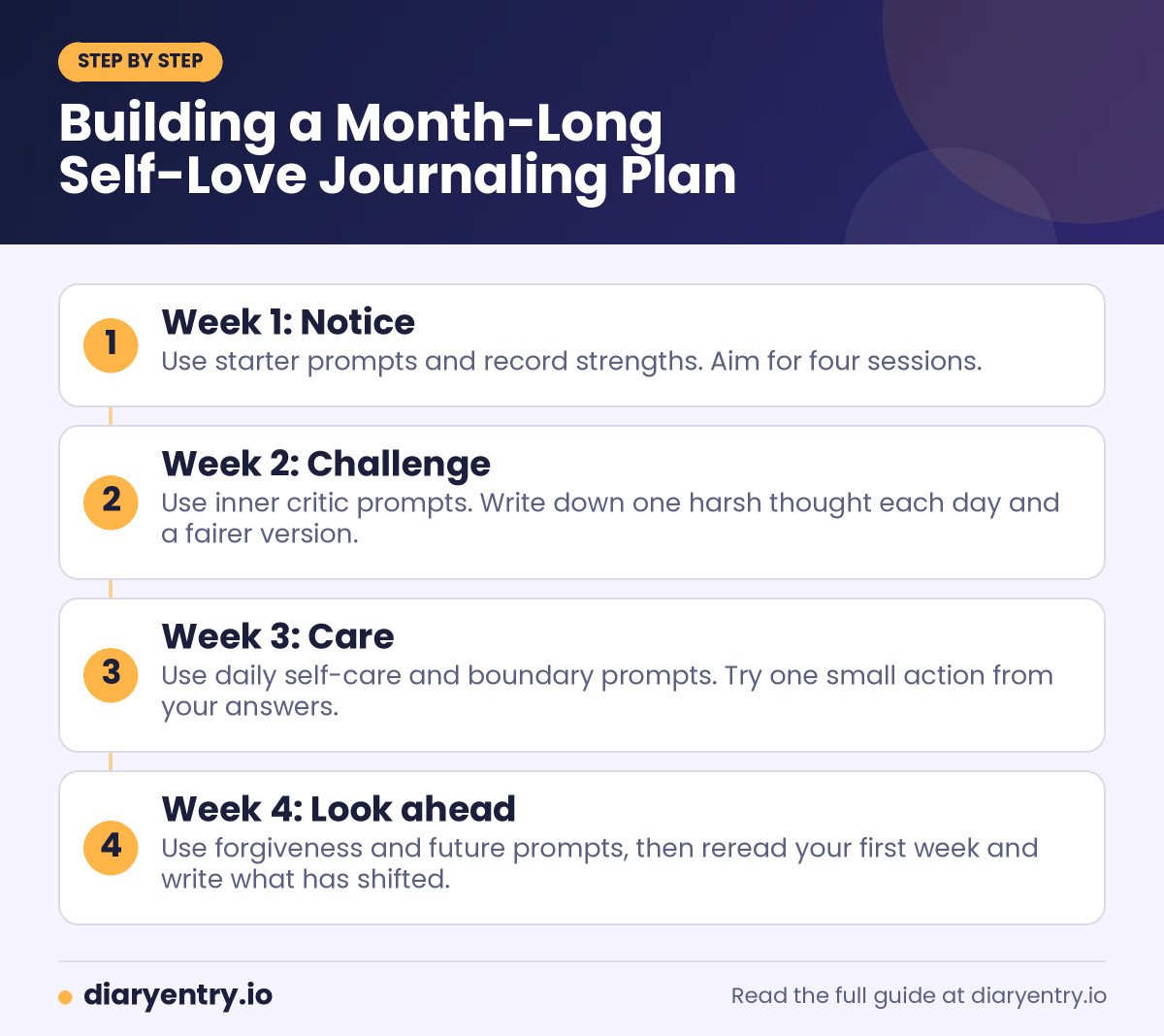
Building a Month-Long Self-Love Journaling Plan
A plan removes the daily decision of what to write. Try this four-week rhythm.
- Week 1: Notice. Use starter prompts and record strengths. Aim for four sessions.
- Week 2: Challenge. Use inner critic prompts. Write down one harsh thought each day and a fairer version.
- Week 3: Care. Use daily self-care and boundary prompts. Try one small action from your answers.
- Week 4: Look ahead. Use forgiveness and future prompts, then reread your first week and write what has shifted.
If you would like structure and feedback, the 4-week Diary Entry Course is built around daily writing and can help you keep the routine going. It is optional, and a plain notebook works just as well.
Frequently Asked Questions
What are good journal prompts for self love?
Good prompts are specific, kind and easy to answer, such as “What am I proud of this week?” or “What would I tell a friend in my situation?” Choose ones that feel slightly challenging but not painful.
How often should I use self-love journal prompts?
Three to five times a week works well for most people, and even once a week is useful. A short, regular practice usually helps more than long, rare sessions.
How long should a self-love journal entry be?
A few sentences are enough. Many people write for five to ten minutes. Stop when you have said what you meant to say.
What if I cannot think of anything positive to write?
Start with something neutral, such as one thing your body did today or one small thing that went fine. You can also write about what you wish you could feel and why it is hard. Honest writing still counts.
Are journal prompts for self love a replacement for therapy?
No. Journaling can support reflection and self-awareness, but it does not replace professional help. If you struggle with persistent low mood or distress, reach out to a qualified professional.
Should I write by hand or on a device?
Either. Handwriting slows you down, which many people find calming. A phone or laptop is easier to keep private and search later. Choose the one you will actually use.
Can I share my self-love journal with others?
You can, but most people keep it private so they can write honestly. If you want accountability, share a single entry or a goal rather than the whole journal.
Conclusion: Start With One Prompt Tonight
Journal prompts for self love work because they are small. One question, a few minutes and a kind closing line are enough to start changing how you talk to yourself. Pick one prompt from this list tonight, write for five minutes, and see how it feels.
Return to the themes that help most, drop the ones that do not, and keep your notebook somewhere you will see it. Over time, the pages become proof that you can treat yourself with care.