

Morning journal prompts are short questions you answer in writing at the start of your day to set your focus, check in with your mood and decide what matters most. Five minutes with a pen and one good prompt can turn a rushed morning into a calmer, more intentional one.
This guide gives you more than 90 morning journal prompts, grouped by purpose, plus a simple routine, sample entries, a comparison of morning styles, and answers to common questions. Use it as a menu: pick one or two prompts that fit your mood and ignore the rest.
What Are Morning Journal Prompts?
A morning journal prompt is a question or sentence starter that you answer in writing soon after you wake up. Examples include “What would make today a good day?” and “What is one thing I am looking forward to?” The prompt gives your thoughts a direction, so you do not have to stare at a blank page while your brain is still waking up.
Morning journaling is not the same as an evening diary. An evening entry looks back at what happened. A morning entry looks forward: it sets intentions, clears mental clutter and gets you ready for the hours ahead. Many people do both, but starting with the morning is often easier because the day has not yet filled up with obligations.
You do not need a special notebook. A plain notebook, a notes app or even the back of a planner page will do. What matters is that you can open it quickly and write without friction.
Benefits of Morning Journaling
People who write in the morning often describe the same handful of benefits. These are commonly reported experiences rather than guarantees, and the effect varies from person to person.
- A clearer head. Writing down worries and to-dos gets them out of your mind and onto paper.
- Better focus. Choosing your top priorities before opening email or social media helps you start with purpose.
- A calmer mood. A few quiet minutes before the day begins can feel like a gentle reset.
- Self-awareness. Noticing how you feel each morning helps you spot patterns over weeks.
- A positive start. Gratitude and intention prompts shift attention toward what is going well.
- A consistent habit. Attaching journaling to your morning routine makes it easier to keep.
For a broader look at why a regular writing practice pays off, see 10 Benefits of Keeping a Daily Journal.
How to Start a Morning Journaling Routine (Step by Step)
You can begin tomorrow with almost no setup. If you have never journaled before, our guide to your first journal entry shows exactly what to write. Follow these steps and adjust them to your schedule.
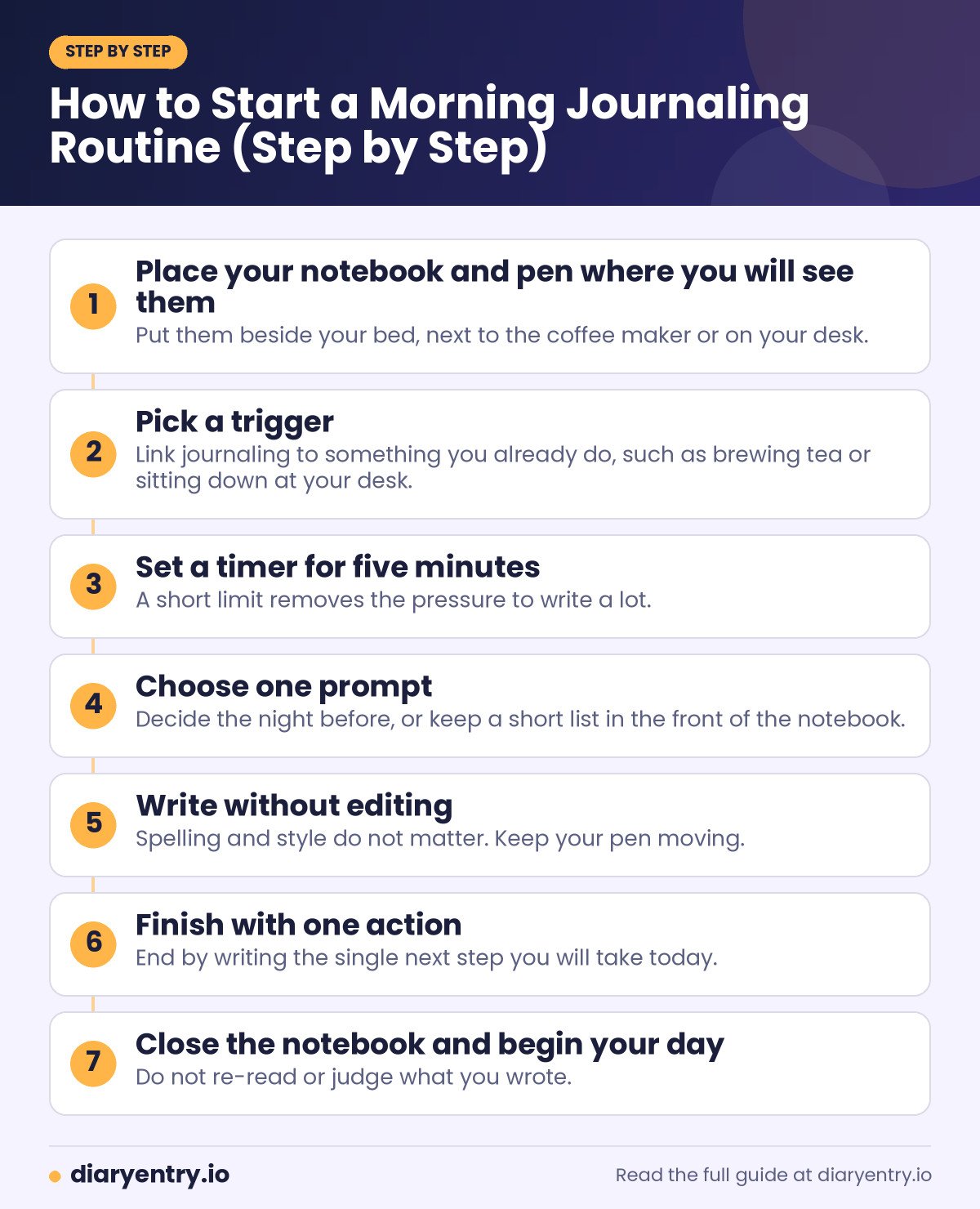
- Place your notebook and pen where you will see them. Put them beside your bed, next to the coffee maker or on your desk.
- Pick a trigger. Link journaling to something you already do, such as brewing tea or sitting down at your desk.
- Set a timer for five minutes. A short limit removes the pressure to write a lot.
- Choose one prompt. Decide the night before, or keep a short list in the front of the notebook.
- Write without editing. Spelling and style do not matter. Keep your pen moving.
- Finish with one action. End by writing the single next step you will take today.
- Close the notebook and begin your day. Do not re-read or judge what you wrote.
If you want help turning this into a habit that lasts, our guide on building a daily journaling habit in 4 weeks breaks the process into manageable weeks.
Quick Answer: What Are Good Morning Journal Prompts?
Good morning journal prompts are short, forward-looking questions such as “How do I want to feel today?”, “What are my top three priorities?”, “What am I grateful for this morning?” and “What is one small thing that would make today a success?” They take only a few minutes and set the tone for the day.
Morning Journal Prompts for Gratitude
Starting the day with appreciation shifts your attention toward what is already good. If you want to build this into a full practice, see how to start a gratitude journal.
- What are three things I am grateful for this morning?
- Who is someone I appreciate, and what could I tell them today?
- What small comfort did I enjoy since waking up?
- What is something about my home that I am thankful for?
- What is a challenge from this week that taught me something?
- Which part of my body, mind or health am I thankful for today?
- What is something I often take for granted?
- Which person made my life easier this week?
- What is a simple pleasure I can look forward to today?
- What opportunity do I have today that I did not have a year ago?
Morning Journal Prompts for Setting Intentions
Intentions are about how you want to show up, not only what you want to get done.
- How do I want to feel at the end of today?
- What is one word I want to guide my day?
- What kind of person do I want to be in my next conversation?
- What would make today a good day, even if everything else goes wrong?
- What do I need to let go of before I start?
- Where do I want to bring more patience today?
- How can I be kind to myself today?
- What is one thing I will say no to so I can say yes to what matters?
- What does my best self do first this morning?
- Which value do I want to act on today?
Morning Journal Prompts for Productivity and Focus
These prompts turn a vague to-do list into a short plan. They pair well with a productivity journal if you like to track work habits.
- What are my top three priorities today?
- What is the one task that would make everything else easier?
- What is likely to distract me, and how will I handle it?
- Which meeting or task needs the most preparation?
- What is the smallest first step on my biggest project?
- What can I delegate, delay or delete?
- When is my best focus time today, and what will I do in it?
- What do I need to finish before I can relax tonight?
- What would I regret not doing today?
- How will I know today was productive?
Morning Journal Prompts for Self-Care and Wellbeing
These prompts invite you to check in gently with your body and mood. If you want a kinder inner voice to go with them, our journal prompts for self love are a good companion. They are not medical advice, and if you often feel overwhelmed, it is wise to speak with a qualified professional.
- How did I sleep, and how do I feel physically right now?
- What does my body need today: movement, rest, water or food?
- What emotion is most present this morning?
- What would help me feel calmer today?
- What is one kind thing I can do for myself today?
- Where do I feel tension, and what could ease it?
- Who can I reach out to if I need support?
- What boundary do I need to remember today?
- What would a slow, gentle version of today look like?
- What am I looking forward to this evening?
Morning Journal Prompts for Goals and Growth
Use these when you want to connect daily actions to bigger ambitions. A dedicated goal-setting diary can help you track progress over time.
- What is one goal I am working on, and what step can I take today?
- What skill do I want to practise this week?
- What did I learn yesterday that I can apply today?
- What habit am I building, and how will I protect it today?
- What would my future self thank me for doing today?
- What is a fear that is holding me back, and how can I face it a little?
- Who could I learn from, and what could I ask them?
- What am I proud of from this month so far?
- What is one thing I want to improve by the end of the week?
- If I could change one thing about my routine, what would it be?
Creative and Free-Writing Morning Prompts
If analysis feels heavy, try a playful prompt. These work well for loosening up before creative work.
- Describe the first thing you noticed when you woke up.
- Write about a dream you remember, even a fragment.
- If today were a book chapter, what would its title be?
- Describe the weather using only colours and sounds.
- Write a letter to someone you have not spoken to in a while.
- Finish the sentence “Today I wonder…” five different ways.
- Imagine a perfect morning. What is in it?
- Write whatever comes to mind for three minutes without stopping.
Sample Morning Journal Entries
Seeing how prompts become real entries helps you avoid overthinking. These samples are short on purpose.
Sample 1: A priorities entry
Prompt: What are my top three priorities today?
“One: finish the draft of the budget summary before lunch. Two: reply to the three emails that have been sitting since Monday. Three: go for a walk at five, even if it is only ten minutes. Everything else is a bonus. The first step is to open the budget file right now.”
Sample 2: A gratitude entry
Prompt: What are three things I am grateful for this morning?
“The quiet before the house wakes up. The smell of coffee. A text from my sister last night that made me laugh. I did not notice how much I needed these small things until I wrote them down.”
Sample 3: An intention entry
Prompt: How do I want to feel at the end of today?
“I want to feel steady, not rushed. That means starting my work on time, taking a real lunch break and not saying yes to extra tasks I cannot manage. If I feel stressed, I will pause for one slow breath and look at my list again.”
Comparing Morning Journal Styles
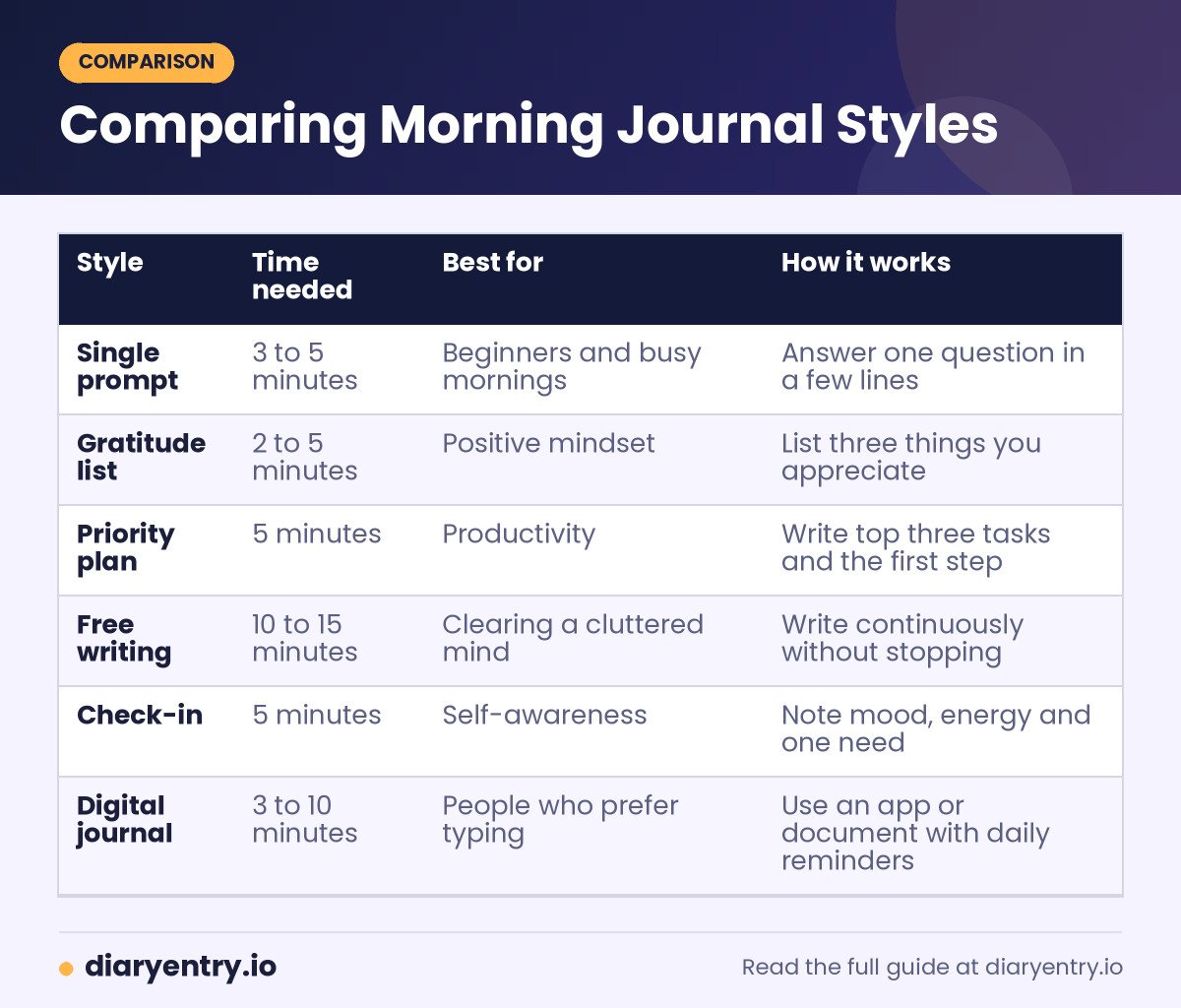
Not every method suits every person. Use this table to choose a format that matches your time and temperament.
| Style | Time needed | Best for | How it works |
|---|---|---|---|
| Single prompt | 3 to 5 minutes | Beginners and busy mornings | Answer one question in a few lines |
| Gratitude list | 2 to 5 minutes | Positive mindset | List three things you appreciate |
| Priority plan | 5 minutes | Productivity | Write top three tasks and the first step |
| Free writing | 10 to 15 minutes | Clearing a cluttered mind | Write continuously without stopping |
| Check-in | 5 minutes | Self-awareness | Note mood, energy and one need |
| Digital journal | 3 to 10 minutes | People who prefer typing | Use an app or document with daily reminders |
Paper and apps both work well. If you are curious about typing instead of handwriting, read our guide to online journaling to compare approaches.
Tips to Make Morning Journaling Stick
Most people stop because the routine is too long or too perfect. These tips keep it realistic.
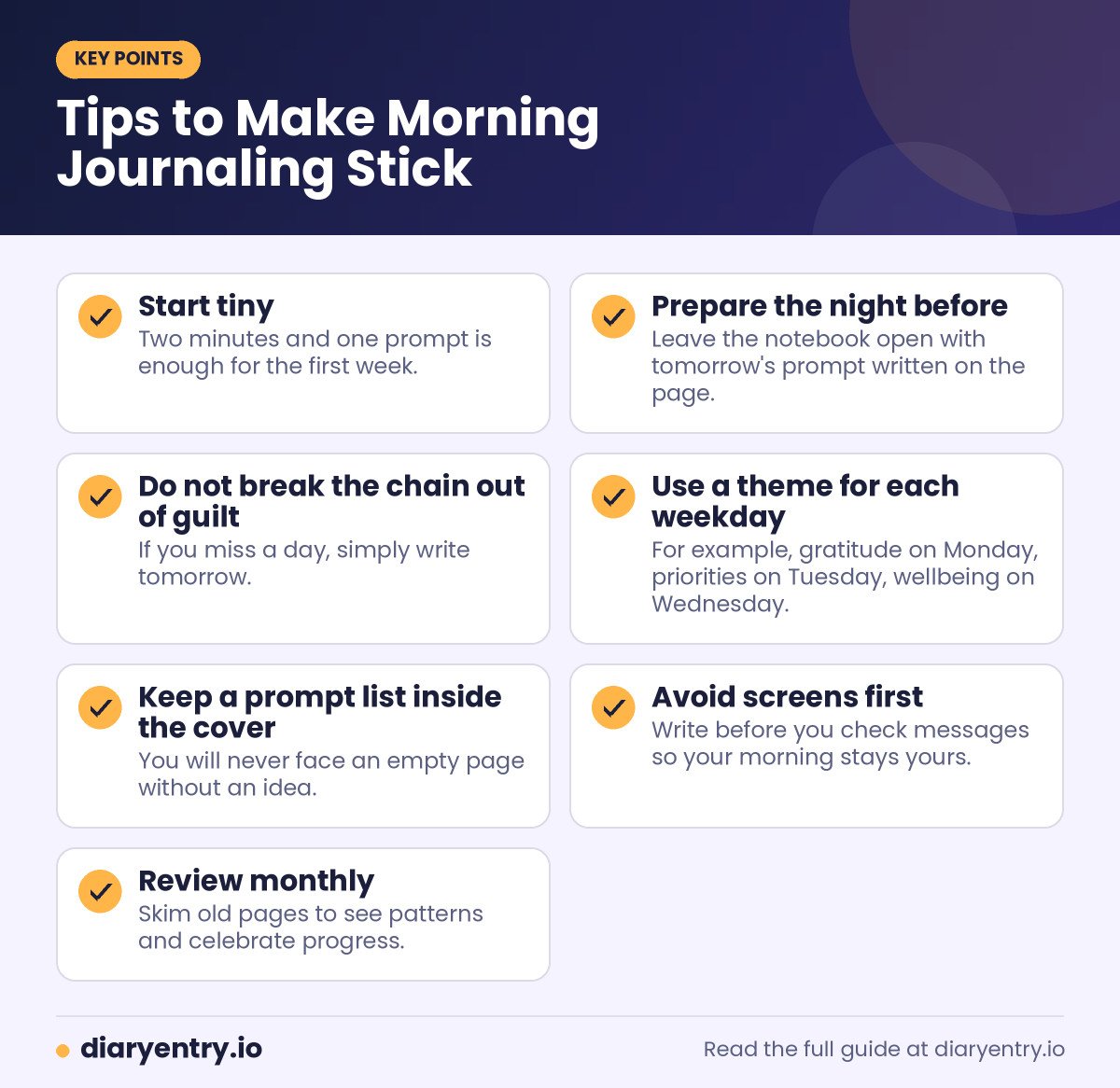
- Start tiny. Two minutes and one prompt is enough for the first week.
- Prepare the night before. Leave the notebook open with tomorrow’s prompt written on the page.
- Do not break the chain out of guilt. If you miss a day, simply write tomorrow.
- Use a theme for each weekday. For example, gratitude on Monday, priorities on Tuesday, wellbeing on Wednesday.
- Keep a prompt list inside the cover. You will never face an empty page without an idea.
- Avoid screens first. Write before you check messages so your morning stays yours.
- Review monthly. Skim old pages to see patterns and celebrate progress.
Common Mistakes to Avoid
A few habits can quietly make morning journaling feel like a chore.
- Writing too much. A long entry on a busy morning leads to skipped days.
- Being too critical. The journal is not an exam, and nobody will grade it.
- Using the same prompt forever. Rotate prompts so the habit stays fresh.
- Journaling late in the morning. The longer you wait, the more distractions appear.
- Only writing about problems. Include something positive or hopeful, even if it is small.
- Expecting instant transformation. Benefits tend to build gradually, so give it a few weeks.
Frequently Asked Questions
What are morning journal prompts?
Morning journal prompts are short questions or sentence starters you answer in writing early in the day, such as “What are my top three priorities?” or “What am I grateful for this morning?” They help you set intentions and focus.
How long should I spend on morning journaling?
Five minutes is enough for most people. If you enjoy it, you can extend to ten or fifteen minutes, but a short, consistent practice is better than an occasional long one.
What should I write in my journal in the morning?
Write whatever helps you start the day well: gratitude, your top priorities, how you feel, or one intention. A single prompt answered honestly is plenty.
Is it better to journal in the morning or at night?
Neither is better for everyone. Mornings suit planning and intention-setting, while evenings suit reflection. Choose the time you can protect, or try both for a week and compare.
Can morning journaling help with productivity?
Many people find that writing down their priorities before the day begins helps them focus on what matters. It is a planning aid, not a guarantee of results.
Should I write by hand or type?
Either works. Handwriting feels slower and more reflective to many people, while typing is faster and easier to search. Choose the format you will actually use.
What if I do not know what to write?
Use the first prompt on your list, or write three sentences beginning with “This morning I feel…”, “Today I want…”, and “I am thankful for…”. Starting with a template removes the pressure.
Conclusion
Morning journal prompts give your day a gentle, intentional start. Choose one prompt, set a five-minute timer and write honestly, then close the notebook and carry on with your morning.
Try a different category each day this week, notice which one you enjoy most, and build your routine around it. If you would like structured support, the 4-Week Diary Entry Course at diaryentry.io is one way to build a writing habit step by step.