

An online prayer journal is a digital space, such as an app, a document or a private website, where you write down your prayers, requests, gratitude and reflections so you can return to them over time. It works like a paper prayer journal but is searchable, always on your phone, and easy to organise by date, person or topic.
If you want a more consistent prayer life, writing your prayers down can help you stay focused and notice how things change. This guide explains how to start an online prayer journal, which formats work best, what to write, and how to keep going when the habit feels hard.
What Is an Online Prayer Journal?
A prayer journal is a written record of your conversation with God, or with the divine as you understand it. People use it to name their worries, give thanks, ask for guidance, record answers and reflect on their faith. An online prayer journal simply keeps that record in a digital tool instead of a notebook.
Typical entries include:
- Prayers of thanks and praise
- Requests for yourself and others
- Confessions or honest struggles
- Passages or phrases that spoke to you
- Notes on how a prayer was later answered or changed
The practice appears across many traditions, and you can shape it to fit your own beliefs. There is no single correct style. What matters is that it feels sincere to you.
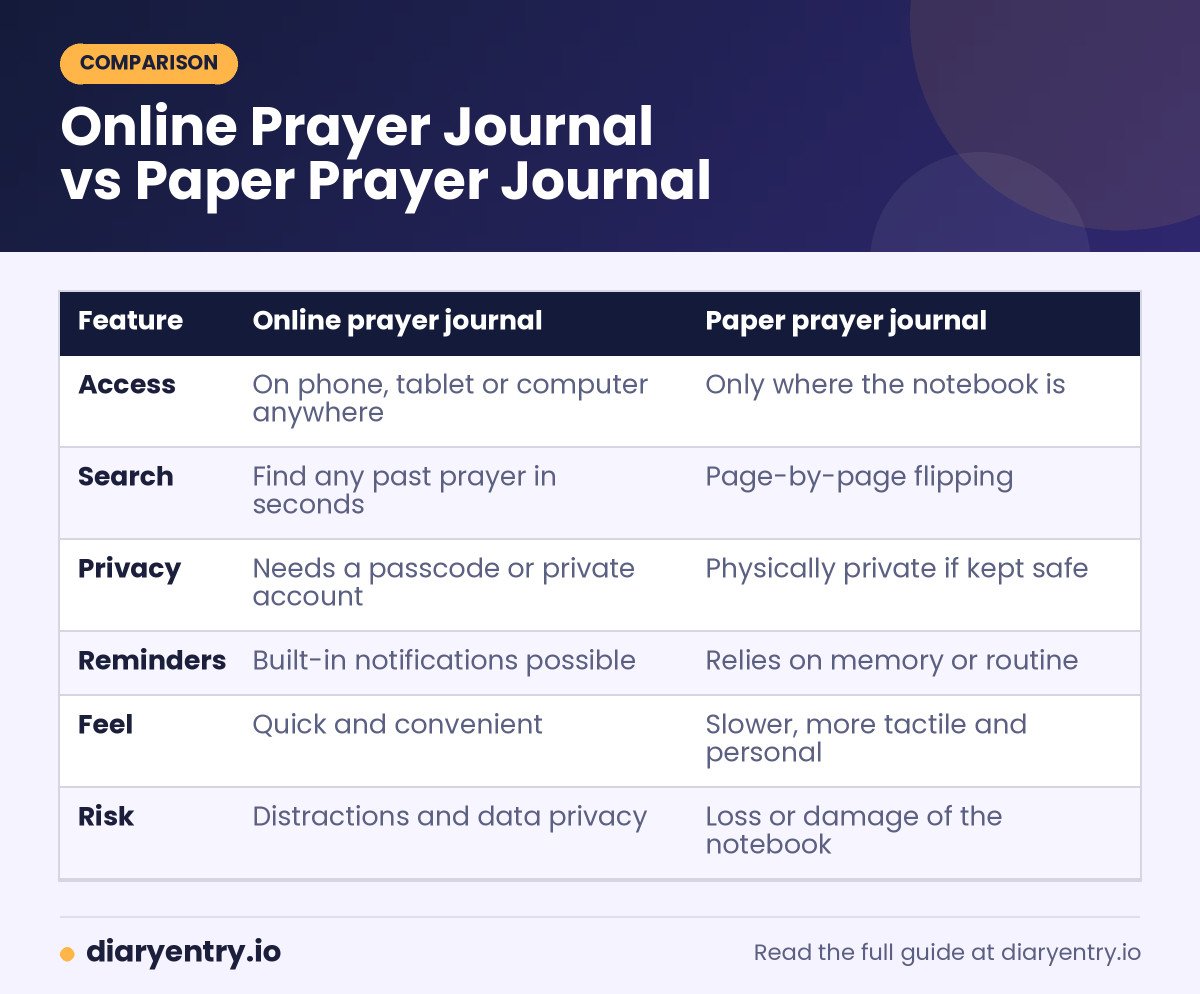
Online Prayer Journal vs Paper Prayer Journal
Neither is better for everyone. Your choice depends on how and where you pray.
| Feature | Online prayer journal | Paper prayer journal |
|---|---|---|
| Access | On phone, tablet or computer anywhere | Only where the notebook is |
| Search | Find any past prayer in seconds | Page-by-page flipping |
| Privacy | Needs a passcode or private account | Physically private if kept safe |
| Reminders | Built-in notifications possible | Relies on memory or routine |
| Feel | Quick and convenient | Slower, more tactile and personal |
| Risk | Distractions and data privacy | Loss or damage of the notebook |
Many people use both: paper for quiet morning prayer and a digital journal for quick notes during the day.
Benefits of Keeping an Online Prayer Journal
Writing your prayers does more than store them. Here is what many people notice.
- Focus. Putting words on a page can calm a wandering mind during prayer.
- Gratitude. Recording small blessings makes them easier to see.
- Memory. You can look back and notice answered prayers or how your concerns changed.
- Honesty. Writing makes it easier to say what you really feel.
- Consistency. A set time and place for writing supports a regular practice.
- Intercession. A list of people you are praying for stops them being forgotten.
These benefits are personal and vary from person to person, but the general principle is simple: writing slows you down and makes prayer more intentional. For a broader practice of thanks, see our gratitude journal guide.
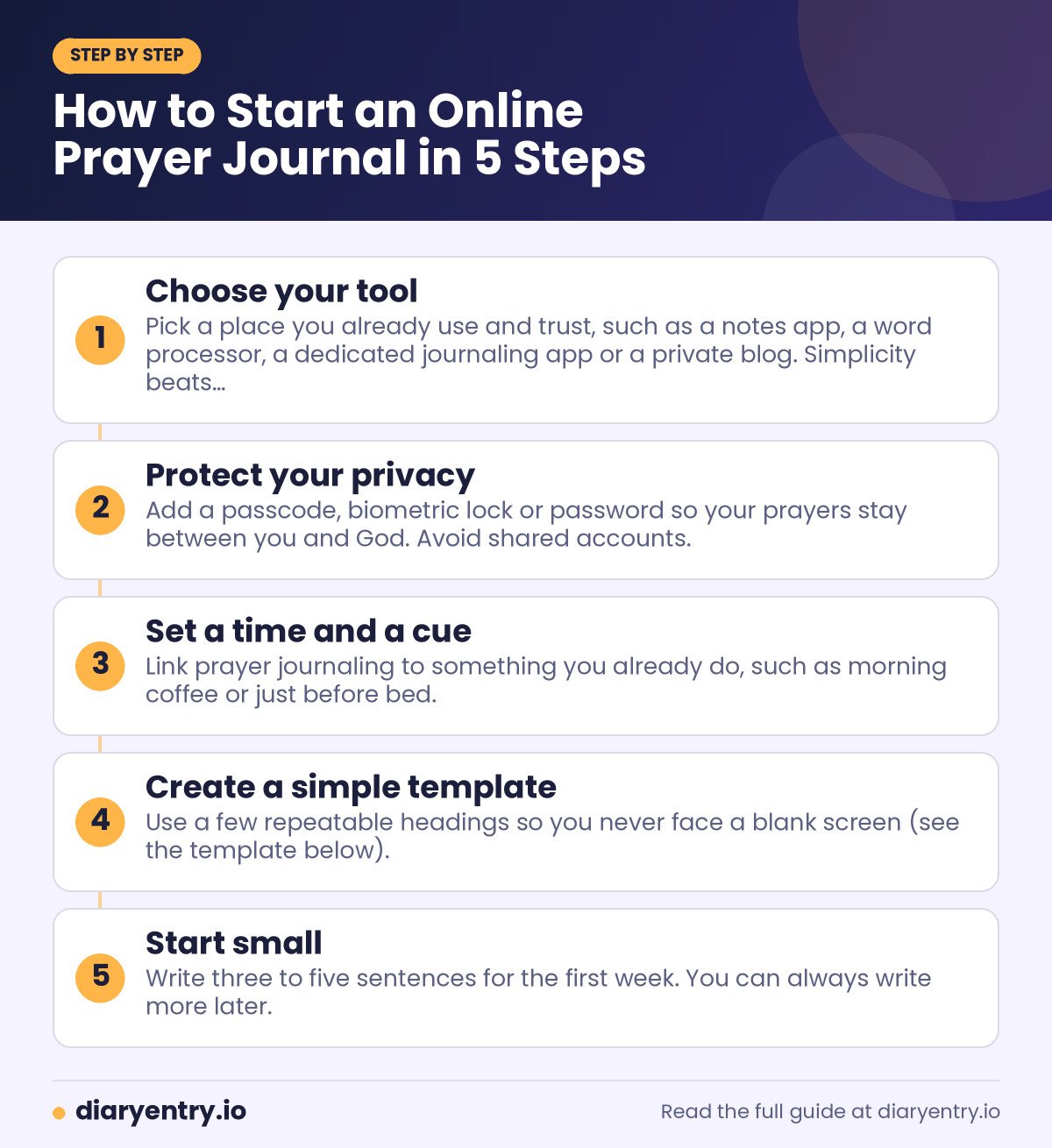
How to Start an Online Prayer Journal in 5 Steps
You can set up a simple system in about ten minutes.
- Choose your tool. Pick a place you already use and trust, such as a notes app, a word processor, a dedicated journaling app or a private blog. Simplicity beats features.
- Protect your privacy. Add a passcode, biometric lock or password so your prayers stay between you and God. Avoid shared accounts.
- Set a time and a cue. Link prayer journaling to something you already do, such as morning coffee or just before bed.
- Create a simple template. Use a few repeatable headings so you never face a blank screen (see the template below).
- Start small. Write three to five sentences for the first week. You can always write more later.
A Simple Online Prayer Journal Template
The popular ACTS framework gives structure without being rigid. It stands for Adoration, Confession, Thanksgiving and Supplication. Here is a version you can copy.
- Adoration: Write a line about who God is to you today.
- Confession: Name honestly where you fell short or what is weighing on you.
- Thanksgiving: List two or three things you are grateful for.
- Supplication: Write your requests for yourself and others.
- Listening: Note any thought, verse or sense of direction that comes to mind.
If ACTS feels too formal, try a simpler three-part version: Thank, Ask, Listen.
What to Write in Your Prayer Journal
When you are not sure what to say, use prompts. They are especially helpful on dry or distracted days.
- Today I am thankful for…
- Something I am struggling with is…
- I am praying for [name] because…
- A verse or line that stayed with me today is…
- I need guidance about…
- One way I saw God at work this week was…
- I want to let go of…
You can pair prayer with scripture by following a reading plan. If that interests you, see our ideas for Bible journaling examples.
Sample Online Prayer Journal Entries
Seeing an entry helps you picture your own. These samples are short on purpose.
Example 1: A morning entry
Tuesday morning. Thank you for a quiet start to the day. I am anxious about the meeting at noon. Please give me clear words and patience. Help me to listen more than I speak. I am also praying for my neighbour who is recovering from surgery.
Example 2: An evening entry
Thursday night. Today was heavy, and I snapped at my daughter. I am sorry. Thank you for the walk after dinner and for her forgiving me quickly. Tomorrow, help me pause before I respond.
Example 3: An answered prayer entry
Sunday. Three weeks ago I asked for direction about the job offer. Looking back, I see that each step opened slowly and I felt at peace with the decision. I am grateful and want to remember this the next time I doubt.
Entries like the third are why many people value a journal: it becomes a record of how your prayers unfolded over time. More formats are in our journal examples.
Best Ways to Keep an Online Prayer Journal
Different tools suit different people. Here are the main options and when to use each.
Notes app or document
Free, simple and already on your phone. Create one note per month or a single running document with dated headings. This is the best option for beginners.
Dedicated journaling or prayer app
Some apps offer reminders, streaks, prompts and scripture integration. Check the privacy policy, whether data is backed up, and whether the free version meets your needs. For a broader look at digital options, read our guide to online journaling.
A private blog or password-protected page
Good if you like writing longer reflections and want a tidy archive. Make sure it is truly private before you write anything personal.
Spreadsheet or tracker
Useful for prayer lists with columns such as date, person, request and update. It is less personal but very practical for intercession.
Organising an Online Prayer Journal for Long-Term Use
After a few months you will have dozens of entries, so a little organisation pays off. You do not need a complicated system. Three simple habits are enough.
Use consistent dates and tags
Start every entry with the date. If your tool supports tags, add short ones such as family, work, gratitude or guidance. Later you can pull up every prayer on one theme in seconds, which is one of the biggest advantages of going digital.
Keep a separate prayer list
Maintain one running list of people and situations you are praying for, with the date you began and a space for updates. When something changes, add a line rather than rewriting the entry. This gives you a clear picture of how circumstances develop.
Back up your entries
Digital tools can fail or change. Export your journal once a month or keep it in a service that syncs across devices. Because these entries are deeply personal, store the backup somewhere private and protected.
Praying Online Without Losing the Quiet
A common worry is that using a phone for prayer invites distraction. That concern is fair, and a few small choices help.
- Switch on do-not-disturb before you open the journal.
- Close every other app so notifications cannot interrupt you.
- Sit somewhere calm and keep the screen brightness low in the evening.
- Spend a minute in silence before you start typing.
- If the screen still pulls you away, write the entry on paper and copy the key lines in later.
The tool is only a container. What matters is the attention you bring to it.
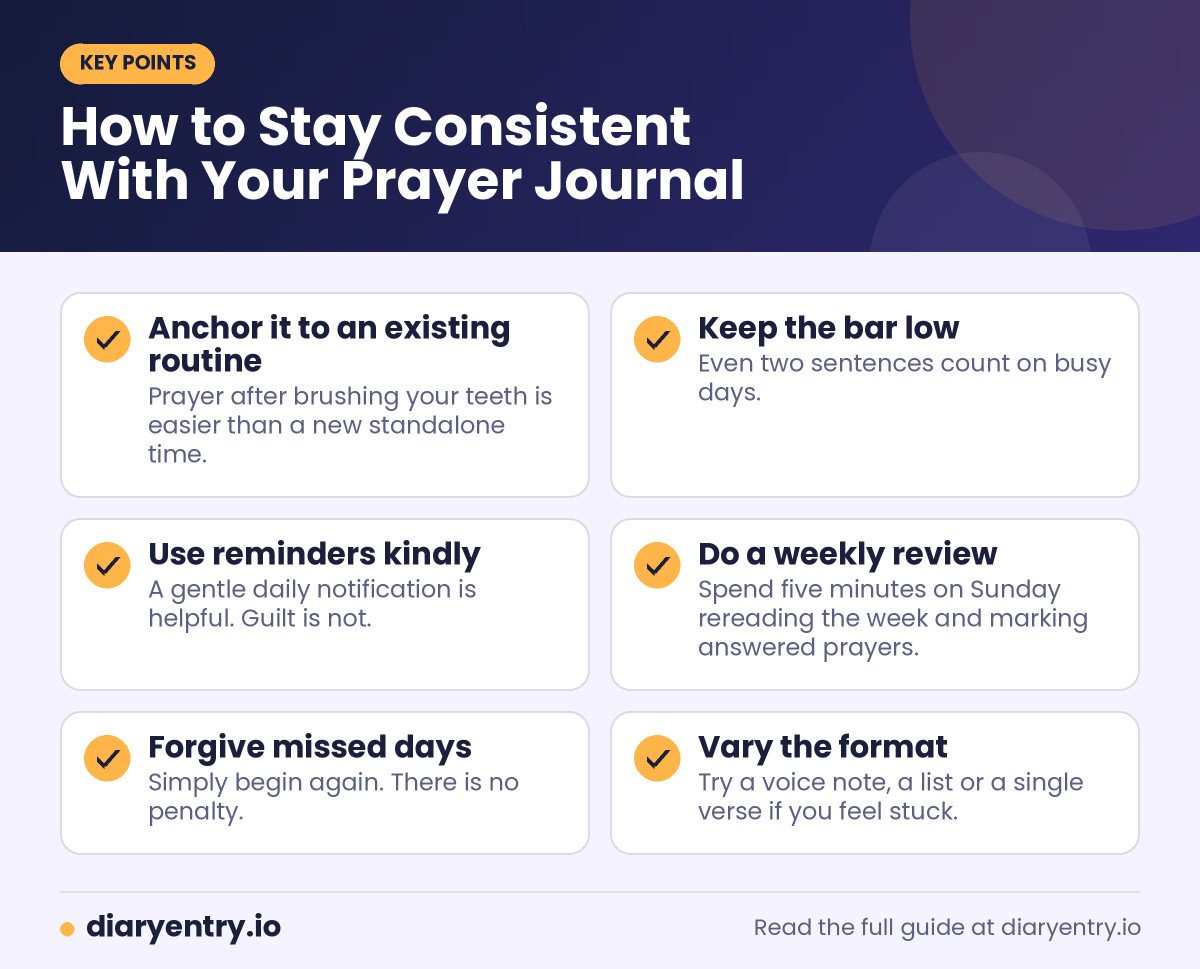
How to Stay Consistent With Your Prayer Journal
Starting is easy. Continuing is where most people struggle. These habits help.
- Anchor it to an existing routine. Prayer after brushing your teeth is easier than a new standalone time.
- Keep the bar low. Even two sentences count on busy days.
- Use reminders kindly. A gentle daily notification is helpful. Guilt is not.
- Do a weekly review. Spend five minutes on Sunday rereading the week and marking answered prayers.
- Forgive missed days. Simply begin again. There is no penalty.
- Vary the format. Try a voice note, a list or a single verse if you feel stuck. A five year journal also keeps entries short.
If you want a proven structure for turning this into a lasting habit, our post on building a daily journaling habit in four weeks applies equally well to prayer.
Common Mistakes to Avoid
Small missteps can make a good practice feel like a chore.
- Treating it as a performance. Your journal is not for anyone else to read, so write plainly.
- Overcomplicating the setup. Spending weeks choosing an app delays the real practice.
- Ignoring privacy. Always lock your device or app, especially if you write about other people.
- Only asking. If every entry is a request list, add some thanks and listening.
- Never looking back. The value grows when you review old entries.
- Quitting after a gap. A missed week does not erase your progress.
Prayer Journaling Within a Wider Spiritual Practice
Prayer journaling pairs naturally with other forms of reflection, such as scripture reading, gratitude lists and quiet meditation. If you are exploring different approaches, take a look at our overview of a spiritual journal for ideas on combining them. Many people also find that writing daily helps them notice patterns in their moods and thoughts, a theme explored in our piece on the benefits of keeping a daily journal.
Frequently Asked Questions
What is an online prayer journal?
It is a digital record of your prayers, thanks, requests and reflections, kept in an app, document or private website so you can search, organise and revisit it easily.
How do I start an online prayer journal?
Choose a simple tool, lock it with a passcode, pick a daily time, use a short template such as Thank, Ask, Listen, and begin with a few sentences. Build from there.
Is an online prayer journal private?
It can be, if you use a locked app or a password-protected document and avoid shared accounts. Always review the privacy settings of any app before writing personal details.
How often should I write in a prayer journal?
Daily is ideal for building the habit, but several times a week still helps. Choose a rhythm you can keep without guilt.
What should I write if I do not know what to pray?
Start with what is true: how you feel, what you are thankful for and what you need. You can also use a prompt, a psalm or a line from a reading as a starting point.
Is it better to use a paper or digital prayer journal?
Neither is universally better. Paper feels slower and more personal, while digital is searchable and convenient. Many people combine both.
How long should a prayer journal entry be?
A few sentences are enough. Some people write a page, others a single line. Consistency matters more than length.
Conclusion: Begin Your Online Prayer Journal Today
An online prayer journal makes it easier to pray with focus, remember your requests and see how your faith grows over time. Pick a simple tool, protect your privacy, use a short template and write a few honest lines today. You can refine the system later.
If you would like gentle structure for writing every day, the 4-Week Diary Entry Course can help you build a steady journaling habit that fits naturally alongside prayer.