

Bible journaling examples show how people turn quiet time with Scripture into something visible and personal. Bible journaling is the practice of responding to a passage by writing, drawing or highlighting in a Bible or a separate notebook. You do not need artistic skill. A few handwritten notes beside a verse count just as much as a beautifully illustrated page. This guide explains how to start, shows examples you can copy, and gives simple methods, prompts and sample entries.
What Is Bible Journaling?
Bible journaling is a way of engaging with Scripture through writing and creative expression. Instead of only reading a passage, you pause to respond to it. That response might be a prayer, a question, a short reflection, a hand-lettered verse or a small drawing.
People practise it in two main ways. Some write directly in a journaling Bible that has wide margins, while others keep a separate notebook and copy or reference the verse there. Both are valid, and which you choose is a matter of preference.
It overlaps with spiritual diary writing, which we explore on our spiritual journal page, but Bible journaling is anchored to a specific passage each time.
Why People Practise Bible Journaling
There are many reasons people turn to this habit. The most common ones are listed below.
- Slower reading: writing makes you linger on a passage rather than skim it.
- Better recall: putting a verse in your own words often helps you remember it.
- A record of your faith journey: looking back at old pages shows how your questions and answers have changed.
- Creative expression: colour, lettering and sketches let you respond in more than words.
- A calmer routine: a short daily session can become a settled moment in a busy day.
Different traditions and individuals approach this differently, so take what is useful and leave the rest.
What You Need to Get Started
You can begin with almost nothing. Here is a simple starter kit, from basic to optional.
- A Bible you are comfortable reading. Choose the translation that makes the most sense to you.
- A pen or pencil. A fine pen that does not bleed through thin pages works best.
- A notebook (optional). Useful if you do not want to write in your Bible.
- Highlighters or coloured pencils (optional). Light touches of colour add emphasis.
- Sticky notes or washi tape (optional). These let you add notes without marking the page.
- A quiet fifteen minutes. The most important item of all.

A tip on page bleed: test your pens on the last page of the book before you use them on a passage that matters to you.
Bible Journaling Examples You Can Copy
Seeing concrete examples makes it easier to begin. Below are eight styles, from the simplest to the most creative. For other kinds of entries, see our journal examples.
Example 1: The Margin Note
Write a single sentence in the margin beside a verse. For instance, next to a passage about trust, you might write, “Today I am trusting God with the meeting at noon.” It takes under a minute and is a good place to begin.
Example 2: The Highlight and Reflection
Highlight one phrase that stood out, then write two or three sentences about why. This combines a visual cue with a short reflection and works well when you are short on time.
Example 3: The Verse in Your Own Words
Rewrite the passage as if explaining it to a friend. This is a gentle way to test whether you understand it, and it often brings out questions worth exploring further.
Example 4: The Written Prayer
Read the passage, then write a short prayer in response. You might thank, ask for help or simply say what is on your heart. Many people find this the most natural form of Bible journaling. Our online prayer journal guide goes further.
Example 5: The Hand-Lettered Verse
Copy your chosen verse in decorative lettering, perhaps with a simple border or a few leaves and flowers. Practise on scrap paper first if you want a cleaner result.
Example 6: The Illustrated Page
Draw a small picture linked to the passage, such as a path for a verse about guidance or a seed for a parable about growth. Stick figures are completely fine.
Example 7: The Question Page
Write down the questions the passage raises for you. You do not have to answer them. Returning months later and seeing which ones you can answer is a quiet joy.
Example 8: The Topic Page
Choose a theme such as peace, patience or gratitude, and collect several verses on it in one notebook spread. This builds a personal reference you can revisit. A gratitude journal works well for the gratitude theme.
Bible Journaling Methods Compared
Different methods suit different personalities. The table below compares four popular ones.
| Method | Time needed | Best for | Skills needed |
|---|---|---|---|
| Margin notes | 2 to 5 minutes | Busy readers | None |
| Written reflection | 10 to 15 minutes | Thoughtful writers | Basic writing |
| Prayer journaling | 5 to 10 minutes | Those who want to pray through a passage | None |
| Illustrated page | 20 to 40 minutes | Creative people | Simple drawing or lettering |
If you enjoy more structure, a spiritual journal layout can combine these methods in a single weekly routine.
How to Start Bible Journaling Step by Step
The following steps work for almost anyone. Follow them in order for your first few sessions, and adapt them as the habit settles.
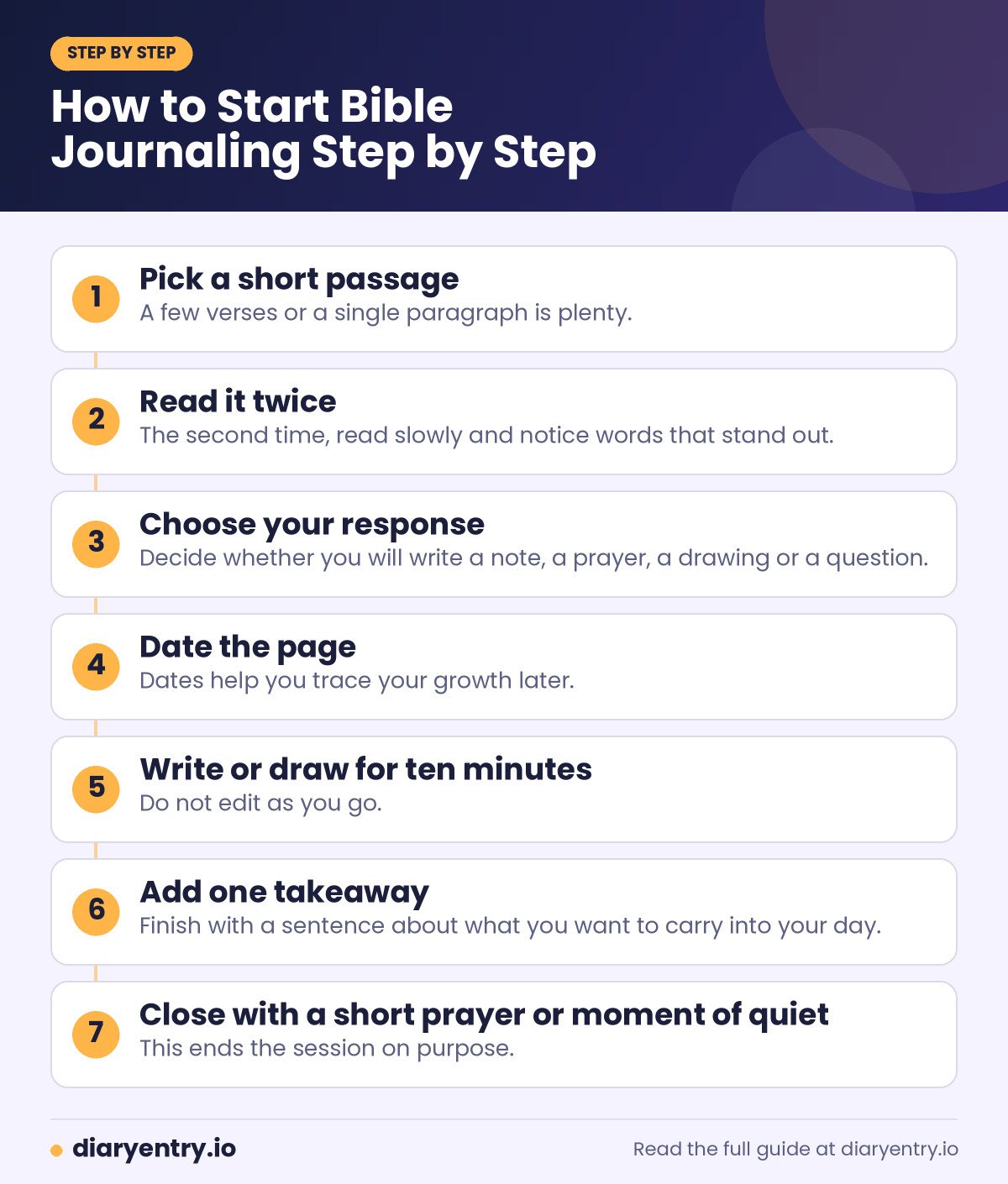
- Pick a short passage. A few verses or a single paragraph is plenty.
- Read it twice. The second time, read slowly and notice words that stand out.
- Choose your response. Decide whether you will write a note, a prayer, a drawing or a question.
- Date the page. Dates help you trace your growth later.
- Write or draw for ten minutes. Do not edit as you go.
- Add one takeaway. Finish with a sentence about what you want to carry into your day.
- Close with a short prayer or moment of quiet. This ends the session on purpose.
Bible Journaling Prompts for Every Day
Prompts help when you do not know how to respond. Choose one per session.
Prompts for Reflection
- What word or phrase stands out to me, and why?
- What does this passage say about God, and what does it say about people?
- How does this passage connect to something happening in my life today?
- Is there a command, a promise or a warning here?
Prompts for Application
- What is one small thing I can do today because of what I read?
- Who in my life could this passage encourage?
- What habit or attitude does this passage invite me to change?
Prompts for Prayer
- What am I thankful for after reading this?
- What do I want to ask for?
- What am I holding on to that I could release?
For further ideas that work in any journal, our list of journal prompts offers many that can be adapted to a faith context.
A Sample Bible Journaling Entry
Here is what a short written entry might look like. It uses a common method of observation, meaning and application.
Date: Tuesday. Passage: a short psalm about trust. Observation: the writer begins with worry and ends with calm. Meaning: trust seems to be something practised, not just felt. Application: today I will pause before replying to the email that annoyed me and say a one-line prayer first.
Notice that the entry is short, specific and personal. That is what makes it useful to read again.
A Simple Observe, Reflect, Apply Template
Copy this layout into any notebook.
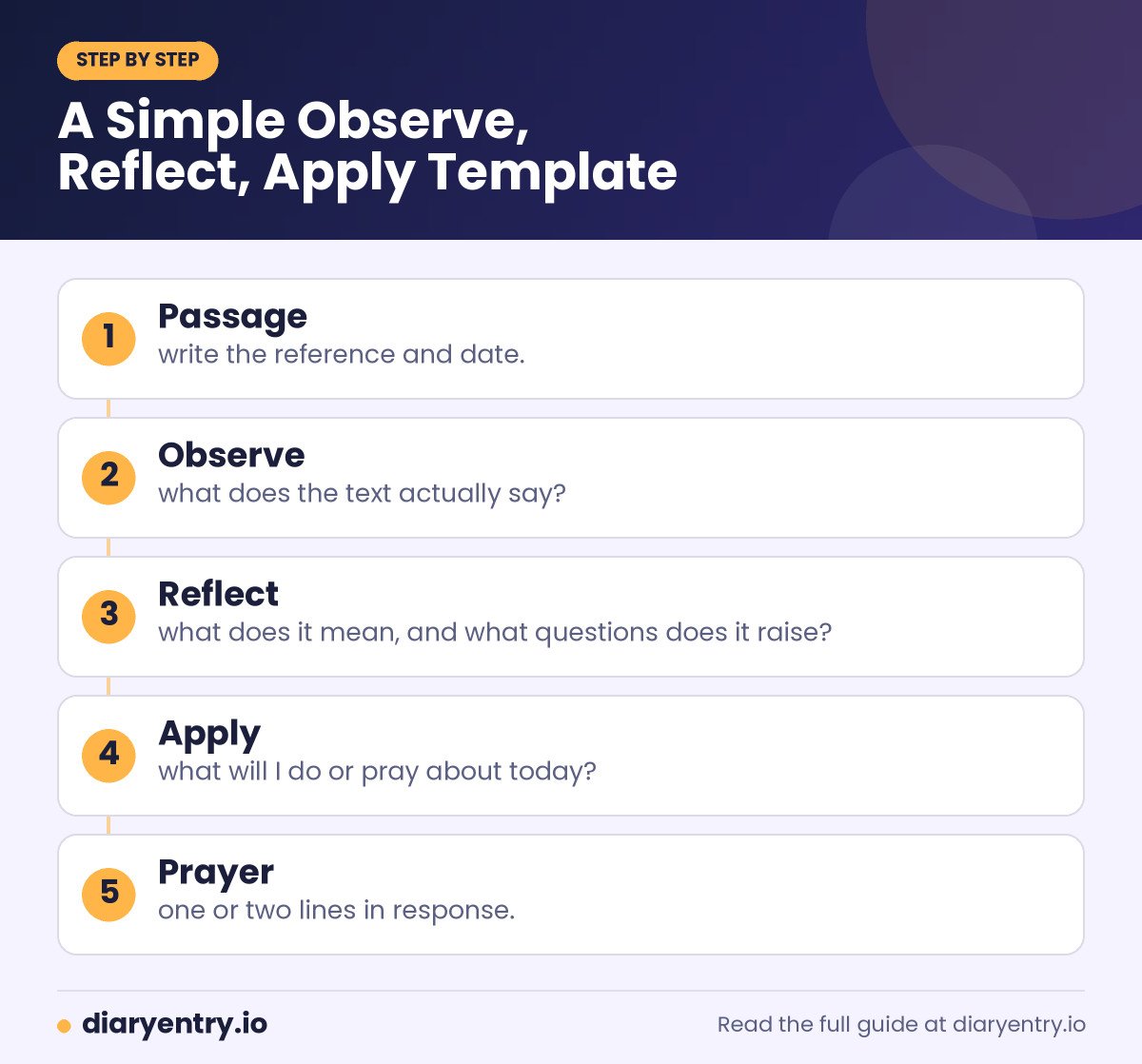
- Passage: write the reference and date.
- Observe: what does the text actually say?
- Reflect: what does it mean, and what questions does it raise?
- Apply: what will I do or pray about today?
- Prayer: one or two lines in response.
You may also like the layouts in our diary template guide, which you can adapt to this structure.
Tips for Beginners
Starting well matters more than starting big. These suggestions help beginners avoid common frustration.
- Begin with margin notes before trying illustrations.
- Keep sessions short, even five minutes, and extend only if you want to.
- Use a pencil first if you worry about mistakes.
- Do not compare your pages with elaborate examples online. Their purpose is to inspire, not to set a standard.
- Keep one notebook for loose thoughts and one for finished pages if you like neat results.
- Write at the same time each day to build a routine.
Common Mistakes to Avoid
Most people who give up on Bible journaling do so because of expectations, not ability. Here are the usual traps.
- Aiming for beautiful pages. The goal is engagement, not display.
- Choosing a passage that is too long. A short passage allows deeper attention.
- Ignoring the context. Read the verses before and after so you do not take a line out of its setting.
- Treating your reflection as the final word. Remain open to learning more, and consult trusted teachers or study resources when a passage is difficult.
- Skipping days and giving up. Missing a day is normal, so simply continue the next day.
- Using fragile pens on thin pages. Test first to avoid bleed-through.
Bible Journaling in a Digital Format
Not everyone wants to write in a printed Bible. A digital approach can work well, especially if you travel, share a Bible with family, or prefer typing.
You can keep entries in a notes app, a word processor or a dedicated journaling app, and add the verse reference to each one. Digital entries are searchable, which makes it easy to find everything you wrote about a theme. Our guide to online journaling covers app choices and privacy basics.
If you would like a deeper look at keeping a faith-based diary online, you may also find our resource on electronic diaries useful.
Building a Lasting Habit
A single beautiful page is nice, but a steady routine does more for your reading life. To build consistency, attach your session to something you already do, such as morning coffee or the last ten minutes before bed. Keep your Bible and pen together so there is no setup. Start with three days a week if daily feels like too much.
If you want a structured plan, the 4-Week Diary Entry Course can help you form a daily writing habit that you can apply to Bible journaling as well.
Frequently Asked Questions
What are some simple Bible journaling examples for beginners?
Good starting examples include a single margin note, a highlighted phrase with two sentences of reflection, a verse rewritten in your own words, and a short written prayer. Each takes only a few minutes.
Do I need to be artistic to do Bible journaling?
No. Many people never draw at all and simply write notes, questions and prayers. Art is optional and can be added gradually if you enjoy it.
Should I write in my Bible or in a separate notebook?
Either works. A journaling Bible has wide margins for notes, while a separate notebook offers more space and keeps your Bible clean. Many people use both.
How long should a Bible journaling session take?
Between five and fifteen minutes is enough for most people. Illustrated pages can take longer, but they are not required.
What pens are best for Bible journaling?
Fine-tipped pens designed not to bleed through thin paper are popular. Always test on a back page first.
Can I do Bible journaling digitally?
Yes. A notes app or journaling app lets you type reflections, add verse references and search later. It suits travel and shared devices well.
Conclusion
The best Bible journaling examples are simple ones you will actually repeat. Start with a short passage, respond with a note, a prayer or a question, and keep your sessions brief and honest. Over time, your pages will become a record of what you noticed, asked and learned. If you want help turning this into a steady writing habit, consider the 4-Week Diary Entry Course.