

What is an entry in writing? An entry in writing is a single, self-contained piece of text recorded at a specific time or on a specific topic, such as one diary entry, one journal entry, one blog entry or one dictionary entry. In journaling, an entry is what you write in one sitting, usually with a date, and it captures events, thoughts or feelings from that moment.
If you have ever been told to “write an entry” for school, a gratitude practice or a personal diary, you have probably wondered what exactly counts. This guide explains what an entry in writing is, the main types, how to structure one, and how to write entries you will actually enjoy rereading.
What Is an Entry in Writing? A Simple Definition
An entry is one discrete unit inside a larger collection. The collection might be a diary, a journal, a logbook, a blog, a ledger or a reference book. The entry is the individual record inside it. Each one stands on its own, yet together the entries form a continuous record.
Three features make something an entry rather than just a piece of writing:
- It is dated or placed in sequence. Entries sit in order, so a reader can see what came before and after.
- It is bounded. It has a clear start and end, usually covering one day, one event or one idea.
- It belongs to a series. It makes sense as part of a larger record, even if it can be read alone.
This is why the same word is used across very different fields. A journal entry in accounting records one transaction, a log entry records one event in a system, and a diary entry records one day in a life.
Types of Entries in Writing
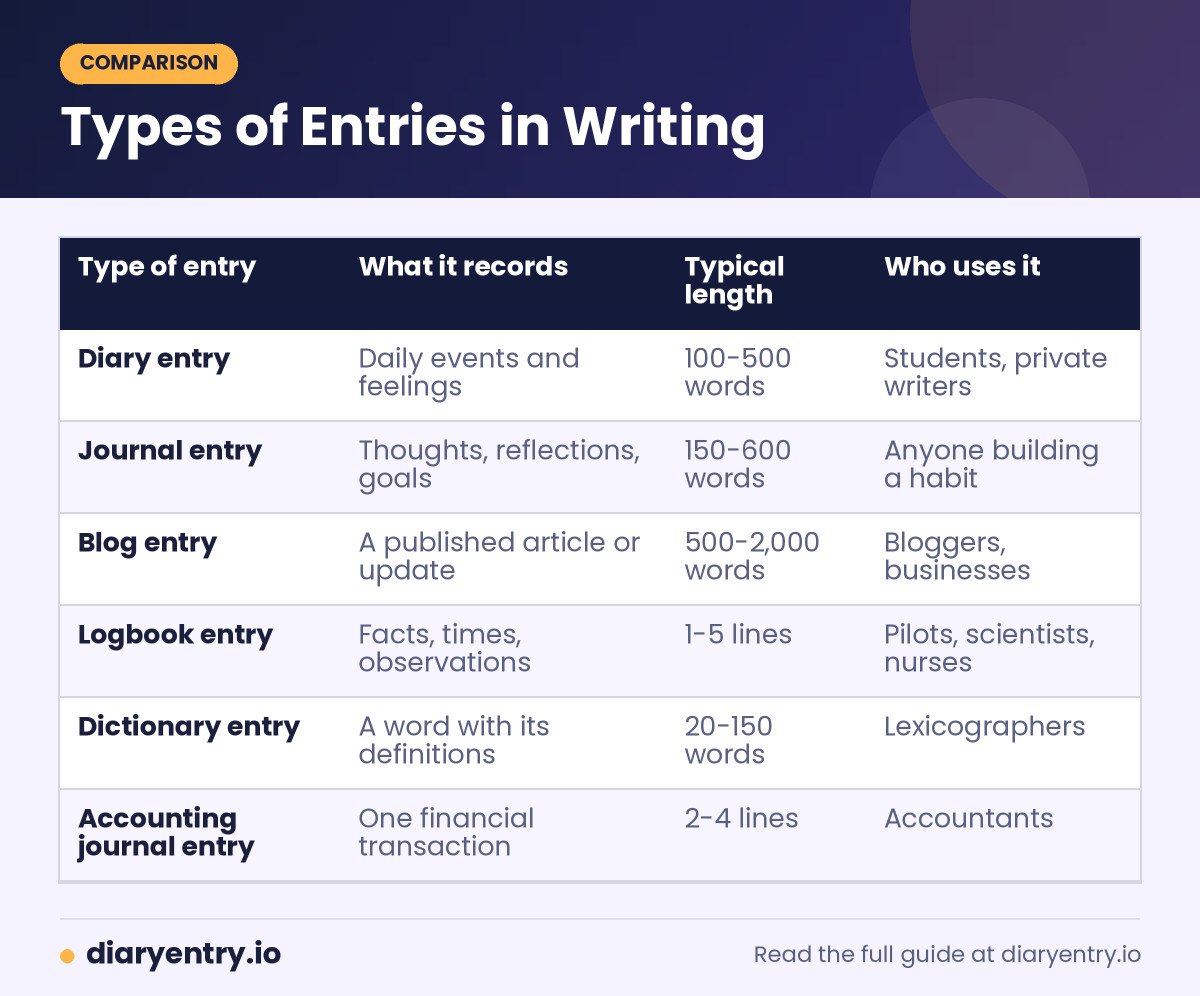
The meaning of “entry” shifts slightly depending on the context. Here is how the main types compare.
| Type of entry | What it records | Typical length | Who uses it |
|---|---|---|---|
| Diary entry | Daily events and feelings | 100-500 words | Students, private writers |
| Journal entry | Thoughts, reflections, goals | 150-600 words | Anyone building a habit |
| Blog entry | A published article or update | 500-2,000 words | Bloggers, businesses |
| Logbook entry | Facts, times, observations | 1-5 lines | Pilots, scientists, nurses |
| Dictionary entry | A word with its definitions | 20-150 words | Lexicographers |
| Accounting journal entry | One financial transaction | 2-4 lines | Accountants |
For the rest of this article we focus on personal writing, meaning diary and journal entries, because that is what most people mean when they ask what an entry is. If you want the school-style format specifically, see our guide to diary entry format for Class 6 to 10.
Diary Entry vs Journal Entry: What Is the Difference?
People often use the two words interchangeably, and in everyday life that is fine. There is a subtle difference, though.
A diary entry is usually a record of what happened and how you felt about it, written in the first person and often addressed to no one in particular. A journal entry is broader. It can include events, but it also covers reflection, planning, problem-solving, creative ideas and goal tracking.
Think of a diary entry as “what happened today” and a journal entry as “what I make of what happened, and what I will do next”. Many writers blend both in a single page. To go deeper on the distinction, read what is a journal.
The Basic Structure of a Journal Entry
You do not need a rigid format, but most good entries share a simple skeleton. Following one makes it far easier to start.
- Date (and sometimes time or place). This anchors the entry in your timeline.
- Opening line. State the mood, the main event or the question on your mind.
- Body. Describe what happened, what you noticed and how you felt. Use concrete details such as names, places and small moments.
- Reflection. Add one or two sentences about why it mattered or what you learned.
- Closing line. End with a next step, a hope or a short sign-off.
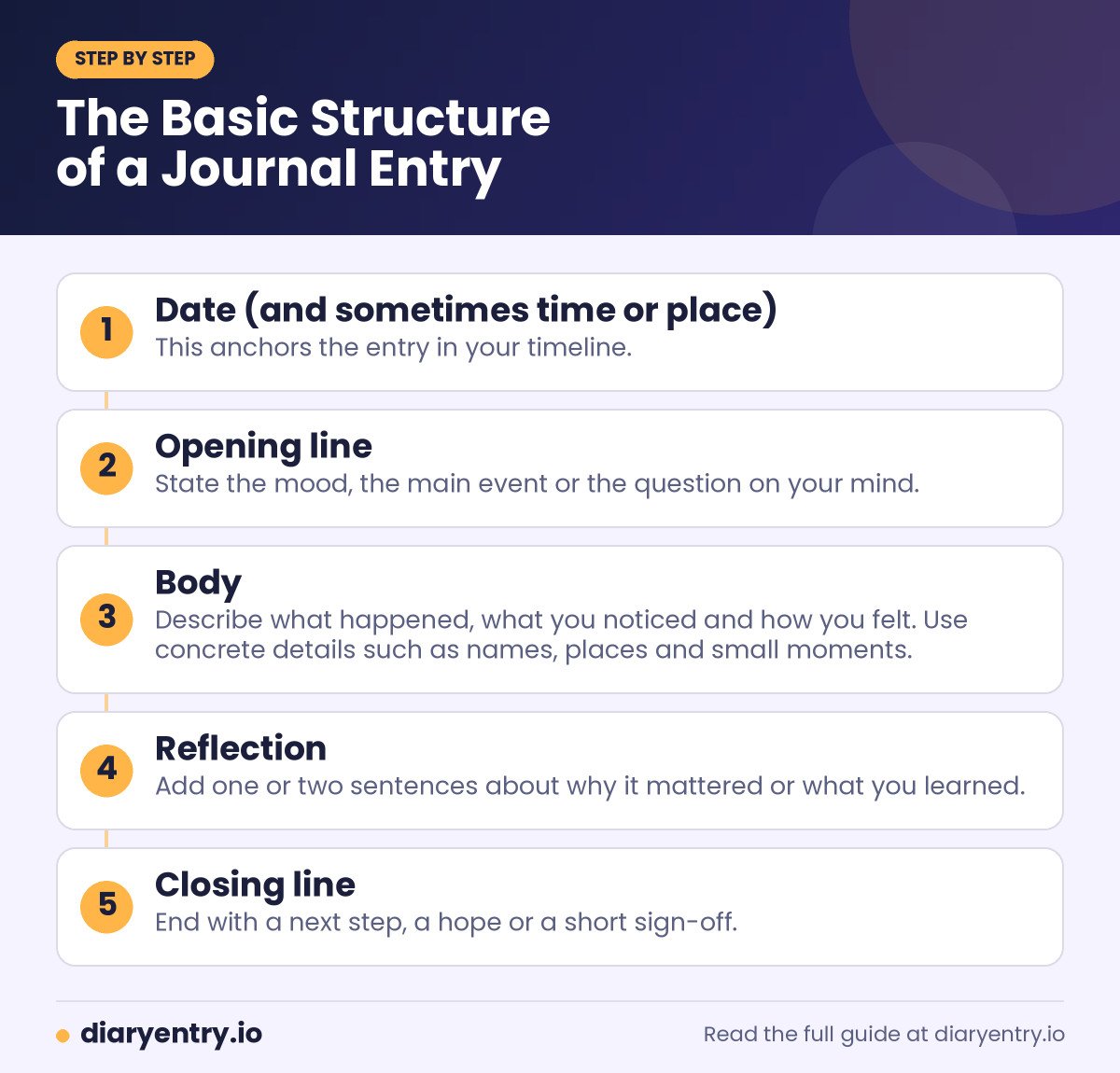
The reflection step is what lifts an entry from a list of events to something useful. Without it you have a log. With it you have insight. Copy-and-paste layouts are in our diary template guide.
How to Write an Entry in a Journal, Step by Step
If you are staring at a blank page, work through these steps in order.
Step 1: Pick a time and a place
Entries are easier when they have a slot in your day. Many people write in the evening to review the day, while others prefer a few minutes after waking. Choose whichever you can repeat.
Step 2: Write the date first
Putting the date down is a tiny action that starts the habit. It also makes the entry searchable later.
Step 3: Start with one honest sentence
Do not try to write something impressive. A sentence like “I am tired and a bit anxious about tomorrow” is a perfectly good opening because it is true.
Step 4: Describe one moment in detail
Pick the most vivid moment of the day and describe it. What did you see, hear or say? Specifics make entries memorable and avoid the vague “it was a normal day” trap.
Step 5: Add what you felt and why
Name the emotion, then trace it back to a cause. This is where most of the self-awareness benefit of journaling comes from.
Step 6: Finish with a small takeaway
One line is enough: what you learned, what you will try tomorrow, or what you are grateful for.
If you want a longer walkthrough, our guides on how to start a journal and how to write a diary entry cover the process in more depth.
Journal Entry Examples You Can Borrow
Seeing real-looking entries helps more than any definition. Here are three short samples in different styles. Adapt the tone to your own voice.
Example 1: A daily diary entry
Monday, 2 November. Today started badly because I missed my bus and walked to work in the rain. I was annoyed until a colleague shared her umbrella on the last stretch. It made me realise how much a small kindness can change a mood. Tomorrow I want to leave ten minutes earlier and pass that kindness on to someone else.
Example 2: A reflective journal entry
Wednesday evening. I presented the project update and my hands were shaking for the first two minutes. After that I settled and the questions were friendly. What worked was rehearsing the opening aloud. What I would change is speaking more slowly. Next time I will record myself first.
Example 3: A gratitude entry
Friday. Three good things today: the first cup of coffee on the balcony, a call with my sister, and finishing a task I had been avoiding. The last one matters most, because avoiding it was costing me more energy than doing it.
Notice the pattern. Each one is short, specific and ends with a thought rather than just a list of events. Our journal examples show many more samples.
What to Write About When You Have Nothing to Say
An empty mind is the most common reason people skip an entry. These prompts work on low-energy days.
- What was the best moment of today, and what made it good?
- What is one thing I am worried about, and what is one small step I could take?
- Who did I talk to today, and what did I notice about how I felt around them?
- What did I learn this week that I did not know last week?
- If today were a chapter title in a book, what would it be?
For a bigger list, browse these 50+ journal prompts or the diary entry prompts for students.
Common Mistakes When Writing Entries
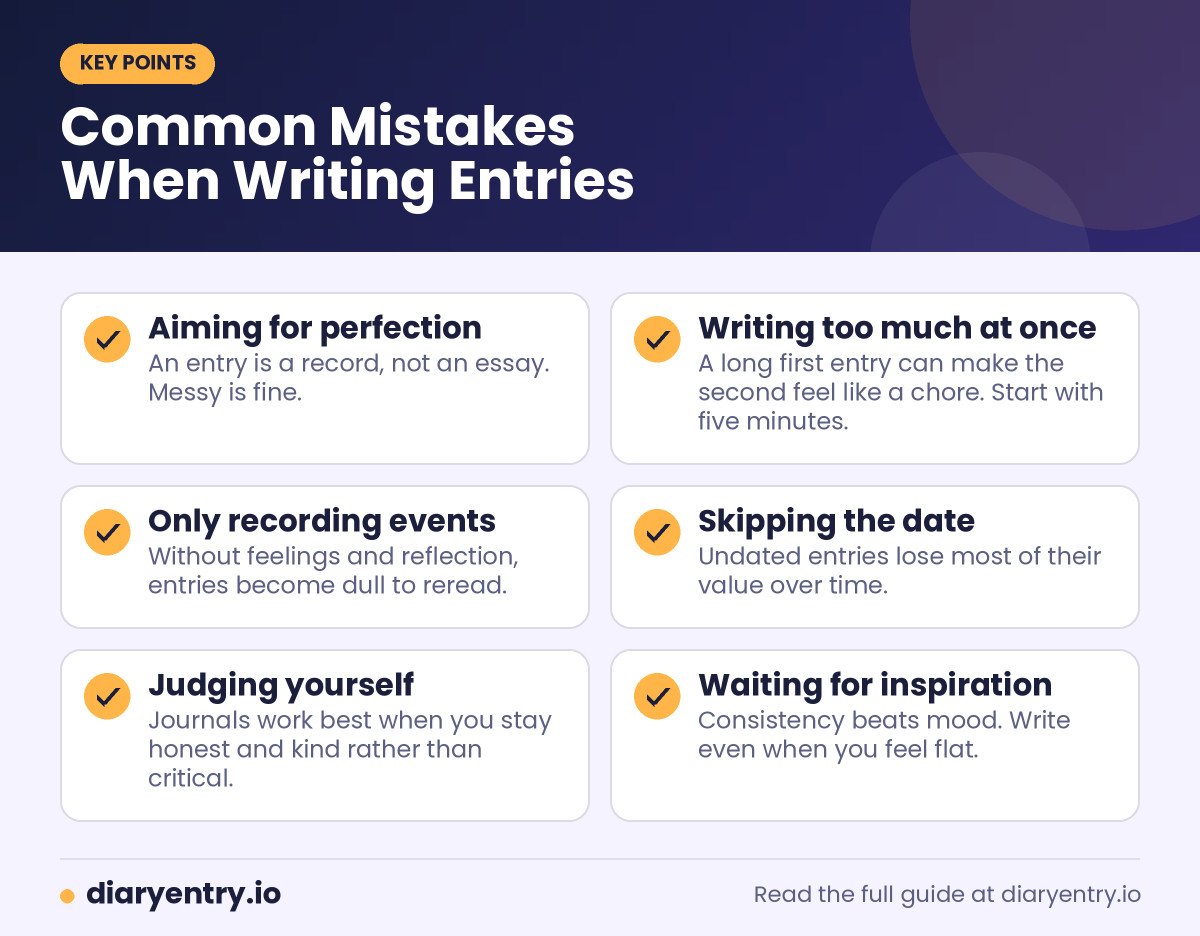
Most people give up on journaling not because it is hard, but because of avoidable mistakes.
- Aiming for perfection. An entry is a record, not an essay. Messy is fine.
- Writing too much at once. A long first entry can make the second feel like a chore. Start with five minutes.
- Only recording events. Without feelings and reflection, entries become dull to reread.
- Skipping the date. Undated entries lose most of their value over time.
- Judging yourself. Journals work best when you stay honest and kind rather than critical.
- Waiting for inspiration. Consistency beats mood. Write even when you feel flat.
Tips for Better Journal Entries
Once the habit is in place, a few small techniques improve the quality of what you write.
Use sensory details
Instead of “the cafe was nice”, write “the cafe smelled of toasted bread and the radio was playing something old”. Details make memories easier to recall years later.
Write in your own voice
You are the only reader, so skip formal language. Contractions, slang and half sentences are all welcome.
Keep entries short but regular
Five lines every day is more valuable than five pages once a month. Regularity is what builds the record.
Review your entries monthly
Reread the last month and underline patterns, such as repeated worries or recurring joys. This turns a pile of entries into self-knowledge.
Choose the format that suits you
Paper feels personal and slows you down. Digital entries are searchable and always in your pocket. You can read more in our guide to online journaling.
Benefits of Writing Regular Entries
Keeping up regular entries is linked in many people’s experience with clearer thinking, calmer evenings and a better memory of the year. You do not need a scientific claim to see the practical value: writing slows your thoughts down enough to examine them, gives worries a place to go and creates a record you can learn from. Our article on the benefits of keeping a daily journal lists ten of them.
Entry Writing for Students and Exams
In school, an entry usually means a diary entry written to a set format. Examiners typically look for a date, a greeting such as “Dear Diary”, a body in the first person and past tense, honest feelings and a brief closing. Word limits are normally between 100 and 150 words. If you mean the planner-style book used for homework, see our school diary guide.
A quick checklist for exam entries:
- Write the date and day at the top left.
- Begin with “Dear Diary” or a similar salutation.
- Use first-person, past tense for events.
- Include feelings, not just facts.
- Close with a sign-off and your name or initial where required.
Practise with our diary entry format guide to see solved examples.
Frequently Asked Questions
What is an entry in writing?
It is one dated, self-contained piece of writing within a larger collection, such as a single page in a diary or journal, one blog post or one dictionary item.
What is the difference between an entry and an article?
An entry is part of an ongoing record and usually tied to a date or sequence. An article is a standalone piece written to inform or persuade, and it does not need to belong to a series.
How long should a journal entry be?
There is no fixed length. Most personal entries run from 100 to 500 words, and a few honest sentences count. For exams, follow the word limit given, often 100 to 150 words.
Should I date every journal entry?
Yes. The date is the simplest way to organise your writing and lets you see how your thoughts change over time.
Can a journal entry be a list?
Yes. Lists of gratitudes, goals or daily wins are valid entries, though adding one or two sentences of reflection makes them more useful.
How often should I write an entry?
Daily is ideal for building the habit, but three times a week is still valuable. Pick a frequency you can keep without stress.
Is a diary entry the same as a journal entry?
They overlap heavily. A diary entry focuses on events and feelings of the day, while a journal entry can also include planning, reflection and creative ideas.
Conclusion: Start Your First Entry Today
So, what is an entry in writing? It is a small, dated record that captures a moment, and the real power lies in repeating it. Write the date, one honest sentence and one detail, and you have already made an entry.
If you would like structure and gentle accountability, the 4-Week Diary Entry Course walks you through building a daily writing habit step by step. Otherwise, open a page now and write today’s date.