

Most people who try journaling quit within a few weeks, and the reason is rarely lack of time. They expect every entry to be long, deep and well written. A daily journal works the other way round: a few honest lines written every day do more for you than a thoughtful page written once a month.
This guide covers ten practical benefits of writing every day, a five-minute routine to get started, three simple formats to choose from and the mistakes that make people stop. It is about the daily habit itself, whatever you write about. If you want a journal that is strictly private, see our guide to the benefits of a secret diary.
Why a daily habit beats an occasional one
Writing daily turns journaling from an event into a routine. You stop asking whether you feel like writing and simply write, the same way you brush your teeth. Short, frequent entries are also easier to start, because the bar is low: one sentence counts. Over weeks, those small entries build into a record of your days that you could never reconstruct from memory.
The 10 benefits of keeping a daily journal
1. Clearer thinking and better decisions
Putting a problem into words forces you to organise it. When you write the options for a decision side by side, with the reasons for and against each, weak arguments become easy to spot. Try writing “The decision is…” followed by two or three options and one sentence on what worries you about each.
2. A calmer end to the day
Unfinished thoughts tend to loop at night. A two-minute brain dump, where you write whatever is on your mind without editing, gets those thoughts out of your head and onto the page. Many people find it easier to switch off afterwards.
3. A steadier mood through pattern spotting
One bad day tells you little. Thirty days of short notes can show that you feel low after poor sleep, or lighter after a walk. Add a one-word mood to each entry, or use a dedicated mood tracker, and the patterns appear on their own.
4. Better focus and productivity
Spend a minute each morning writing the three things that matter most today. At night, note what you finished and what moved to tomorrow. This simple loop keeps your attention on priorities instead of whatever arrives in your inbox. The productivity journal format builds on exactly this idea. If you want a job-focused version, see our guide to keeping a work diary.
5. Stronger writing and a wider vocabulary
Writing is a skill that improves with repetition. A daily journal gives you a no-pressure place to practise sentence structure, description and tone. Students in particular benefit, because the same habits carry over to essays, letters and exam answers.
6. A better memory of your days
We forget most of what happens to us within weeks. Noting one specific moment each day, such as a conversation, a meal or something you overheard, gives you a memory you can return to years later. Specific details matter more than summaries.
7. Follow-through on habits and goals
What you record, you tend to repeat. Writing “walked 20 minutes” or “wrote for an hour” each day makes progress visible and gaps obvious. If you set goals, a regular check-in on the page keeps them from fading. Our goal-setting diary guide shows how.
8. More gratitude and perspective
Ending each entry with one thing that went well trains your attention to notice good moments. It does not mean ignoring problems. It means giving the small wins the same space as the worries.
9. A smoother evening routine
Writing at a fixed time gives your day a clear closing step. Pairing it with a cup of tea or a dimmed light makes it a cue that the day is over. Many people report that this helps them wind down, though results vary from person to person.
10. A record of your own progress
Reading an entry from six months ago often shows how much has changed: problems that felt huge and are now solved, skills you could not do then, people who matter to you now. That record is hard to get any other way.
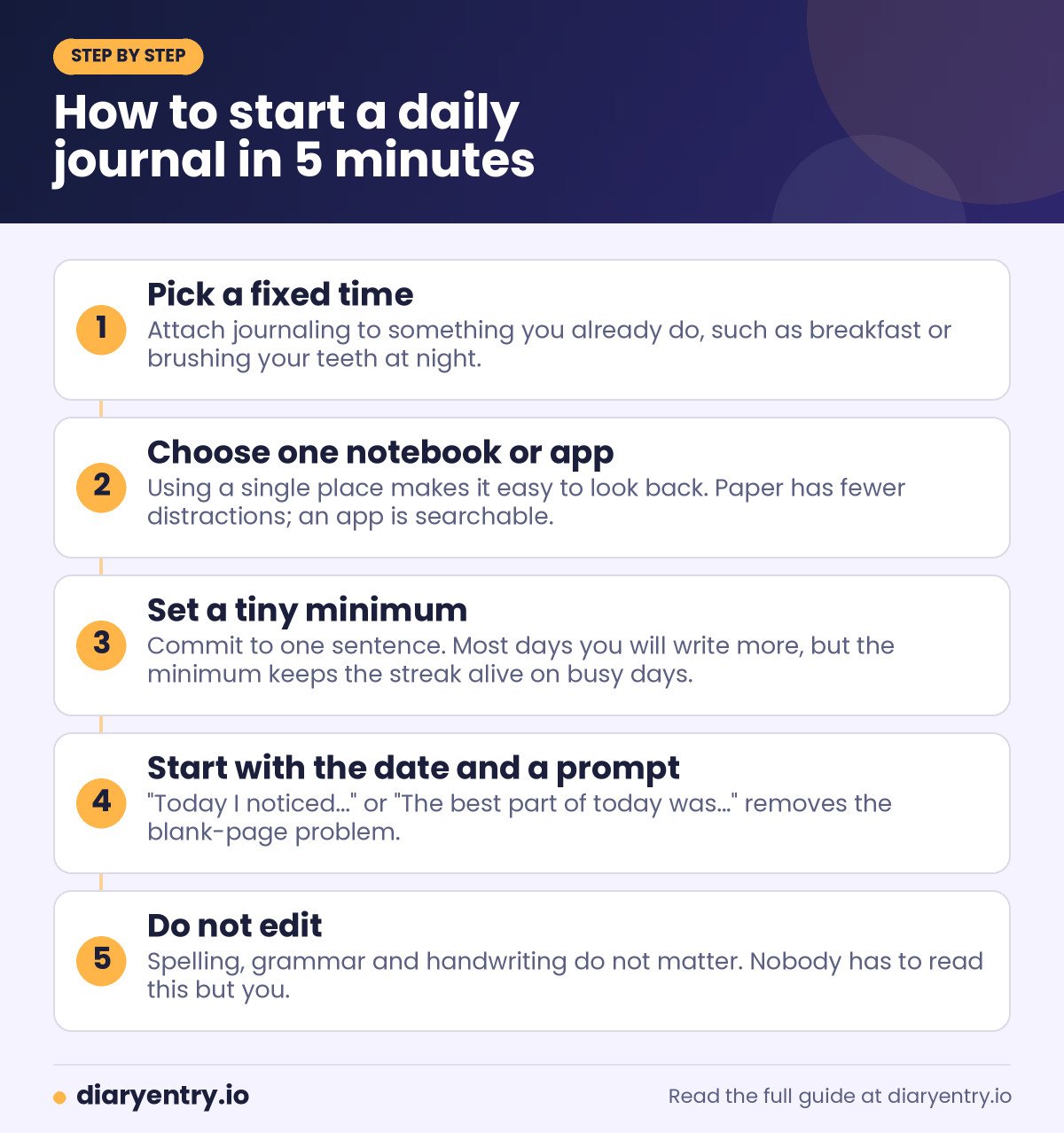
How to start a daily journal in 5 minutes
- Pick a fixed time. Attach journaling to something you already do, such as breakfast or brushing your teeth at night.
- Choose one notebook or app. Using a single place makes it easy to look back. Paper has fewer distractions; an app is searchable.
- Set a tiny minimum. Commit to one sentence. Most days you will write more, but the minimum keeps the streak alive on busy days.
- Start with the date and a prompt. “Today I noticed…” or “The best part of today was…” removes the blank-page problem.
- Do not edit. Spelling, grammar and handwriting do not matter. Nobody has to read this but you.
For more ideas, our step-by-step guide to starting a journal goes deeper, and the list of 50+ journal prompts will keep you going when you run out of things to say.
Three daily journal formats to try
The morning page
Write for five minutes as soon as you wake up, covering whatever is on your mind. It suits people who think best in the morning and want to clear their head before work or school.
The evening review
Answer three questions: What happened? What went well? What will I do differently tomorrow? It is short, structured and easy to repeat.
One line a day
Write a single sentence about the day. It takes under a minute and is the easiest format to keep for years. Many people find that a year of single lines is a surprisingly rich record. A five year journal builds on this idea with a single line a day across five years.
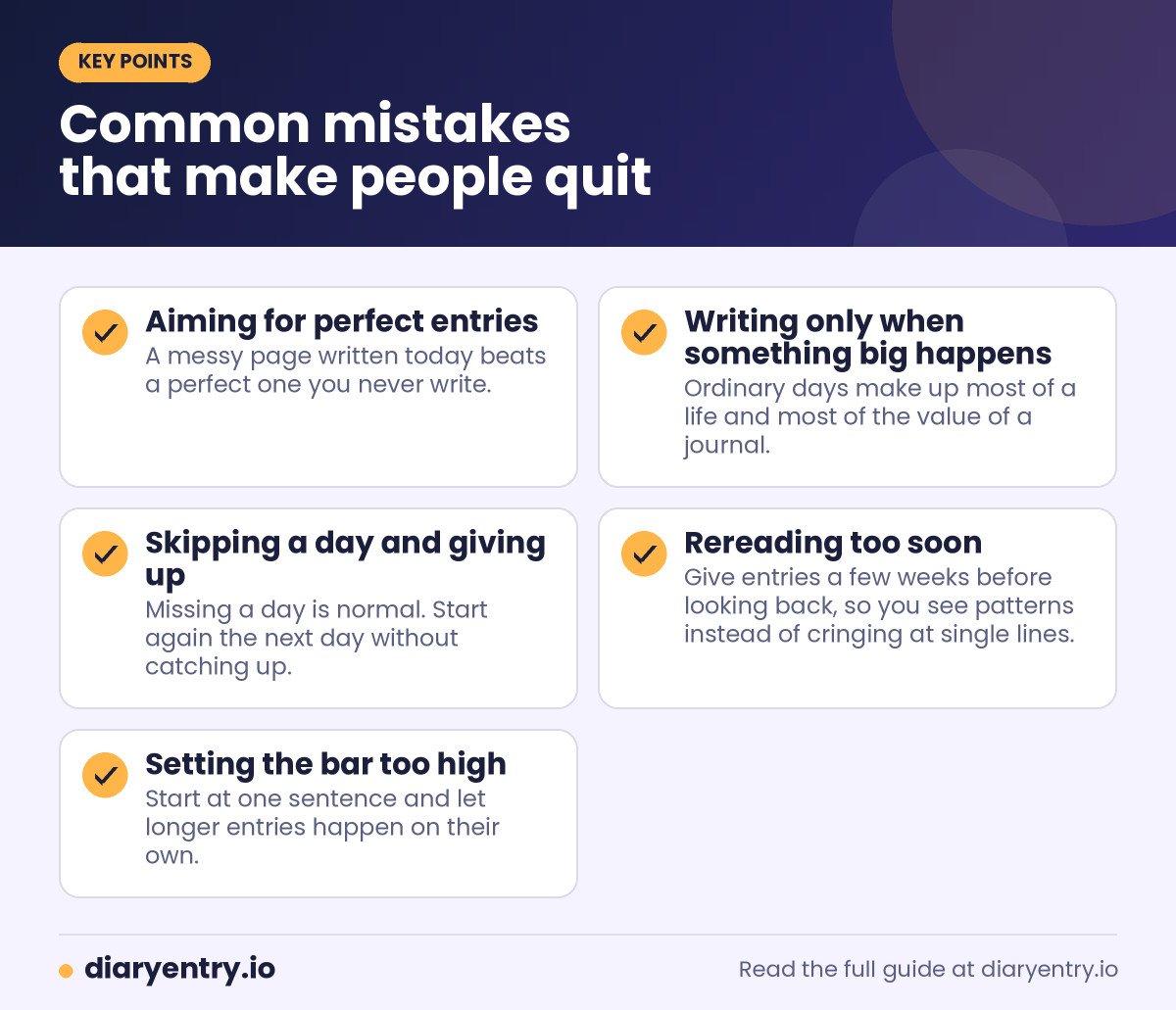
Common mistakes that make people quit
- Aiming for perfect entries. A messy page written today beats a perfect one you never write.
- Writing only when something big happens. Ordinary days make up most of a life and most of the value of a journal.
- Skipping a day and giving up. Missing a day is normal. Start again the next day without catching up.
- Rereading too soon. Give entries a few weeks before looking back, so you see patterns instead of cringing at single lines.
- Setting the bar too high. Start at one sentence and let longer entries happen on their own.
A note on when journaling is not enough
Journaling is a useful self-help habit, but it is not a replacement for professional support. If your entries keep returning to feelings that are overwhelming or that affect your daily life, consider speaking to a qualified mental health professional.
Frequently asked questions
How long should a daily journal entry be?
As long as you like, but start with one to five sentences. Five minutes a day is enough to build the habit.
What is the best time of day to journal?
The best time is the one you will stick to. Mornings suit planning and clearing your head; evenings suit review and reflection.
Should I write by hand or on a device?
Either works. Handwriting feels slower and more reflective, while apps are searchable and always with you. Choose the one you are more likely to open every day.
What if I miss a day?
Just write the next day. Do not try to fill in the gap with a long entry; a single line about what you remember is enough.
How is a daily journal different from a diary?
The words are often used interchangeably. A diary usually records events and feelings, while a journal can also hold goals, ideas, lists and reflections. Our guide to the types of journals explains the differences, and our pages on what a journal is and what a diary is cover the basics.