

Quick Answer
The formal letter format is a fixed layout used for official, business and school correspondence. It runs in order: sender’s address, date, receiver’s address, subject line, salutation, body paragraphs, complimentary close and signature. Keep the tone polite, the language precise and the message focused on one clear purpose.
Key Takeaways
- A formal letter follows a set order of parts, so readers can find the purpose quickly.
- The subject line states the purpose in one short phrase and is placed after the salutation in most school formats.
- The closing depends on the salutation: “Yours faithfully” after “Dear Sir or Madam”, “Yours sincerely” after a name.
- Short paragraphs, polite wording and one request per letter make a formal letter effective.
- Proofreading names, dates and addresses prevents the most common lost marks and lost replies.
What Is a Formal Letter?
A formal letter is a written message sent to someone you do not know personally, or to a person or organisation you must address with respect. Typical readers are principals, editors, managers, government offices, banks and companies. The purpose is practical: you want something done, explained, approved or corrected.
Because the reader may be busy, a formal letter gets to the point quickly. It avoids slang, jokes, abbreviations and emotional language. It also keeps a record, which is why dates, references and exact details matter.
If you want a friendly letter to a relative or friend instead, read our guide to the informal letter format. The two formats differ in tone, layout and closing.
Formal Letter Format: Parts in the Correct Order
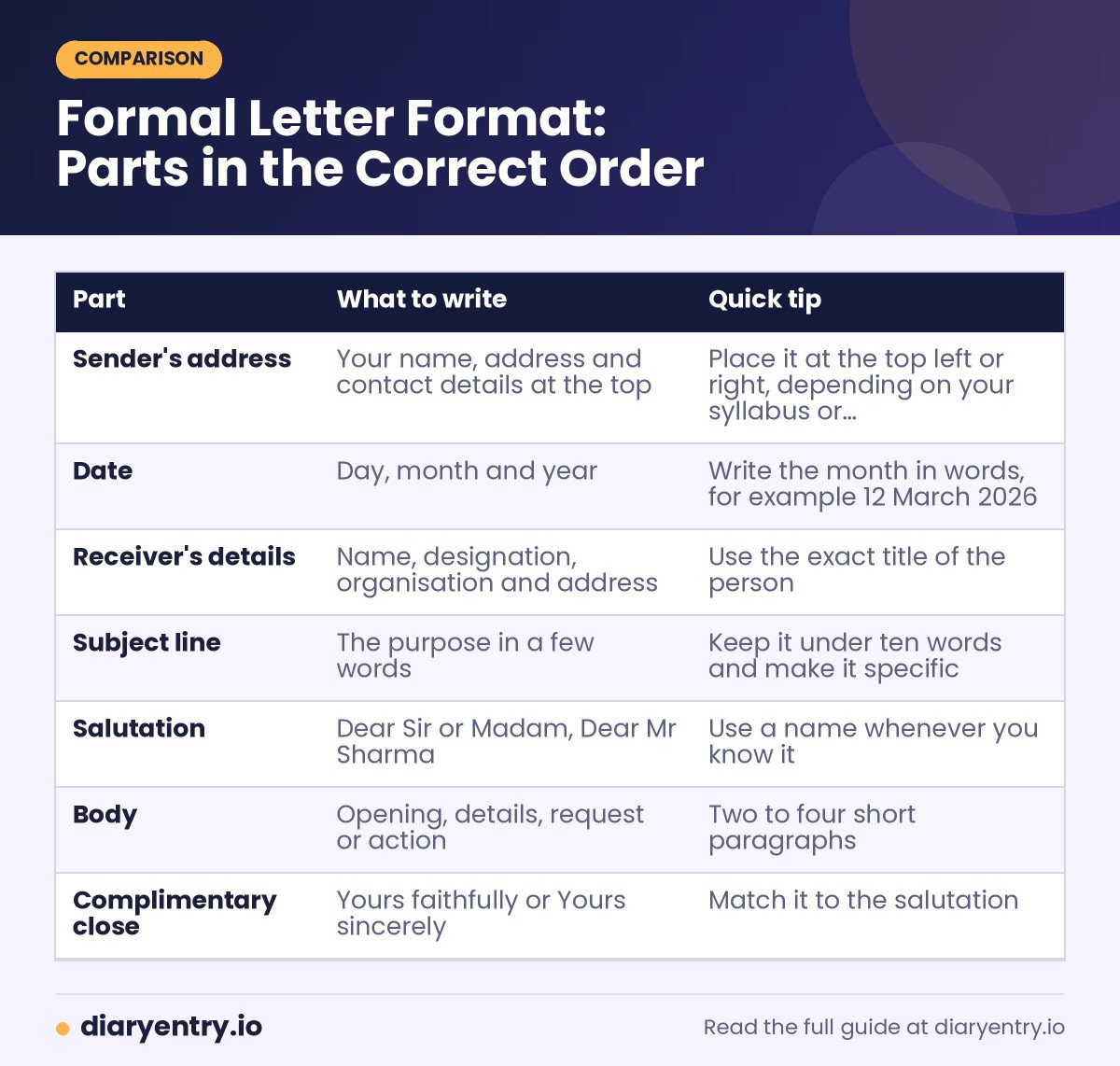
Every standard formal letter format has the same building blocks. The table below shows each part, what goes in it and a quick tip.
| Part | What to write | Quick tip |
|---|---|---|
| Sender’s address | Your name, address and contact details at the top | Place it at the top left or right, depending on your syllabus or company style |
| Date | Day, month and year | Write the month in words, for example 12 March 2026 |
| Receiver’s details | Name, designation, organisation and address | Use the exact title of the person |
| Subject line | The purpose in a few words | Keep it under ten words and make it specific |
| Salutation | Dear Sir or Madam, Dear Mr Sharma | Use a name whenever you know it |
| Body | Opening, details, request or action | Two to four short paragraphs |
| Complimentary close | Yours faithfully or Yours sincerely | Match it to the salutation |
| Signature | Handwritten or typed name, designation | Leave a gap for a handwritten signature |
1. Sender’s Address
Start with your full address and, where useful, a phone number or email. In many school formats the sender’s address sits at the top left. Business letters often use a letterhead that already contains this information.
2. Date
Put the date below the sender’s address. Write the month as a word to avoid confusion between day-month and month-day styles. Do not abbreviate the year.
3. Receiver’s Address
Write the name and designation of the person you are writing to, then the organisation and its address. When you do not know a name, use the job title, such as “The Principal” or “The Editor”. This block helps the letter reach the right desk.
4. Subject Line
The subject line tells the reader why you are writing before they read a single paragraph. Examples are “Request for a transfer certificate” or “Complaint about delayed delivery of order 4471”. Avoid vague lines such as “Request” or “Regarding my problem”.
5. Salutation
Use “Dear Sir or Madam” when you do not know the name. Use “Dear Mr Sharma” or “Dear Ms Rao” when you do. Avoid “Hello” and avoid first names in strict formal contexts.
6. Body of the Letter
The body usually has three parts. The first paragraph states why you are writing. The middle paragraph gives the necessary details, dates and reasons. The last paragraph states what you want the reader to do and thanks them for their time.
7. Complimentary Close and Signature
Close with “Yours faithfully” if you began with “Dear Sir or Madam”. Close with “Yours sincerely” if you began with a name. Then add your signature, your typed name and, if relevant, your designation or class and roll number.
Block Format vs Semi-Block Format
Two layouts are common. In the block format, every part starts at the left margin and paragraphs are separated by a blank line. It is clean, fast to type and the standard in most offices. In the semi-block format, the sender’s address, date and closing move to the right side, and paragraphs may be indented.
Follow whichever format your exam board, school or employer specifies. When nothing is specified, the block format is a safe choice because it is easy to read on screen and on paper.
Step-by-Step: How to Write a Formal Letter
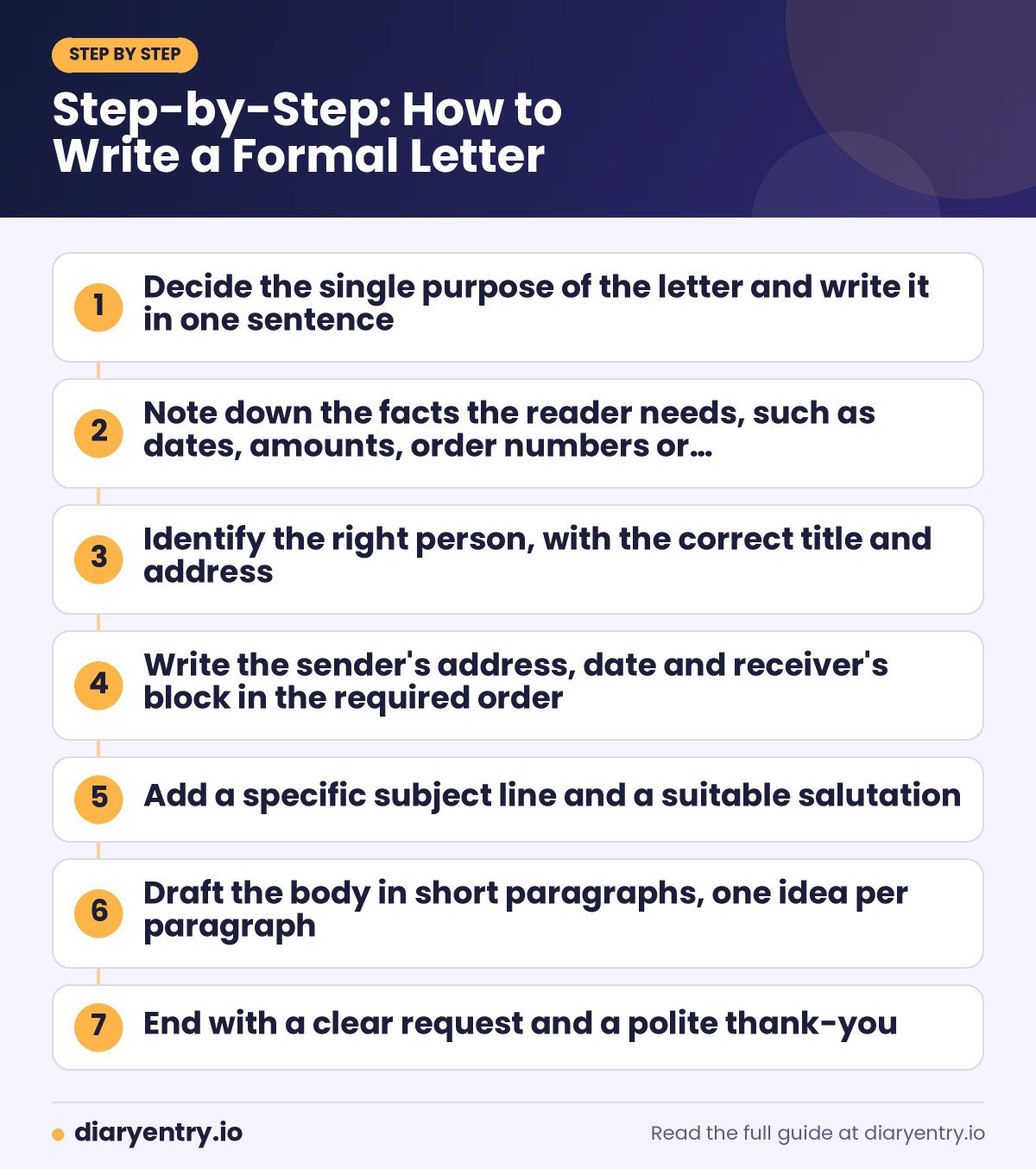
Use this process whenever you face a blank page.
- Decide the single purpose of the letter and write it in one sentence.
- Note down the facts the reader needs, such as dates, amounts, order numbers or reasons.
- Identify the right person, with the correct title and address.
- Write the sender’s address, date and receiver’s block in the required order.
- Add a specific subject line and a suitable salutation.
- Draft the body in short paragraphs, one idea per paragraph.
- End with a clear request and a polite thank-you.
- Choose the matching complimentary close and sign.
- Proofread for spelling, tone and missing details.
Formal Letter Sample 1: Application for Leave
Sender’s address: 24, Green Park, Pune – 411001
Date: 14 March 2026
To: The Principal, Sunrise Public School, Pune
Subject: Application for three days of leave
Dear Sir or Madam,
I am a student of Class 10-B, Roll No. 18. I request leave from 17 March to 19 March 2026 because I must attend a family wedding out of town.
I will complete all missed homework and take notes from my classmates. I kindly request you to grant me leave for these days.
Thank you for your consideration.
Yours faithfully,
Aarav Mehta
Formal Letter Sample 2: Complaint to a Company
Sender’s address: 8, Lake Road, Jaipur – 302001
Date: 2 June 2026
To: The Customer Care Manager, BrightHome Appliances, Jaipur
Subject: Complaint about a defective mixer grinder, order 55820
Dear Sir or Madam,
I purchased a mixer grinder from your online store on 20 May 2026 (order 55820). The motor stopped working on the third day of use.
I have attached the invoice and a photograph of the product. I request a replacement or a full refund within seven working days.
I look forward to your prompt reply.
Yours faithfully,
Neha Kapoor
Formal Letter Sample 3: Job Application Letter
Sender’s address: 41, Park Street, Kolkata – 700016
Date: 5 July 2026
To: The Hiring Manager, Orion Textiles, Kolkata
Subject: Application for the post of Marketing Assistant
Dear Mr Banerjee,
I am writing to apply for the post of Marketing Assistant advertised on your website on 1 July 2026. I hold a bachelor’s degree in commerce and have completed a six-month internship in social media planning.
My resume is attached. I would welcome the chance to discuss how my skills can support your team.
Thank you for your time.
Yours sincerely,
Rohan Das
Formal Letter Sample 4: Letter to the Editor
Sender’s address: 17, Civil Lines, Lucknow – 226001
Date: 9 August 2026
To: The Editor, The Daily Chronicle, Lucknow
Subject: Need for better street lighting in Civil Lines
Dear Sir or Madam,
Through your newspaper I wish to draw the attention of the municipal authorities to the poor street lighting in Civil Lines. Several lamps have remained broken for over a month.
The dark roads make walking unsafe for women, children and older residents. I request the authorities to repair the lamps at the earliest.
Yours faithfully,
Priya Singh
Formal Letter Sample 5: Request for Information
Sender’s address: 3, Hill View, Shimla – 171001
Date: 11 September 2026
To: The Admissions Officer, Himalaya College, Shimla
Subject: Request for information about the BA English programme
Dear Sir or Madam,
I plan to apply for the BA English programme next year. Could you please send details about eligibility, fee structure and the last date for applications?
I would be grateful for a reply by email or post.
Yours faithfully,
Kabir Thakur
Formal vs Informal Letter: Quick Comparison
Students often mix the two styles under exam pressure. This comparison keeps them apart.
| Feature | Formal letter | Informal letter |
|---|---|---|
| Reader | Official, manager, editor or institution | Friend or family member |
| Tone | Polite, precise, impersonal | Warm, personal, relaxed |
| Subject line | Required in most formats | Not used |
| Salutation | Dear Sir or Madam, Dear Mr Rao | Dear Rohan, Dear Mom |
| Closing | Yours faithfully, Yours sincerely | Love, Yours lovingly, Take care |
| Language | No slang or contractions | Contractions and idioms are fine |
For more guidance on writing for different readers, see our letter writing for Class 10 guide, which covers exam-style questions and marking expectations.
Tone and Language Tips for Formal Letters
Good formal writing is simple, not complicated. Choose plain words over long ones and keep sentences short. Use “I would like to request” instead of “gimme” and “I am writing to inform you” instead of “just letting you know”.
Be polite even when you are complaining. A calm, factual complaint is more likely to get a response than an angry one. State what happened, what you want and by when. Our complaint letter format guide shows this in full.
Avoid these habits:
- Using slang, emojis or text-message abbreviations.
- Writing one long paragraph that mixes several requests.
- Using exaggerated words such as “terrible” or “worst” without facts.
- Repeating the same point in different words.
Common Mistakes to Avoid
Most lost marks and lost replies come from a few repeated errors. Check your letter against this list before sending it.
- Missing subject line, or a subject line that is too vague.
- Mismatched salutation and closing, such as “Dear Sir or Madam” followed by “Yours sincerely”.
- Wrong or missing date and address blocks.
- Casual language and contractions.
- No clear request in the final paragraph.
- Spelling errors in the receiver’s name or designation.
A good habit is to read the letter once aloud. If a sentence sounds like something you would say to a friend, rewrite it.
Formal Letter Format for Email
Email has changed how formal letters are sent, but the logic is the same. The subject line becomes the email subject, and the sender’s and receiver’s addresses are replaced by the email headers. Keep the salutation, body and closing.
Use a short, specific subject, such as “Application for Marketing Assistant – Rohan Das”. Attach documents rather than pasting long text, and mention attachments in the body. End with your full name and contact number, since there is no letterhead.
Quick Checklist Before You Send
Run through this checklist for every formal letter.
- Is the purpose clear in the first two sentences?
- Are the receiver’s name, title and address correct?
- Does the subject line tell the reader exactly why you are writing?
- Do the salutation and closing match?
- Is the tone polite and free of slang?
- Have you included the request and a thank-you?
- Have you checked spelling, dates and figures?

Practice Ideas to Improve Your Letters
Like any writing skill, formal letters improve with regular practice. Choose one situation each week, such as asking for a duplicate certificate or complaining about a late delivery, and write a fresh letter in 150 to 200 words. Compare it with the layout in this guide and mark every part you included. Two useful letters to practise next are the leave application format and the letter to the editor format.
Keeping a short daily writing habit also helps. The 4-Week Diary Entry Course is built to help students and adults write a little every day, which can make structured writing like letters feel more natural. For short official messages, you can also compare the structure with a notice writing format, and for factual accounts see our report writing format for Class 12.
Frequently Asked Questions
What is the correct formal letter format?
The correct formal letter format includes the sender’s address, date, receiver’s address, subject line, salutation, body, complimentary close and signature, in that order. Some schools place the subject before the salutation, so follow your syllabus.
Where does the subject line go in a formal letter?
In most school and exam formats, the subject line comes after the salutation. In some business formats, it comes before the salutation. Follow the format your teacher or employer uses and stay consistent.
When do I use “Yours faithfully” and “Yours sincerely”?
Use “Yours faithfully” when you begin with “Dear Sir or Madam”. Use “Yours sincerely” when you begin with a person’s name, such as “Dear Mr Sharma”.
How long should a formal letter be?
Most formal letters are 120 to 200 words in school exams and about one page in professional settings. Aim for short, focused paragraphs and include only details the reader needs.
Can I use contractions in a formal letter?
No. Write “do not” instead of “don’t” and “I am” instead of “I’m”. Avoiding contractions keeps the tone official and polite.
What is the difference between formal and informal letters?
A formal letter is written to officials, companies or unknown readers in a polite, impersonal tone with a subject line. An informal letter is written to friends or family in a relaxed, personal tone without a subject line.
Conclusion
The formal letter format becomes easy once you remember the order of its parts and the purpose of each one. Choose a clear subject, keep the tone polite, make one request and match your closing to your salutation. Use the samples above as models, adapt the details to your own situation and practise regularly so that formal letters feel like a normal part of your writing toolkit.