

Quick Answer
The essay writing format is a three-part structure made up of an introduction, body paragraphs and a conclusion. The introduction hooks the reader and states the thesis, each body paragraph develops one point with evidence, and the conclusion restates the main idea. A clear title, logical order and formal tone complete the format.
Key Takeaways
- Every standard essay follows an introduction, body and conclusion structure.
- A strong thesis statement gives the essay a clear direction and purpose.
- Each body paragraph should cover one main idea, supported by an example or evidence.
- The best structure depends on the type of essay, such as narrative, descriptive, expository or argumentative.
- Planning an outline before writing saves time and improves marks.
What Is an Essay?
An essay is a short, structured piece of writing that explores one topic from a particular point of view. It can describe, explain, argue or tell a story, but it always has a central idea that holds the piece together.
Unlike a diary entry, which is private and informal, an essay is written for a reader and follows a planned structure. If you want to see the difference, compare it with our guide on how to write a diary entry.
The Basic Essay Writing Format
Almost every essay, from a Class 8 paragraph to a university paper, builds on the same skeleton. The table below shows how the parts fit together.
| Part | Purpose | Typical length |
|---|---|---|
| Title | Tells the reader what the essay is about | One short line |
| Introduction | Hooks the reader, gives background, states the thesis | 10 to 15 percent of the essay |
| Body paragraphs | Develop the main points with examples and evidence | 70 to 80 percent of the essay |
| Conclusion | Sums up the argument and leaves a final thought | 10 percent of the essay |

The Introduction
A good introduction does three jobs. First, it opens with a hook, such as a surprising fact, a question, a short anecdote or a bold statement. Second, it gives a sentence or two of background so the reader understands the topic. Third, it ends with a thesis statement that names your main idea.
The Thesis Statement
The thesis is the most important sentence in your essay. It tells readers what you will say and often hints at how. A weak thesis simply names a topic: “This essay is about pollution.” A strong thesis takes a clear position: “Pollution in cities can be reduced most effectively through public transport and stricter waste rules.”
The Body Paragraphs
Each body paragraph should focus on one idea. A reliable pattern is the PEEL structure.
- Point: open with a topic sentence that states the main idea.
- Evidence: give a fact, example, quote or observation that supports it.
- Explanation: explain how the evidence proves the point.
- Link: connect back to the thesis or lead into the next paragraph.
Aim for four to six sentences in each paragraph. Use linking words such as “however”, “in addition” and “as a result” to keep the flow smooth.
The Conclusion
The conclusion should not introduce new arguments. Restate the thesis in fresh words, summarise the key points briefly and end with a closing thought, a recommendation or a question for the reader to consider.
Step-by-Step: How to Write an Essay
Follow this process for any essay topic.
- Read the question carefully and underline the key words.
- Brainstorm ideas and note down anything relevant.
- Choose three or four main points and discard weaker ones.
- Write a one-sentence thesis statement.
- Create an outline listing each paragraph and its point.
- Write the introduction, body and conclusion in that order.
- Add transitions between paragraphs.
- Revise for clarity, then proofread for spelling and grammar.

Types of Essays and Their Formats
Not all essays work the same way. The format stays the same, but the content and tone change with the type.
| Essay type | Goal | Key features |
|---|---|---|
| Narrative | Tell a story | First person, sequence of events, personal reflection |
| Descriptive | Paint a picture | Sensory detail, figurative language, vivid imagery |
| Expository | Explain or inform | Facts, definitions, clear logical order |
| Argumentative | Convince the reader | Thesis, evidence, counterarguments, strong conclusion |
| Persuasive | Move the reader to act | Emotional appeal, call to action |
Narrative Essay
A narrative essay tells a story from your own experience. It has a beginning, a turning point and an ending, and it usually carries a lesson or insight. Use the first person and a natural, engaging voice.
Descriptive Essay
A descriptive essay focuses on a person, place or object and helps the reader see it. Use sensory detail, precise words and a logical order. Our guide to descriptive writing covers these techniques in depth.
Expository Essay
An expository essay explains a topic using facts and clear reasoning. Typical subjects include how something works, the causes of an event or a comparison between two things. Keep the tone neutral and avoid personal opinion.
Argumentative Essay
An argumentative essay takes a position and defends it with evidence. A strong one also addresses the opposing view and explains why it is weaker. Structure it as thesis, supporting arguments, counterargument and rebuttal, then conclusion.
Persuasive Essay
A persuasive essay is similar but leans more on emotion, values and a direct appeal. It often ends with a clear call to action.
Sample Essay Outline
This outline works for an argumentative essay on a school topic.
Topic: Should students keep a daily journal?
Introduction: Hook with a short anecdote about a student who forgot what they learned. Give background on journaling in schools. Thesis: a daily journal helps students think clearly, remember more and write better.
Body paragraph 1: Journaling improves memory and reflection. Example: reviewing what was learned at the end of each day.
Body paragraph 2: Journaling builds writing skills. Example: regular practice improves vocabulary and sentence control.
Body paragraph 3: Journaling supports well-being. Example: writing down worries can make them easier to manage.
Counterargument: Some students say they do not have time. Response: five minutes a day is enough.
Conclusion: Restate the thesis, summarise the three benefits and end with an invitation to try a week of journaling.
Short Sample Essay With Annotations
Title: The Value of a Daily Reading Habit
Introduction: A single page read each day may seem small, but over a year it adds up to hundreds of pages. A daily reading habit improves vocabulary, focus and imagination, which makes it one of the simplest ways for students to grow. (Hook, background, thesis.)
Body 1: First, reading builds vocabulary. When students meet new words in context, they learn how those words are used rather than just memorising definitions. Over time, this makes their own writing richer and more precise. (Point, evidence, explanation.)
Body 2: Second, reading strengthens concentration. In an age of constant notifications, sitting with one book for twenty minutes trains the mind to stay with a task. This skill carries over into study and exams. (Point, evidence, explanation.)
Conclusion: In short, a daily reading habit is a small investment with large returns. By reading a little every day, students can expand their vocabulary and sharpen their focus. (Restated thesis, summary, closing thought.)
Essay Format for Exams and School
In board and school exams, the word limit and time are fixed, so structure matters even more. Use these guidelines.
- Plan for two to three minutes before writing.
- Use a title if the question asks for one.
- Write four to five paragraphs for a 250 to 300 word essay.
- Keep paragraphs balanced in length.
- Reserve the last few minutes for proofreading.
Different writing tasks need different formats, so it helps to compare them. For longer formal pieces with a clear audience, see our guides on article writing for Class 12 and the speech writing format. If you also write official messages, the formal letter format shows another fixed structure.
Formatting Rules for Academic Essays
Academic essays add a few conventions. Always follow the specific style guide your institution requires, such as MLA, APA or Chicago. Common rules include a readable font, double spacing, one-inch margins and consistent heading and citation style.
For help with grammar, citations and academic conventions, the Purdue Online Writing Lab is a widely used free reference. Remember to cite every source you use and to write all ideas in your own words.
Transition Words That Connect Your Ideas
Transitions act as signposts that guide readers from one idea to the next. Without them, even good paragraphs can feel like separate fragments. Use them at the start of paragraphs and between sentences, but vary them so the writing does not sound mechanical.
- To add an idea: in addition, moreover, furthermore.
- To contrast: however, on the other hand, despite this.
- To show cause and effect: therefore, as a result, consequently.
- To give an example: for instance, such as, to illustrate.
- To conclude: in short, in conclusion, overall.
A good test is to read only the first sentence of each paragraph. If those sentences, read in order, tell a clear story that supports your thesis, your structure is working. If they do not, reorder the paragraphs or sharpen the topic sentences before polishing the wording.
Common Essay Writing Mistakes
Many weak essays share the same problems. Check your draft for these.
- No clear thesis: the essay wanders without a central point.
- Paragraphs with several ideas: each paragraph should do one job.
- Missing evidence: claims without examples feel empty.
- Repeating the same point: each paragraph should add something new.
- New arguments in the conclusion: the ending should wrap up, not start fresh.
- Informal language: avoid slang and contractions in formal essays.
- Poor proofreading: spelling and grammar errors lower the impression of even good ideas.
Tips to Improve Your Essay Writing
Small habits make a big difference.
- Read the question twice before you start.
- Outline first, even if it is only a few lines.
- Write the thesis before anything else.
- Use specific examples instead of general statements.
- Vary sentence length to keep the reading smooth.
- Read your essay aloud to catch awkward phrases.
- Practise one short essay every week.
Writing regularly is the best way to improve. A daily writing habit, even a few lines in a diary, makes organised writing feel more natural. The 4-Week Diary Entry Course is designed to help you build that habit step by step.
Essay Checklist Before You Submit
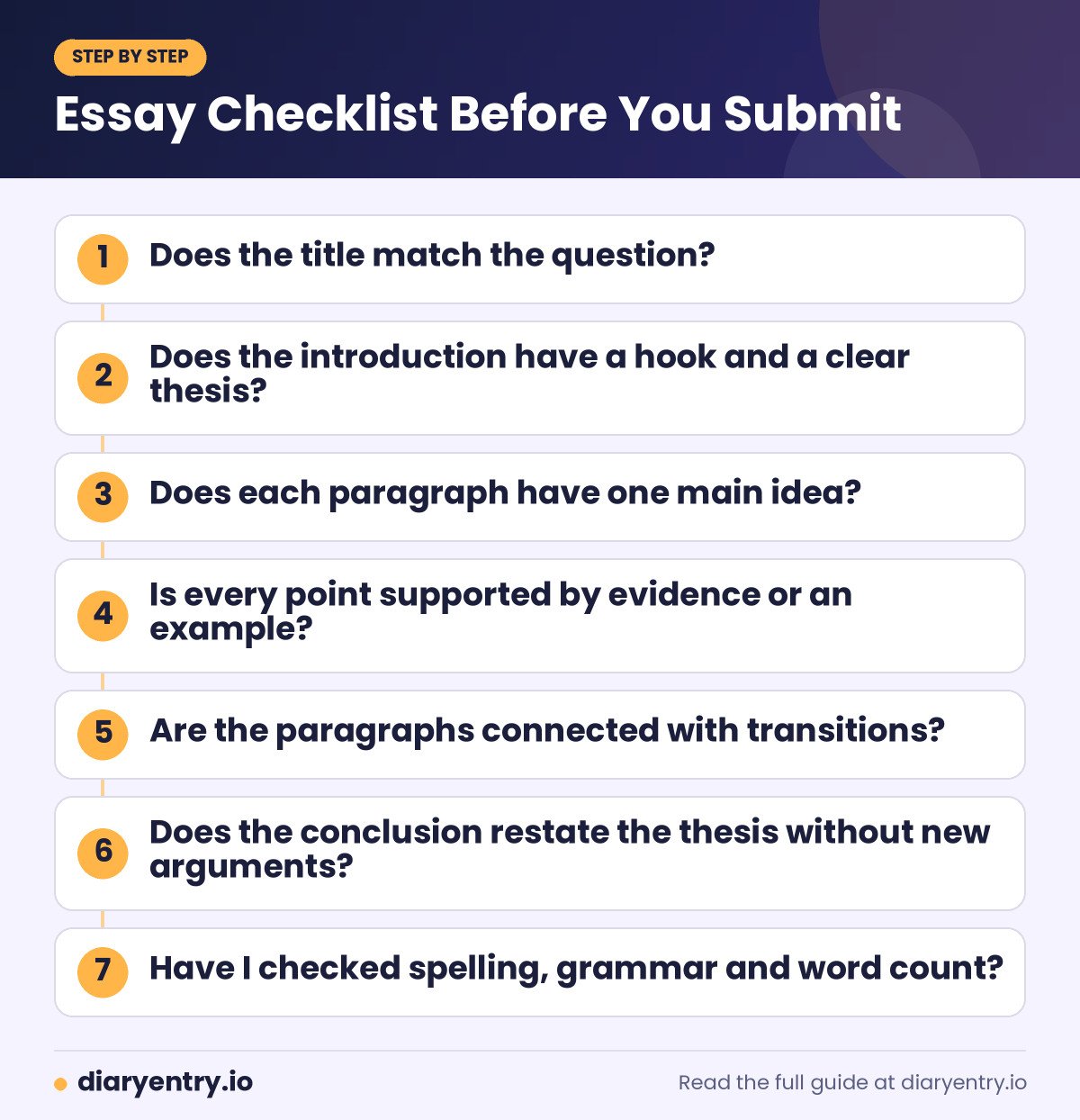
Use this final checklist.
- Does the title match the question?
- Does the introduction have a hook and a clear thesis?
- Does each paragraph have one main idea?
- Is every point supported by evidence or an example?
- Are the paragraphs connected with transitions?
- Does the conclusion restate the thesis without new arguments?
- Have I checked spelling, grammar and word count?
Frequently Asked Questions
What is the basic essay writing format?
The basic essay writing format has an introduction with a thesis statement, several body paragraphs that each develop one point, and a conclusion that sums up the main idea. A title is added where required.
How many paragraphs should an essay have?
A standard school essay has five paragraphs: one introduction, three body paragraphs and one conclusion. Longer essays can have more body paragraphs, depending on the word limit.
What is a thesis statement?
A thesis statement is one or two sentences, usually at the end of the introduction, that state the main idea or argument of the essay. It guides everything that follows.
How do I start an essay?
Start with a hook, such as a surprising fact, a short story, a question or a bold statement. Then give brief background and end the introduction with your thesis.
What are the main types of essays?
The main types are narrative, descriptive, expository, argumentative and persuasive. Each has the same basic structure but a different purpose and style.
How long should an essay be?
Length depends on the assignment. School essays are often 150 to 500 words, while academic essays can run to several thousand. Always follow the word limit you are given.
Conclusion
The essay writing format is simple once you see it as a roadmap: a clear introduction, focused body paragraphs and a firm conclusion. Choose the structure that fits your essay type, plan with an outline and revise carefully. With regular practice, you will be able to organise your thoughts quickly and write essays that are clear, convincing and well structured.