
Good pregnancy journal ideas turn nine ordinary months into a record you will treasure for decades. A pregnancy journal is simply a place to write down what you feel, notice and hope for while you wait for your baby. You can use a notebook, an app or loose pages, and you do not need to write every day. This guide gives you practical ideas, trimester-by-trimester prompts, templates and sample entries so you can start today.
This guide is for general inspiration only. For any medical question about your pregnancy, speak with your doctor or midwife.
What Is a Pregnancy Journal?
A pregnancy journal is a personal record of your pregnancy. Some people treat it as a diary of feelings, while others use it as a scrapbook of appointments, photos and milestones. Many write letters to their unborn child that can be read years later.
It is different from a medical record or a baby book. A medical record tracks health information, and a baby book usually starts at birth. A pregnancy journal fills the gap and captures the waiting, the excitement, the worry and the small daily details.
There is no right way to keep one. If you are new to the habit, our guide on how to start a journal explains the basics in plain steps.
Why Keep a Pregnancy Journal?
People keep pregnancy journals for many reasons. Here are some of the most common ones.
- A keepsake for you and your child: reading about your hopes before they were born can mean a great deal later on.
- A place to process feelings: pregnancy brings a mix of joy and anxiety, and writing gives both somewhere to go.
- A memory aid: the details of appointments, cravings and first kicks fade faster than you expect.
- A shared record: partners and family members can contribute their own notes.
- A calm daily pause: a few minutes of writing can be a quiet break in a busy day.
If you want a wider look at why writing helps, see our article on the benefits of keeping a daily journal.
Pregnancy Journal Formats Compared
Before choosing ideas, choose a format that suits your routine. The table below compares the main options.
| Format | Best for | Strength | Watch out for |
|---|---|---|---|
| Paper notebook | Keepsake lovers | Personal and tactile | Can be hard to keep updated daily |
| Guided pregnancy journal | People who dislike blank pages | Prompts are built in | Less room for free writing |
| Journaling app | Busy people | Fast, searchable, photo friendly | Needs a phone and backup |
| Scrapbook style | Creative people | Rich with photos and mementos | Takes more time |
| Letters to baby | Sentimental writers | Deeply personal | May feel emotional |
If you prefer writing on a screen, our guide to online journaling covers the options and privacy basics.
25 Pregnancy Journal Ideas to Try
You do not need to use all of these. Pick the ones that appeal and ignore the rest.
Ideas for Recording Facts and Milestones
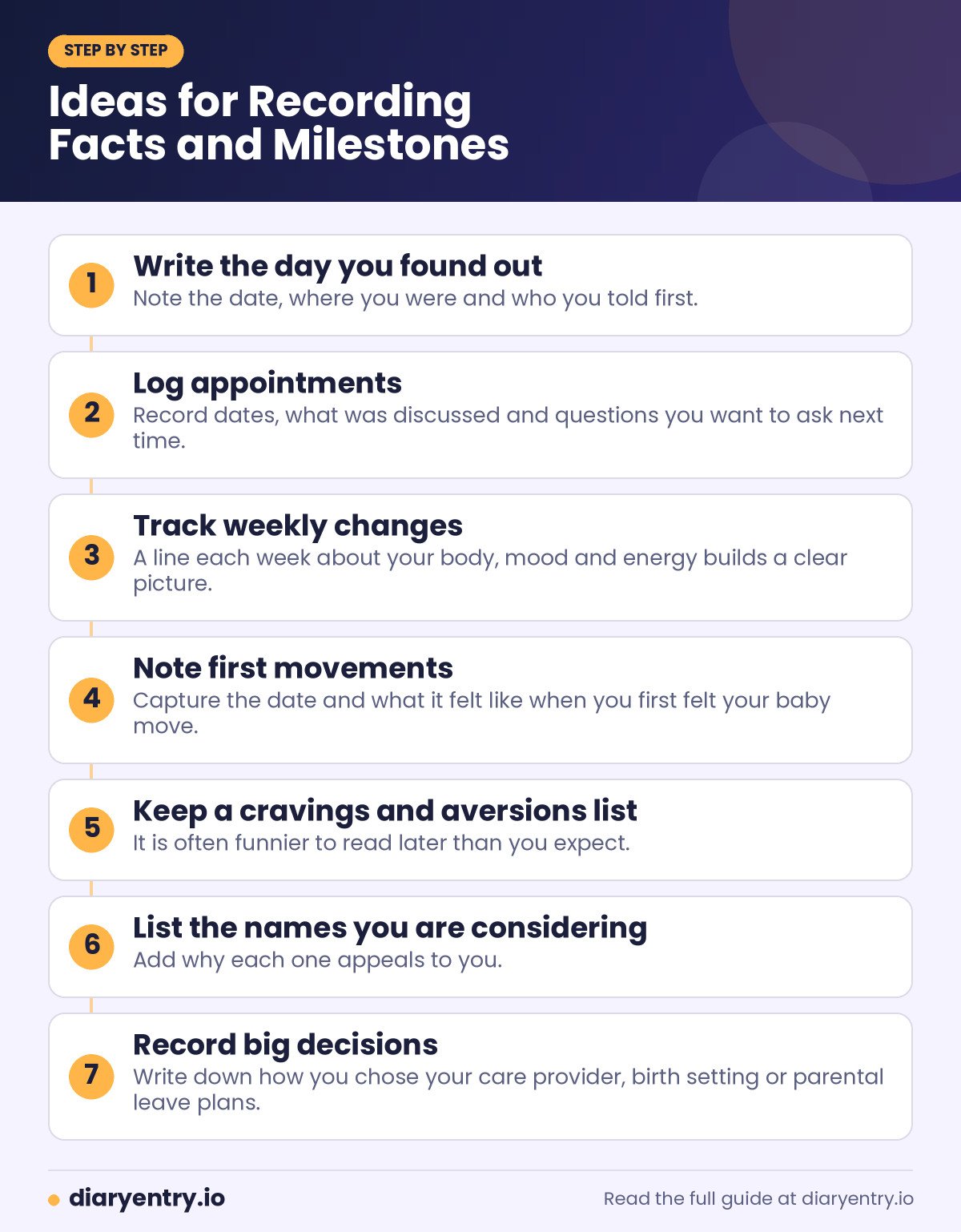
- Write the day you found out. Note the date, where you were and who you told first.
- Log appointments. Record dates, what was discussed and questions you want to ask next time.
- Track weekly changes. A line each week about your body, mood and energy builds a clear picture.
- Note first movements. Capture the date and what it felt like when you first felt your baby move.
- Keep a cravings and aversions list. It is often funnier to read later than you expect.
- List the names you are considering. Add why each one appeals to you.
- Record big decisions. Write down how you chose your care provider, birth setting or parental leave plans.
- Stick in mementos. Add ultrasound pictures, ticket stubs, or a pressed flower from a walk.
Ideas for Feelings and Reflection
- Describe your hopes. What do you hope your child will be like and what do you hope for yourself as a parent?
- Write down your worries. Naming a fear on paper can make it feel smaller.
- Note small joys. One good thing each day, however tiny, is enough.
- Capture how your relationship is changing. Partners often grow closer, and sometimes feel strain. Both are worth recording.
- Write about your own childhood. Think about what you want to repeat and what you want to do differently.
- Record advice you receive. Note which advice was helpful and which you quietly ignored.
- Write a gratitude list. Thank the people helping you through this time. Our gratitude journal guide has more prompts.
Ideas for Connecting With Your Baby
- Write a letter to your baby each trimester. Let it be simple and honest.
- Describe your home as it is now. Your child may love reading about the place they will soon live in.
- Record the world as it is today. Note music you are listening to, books you are reading and what everyday life feels like.
- Write the story of how you met your partner. It becomes a family story to pass down.
- Add a message from grandparents or friends. A few lines from loved ones make a lovely page.
Ideas for Preparing for Birth and Beyond
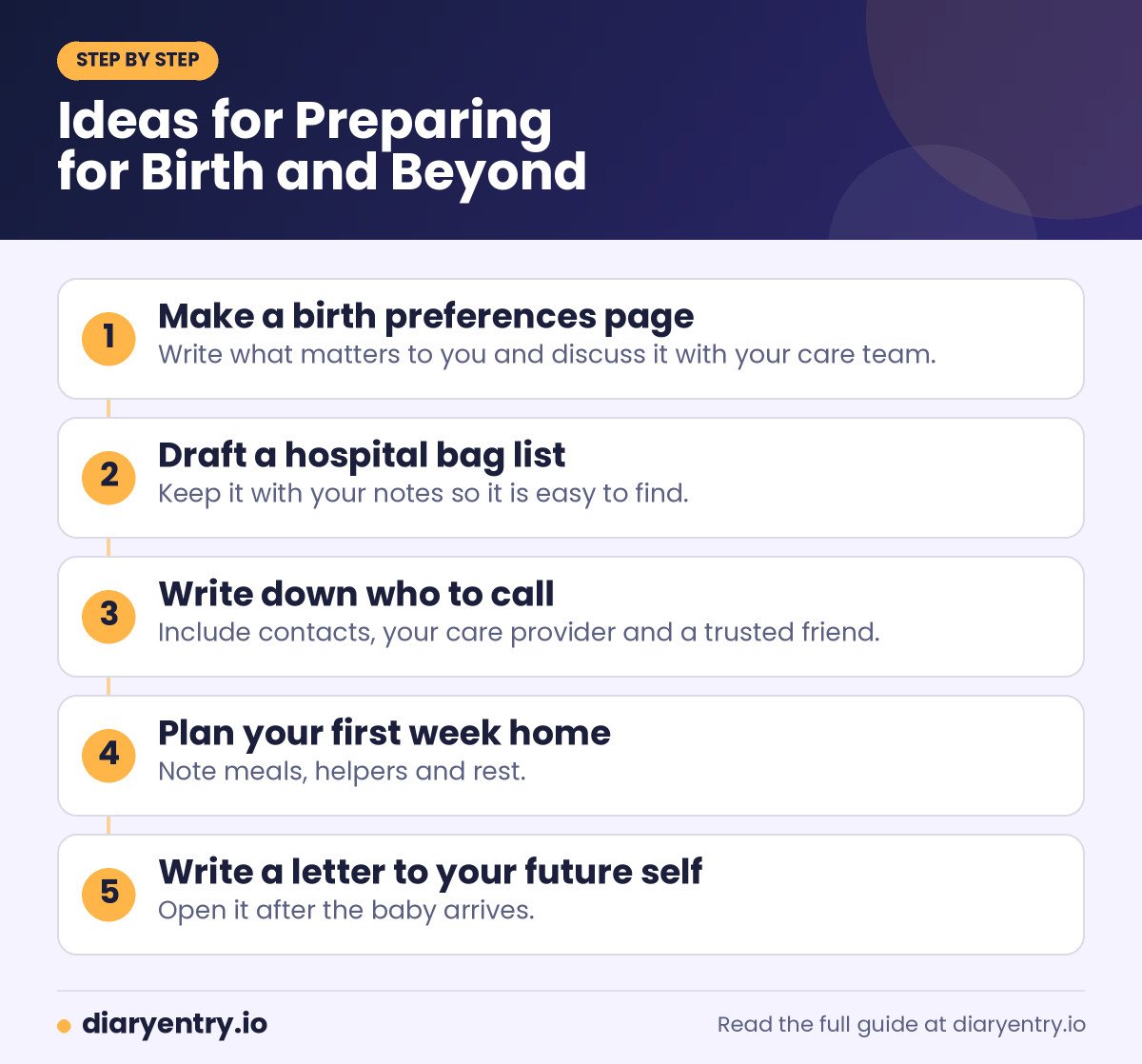
- Make a birth preferences page. Write what matters to you and discuss it with your care team.
- Draft a hospital bag list. Keep it with your notes so it is easy to find.
- Write down who to call. Include contacts, your care provider and a trusted friend.
- Plan your first week home. Note meals, helpers and rest.
- Write a letter to your future self. Open it after the baby arrives.
Pregnancy Journal Prompts by Trimester
Prompts remove the pressure of a blank page. Use these as starting points, and answer in as many or as few sentences as you like.
First Trimester Prompts
- How did I feel when I first found out, and what went through my mind?
- Who knows so far, and how did they react?
- What small changes am I noticing in my body and energy?
- What am I most excited about right now?
- What am I nervous about, and what would help?
Second Trimester Prompts
- How has my mood changed since the early weeks?
- What did it feel like when I first felt my baby move?
- What is my favourite part of this stage?
- How are we preparing our home and our routines?
- What do I want my baby to know about the world they are about to join?
Third Trimester Prompts
- What am I looking forward to most about meeting my baby?
- What worries come up as the due date nears, and who can I talk to?
- What do I want to remember about being pregnant?
- How do I want my first days with my baby to feel?
- What would I like to tell my future self about this time?
A Simple Weekly Pregnancy Journal Template
If you prefer structure, copy this template for each week. It takes about five minutes.
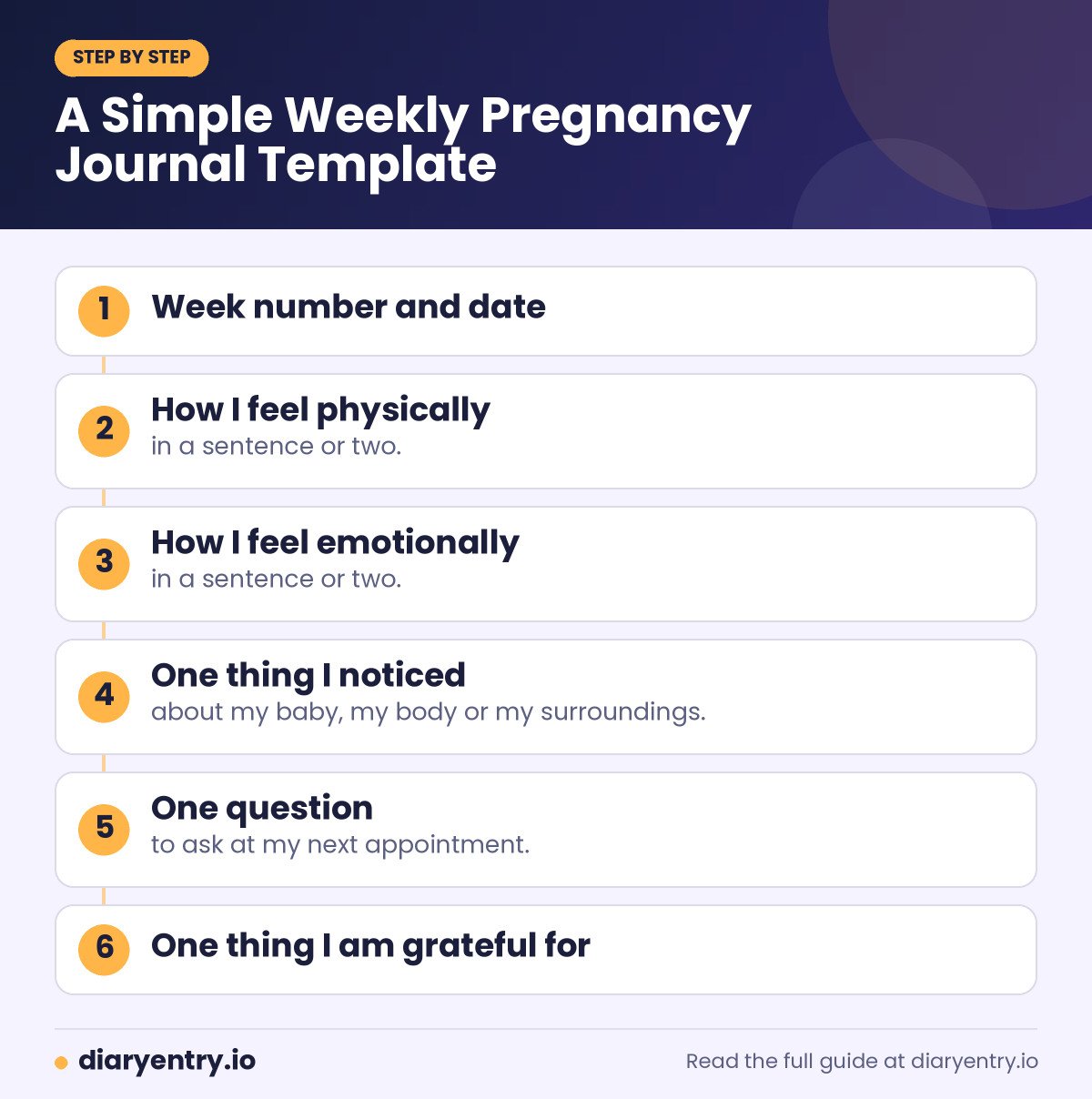
- Week number and date.
- How I feel physically in a sentence or two.
- How I feel emotionally in a sentence or two.
- One thing I noticed about my baby, my body or my surroundings.
- One question to ask at my next appointment.
- One thing I am grateful for.
You can find more layouts to adapt in our diary template guide.
Sample Pregnancy Journal Entries
Seeing real-sounding examples helps when you are unsure what to write. These are short on purpose.
Sample Entry: Early Weeks
Week 7. Tired all afternoon and not hungry until evening. Told only my sister, who cried happy tears on the phone. I keep touching my stomach even though nothing has changed yet. Question for the clinic: which foods should I avoid?
Sample Entry: Feeling Movement
Week 20. Felt a small flutter while lying on the sofa tonight. I held my breath so I would not miss it again. It happened twice. I could not stop smiling and called my partner in from the kitchen.
Sample Entry: Final Weeks
Week 38. The bag is packed and the cot is built. I am excited and a little scared in equal amounts. Tonight we ate dinner slowly and talked about names again. I think I am ready, or ready enough.
Notice that none of these entries is long or polished. Honest and specific beats perfect. For samples of other journal types, see our journal examples.
How to Stay Consistent With Your Pregnancy Journal
Starting is easy and continuing is harder. These habits help.
- Keep your journal somewhere visible, such as next to the bed.
- Link writing to something you already do, like your evening tea.
- Set a low bar, such as three sentences a day or one page a week.
- Do not worry about missed days. Just start again.
- Use photos as prompts when words will not come.
- Ask your partner to add a line each week.
If you want a structured way to build a writing habit, the 4-Week Diary Entry Course offers daily guidance that you can adapt for pregnancy writing.
Common Mistakes to Avoid
Most people who give up on a pregnancy journal do so for simple reasons. Watch out for these.
- Trying to write perfectly. This is a keepsake, not an essay.
- Waiting for the right moment. There is rarely a perfect time, so write in small gaps.
- Only recording happy moments. Hard days are part of the story and often matter most later.
- Putting medical advice in your journal as fact. Record what your care provider told you, but rely on them for guidance.
- Forgetting privacy. If you use an app, set a passcode, and keep paper journals somewhere safe.
- Skipping dates. Always add the date so your story has order.
Ideas for Partners and Family
A pregnancy journal does not have to be only yours. Partners can keep their own pages, and grandparents can add short letters. A partner’s perspective on the day of the first ultrasound or the nesting phase is something many children later love to read.
Here are some ways to include others.
- Let your partner write one page per trimester.
- Ask relatives to write a short note of advice or a family memory.
- Create a shared digital journal for photos and quick updates.
- Add a page where friends write wishes for the baby.
Turning Your Journal Into a Keepsake
After the birth, you can turn your journal into something lasting. Add a photo of your baby to the final page, write a short summary of the birth day, and store the journal with other keepsakes. Some people type their entries into a printed photo book, while others read selected pages aloud on the child’s birthday. A five year journal is a good way to keep recording the early years afterwards.
If you wrote online, export your entries and save a copy in more than one place so nothing is lost.
Frequently Asked Questions
What should I write in a pregnancy journal?
Write about how you feel, what you notice, appointments, cravings, hopes, worries and letters to your baby. There are no rules, so choose whatever feels natural.
When should I start a pregnancy journal?
Any time is fine. Many people start when they find out, but you can begin in the second or third trimester and fill in earlier memories from notes or photos.
How often should I write in my pregnancy journal?
Some people write daily, but weekly entries are enough for most. Choose a rhythm you can keep up without stress.
Is a pregnancy journal the same as a baby book?
No. A baby book usually begins at birth, while a pregnancy journal records the months before. Many families keep both.
Can partners contribute to a pregnancy journal?
Yes. Partners can write their own entries, add letters to the baby or share photos. It often becomes one of the most meaningful parts of the journal.
Should I use a guided journal or a blank notebook?
If blank pages feel intimidating, a guided journal gives you prompts. If you like freedom, a blank notebook or app gives more room. You can also combine them.
Conclusion
The best pregnancy journal ideas are the ones you will actually use. Start with a format you enjoy, pick a few prompts from each trimester, and write short, honest entries rather than perfect ones. Add mementos, letters to your baby and notes from the people who love you. Years from now, those small pages will mean more than you can imagine. If you would like support building a steady writing habit, take a look at the 4-Week Diary Entry Course.