

Quick Answer
Active and passive voice rules explain who or what comes first in a sentence. In active voice the subject performs the action (“The chef cooked the meal”). In passive voice the subject receives it (“The meal was cooked by the chef”). To convert, move the object to the front, add a form of “be” and use the past participle.
Key Takeaways
- In active voice the subject does the action; in passive voice the subject receives the action.
- The passive is built with a form of “be” plus the past participle of the main verb.
- The tense of the passive sentence is shown by the form of “be”, not by the participle.
- Only transitive verbs, which take an object, can be turned into the passive.
- Use the passive when the doer is unknown, unimportant or deliberately left out; otherwise active is usually clearer.
What Are Active and Passive Voice?
Voice describes the relationship between the subject of a sentence and its verb. In an active sentence, the subject is the doer: “Maya wrote the letter.” The focus is on Maya. In a passive sentence, the focus shifts to the receiver of the action: “The letter was written by Maya.” The same event is described, but a different part of it is placed first.
Understanding active and passive voice rules matters for school exams, competitive tests and everyday writing. Questions asking you to change the voice of a sentence appear in many English papers, and the skill helps you choose the most natural sentence for your purpose.
To follow the rules below comfortably, it helps to be confident about the 12 tenses, because the passive form depends on the tense of the original sentence.
The Basic Rule: How to Form the Passive Voice
Every passive sentence follows the same pattern. Active: Subject + verb + object. Passive: Object (as new subject) + form of “be” + past participle + (by + doer).
Compare these pairs to see the pattern at work:
- Active: The teacher praised the students.
- Passive: The students were praised by the teacher.
- Active: Rohan is painting the wall.
- Passive: The wall is being painted by Rohan.
Notice three changes. The old object becomes the new subject, the verb changes to a form of “be” plus the past participle, and the old subject moves to the end after “by” (or disappears).
How to Change Active Voice to Passive Voice: Step by Step
Use these steps every time. They work for every tense.
- Identify the subject, the verb and the object in the active sentence.
- Move the object to the front so it becomes the subject of the new sentence.
- Find the tense of the active verb, and choose the matching form of “be” for the same tense.
- Change the main verb into its past participle (third form): write, wrote, written.
- Add “by” plus the old subject at the end, or leave it out if it is unimportant.
- Check that the verb agrees with the new subject in number.

Example: “They will announce the results tomorrow.”
Step 1: subject “They”, verb “will announce”, object “the results”. Steps 2 and 3: “The results” + “will be” (future simple, so will + be). Step 4: announced. Step 5: by them (usually dropped). Result: “The results will be announced tomorrow.”
Active and Passive Voice Rules for All Tenses
The table below shows the passive form of each common tense. Learn the “be” pattern, and you can build the passive for any sentence.
| Tense | Active | Passive | Pattern |
|---|---|---|---|
| Simple present | She writes a letter. | A letter is written by her. | am/is/are + past participle |
| Present continuous | She is writing a letter. | A letter is being written by her. | am/is/are + being + past participle |
| Present perfect | She has written a letter. | A letter has been written by her. | has/have + been + past participle |
| Simple past | She wrote a letter. | A letter was written by her. | was/were + past participle |
| Past continuous | She was writing a letter. | A letter was being written by her. | was/were + being + past participle |
| Past perfect | She had written a letter. | A letter had been written by her. | had + been + past participle |
| Simple future | She will write a letter. | A letter will be written by her. | will + be + past participle |
| Future perfect | She will have written a letter. | A letter will have been written by her. | will + have + been + past participle |
| Modal verbs | She can write a letter. | A letter can be written by her. | modal + be + past participle |
Two points are worth noting. First, perfect continuous tenses (such as “has been writing”) are rarely made passive because the result is clumsy. Second, the future continuous is almost never used in the passive in everyday English.
Rules for Special Sentence Types
Not every sentence is a plain statement. Here is how to handle other common types.
Questions
Keep the question word or auxiliary in its place, then apply the passive pattern.
- Active: Who wrote this poem?
- Passive: By whom was this poem written?
- Active: Did she close the window?
- Passive: Was the window closed by her?
Negative sentences
Add “not” after the first auxiliary: “She did not buy the book” becomes “The book was not bought by her.”
Imperative sentences
Commands change to a form beginning with “Let” or with “You are requested”, depending on the style.
- Active: Close the door.
- Passive: Let the door be closed.
- Active: Please send the report.
- Passive: You are requested to send the report.
Sentences with two objects
Some verbs, such as give, send and show, take a direct and an indirect object. Either one can become the subject.
- Active: The teacher gave the student a prize.
- Passive 1: The student was given a prize by the teacher.
- Passive 2: A prize was given to the student by the teacher.
Sentences with modal verbs
Use the pattern modal + be + past participle: “You must finish the work” becomes “The work must be finished.”
Pronoun changes
When the subject or object is a pronoun, change its form.
| Active pronoun | Becomes in passive |
|---|---|
| I | me |
| we | us |
| he | him |
| she | her |
| they | them |
| me, us, him, her, them | I, we, he, she, they |

For example, “He helped me” becomes “I was helped by him.”
When Should You Use Passive Voice?
Active voice is the default in most writing, but the passive has real uses. Choose it when:
- The doer is unknown: “My bicycle was stolen.”
- The doer is obvious or unimportant: “The road was repaired last month.”
- You want to focus on the receiver: “The patient was taken to the hospital.”
- You want a formal or impersonal tone: “Applications must be submitted by Friday.”
- You want to avoid blaming someone: “A mistake was made in the report.”
Scientific and technical writing often prefers the passive for processes: “The samples were heated to 60 degrees.” In stories and everyday explanations, active voice sounds stronger and more direct.
Active vs Passive Voice: Quick Comparison
| Feature | Active voice | Passive voice |
|---|---|---|
| Focus | The doer | The receiver |
| Structure | Subject + verb + object | Object + be + past participle + by doer |
| Tone | Direct, clear, energetic | Formal, impersonal, neutral |
| Length | Usually shorter | Usually longer |
| Best for | Stories, instructions, everyday writing | Reports, science, when the doer is unknown |
| Example | The storm destroyed the bridge. | The bridge was destroyed by the storm. |
Verbs That Cannot Be Made Passive
Only transitive verbs can be turned into the passive, because they need an object to promote to subject. Intransitive verbs have no object, so they have no passive form.
- “The sun rose” cannot become a passive sentence, because “rose” has no object.
- “She arrived late”, “They slept”, “He fell” and “It happened” are all intransitive.
Some transitive verbs also resist the passive when they describe states: “He has a car” is not normally changed into “A car is had by him”. Verbs like have, resemble, suit, fit and lack rarely work in the passive.
If you want to see how the idea of an object fits into the bigger picture of sentences, our guide to the parts of speech is a useful companion.
Common Mistakes with Active and Passive Voice
These are the errors teachers see most often.
- Using the wrong form of “be”: “The letter is written yesterday” should be “The letter was written yesterday.”
- Using the base verb instead of the participle: “The cake was bake” should be “The cake was baked.”
- Forgetting agreement: “The books was returned” should be “The books were returned.” Our guide to subject verb agreement covers this in detail.
- Keeping the pronoun in the wrong case: “They were helped by I” should be “They were helped by me.”
- Changing the tense by accident: “She is cooking dinner” becomes “Dinner is being cooked”, not “Dinner was cooked”.
- Using the passive too often, which makes writing vague and heavy.
- Trying to make intransitive verbs passive: “The meeting was happened” is wrong.
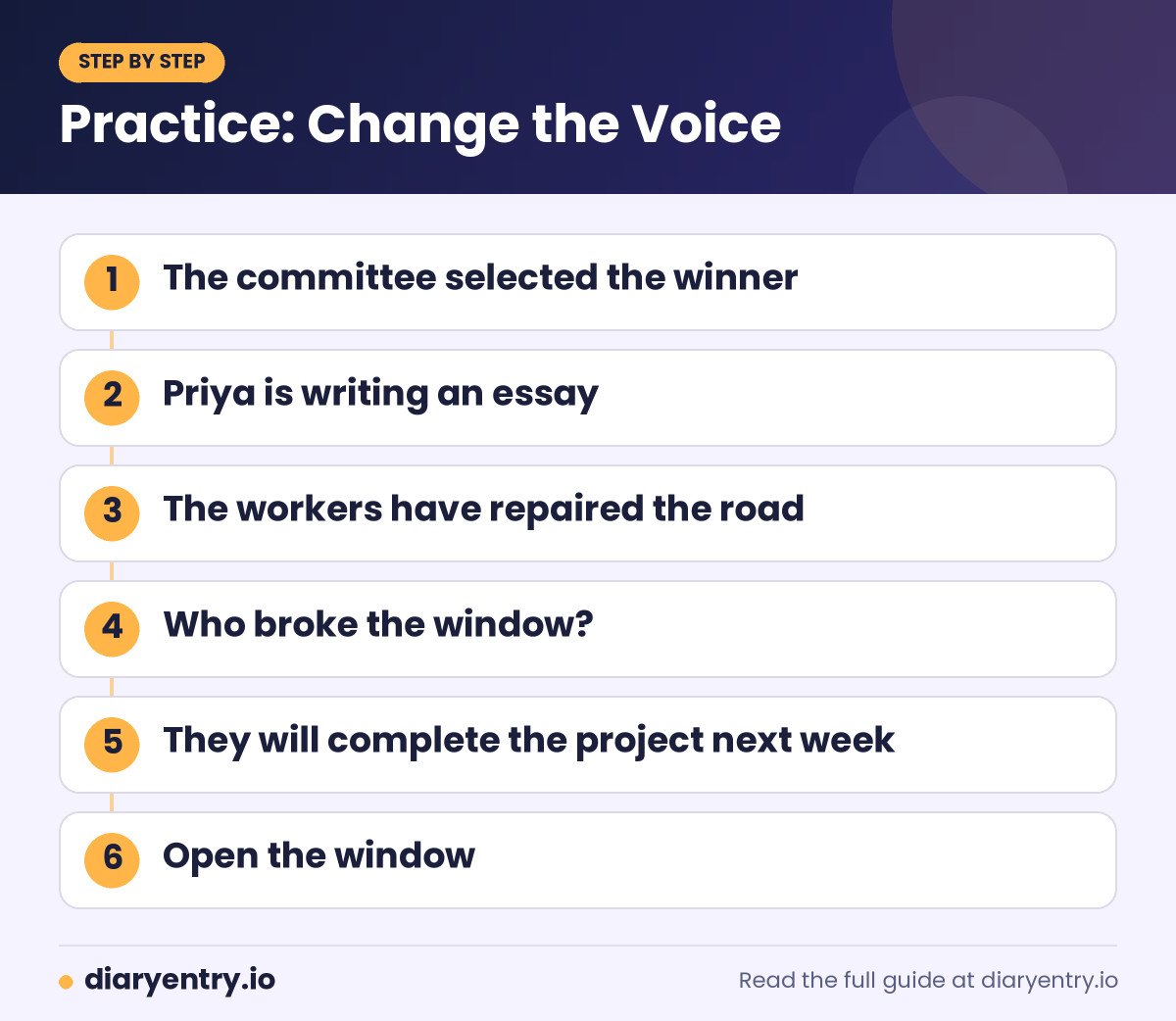
Practice: Change the Voice
Convert each sentence, then check the answers.
- The committee selected the winner.
- Priya is writing an essay.
- The workers have repaired the road.
- Who broke the window?
- They will complete the project next week.
- Open the window.
Answers:
- The winner was selected by the committee.
- An essay is being written by Priya.
- The road has been repaired by the workers.
- By whom was the window broken?
- The project will be completed next week.
- Let the window be opened.
For extra practice, take sentences from a newspaper article or your own diary, and turn each one into the other voice. Doing this with real sentences is much more effective than memorising rules. The same habit helps with direct and indirect speech rules, where you also keep the meaning while changing the structure.
Voice in Everyday Writing: A Quick Example
Consider two versions of the same news line. “Heavy rain damaged hundreds of homes” is active: it is short, vivid and names the cause. “Hundreds of homes were damaged” is passive: it puts the victims first, which suits a report focusing on the people affected. Neither is wrong; the better choice depends on what you want the reader to notice first.
A useful editing habit is to read your draft and highlight every passive sentence. For each one, ask whether the doer matters. If it does, rewrite the sentence in the active voice. If it does not, keep the passive. This small check improves clarity quickly, and it works for letters, essays and diary entries alike.
Frequently Asked Questions
What is the rule of active and passive voice?
In active voice the subject performs the action. In passive voice the subject receives the action, and the sentence uses a form of “be” followed by the past participle of the main verb.
How do you identify passive voice quickly?
Look for a form of “be” (is, was, were, been, being) plus a past participle, such as “was written” or “has been done”. You can also add “by someone” at the end. If it still makes sense, the sentence is probably passive.
Is it wrong to use passive voice?
No. Passive voice is correct grammar and is very useful when the doer is unknown or unimportant. It becomes a problem only when it is overused, which can make writing unclear or dull.
Can all sentences be changed into passive voice?
No. Only sentences with a transitive verb and an object can be changed. Sentences with intransitive verbs, like “The baby slept”, cannot.
How do you change the voice of a question?
Move the object to the front as the new subject, keep the auxiliary in the correct tense, and use the past participle. “Who wrote this?” becomes “By whom was this written?”
Which tense has the most common passive form?
The simple past and the simple present are the most common in everyday use, for example “The house was built in 1990” and “English is spoken here”.
Why do exams ask for voice change?
Voice change tests whether you understand sentence structure, tenses and verb forms together. If you can convert a sentence correctly, you have usually mastered all three.
Conclusion
The active and passive voice rules come down to one idea: decide what you want to emphasise, the doer or the receiver, and build the sentence around it. For the passive, move the object to the front, choose the correct form of “be” for the tense and add the past participle. Check agreement, keep the tense unchanged and use “by” only when the doer matters.
Practice is what makes this automatic. Turn a few sentences from your own writing into the other voice each day, and compare which one reads better. A short daily diary entry is an easy place to notice how often you naturally use each voice, and our 4-Week Diary Entry Course is one way to build that habit.