

Quick Answer
Direct and indirect speech rules explain how to turn a speaker’s exact words (direct speech) into a reported sentence (indirect speech). Remove the quotation marks, add a joining word such as that, if or whether, then shift the tense, pronouns and time or place words to match the reporter’s point of view.
Key Takeaways
- Direct speech quotes the exact words in inverted commas; indirect speech reports the meaning without quotation marks.
- When the reporting verb is in the past tense, the tense of the reported words usually moves one step back.
- Pronouns change according to the speaker, the listener and the reporter.
- Time and place words such as today, here and tomorrow change to that day, there and the next day.
- Questions use if or whether and statement word order; commands use to-infinitives.
- Universal truths, habitual facts and a present-tense reporting verb usually leave the tense unchanged.
What Are Direct and Indirect Speech?
When we repeat what someone said, we have two choices. We can quote the exact words, or we can report their meaning in our own sentence. These two choices are called direct speech and indirect speech. Indirect speech is also known as reported speech, and the two names are used interchangeably in most textbooks.
Here is the same message in both forms.
- Direct: Neha said, “I am reading a novel.”
- Indirect: Neha said that she was reading a novel.
Several things changed. The quotation marks and comma disappeared, the word that joined the two parts, the pronoun I became she, and the verb am reading became was reading. These changes are not random. They follow a small set of rules that this guide explains one at a time.
Every reported sentence has two parts. The reporting clause is the part that tells us who spoke (“Neha said”), and the reported clause is the part that carries the message (“she was reading a novel”). The reporting verb can be said, told, asked, replied, exclaimed, advised, ordered, requested and many more. Choosing the right one makes your sentence more accurate.
The Five Basic Steps of Conversion
Almost every exercise can be solved by following the same routine. Learn the order and practise it until it becomes automatic.
- Identify the type of sentence: statement, question, command or request, or exclamation.
- Remove the inverted commas and put in the correct joining word (that, if, whether, to, or a question word).
- Change the pronouns to suit the reporter’s point of view.
- Shift the tense of the verb if the reporting verb is in the past tense.
- Change the time and place words, then check word order and punctuation.

Rule 1: Change of Tense
When the reporting verb is in the past tense (said, told, asked), the verb inside the reported clause moves one step into the past. This is often called “backshift.” The chart below shows the standard changes. If you are unsure about any tense name, our tenses chart with all 12 tenses is a useful companion.
| Direct speech tense | Indirect speech tense | Example (direct to indirect) |
|---|---|---|
| Simple present | Simple past | “I live here.” became He said he lived there. |
| Present continuous | Past continuous | “I am cooking.” became She said she was cooking. |
| Present perfect | Past perfect | “I have finished.” became He said he had finished. |
| Present perfect continuous | Past perfect continuous | “I have been waiting.” became She said she had been waiting. |
| Simple past | Past perfect | “I saw him.” became She said she had seen him. |
| Past continuous | Past perfect continuous | “I was sleeping.” became He said he had been sleeping. |
| Simple future (will) | Would | “I will call.” became She said she would call. |
| Can / may / shall | Could / might / should | “I can swim.” became He said he could swim. |
Notice that the past perfect does not change further. “I had eaten” stays “he had eaten” in reported speech. Modal verbs such as would, could, should, might and must also usually stay the same.
When the Tense Does Not Change
Backshift is not compulsory in every case. Keep the original tense in these situations.
- The reporting verb is in the present or future tense: “She says, ‘I am tired'” becomes “She says that she is tired.”
- The statement is a universal truth: “The teacher said, ‘The sun rises in the east'” becomes “The teacher said that the sun rises in the east.”
- The statement is a habitual fact that is still true: “He said, ‘I live in Delhi'” can become “He said that he lives in Delhi” if he still does.
- The reported speech is a historical fact or a proverb.
Many exam answers prefer the unchanged tense for universal truths, so treat that as a rule worth memorising.
Rule 2: Change of Pronouns
Pronouns are changed so that they make sense from the reporter’s point of view. A simple formula works for most sentences: first-person pronouns follow the subject of the reporting clause, second-person pronouns follow the object of the reporting clause, and third-person pronouns usually stay the same.
- First person (I, me, my, we, us, our) changes to match the subject of the reporting verb. Direct: Arun said, “I like my school.” Indirect: Arun said that he liked his school.
- Second person (you, your) changes to match the object of the reporting verb. Direct: Mother said to me, “You are late.” Indirect: Mother told me that I was late.
- Third person (he, she, they, it) normally does not change. Direct: Sita said, “He is kind.” Indirect: Sita said that he was kind.
If you need to review what each pronoun type does, read our guide to the types of pronouns. Many reported-speech mistakes come from using the wrong pronoun, not the wrong tense.
Rule 3: Change of Time and Place Words
Words that point to a particular moment or location depend on when and where the sentence was spoken. When the reporter speaks at a different time, these words usually change.
| Direct speech word | Indirect speech word |
|---|---|
| now | then |
| today | that day |
| tonight | that night |
| tomorrow | the next day / the following day |
| yesterday | the previous day / the day before |
| last week | the previous week / the week before |
| next month | the following month |
| ago | before |
| here | there |
| this / these | that / those |
| come | go |
If the reporter speaks on the same day or in the same place, the words need not change. For example, if you report in the same room, “here” can stay “here.” In exams, though, the expected answer almost always uses the changed forms, so apply them unless the question says otherwise.
Reporting Statements
For statements, the reporting verb is usually said or told. Use said without an object and told with an object. After the verb, join the clauses with that, which can be omitted in informal writing. Because that works as a link between two clauses, it is related to the words covered in our guide to conjunctions.
- Direct: Ravi said, “I will meet you tomorrow.”
- Indirect: Ravi said that he would meet me the next day.
- Direct: The manager said to us, “We have completed the project.”
- Indirect: The manager told us that they had completed the project.
Remember that said to becomes told. Writing “said me” or “said to me that” is acceptable in some styles, but “told me” is the standard answer.
Reporting Questions
Questions need extra care because their word order changes. In direct speech the helping verb comes before the subject (“Where are you going?”). In indirect speech the order becomes that of a statement (“where I was going”), and no question mark is used.
Yes/No Questions
Questions that can be answered with yes or no are joined with if or whether, and the reporting verb becomes asked or enquired.
- Direct: She asked, “Do you like tea?”
- Indirect: She asked if I liked tea.
- Direct: He said to me, “Have you seen the film?”
- Indirect: He asked me whether I had seen the film.
Wh- Questions
Questions that begin with what, where, when, why, how or who keep their question word as the link. Only the order of the subject and verb changes.
- Direct: The teacher asked, “Where did you keep the book?”
- Indirect: The teacher asked where I had kept the book.
- Direct: Mohan asked her, “Why are you crying?”
- Indirect: Mohan asked her why she was crying.
Reporting Commands, Requests and Advice
Imperative sentences become to-infinitive clauses. The reporting verb changes to match the force of the sentence: ordered or commanded for a command, requested or begged for a request, advised or urged for advice, and warned for a warning. Negative commands use not to.
- Direct: The officer said to him, “Leave the room.”
- Indirect: The officer ordered him to leave the room.
- Direct: She said, “Please help me.”
- Indirect: She requested them to help her.
- Direct: The doctor said, “Don’t skip your medicine.”
- Indirect: The doctor advised me not to skip my medicine.
- Direct: Rahul said, “Let us go for a walk.”
- Indirect: Rahul suggested that they go for a walk.
Reporting Exclamations and Wishes
Exclamatory sentences become statements with the help of verbs such as exclaimed with joy, cried out with sorrow or said with surprise. Words like alas, hurrah and wow are dropped, and how or what is often changed to very or a great.
- Direct: Priya said, “Wow! What a beautiful painting!”
- Indirect: Priya exclaimed with delight that it was a very beautiful painting.
- Direct: He said, “May you succeed!”
- Indirect: He wished that I might succeed.
Direct and Indirect Speech Chart: Quick Revision
Use this short list to check your work before submitting an answer.
- Statements use that and the reporting verb said or told.
- Yes/No questions use if or whether and the reporting verb asked.
- Wh- questions keep the question word and use statement order.
- Commands and requests use to or not to with verbs such as ordered or requested.
- Exclamations use exclaimed or cried out, with a statement structure.
- Change the tense, pronouns, and time and place words together, not one at a time.

Solved Examples With Explanations
Study these examples slowly. In each case, notice which rule is doing the work.
Example 1. Direct: Amit said to Sonia, “I will bring your notes tomorrow.” Indirect: Amit told Sonia that he would bring her notes the next day. Here said to became told, I became he because the subject is Amit, your became her because the listener is Sonia, will became would, and tomorrow became the next day.
Example 2. Direct: The mother said to the child, “Have you finished your homework?” Indirect: The mother asked the child whether he or she had finished his or her homework. The question is a yes/no question, so whether is used, and have finished became had finished.
Example 3. Direct: “Where are you going tonight?” asked Kavita. Indirect: Kavita asked where I was going that night. The word order changed from “are you going” to “I was going.”
Example 4. Direct: The captain said to the soldiers, “Do not move.” Indirect: The captain ordered the soldiers not to move. A negative command takes not to.
Example 5. Direct: The teacher said, “Honesty is the best policy.” Indirect: The teacher said that honesty is the best policy. The tense stays the same because it is a proverb and a universal truth.
Example 6. Direct: Rita said, “I was ill yesterday, so I could not attend the class.” Indirect: Rita said that she had been ill the previous day, so she could not attend the class. The simple past became past perfect, while could stayed unchanged.
Reported Speech in Conversations and Longer Passages
Exam questions often give a short dialogue and ask you to convert it into one connected passage. The method is the same, but you should vary the reporting verbs so that the paragraph reads naturally. Begin with “said,” then use replied, added, asked, explained or suggested as the context allows. Link sentences with words such as and, then or later so the answer does not look like a list of separate sentences.
Consider a short exchange. Direct: Anita asked, “Will you join the club?” Dev replied, “I will think about it.” Indirect: Anita asked Dev if he would join the club, and he replied that he would think about it. The passage is shorter and smoother than two separate converted sentences. Reported speech is also a key skill in news writing, which is why it appears in our guides to formats such as report writing for Class 12, where speakers are quoted indirectly.
Common Mistakes and How to Avoid Them
- Keeping a question mark in indirect speech. Reported questions are statements in form, so they end with a full stop.
- Keeping question word order. Write “she asked where I lived,” not “she asked where did I live.”
- Changing every pronoun automatically. Only first and second person pronouns normally change; check who is speaking and who is listening.
- Forgetting time words. “Tomorrow” should become “the next day” when the reporting verb is in the past tense.
- Using that with questions and commands. Use if, whether, a question word or to instead.
- Over-correcting the tense. Universal truths and present reporting verbs keep the original tense.
- Using the voice of the quotation. Do not mix direct and indirect forms in a single clause, such as “He said that ‘I am happy’.”
Converting between forms also relates to changing a sentence from active to passive, because both topics train you to keep meaning while changing structure. If you find that skill interesting, try our guide to active and passive voice rules next.
Practice Sentences
Convert each sentence into indirect speech, then compare with the answers below.
- Mina said, “I am learning to drive.”
- The coach said to the team, “Practise every day.”
- Raj asked, “Where did you buy this bag?”
- The guide said, “The Taj Mahal was built in the seventeenth century.”
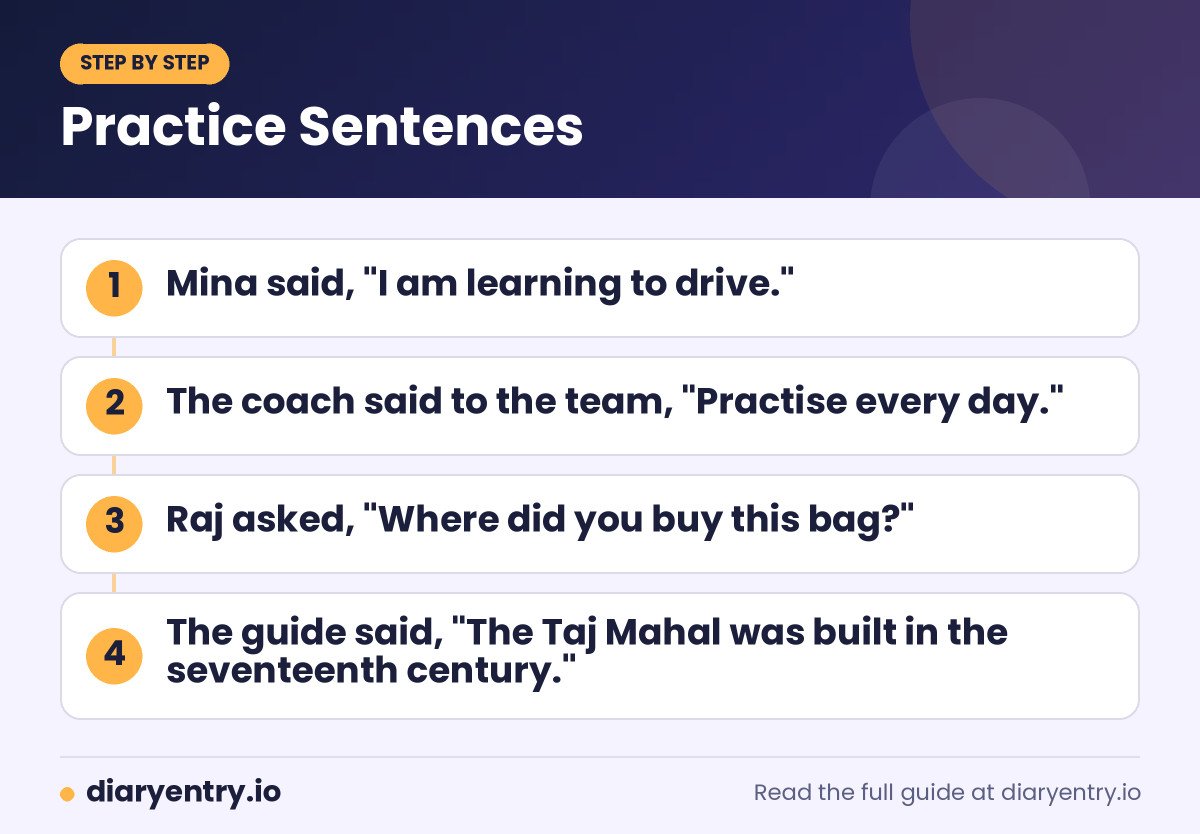
Answers: (1) Mina said that she was learning to drive. (2) The coach advised the team to practise every day. (3) Raj asked me where I had bought that bag. (4) The guide said that the Taj Mahal was built in the seventeenth century. In the last answer, the past tense stays because the event is a historical fact.
Frequently Asked Questions
What is the difference between direct and indirect speech?
Direct speech repeats the exact words of the speaker inside quotation marks. Indirect speech reports the same message in the reporter’s own words, without quotation marks, and usually changes the tense, pronouns and time words.
Why does the tense go back in reported speech?
The speaking happened in the past, so the reported words are moved back to match that time. This is called backshift, and it applies mainly when the reporting verb is in the past tense.
Do I always change the tense in indirect speech?
No. Keep the tense unchanged for universal truths, habitual facts still true now, and any sentence whose reporting verb is in the present or future tense.
How do you change a question into indirect speech?
Use asked as the reporting verb, join yes/no questions with if or whether, keep the question word for wh- questions, and write the rest in statement order without a question mark.
How do you report a command or request?
Use a verb like ordered, requested, advised or warned, followed by the person and a to-infinitive. For negatives, use not to before the verb.
Does “said to” always become “told”?
For statements, yes, said to becomes told. For questions it becomes asked, and for commands it becomes ordered, requested or advised, depending on the meaning.
Are direct and indirect speech the same as reported speech?
Reported speech is another name for indirect speech. Direct speech is the quoted version, and indirect or reported speech is the converted version.
Conclusion
Direct and indirect speech rules look long at first, but they reduce to five steps: identify the sentence type, join the clauses correctly, adjust pronouns, shift the tense, and change the time and place words. Practise with ten sentences a day, say each conversion aloud, and check each change against the charts above. If you want a daily writing habit that naturally lets you report conversations, the 4-Week Diary Entry Course is a gentle way to practise.