

Quick Answer
A tenses chart sorts English verb forms into 12 tenses: past, present, and future, each in simple, continuous, perfect, and perfect continuous form. The tense tells the reader when an action happens and whether it is complete or ongoing. For example, “I write” is simple present, and “I had written” is past perfect.
Key Takeaways
- English has three time frames (past, present, future) and four aspects (simple, continuous, perfect, perfect continuous), which together make 12 tenses.
- Simple tenses state facts and habits, continuous tenses show actions in progress, and perfect tenses show completed actions linked to another time.
- Each tense follows a fixed formula, such as “has/have + past participle” for the present perfect.
- Time words like “yesterday”, “now”, “since”, and “by next week” are strong clues to the correct tense.
- Keeping one tense consistent within a passage is one of the easiest ways to improve your writing.
Tenses Chart: All 12 Tenses at a Glance
This tenses chart shows every tense with its formula and one example. Keep it open while you read the rest of the guide, and come back to it whenever you need a quick check.
| Tense | Present | Past | Future |
|---|---|---|---|
| Simple | I write | I wrote | I will write |
| Continuous | I am writing | I was writing | I will be writing |
| Perfect | I have written | I had written | I will have written |
| Perfect continuous | I have been writing | I had been writing | I will have been writing |
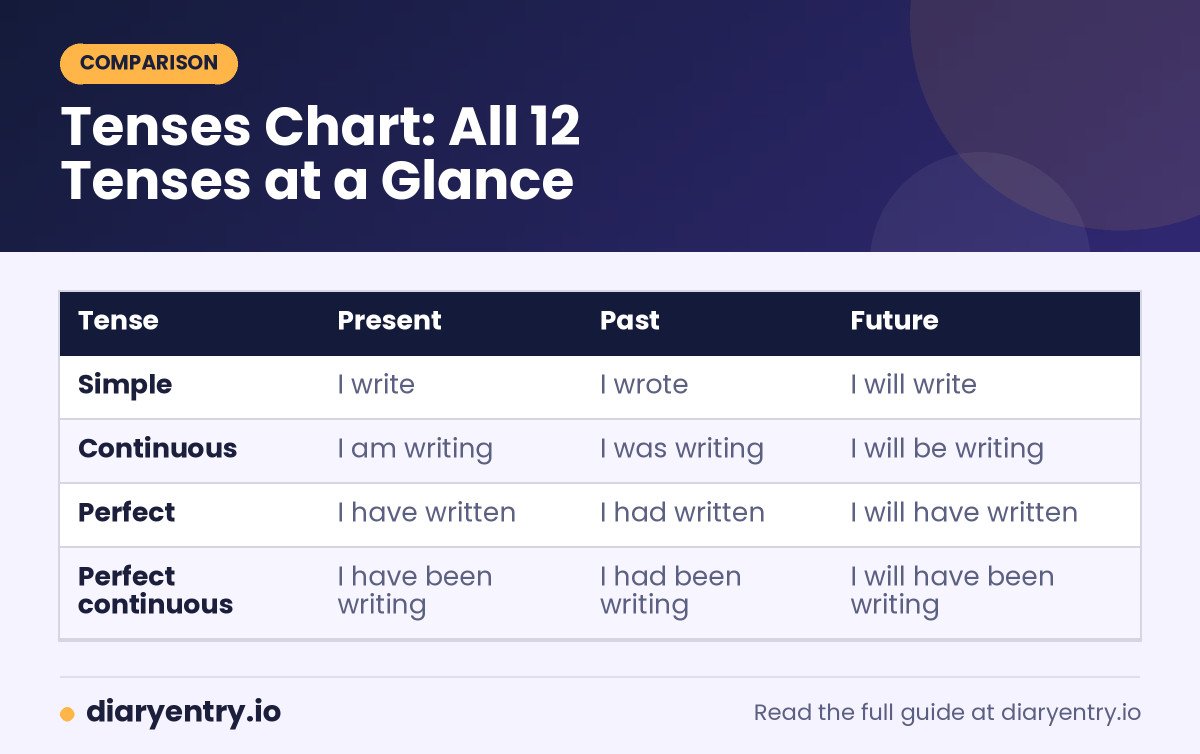
The pattern is easy to see: the four rows are the aspects, and the three columns are the time frames. Learn the chart as a grid and you will never need to memorise twelve separate rules.
What Is a Tense?
A tense is the form of a verb (one of the eight parts of speech) that shows when an action or state happens. English marks tense mainly through changes in the verb itself (“walk”, “walked”) and through helping verbs (“will walk”, “has walked”). The three time frames are the present, the past, and the future.
Each time frame has four aspects. Aspect tells us how the action is viewed: as a simple fact, as something in progress, as something completed, or as something that has been continuing up to a point. Combining three time frames with four aspects gives the 12 tenses.
The Four Present Tenses
Simple present
The simple present describes habits, routines, general truths, and fixed arrangements. The formula is the base verb, with “s” or “es” added for he, she, and it. Examples: “She writes every morning”, “Water boils at 100 degrees Celsius”, and “The train leaves at six.”
Present continuous
The present continuous describes an action happening now or around now, and also near-future plans. The formula is “am/is/are + verb-ing”. Examples: “I am writing a letter”, “They are studying for exams”, and “We are meeting her tomorrow.”
Present perfect
The present perfect connects the past to the present. It is used for experiences, recent actions with a present result, and situations that began in the past and continue. The formula is “has/have + past participle”. Examples: “I have visited Jaipur”, “She has finished her homework”, and “He has lived here since 2020.” Notice how “since” and “for” mark time here. Our guide to prepositions explains the difference between them in detail.
Present perfect continuous
This tense stresses how long an action has been going on up to now. The formula is “has/have been + verb-ing”. Examples: “I have been reading for two hours” and “It has been raining since morning.”
The Four Past Tenses
Simple past
The simple past describes a finished action at a definite time in the past. The formula is the past form of the verb: add “ed” for regular verbs and use the second form for irregular ones. Examples: “We visited the museum yesterday” and “She wrote a poem last night.”
Past continuous
The past continuous describes an action that was in progress at a moment in the past, or an action interrupted by another. The formula is “was/were + verb-ing”. Examples: “I was reading when the phone rang” and “They were playing at five o’clock.”
Past perfect
The past perfect shows that one past action was completed before another past action. The formula is “had + past participle”. Examples: “The train had left before we reached the station” and “She had finished dinner when I called.”
Past perfect continuous
This tense shows how long an action had been going on before another past event. The formula is “had been + verb-ing”. Examples: “He had been waiting for an hour when the bus arrived.”
The Four Future Tenses
Simple future
The simple future describes actions that will happen, predictions, promises, and decisions made at the moment of speaking. The formula is “will/shall + base verb”. Examples: “I will call you tonight” and “It will rain tomorrow.”
Future continuous
The future continuous describes an action that will be in progress at a certain time in the future. The formula is “will be + verb-ing”. Examples: “This time next week, I will be travelling” and “She will be waiting at the gate.”
Future perfect
The future perfect describes an action that will be complete before a certain time in the future. The formula is “will have + past participle”. Examples: “By 2030, he will have completed his degree” and “I will have finished the report by Friday.”
Future perfect continuous
This tense shows how long an action will have been going on by a future time. The formula is “will have been + verb-ing”. Examples: “By June, she will have been working here for five years.”
Tense Formulas in One Table
The next table collects the structure of all twelve tenses so that you can compare them quickly.
| Tense | Structure | Example |
|---|---|---|
| Simple present | base verb (+ s/es) | He plays chess. |
| Present continuous | am/is/are + verb-ing | He is playing chess. |
| Present perfect | has/have + past participle | He has played chess. |
| Present perfect continuous | has/have been + verb-ing | He has been playing chess. |
| Simple past | past form | He played chess. |
| Past continuous | was/were + verb-ing | He was playing chess. |
| Past perfect | had + past participle | He had played chess. |
| Past perfect continuous | had been + verb-ing | He had been playing chess. |
| Simple future | will + base verb | He will play chess. |
| Future continuous | will be + verb-ing | He will be playing chess. |
| Future perfect | will have + past participle | He will have played chess. |
| Future perfect continuous | will have been + verb-ing | He will have been playing chess. |
Regular and Irregular Verbs in the Chart
Regular verbs add “ed” to form both the simple past and the past participle, as in “walk, walked, walked”. Irregular verbs change in other ways, as in “write, wrote, written”, “go, went, gone”, and “eat, ate, eaten”. Because the past participle is used in all the perfect tenses, learning the three forms of common irregular verbs is one of the best investments you can make. Keep a short list and add to it whenever you meet a new verb. The past participle also builds the passive, which our active and passive voice rules guide explains tense by tense.
Signal Words That Help You Choose the Tense
Many sentences contain clue words that point to a particular tense. They are not a perfect rule, but they work well most of the time, especially in exams.
- Simple present: always, usually, often, every day, never, generally.
- Present continuous: now, at the moment, currently, today, these days.
- Present perfect: already, just, yet, ever, never, since, for, recently.
- Simple past: yesterday, last week, in 2019, ago, when I was young.
- Past perfect: before, after, by the time, already, until then.
- Simple future: tomorrow, next week, soon, in two days, one day.
- Future perfect: by next month, by the time, by 2030.
How to Choose the Right Tense: A Step-by-Step Method
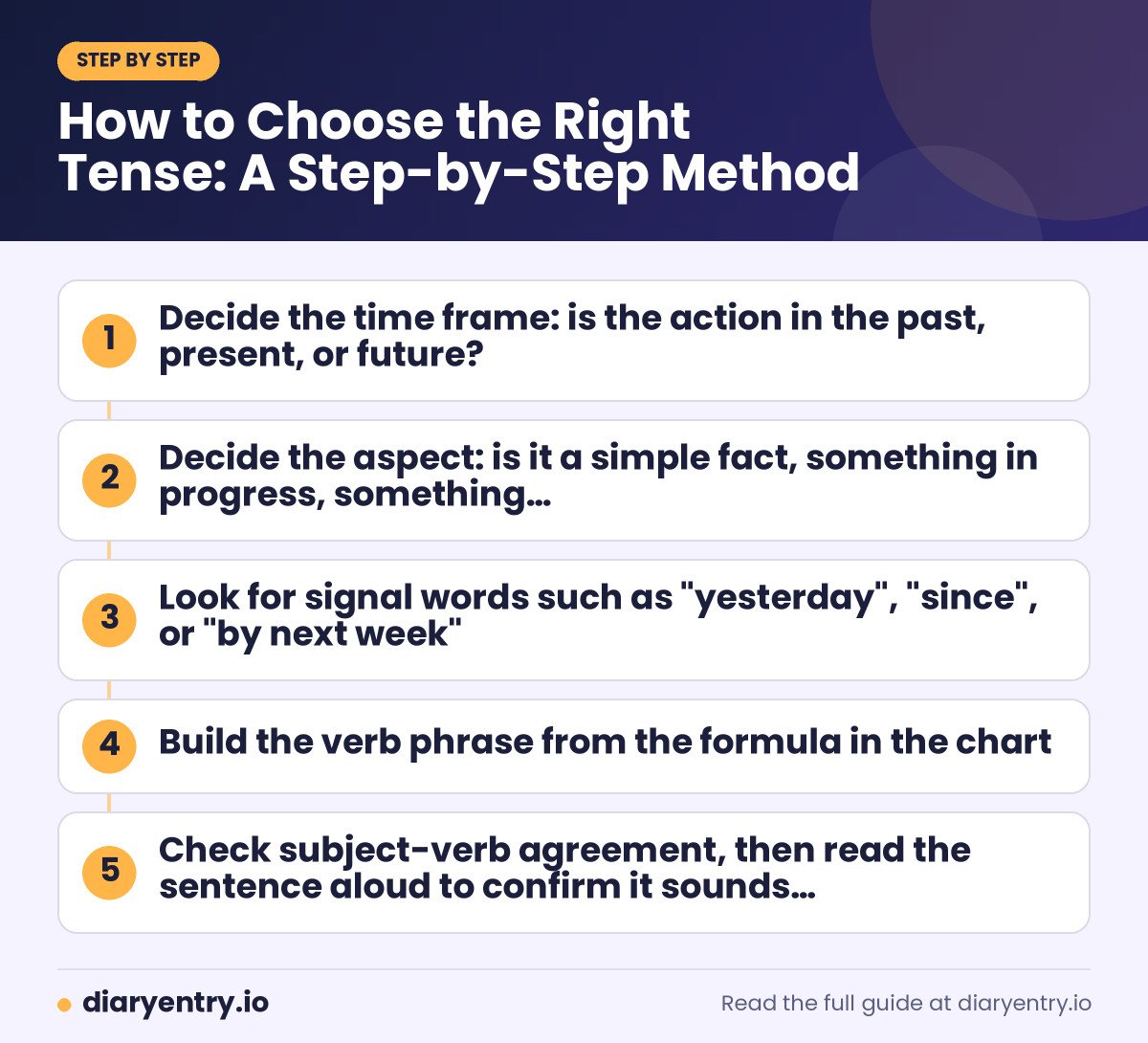
If you are unsure which tense fits a sentence, follow these five steps in order.
- Decide the time frame: is the action in the past, present, or future?
- Decide the aspect: is it a simple fact, something in progress, something completed, or something that has continued for a while?
- Look for signal words such as “yesterday”, “since”, or “by next week”.
- Build the verb phrase from the formula in the chart.
- Check subject-verb agreement, then read the sentence aloud to confirm it sounds natural.
Tenses in Real Writing
Tenses are not just exam topics. Every kind of writing leans on a few tenses, and knowing which ones helps you write with confidence.
A diary or journal entry is usually written in the simple past, with the past continuous for scenes and the present tense for feelings about the day. Our guide on how to write a diary entry shows this pattern in sample entries. If you want to build the daily habit, the 4-Week Diary Entry Course is designed around short, regular writing sessions.
Stories and personal accounts are told mostly in the simple past, with the past perfect used for events that happened earlier. You can see how this works in practice in our narrative writing guide.
News reports use the past tense for events that have happened, and the present perfect for recent developments. The report writing format for Class 12 samples are a useful model, since reports are written in the third person and the past tense.
Summaries, by contrast, are normally written in the present tense, even when the original text was in the past. Our summary writing format guide explains why.
Common Mistakes With Tenses
Most tense errors come from a small set of habits. Check for these when you proofread.
- Mixing tenses without a reason: “She walked into the room and sees a letter” should be “walked … and saw”.
- Using the simple past with “since” or “for”: say “I have lived here for five years”, not “I lived here for five years” when you still live there.
- Using “will” in a time clause: say “When he arrives, we will start”, not “When he will arrive”.
- Forgetting the third person “s”: “She write” should be “She writes”.
- Using the wrong participle: “I have wrote” should be “I have written”.
- Using the present continuous with state verbs: say “I know the answer”, not “I am knowing the answer”.
Practice Questions
Put the verb in brackets into the correct tense, and then check the answers.
- She (live) in Pune for ten years.
- They (play) cricket when it started to rain.
- By next March, I (finish) my course.
- He (not eat) anything since morning.
- The sun (rise) in the east.
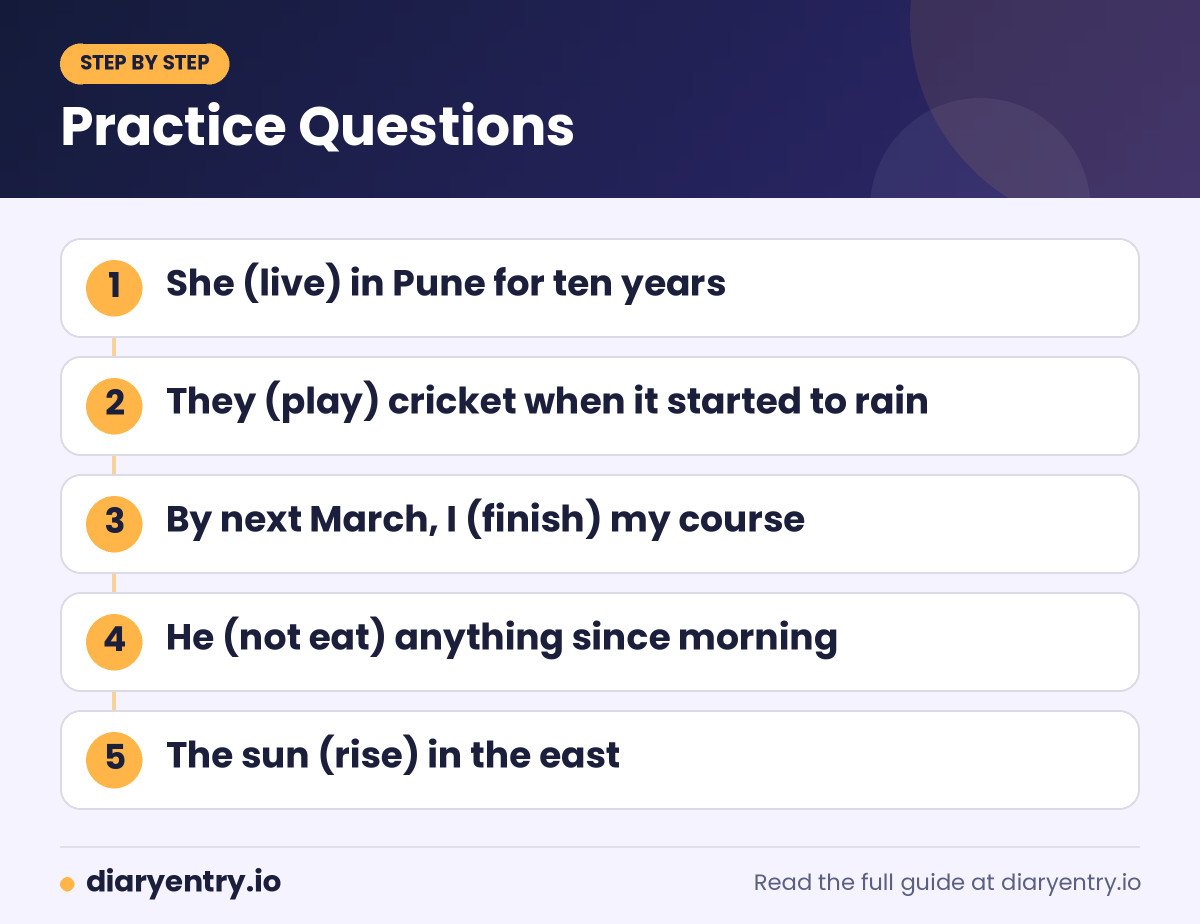
Answers: 1. has lived. 2. were playing. 3. will have finished. 4. has not eaten. 5. rises.
Frequently Asked Questions About Tenses
How many tenses are there in English?
There are 12 tenses in the standard grammar chart: simple, continuous, perfect, and perfect continuous forms of the past, present, and future. Some linguists argue that English has only two true tenses (past and present), but school grammar uses the 12-tense system.
What is the easiest way to learn the tenses chart?
Learn it as a grid with three time frames and four aspects, then memorise the formula for each aspect once. Practise with short sentences about your own day, such as “I wrote”, “I am writing”, and “I will have written”.
What is the difference between simple past and present perfect?
The simple past describes a finished action at a definite time (“I visited Agra in 2022”). The present perfect connects the past to now and does not name a finished time (“I have visited Agra”).
When do we use the past perfect tense?
Use the past perfect to show that one past action happened before another past action, as in “The film had started before we arrived.”
What is the difference between present continuous and present perfect continuous?
The present continuous describes an action happening now (“I am studying”). The present perfect continuous adds how long it has been happening (“I have been studying for two hours”).
Can I use “will” and “going to” for the future?
Yes. “Will” is used for predictions, promises, and spontaneous decisions, while “going to” is common for plans and for predictions based on present evidence, such as “Look at those clouds. It is going to rain.”
Which tense should I use in a diary entry?
Most diary entries use the simple past for events and the present tense for current feelings. The key is to stay consistent within each part of the entry.
Conclusion
A good tenses chart turns twelve confusing rules into one simple grid. Learn the three time frames and the four aspects, remember the formulas, and use signal words as clues. Then practise by writing a few sentences each day, because regular use is what makes the tenses feel natural. Come back to this tenses chart whenever you need a quick reminder, and pair it with daily writing practice for the fastest improvement.