

Quick Answer
A bio sketch format is a short, structured profile that introduces a person through their name, background, key achievements and purpose. For school tasks it follows a simple order: heading, introduction, early life, major work, qualities and a closing line. A professional bio sketch is more concise, written in the third person and tailored to its audience.
Key Takeaways
- A bio sketch is a brief profile, usually 100 to 250 words, that highlights the most important facts about a person.
- The school format has a heading, an opening paragraph, early life, achievements, qualities and a concluding line.
- Professional bios stay in the third person, lead with current role and add one or two credentials.
- Facts must be accurate, so check dates, names and spellings before you finalise the sketch.
- A bio sketch differs from a full biography, an autobiography and a character sketch.
What Is a Bio Sketch?
A bio sketch, short for biographical sketch, is a compact written profile of a person’s life and work. Instead of narrating every event, it selects the facts that matter most, such as who the person is, what they have done and why they are worth knowing about. The tone is factual and respectful, and the writing is usually in the third person.
The phrase is used in two common settings. In school English papers, students are asked to write a bio sketch of a famous person, a family member or a fictional character in a limited number of words. In professional settings, a bio sketch is a short summary used in conference programmes, websites, grant applications and speaker introductions. Both uses share the same goal: to give the reader a clear picture in very little space.
Bio Sketch Format: Standard Structure
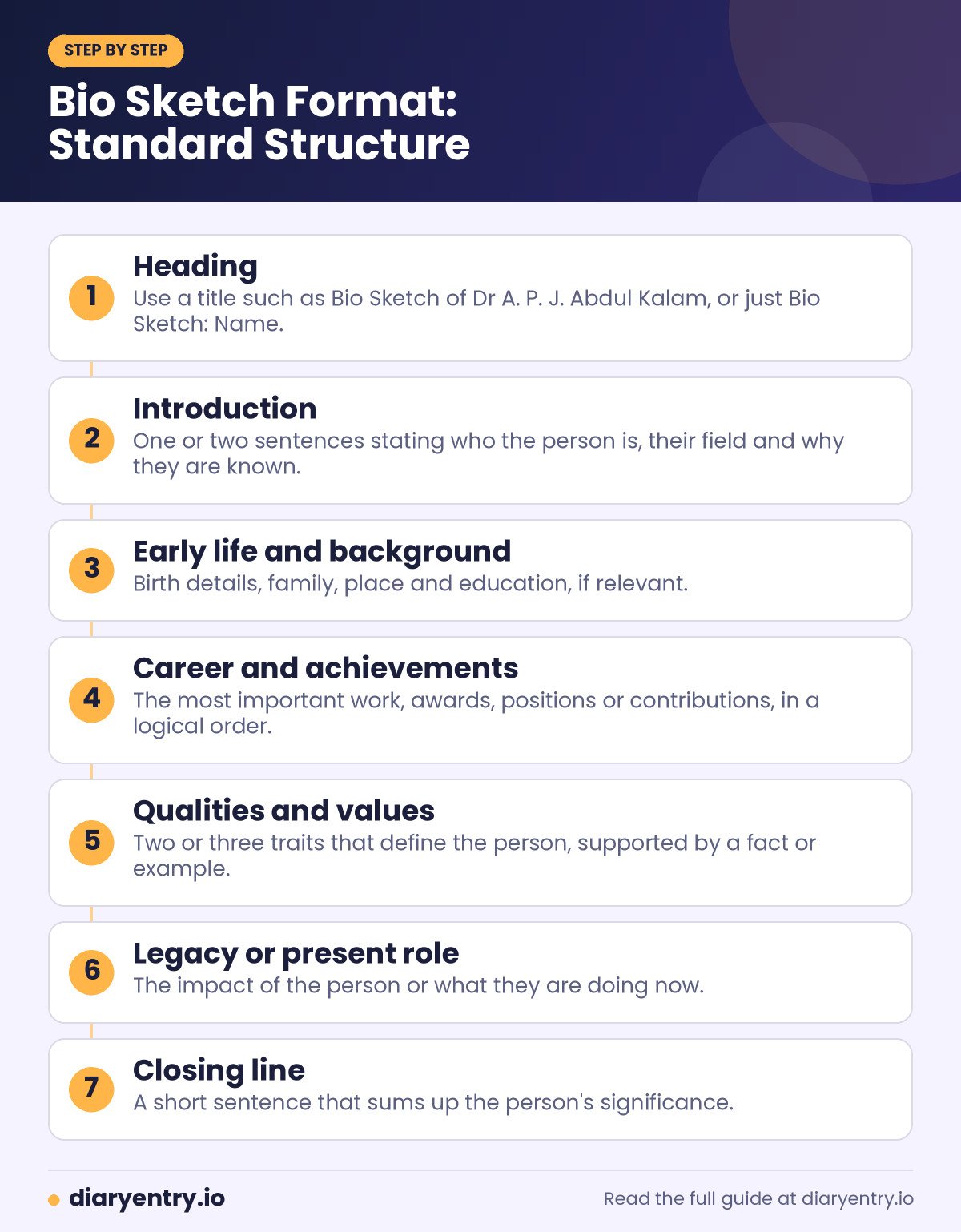
The bio sketch format below works for most school and general writing tasks. Follow the order and adjust the length to your word limit.
- Heading. Use a title such as Bio Sketch of Dr A. P. J. Abdul Kalam, or just Bio Sketch: Name.
- Introduction. One or two sentences stating who the person is, their field and why they are known.
- Early life and background. Birth details, family, place and education, if relevant.
- Career and achievements. The most important work, awards, positions or contributions, in a logical order.
- Qualities and values. Two or three traits that define the person, supported by a fact or example.
- Legacy or present role. The impact of the person or what they are doing now.
- Closing line. A short sentence that sums up the person’s significance.
Bio sketch structure at a glance
| Part | What to include | Approx. length |
|---|---|---|
| Heading | Title with the person’s name | One line |
| Introduction | Who they are and why they matter | 2 sentences |
| Early life | Birth, family, education | 2 to 3 sentences |
| Achievements | Key work and awards | 3 to 5 sentences |
| Qualities | Traits with an example | 2 sentences |
| Closing | Legacy or summary | 1 sentence |
How to Write a Bio Sketch Step by Step
A clear method will keep your writing focused and accurate. Use these steps whenever you need to write one.
- Decide the purpose and word limit. A school task may allow 100 to 150 words, while a conference bio may need only 50 to 100.
- Collect facts. Gather dates, places, achievements and a short quote only if it can be verified. Use reliable sources such as official websites, books and credible news reports.
- Choose the most important points. Rank the facts and keep only the strongest three to five.
- Write the opening line. Start with the name and the main reason the person is known.
- Arrange the details in order. Early life first, then achievements, then qualities and legacy.
- Use simple, active sentences. Prefer short sentences and strong verbs such as founded, led, wrote and discovered.
- Check facts and language. Verify names, dates and spellings, and read the sketch aloud to catch awkward phrases.
Bio Sketch Sample for Students
Here is a short sample you can use to understand the structure. The facts are well known and widely documented, but always confirm details from a trusted source before using them in your own work.
Sample: Bio sketch of Mahatma Gandhi
Heading: Bio Sketch of Mahatma Gandhi
Mohandas Karamchand Gandhi, known as Mahatma Gandhi, was a leader of India’s freedom movement and a global symbol of nonviolence. He is widely remembered as the Father of the Nation.
Gandhi was born on 2 October 1869 in Porbandar, Gujarat. He studied law in London and later worked in South Africa, where he began to resist unjust laws through peaceful protest.
After returning to India, he led movements such as the Champaran satyagraha and the Salt March, urging people to use truth and nonviolence as tools of change. He also wrote and spoke on simple living, self-reliance and the dignity of labour.
Gandhi was patient, disciplined and deeply committed to his principles. His ideas continue to inspire movements for peace and justice around the world.
Sample: Bio sketch of a family member or teacher
Heading: Bio Sketch of Mrs Kavita Rao
Mrs Kavita Rao is a primary school teacher with more than twenty years of experience in Pune. She teaches English and organises the annual reading week in her school.
She was born in Nashik, completed her B.Ed. in Pune and began her teaching career in 2003. Her students remember her for her patient explanations and her habit of ending each class with a story.
Mrs Rao is kind, well prepared and always ready to help a student in need. Her dedication has made her a role model for younger teachers.
Professional Bio Sketch Format
A professional bio sketch is used for websites, conference programmes, speaker introductions and funding applications. It is shorter, more targeted and more polished than a school sketch.
The core elements
- Name and current role. Start with who you are and what you do now.
- Key expertise. One or two areas of specialisation or experience.
- Notable achievements. Awards, publications, major projects or results, stated factually.
- Education or credentials. Include only those relevant to the audience.
- A human detail. One short line about interests or values makes the bio memorable.
Sample professional bio
Ananya Sharma is a content strategist at a mid-sized education company, where she leads a team of six writers. She has more than eight years of experience in editorial planning and educational content. Ananya holds a master’s degree in English and has contributed to several student learning guides. Outside work, she enjoys journaling and long walks with her dog.
Academic and scientific bio sketches
Some grant agencies, such as the US National Institutes of Health, require a structured biographical sketch with specific sections and page limits. If you are preparing one, follow the instructions published by the funder, such as the NIH biosketch guidelines, because their formats are fixed and updated periodically.
Bio Sketch vs Biography vs Autobiography vs Character Sketch
These forms are related but not identical. Knowing the difference helps you choose the right format for a task.
| Form | Length | Perspective | Focus |
|---|---|---|---|
| Bio sketch | Short, 100 to 250 words | Third person | Key facts and highlights |
| Biography | Long, a book or detailed article | Third person | Full life story |
| Autobiography | Long | First person | The writer’s own life |
| Character sketch | Short to medium | Third person | Personality and traits, often of a fictional character |
| Personal bio | Very short, 50 to 150 words | Often third person | Professional introduction |
If you are asked to describe someone’s qualities through their actions, you are writing a character sketch. If you are asked to give a quick profile of a person’s life, you are writing a bio sketch.
Tips for Writing a Strong Bio Sketch
A few habits will make your bio sketch clearer and more convincing.
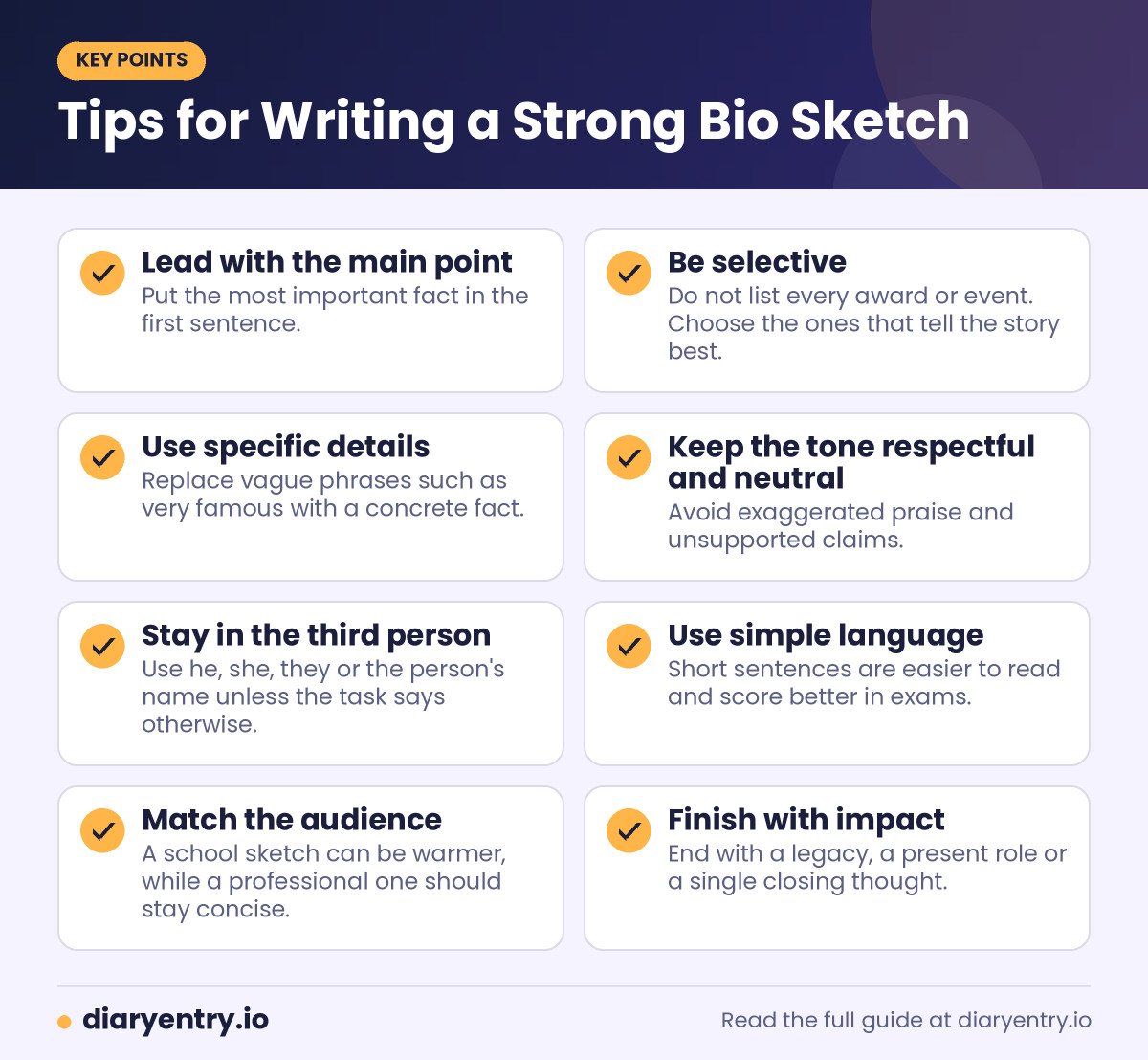
- Lead with the main point. Put the most important fact in the first sentence.
- Be selective. Do not list every award or event. Choose the ones that tell the story best.
- Use specific details. Replace vague phrases such as very famous with a concrete fact.
- Keep the tone respectful and neutral. Avoid exaggerated praise and unsupported claims.
- Stay in the third person. Use he, she, they or the person’s name unless the task says otherwise.
- Use simple language. Short sentences are easier to read and score better in exams.
- Match the audience. A school sketch can be warmer, while a professional one should stay concise.
- Finish with impact. End with a legacy, a present role or a single closing thought.
Writing About Yourself: Personal Bio Tips
Writing your own bio can feel strange because it is hard to see yourself from the outside. A useful trick is to imagine you are introducing a friend to a group of strangers. What would you say in thirty seconds? Start with your name and role, add one or two achievements, then close with a human detail.
Write it in the third person even though it is about you, because that is the standard for programmes, websites and profiles. Keep two versions ready, a short one of around 50 words and a longer one of around 150 words, and update them every few months. Journaling regularly can also help you notice patterns in your work and growth, which makes these summaries easier to write. If you need to attach a bio to a job application, see our guide to the application letter format.
Common Mistakes to Avoid
Many bio sketches lose marks or credibility for simple reasons. Check your draft against this list.
- Writing a long life story instead of a short profile.
- Mixing first and third person.
- Including unverified facts, dates or quotes.
- Using exaggerated words like greatest or best without evidence.
- Ignoring the word limit.
- Listing facts without any flow or order.
- Leaving out a closing line or any sense of legacy.
- Copying text from the internet instead of writing in your own words.
Linking Bio Sketches to Other Writing Skills
Bio sketches draw on several writing skills at once. You need the clear, ordered sentences of a good paragraph, the vivid detail of descriptive writing, and the sense of time and sequence found in narrative writing. Practising these together will make your profiles smoother and more engaging.
Bio Sketch Checklist
Use this list before you hand in or publish your bio sketch.
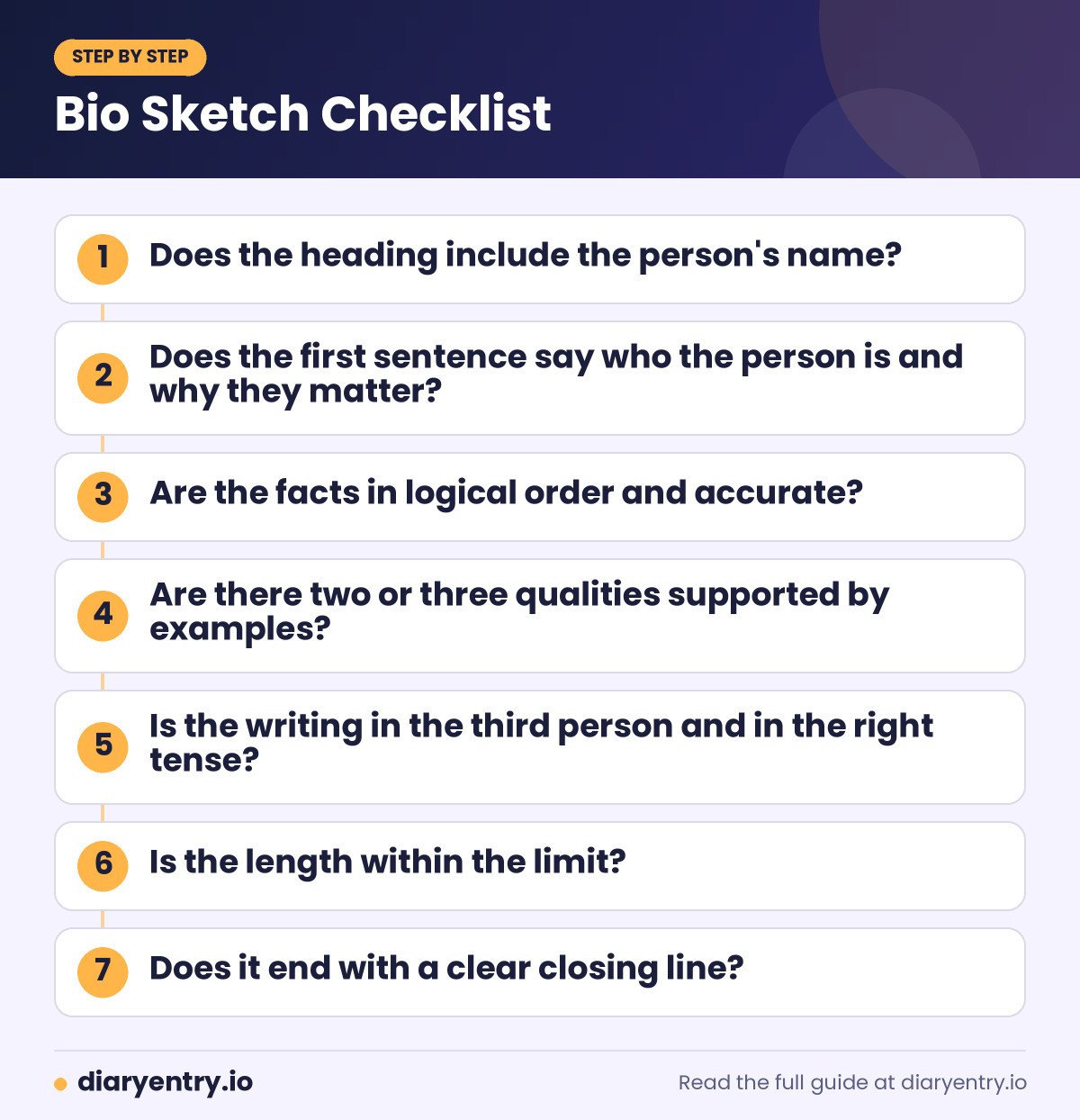
- Does the heading include the person’s name?
- Does the first sentence say who the person is and why they matter?
- Are the facts in logical order and accurate?
- Are there two or three qualities supported by examples?
- Is the writing in the third person and in the right tense?
- Is the length within the limit?
- Does it end with a clear closing line?
Frequently Asked Questions
What is a bio sketch?
A bio sketch is a brief written profile that presents the key facts about a person’s life, work and achievements. It is usually 100 to 250 words long and written in the third person.
What is the format of a bio sketch?
The common format has a heading, an introduction, early life, achievements, qualities and a closing line. Professional bios replace early life with credentials and current role.
How long should a bio sketch be?
Follow the word limit given in your task. If none is given, 100 to 150 words suits school work, and 50 to 150 words suits a professional bio.
What is the difference between a bio sketch and a character sketch?
A bio sketch focuses on facts from a person’s life, while a character sketch focuses on personality and traits, often of a fictional character.
Should a bio sketch be in first or third person?
The third person is standard, even for a bio about yourself. Use the first person only if your task specifically asks for it.
What tense should I use in a bio sketch?
Use the past tense for events that have finished and the present tense for current roles or ongoing work. Keep the tense consistent within each part.
Can I use a quote in a bio sketch?
Yes, if it is short, accurate and clearly adds to the profile. Always confirm the quote from a reliable source, and skip it if you are not sure.
Conclusion: Master the Bio Sketch Format
Once you understand the bio sketch format, you can write one for a famous figure, a teacher, a speaker or yourself in a few minutes. Start with the main point, arrange the facts in order, show two or three qualities with proof, and end with a line that captures the person’s importance. Practise with different people and word limits, and check every fact. If you want a daily routine that builds writing fluency, the 4-Week Diary Entry Course at diaryentry.io is a good place to start.