

Quick Answer
Prepositions are words that show how a noun or pronoun relates to another word in a sentence, such as its place, time, direction, or method. Common examples include in, on, at, by, with, from, and between. A preposition is always followed by an object, which can be a noun, a pronoun, or an -ing word.
Key Takeaways
- A preposition links a noun or pronoun to the rest of the sentence and is always followed by its object.
- The main types are prepositions of time, place, direction, and manner, plus compound and phrasal prepositions.
- In, on, and at follow a size pattern: in for large spaces and periods, on for surfaces and days, at for exact points.
- Many verbs and adjectives take a fixed preposition, so learn them as pairs, such as “depend on” and “afraid of”.
- A pronoun after a preposition takes the object form, as in “between you and me”.
What Are Prepositions? Definition and Examples
Prepositions are small words with a big job, and they are one of the eight parts of speech. They connect a noun, pronoun, or noun phrase to another part of the sentence and tell the reader how the two are related. Without them, we could not say where something is, when something happens, or how something is done.
Look at the sentence “The keys are on the table.” The word “on” connects “keys” to “table” and shows where the keys are. Change the preposition and the meaning changes with it: “under the table”, “near the table”, and “behind the table” each place the keys somewhere new.
Every preposition has an object. In “She walked to school”, “school” is the object of “to”. Together, the preposition and its object (plus any describing words) form a prepositional phrase, such as “to school” or “after the long meeting”. A prepositional phrase works like an adjective or an adverb, because it adds detail about a noun or a verb.
Common prepositions at a glance
There are well over a hundred prepositions in English, but a short list covers most everyday writing: about, above, across, after, against, along, among, around, at, before, behind, below, beside, between, by, down, during, for, from, in, inside, into, like, near, of, off, on, onto, out, over, since, through, to, toward, under, until, up, with, within, and without.
Types of Prepositions
Grammar books group prepositions in slightly different ways, but most students are taught the following types. The table gives a quick comparison, and the sections after it explain each one.
| Type | What it shows | Examples |
|---|---|---|
| Time | When something happens | at noon, on Monday, in June, during the exam |
| Place | Where something is | in the box, on the wall, at the gate, behind the door |
| Direction | Where something moves | to the market, into the room, across the road |
| Manner or instrument | How something is done | by bus, with a pen, in a hurry |
| Cause or purpose | Why something happens | because of the rain, for health |
| Compound | Two or more words acting as one | according to, in front of, because of |

Prepositions of time
These tell us when an event happens or how long it lasts. The common ones are at, on, in, by, before, after, during, since, for, until, and from. For example: “The class starts at nine”, “We met on Friday”, and “She has lived here since 2020.”
Prepositions of place
These tell us where a person or thing is. Typical examples are in, on, at, above, below, beside, between, behind, near, under, and over. For example: “The cat is under the chair” and “The shop is between the bank and the school.”
Prepositions of direction and movement
These describe movement toward, away from, or through a place: to, into, onto, from, across, through, along, toward, and past. For example: “The children ran across the field” and “He walked into the kitchen.”
Prepositions of manner, agent, and instrument
These explain how something is done or who or what did it. “By” often shows the agent or the means, and “with” often shows the tool. For example: “The letter was written by my aunt”, “She cut the cake with a knife”, and “We travelled by train.”
Compound and phrasal prepositions
A compound preposition is made of more than one word but behaves like a single preposition. Examples include “in front of”, “because of”, “instead of”, “on behalf of”, “according to”, “with reference to”, and “in spite of”. These are especially common in formal writing, such as the openings of a formal letter, where “with reference to” and “in response to” are standard.
In, On, and At: The Three Prepositions Learners Mix Up Most
In, on, and at cause the most trouble because they are used for both time and place. A simple idea helps: think of a funnel that moves from large to small. “In” covers the biggest spaces and longest periods, “on” covers surfaces and specific days, and “at” covers exact points.
| Preposition | Time | Place |
|---|---|---|
| In | in 2026, in July, in the morning, in the 21st century | in India, in the city, in a room, in the box |
| On | on Monday, on 5 May, on my birthday, on Diwali | on the table, on the wall, on the second floor, on the bus |
| At | at 6 p.m., at noon, at night, at the weekend | at the door, at the bus stop, at school, at the corner |
Rules worth remembering
- Use “in” for months, years, seasons, centuries, and parts of the day: “in winter”, “in the evening”.
- Use “on” for days and dates, including special days: “on Sunday”, “on New Year’s Day”.
- Use “at” for clock times and a few fixed phrases: “at 7:30”, “at midnight”, “at the same time”.
- “At night” is the usual form, but we say “in the morning”, “in the afternoon”, and “in the evening”.
- Use “at” for a location seen as a point (at the station) and “in” when you mean being inside a space (in the station hall).
Prepositions of Direction: To, Into, Onto, Toward
Direction prepositions often travel in pairs that look alike, so it helps to compare them side by side. “To” shows the destination: “We are going to Jaipur.” “Into” shows entering a space: “She jumped into the pool.” “Onto” shows movement to a surface: “The cat leaped onto the sofa.” “Toward” shows the general direction without promising arrival: “He walked toward the gate.”
The difference between “in” and “into” is a good example. “In” describes a position (the fish is in the tank), while “into” describes movement that ends inside (the fish swam into the tank). The same pattern applies to “on” and “onto”.
Between vs Among and Other Confusing Pairs
Some prepositions are easy to confuse because their meanings overlap. These pairs appear again and again in school exams and everyday writing.
Between and among
Use “between” for two people or things, or for clearly separate items: “Divide the sweets between the two of you.” Use “among” for three or more items seen as a group: “She was happy among her classmates.” Careful writers also use “between” for specific, named items even when there are more than two: “the treaty between the three nations”.
Since and for
Use “since” with a starting point in time and “for” with a length of time. “I have lived here since 2019” names the start. “I have lived here for seven years” gives the duration. Both usually go with the present perfect tense.
By and with
“By” usually introduces the doer or the method, while “with” introduces the tool or the companion. “The poem was written by Tagore” names the doer. “He painted the wall with a roller” names the tool. “She went with her brother” names the companion. The same “by” appears in passive sentences, which our active and passive voice rules guide explains.
Beside and besides
“Beside” means next to: “He sat beside me.” “Besides” means in addition to or apart from: “Besides English, she speaks Hindi and Punjabi.”
During and while
“During” is a preposition and needs a noun: “We stayed indoors during the storm.” “While” is a conjunction and needs a clause: “We stayed indoors while the storm raged.”
Dependent Prepositions: Words That Travel Together
Some verbs, adjectives, and nouns are almost always followed by one particular preposition. These are called dependent prepositions, and there is rarely a logical reason behind them. The best approach is to learn them as pairs and notice them as you read.
Verbs and their prepositions
- depend on, rely on, insist on, focus on, agree with, apologise for, believe in, belong to, listen to, wait for, look for, and worry about.
- Example: “Success depends on regular practice” and “Please wait for me at the gate.”
Adjectives and their prepositions
- afraid of, proud of, good at, interested in, keen on, fond of, tired of, aware of, and responsible for.
- Example: “She is good at drawing” and “He is afraid of heights.”
Dictionaries list these pairings, and checking a learner’s dictionary for the right preposition is a habit that pays off quickly. If you read widely, including everyday writing such as a diary entry, you will start to notice which pairs sound natural. Combinations whose meaning changes, such as “give up” or “look after”, are covered in our guide to phrasal verbs.
How to Choose the Right Preposition: A Step-by-Step Method
When you are unsure which preposition fits, work through these steps in order. The method takes only a few seconds once it becomes a habit.
- Find the word the preposition has to connect, usually a verb, adjective, or noun just before the gap.
- Decide what the relationship is: time, place, direction, method, or cause.
- Check whether the word forms a fixed pair, such as “interested in” or “depend on”.
- For time and place, apply the in, on, at pattern from large to small.
- Read the finished sentence aloud and check that the object after the preposition is in the object form.

Prepositions in Everyday Writing
Prepositions are not just a grammar topic. They shape how clear and natural your writing sounds, whether you are writing a school task or a personal note.
In descriptive writing, place prepositions create a picture the reader can see: “A lamp glowed beside the window, and a cat slept under the old desk.” You can practise this skill with our guide to descriptive writing, where spatial detail does a lot of the work.
In letters and emails, time prepositions set deadlines and appointments: “Please reply by Friday” or “The meeting is on 12 March at 10 a.m.” Informal writing is more relaxed, as you can see in our informal letter format samples.
In a daily journal, time and place prepositions anchor each entry: “In the morning I walked to the park, and at lunch I met Rhea at the cafe.” If you want to turn regular writing into a habit, the 4-Week Diary Entry Course gives you a simple daily structure to practise with.
Common Mistakes With Prepositions
Most preposition errors fall into a few predictable groups. Knowing them helps you proofread your own work.
- Wrong preposition after a verb: say “I am waiting for the bus”, not “waiting the bus”, and “discuss the plan”, not “discuss about the plan”.
- Mixing in, on, and at for time: “on Monday” and “in the morning”, but not “in Monday”.
- Using the subject form after a preposition: “between you and me”, not “between you and I”.
- Adding an unnecessary preposition: “Where is it?” is better than “Where is it at?”
- Dropping a needed preposition: “She is interested in music”, not “interested music”.
Can a sentence end with a preposition?
Yes. The old rule against it came from attempts to apply Latin grammar to English, and modern style guides accept it when the sentence sounds natural. “Who are you talking to?” is perfectly good English. In formal writing, you can rewrite it as “To whom are you speaking?” if the tone calls for it.
Prepositions Examples in Sentences
Reading examples in groups helps the patterns stick. Here are sample sentences for each main type.
- Time: “The shop closes at eight.” “We have exams in March.” “He was born on 14 November.”
- Place: “The book is on the shelf.” “She waited at the station.” “Their house is near the river.”
- Direction: “The bus goes to Delhi.” “He climbed onto the roof.” “They walked through the forest.”
- Manner: “She answered with a smile.” “He paid by card.” “They spoke in whispers.”
- Cause: “The match was cancelled because of rain.” “She was famous for her kindness.”
Quick practice
Fill in the blanks with the correct preposition, then check against the answers below.
- The train arrives ___ 6 a.m. ___ Sunday.
- She is proud ___ her sister.
- Divide the notes ___ the three of you.
- The dog jumped ___ the river.
- I have not seen him ___ last week.
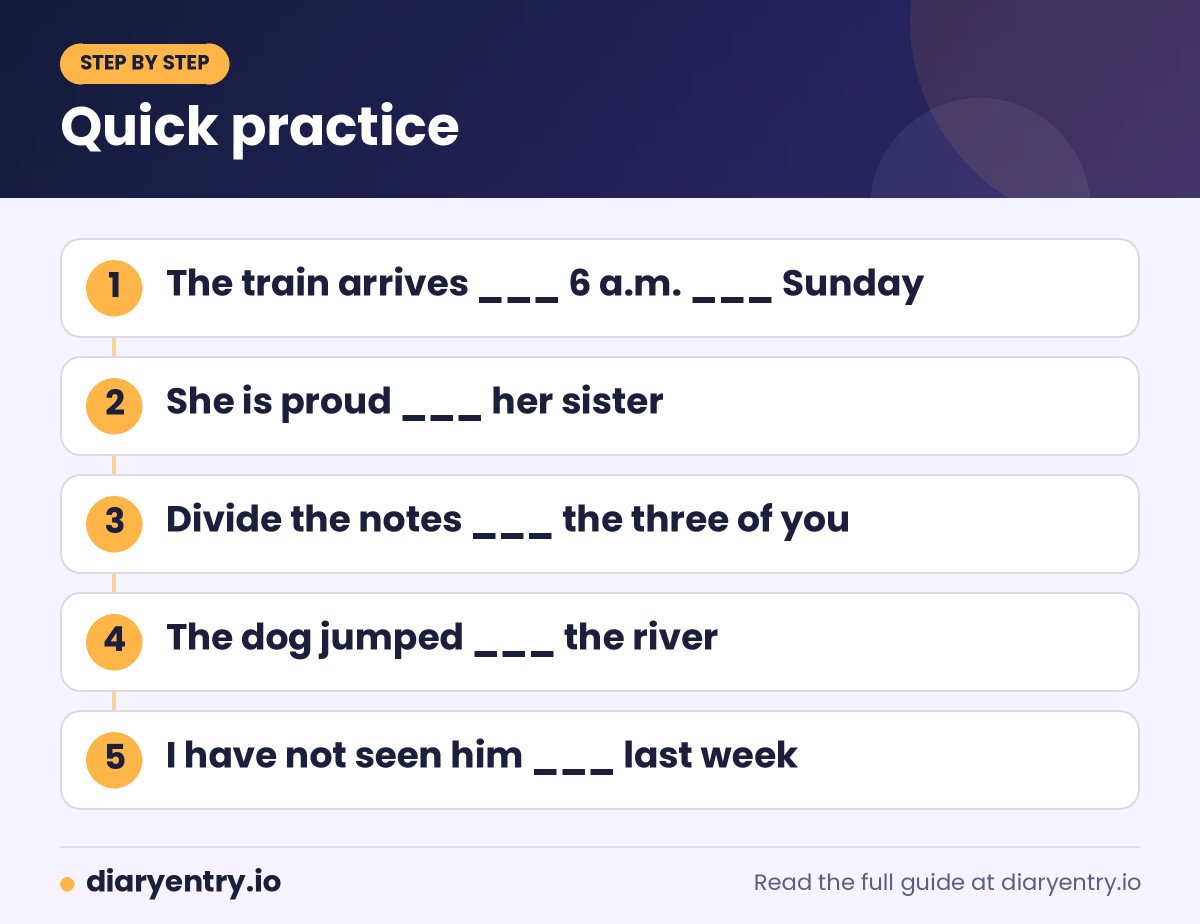
Answers: 1. at, on. 2. of. 3. among (or between, if you treat the three as separate people). 4. into. 5. since.
Frequently Asked Questions About Prepositions
What are prepositions in simple words?
Prepositions are linking words that show how a noun or pronoun relates to another word, usually by telling us the time, place, direction, or method of something. Examples are in, on, at, by, with, and from.
How many types of prepositions are there?
Most school grammar books describe the main types as time, place, direction, and manner, along with compound prepositions. Some books add cause, purpose, and phrasal prepositions, so the exact count depends on the book you follow.
What is the difference between in, on, and at?
“In” is for large spaces and longer periods, “on” is for surfaces and days, and “at” is for exact points and clock times. For example: in July, on Tuesday, at 5 p.m.
What is a prepositional phrase?
A prepositional phrase is a group of words that begins with a preposition and ends with its object, such as “under the bridge” or “after dinner”. It adds information about a noun or a verb.
Can a preposition come at the end of a sentence?
Yes. Modern grammar guides accept it when the sentence sounds natural, as in “This is the pen I wrote with.”
What is the difference between a preposition and a conjunction?
A preposition is followed by a noun or pronoun, while a conjunction joins clauses or words of equal rank. “After lunch” uses “after” as a preposition, and “After we had lunch” uses it as a conjunction.
How can I learn prepositions faster?
Learn them in phrases rather than alone, read a little every day, and keep a list of fixed pairs like “good at” and “depend on”. Writing short daily notes and checking each preposition is also effective.
Conclusion
Prepositions look small, but they carry a lot of meaning, and getting them right makes writing clearer and more natural. Start with the in, on, and at pattern, learn the common fixed pairs, and keep the main types in mind when you proofread. With regular reading and a little daily writing, using prepositions will soon feel automatic. If you want a steady practice habit, the Diary Entry Course is a gentle place to begin.