

Quick Answer
Narrative writing is a style of writing that tells a story, real or imagined, through a clear sequence of events, characters, a setting and a conflict that reaches a resolution. Its basic structure is a beginning, a middle and an end, told from a chosen point of view in vivid, engaging language.
Key Takeaways
- Narrative writing tells a story with characters, setting, plot, conflict and resolution.
- A narrative usually follows five stages: exposition, rising action, climax, falling action and resolution.
- Point of view (first or third person) shapes how close the reader feels to the story.
- Showing details through senses, action and dialogue is stronger than simply telling the reader what happened.
- Revising for clarity, pacing and tense consistency turns a rough draft into a polished story.
What Is Narrative Writing?
Narrative writing is writing that recounts events in a meaningful order so that the reader experiences a story. It can be fiction, such as a short story, or non-fiction, such as a personal memoir or a true account of a school trip. What defines it is not whether the events are real but that they are organised as a story with a purpose.
You use narrative writing more often than you may realise. A diary entry that describes your day, a story you tell a friend, a travel memory and a school essay called “A Day I Will Never Forget” are all narratives. Even a short life profile, such as a bio sketch, arranges facts in a purposeful order. The difference between a weak narrative and a strong one is control: strong writers choose which events to include, in what order, and with what detail.
If you want to know how narrative differs from other forms, our guide on descriptive writing explains how description paints a scene, while narrative moves that scene forward through time.
Narrative Writing vs Other Types of Writing
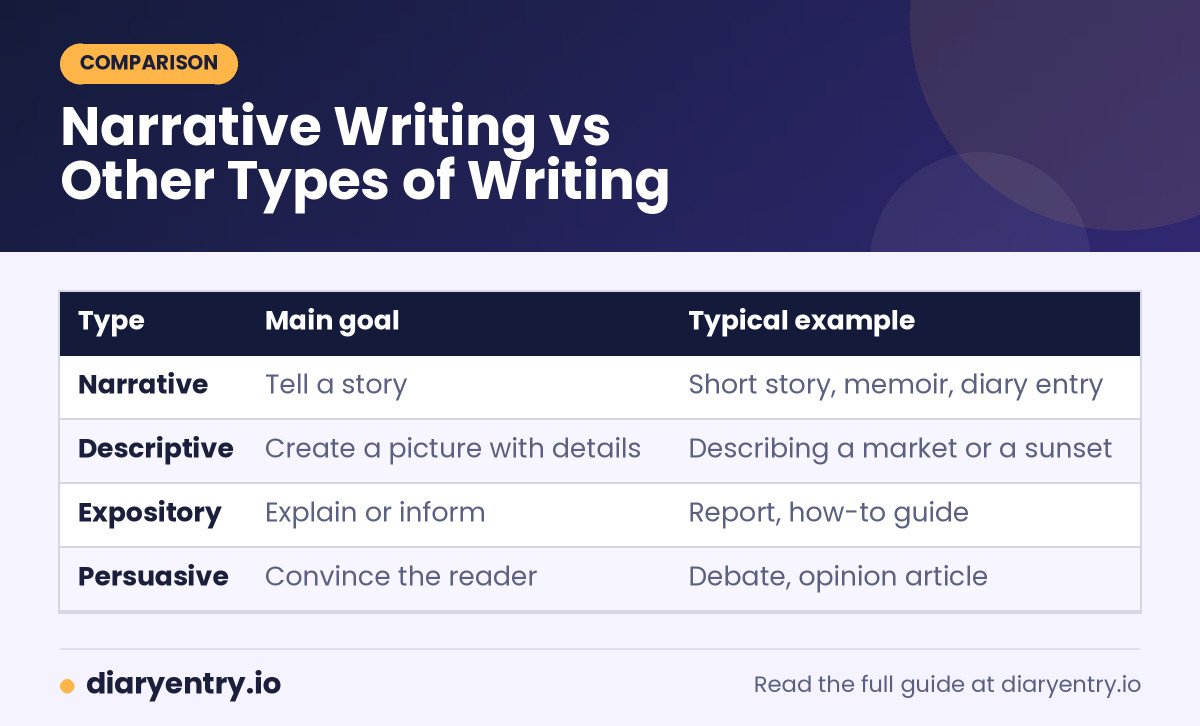
The four classic types of writing often overlap in practice, but each has a different main goal.
| Type | Main goal | Typical example |
|---|---|---|
| Narrative | Tell a story | Short story, memoir, diary entry |
| Descriptive | Create a picture with details | Describing a market or a sunset |
| Expository | Explain or inform | Report, how-to guide |
| Persuasive | Convince the reader | Debate, opinion article |
Elements of Narrative Writing
Every effective narrative is built from the same small set of elements. Knowing them gives you a checklist for planning and revising.
Characters
Characters are the people (or animals, or objects) who experience the events. A main character, or protagonist, usually wants something. Even in a short narrative of 200 words, tell the reader one or two specific facts about the character so they feel real.
Setting
The setting is where and when the story happens. It sets the mood and can even create the conflict, for example a storm that traps a family indoors. Use two or three concrete details instead of a long description.
Plot
The plot is the chain of events, where each one causes the next. A plot is not just “this happened, then that happened”. It is “this happened, so that happened, which led to this problem”.
Conflict
Conflict is the problem or struggle the character faces. It can be external, such as a race against time, or internal, such as fear of speaking in public. Without conflict, a narrative has no tension to keep the reader interested.
Theme
The theme is the underlying message or idea, such as courage, friendship or honesty. It is rarely stated directly. Instead it grows out of what the character learns.
Point of View
Point of view is the perspective from which the story is told. First person uses “I” and feels personal. Third person uses “he”, “she” or “they” and gives the writer more freedom to describe different characters.
Narrative Writing Structure
Most narratives follow a pattern that has been used for centuries. You can think of it as a mountain: the story rises, reaches a peak and comes back down.
- Exposition: introduce the characters, setting and situation.
- Rising action: show the events that build the problem.
- Climax: present the moment of greatest tension or the turning point.
- Falling action: show the immediate results of the climax.
- Resolution: close the story and show how things have changed.

Exposition: Start in the Right Place
Begin as close to the action as possible. Instead of explaining the whole background, drop the reader into a moment, such as “The bus left without me.” You can fill in background in a sentence or two later.
Rising Action: Build Tension Step by Step
Include two or three events that make the problem harder. Each event should raise the stakes slightly. This is the middle of your narrative and usually the longest part.
Climax: The Turning Point
The climax is where the character makes a decision or faces the main challenge. Keep it short and intense. This is the part the reader will remember.
Falling Action and Resolution
After the climax, show the consequences and end with a sense of closure. A good ending often echoes the beginning or shows how the character has changed. You do not need to tie up every detail, but the main question of the story should be answered.
How to Write a Narrative Step by Step
Follow the process below to move from a blank page to a finished narrative.
- Choose a topic and decide the purpose of your story.
- Pick a point of view and a tense, and stay with them.
- List your characters and the setting in a few words.
- Outline the five stages of the plot in one line each.
- Write a draft, focusing on getting the events down.
- Add sensory details, dialogue and strong verbs.
- Revise for clarity, pacing and consistency, then proofread.

Choosing a Topic
Strong narratives often come from small, personal moments rather than huge events. Think about a time you felt nervous, proud, embarrassed or surprised. These emotions make it easy to write honestly.
Planning Before You Write
A five-line outline is enough. Write one sentence for each stage of the plot. This keeps the story from drifting and helps you control the word count.
Drafting and Revising
In the first draft, do not worry about perfect sentences. Once the story is down, go back and strengthen it. Cut anything that does not move the story forward, and replace general words with specific ones.
Show, Don’t Tell: Techniques for Vivid Narrative Writing
Good narrative writing makes the reader see and feel the events. Compare these two versions.
| Telling | Showing |
|---|---|
| She was nervous. | Her hands shook as she gripped the edge of the paper. |
| It was a hot day. | The pavement shimmered, and even the dogs lay still in the shade. |
| He was angry. | He slammed the door so hard that the window rattled. |
Use the Five Senses
Mention what the character sees, hears, smells, touches and tastes. One well-chosen sensory detail, such as the smell of rain on dry earth, can bring a scene alive.
Use Dialogue Carefully
Dialogue reveals character and moves the plot. Keep it short, natural and purposeful. Start a new line for each speaker and avoid long speeches.
Choose Strong Verbs
Replace weak verb and adverb pairs with a single strong verb. “Walked slowly” becomes “crept” or “trudged”. This tightens your writing and adds energy.
Narrative Writing Example
Here is a short narrative of about 150 words that follows the five-stage structure.
Title: The Last Bus
Meena checked her watch for the third time. The last bus to her village left at six, and the school bell had rung late. She ran, her heavy bag thumping against her back.
At the corner, she saw the bus pulling away. “Wait!” she shouted, but the engine drowned her voice. Her stomach dropped. The next bus was not until morning.
She turned and noticed her teacher, Mr Rao, locking his scooter. Taking a deep breath, she walked up and explained everything. He listened, nodded and offered to call her father.
Within half an hour, her father arrived, smiling with relief. On the ride home, Meena realised that asking for help had been easier than she feared. From that day, she never hesitated to speak up when she needed support.
Why This Example Works
It opens near the action, presents a clear problem, builds tension with a missed bus, reaches a climax when Meena asks for help, and ends with a small change in the character. The details are specific, and the language is simple.
Types of Narrative Writing
Narrative writing is a broad umbrella. Knowing the different forms helps you choose the right tone and length.
- Personal narrative: a true story about your own experience, often written in first person.
- Short story: an imagined story with characters and a plot.
- Anecdote: a very short story used to make a point.
- Memoir: a longer account of a period in a person’s life.
- Diary or journal narrative: a story told in dated entries.
- Folktale or fable: a traditional story that carries a moral.
Narrative Writing and Diary Entries
A diary entry is one of the easiest ways to practise narrative skills. When you write about your day, you decide which moment to describe, which details to keep and how to end the entry. Our guide on how to write a diary entry shows the format step by step, and the storytelling diary page offers prompts for turning daily moments into small scenes.
Common Mistakes in Narrative Writing
Most problems in student narratives are easy to fix once you know what to look for.
- Starting too early: long background explanations delay the action.
- Telling instead of showing: stating emotions rather than revealing them through action.
- Changing tense by accident: moving between past and present within a scene.
- Having no clear problem: events happen, but nothing is at stake.
- Rushing the ending: closing the story in one sentence without a sense of change.
- Overusing adjectives: more words do not always mean better description. Our guide to the parts of speech shows how stronger nouns and verbs can do more work.
Tips to Improve Your Narrative Writing
Use these practical habits to grow steadily as a storyteller.
Read Widely
Reading stories shows you how other writers handle pacing, dialogue and endings. Notice how a favourite story begins and ends, and try to borrow the technique, not the words.
Write a Little Every Day
Short daily practice builds fluency faster than a long session once a week. A habit of writing even ten minutes a day makes storytelling feel natural. If you need help getting started, take a look at our guide to building a daily journaling habit.
Read Your Story Aloud
Reading aloud helps you hear awkward sentences, repeated words and slow sections. Mark them and fix them in your next draft.
Get Feedback
Share your narrative with a teacher or friend and ask one question: “Where did you get bored or confused?” Their answer shows exactly where to revise.
Narrative Writing in Exams and Everyday Life
In school exams, a narrative task usually gives you a title, a picture or an opening line and asks for a story of 150 to 300 words. Examiners reward a clear structure, relevant details, correct tense and a satisfying ending. Plan for two minutes, write for most of the time, and keep the final minutes for checking.
Outside exams, narrative skills help in many places. Job interviews reward candidates who can tell a clear story about a past achievement. Marketing, speeches and even emails become more memorable when they include a short story. Students who want guided practice can also consider the diaryentry.io 4-Week Diary Entry Course, which helps build the daily writing habit that supports good storytelling.
Frequently Asked Questions
What is narrative writing in simple words?
Narrative writing is writing that tells a story. It describes events in order, usually with characters, a setting and a problem that gets solved.
What are the 5 elements of narrative writing?
The commonly taught elements are characters, setting, plot, conflict and theme. Some teachers also add point of view as a sixth element.
What is the structure of a narrative?
A narrative usually has five stages: exposition, rising action, climax, falling action and resolution. In simpler terms, it has a beginning, a middle and an end.
What is the difference between narrative and descriptive writing?
Narrative writing tells what happens over time, while descriptive writing focuses on how a person, place or thing looks, sounds and feels. Most stories use both.
Which point of view is best for narrative writing?
Neither is better in every case. First person feels personal and works well for diary-style stories, while third person gives you more freedom to describe several characters.
How long should a narrative essay be?
It depends on the task. School narratives are often 150 to 300 words, while a college narrative essay may run 500 to 650 words. Always follow the word limit given.
How do I make my narrative more interesting?
Start close to the action, give the character a clear problem, use sensory details and dialogue, and end with a change or realisation. See also our English story writing guide for sample stories.
Conclusion
Narrative writing is the art of turning events into a story that a reader can see, feel and remember. Plan the five stages, give your character a real problem, show details instead of telling, and revise with care. With regular practice, your narrative writing will grow more natural and confident. If you want a gentle way to practise every day, consider joining our 4-Week Diary Entry Course.