

Quick Answer
The application letter format is a formal letter structure used to apply for a job, a school seat, an internship or a scholarship. It runs in order: sender’s address, date, receiver’s address, subject line, salutation, a body of three or four short paragraphs, a polite closing and your signature. Keep it to one page and tailor it to the opening.
Key Takeaways
- An application letter follows the formal letter layout: addresses, date, subject, salutation, body, closing and signature.
- The body works best in three parts: why you are writing, why you are a good fit, and what you would like to happen next.
- A subject line that names the post or purpose helps the reader sort the letter in seconds.
- Job applications stress skills and results, while school applications stress eligibility, marks and the reason for applying.
- One page, formal language and zero spelling mistakes matter more than clever phrasing.
What Is an Application Letter?
An application letter is a written request addressed to a person or institution, asking to be considered for something specific. That could be a vacancy, an admission, a transfer certificate, a scholarship or a place on a team. It introduces you, explains why you are suitable, and invites the reader to take the next step.
People often confuse it with a resume or CV. A resume lists facts in a compact structure, whereas an application letter explains those facts in sentences and connects them to the opening. A short letter that points to the attached resume usually works better than one that repeats it line by line.
In school exams, an application letter question usually asks you to write to a principal, a headmaster or an employer. In real life, the same format is used for job applications, internship requests and college forms. Because it is a formal letter, it follows the same rules as any other official correspondence, which you can revise in our guide to the formal letter format.
Application Letter Format: The Standard Structure
Every good application letter follows the same skeleton. Learn the order once and you can adapt it to almost any situation.
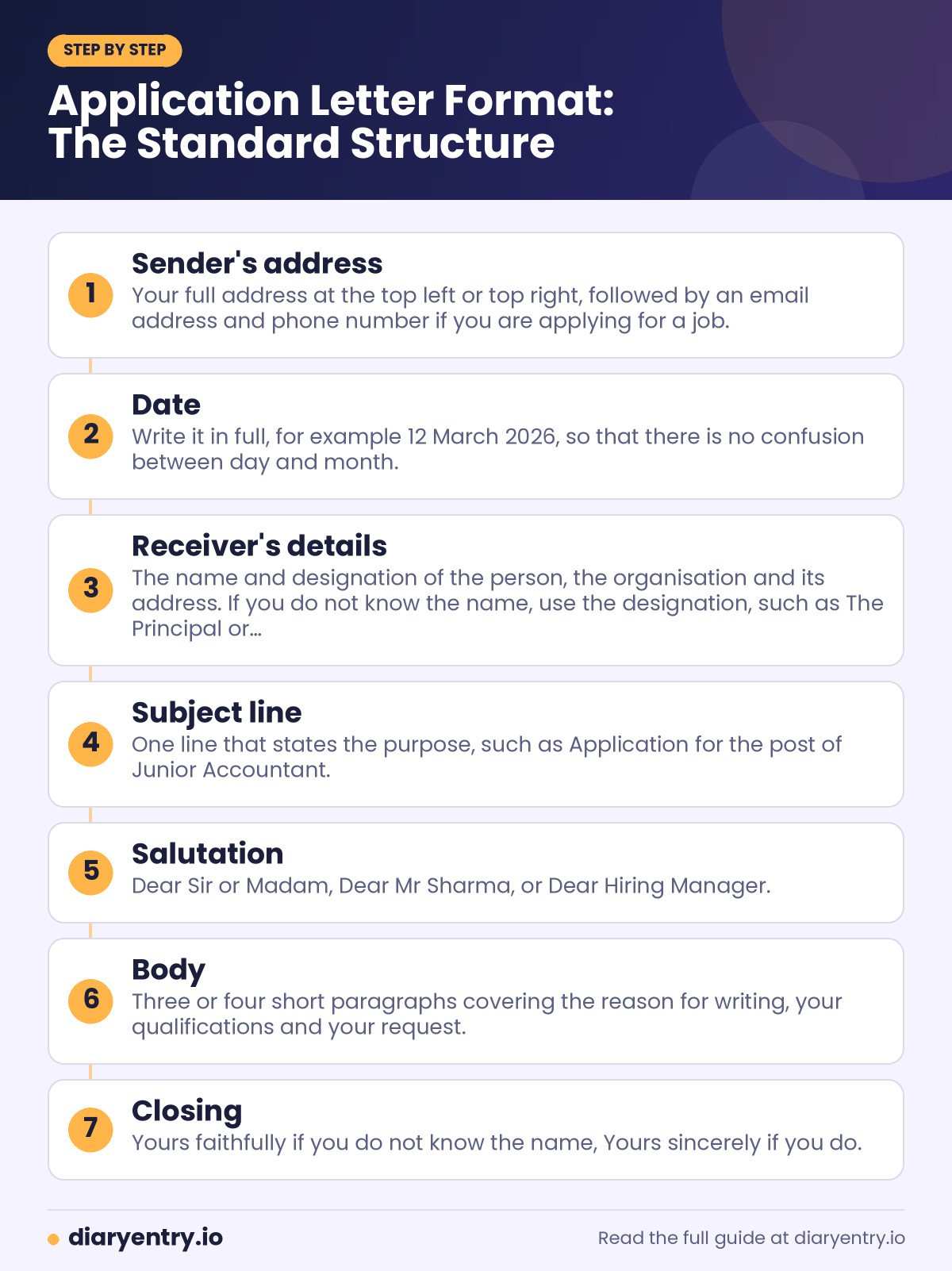
- Sender’s address. Your full address at the top left or top right, followed by an email address and phone number if you are applying for a job.
- Date. Write it in full, for example 12 March 2026, so that there is no confusion between day and month.
- Receiver’s details. The name and designation of the person, the organisation and its address. If you do not know the name, use the designation, such as The Principal or The Hiring Manager.
- Subject line. One line that states the purpose, such as Application for the post of Junior Accountant.
- Salutation. Dear Sir or Madam, Dear Mr Sharma, or Dear Hiring Manager.
- Body. Three or four short paragraphs covering the reason for writing, your qualifications and your request.
- Closing. Yours faithfully if you do not know the name, Yours sincerely if you do.
- Signature and name. Sign above the typed name. For a school application, add the class or roll number if it is relevant.
- Enclosures. If you attach a resume, certificates or a photograph, mention them in one line.
Quick format at a glance
| Part | What to write | Example |
|---|---|---|
| Sender | Name, address, contact | 14 Lake Road, Pune, 411001 |
| Date | Full date | 12 March 2026 |
| Receiver | Designation and organisation | The Principal, Green Valley School |
| Subject | Purpose in one line | Application for admission to Class 9 |
| Salutation | Polite greeting | Dear Sir or Madam, |
| Body | Reason, fit, request | Three short paragraphs |
| Closing | Formal ending | Yours faithfully, |
How to Write an Application Letter Step by Step
A reliable method saves time and removes the fear of the blank page. Follow these steps in order.
- Read the opening carefully. Note the exact post name, the required skills and the closing date. Use the same words in your letter where they are honest.
- Find the right name. A letter addressed to a person gets more attention than one addressed to nobody. Check the website or the advertisement.
- Write the subject line first. It forces you to be clear about the purpose before you write anything else.
- Open with your purpose. State what you are applying for and where you saw it, in one or two sentences.
- Make your case. Choose two or three strengths that match the opening and support each with a fact, such as a project, a mark, a result or an experience.
- Close with a request. Say that you would welcome an interview or a chance to meet, and thank the reader for their time.
- Proofread twice. Check names, dates, spelling and the closing phrase. Read it aloud once to catch awkward sentences.
Job Application Letter: Format and Sample
A job application letter, often called a cover letter, accompanies your resume. Employers usually read it in under a minute, so every sentence has to earn its place.
What to include
- The exact post and where you found it.
- Two or three skills or achievements that match the job.
- A sentence on why you want to work for this organisation in particular.
- A clear closing line asking for an interview.
Sample job application letter
14 Lake Road, Pune, 411001
12 March 2026
The Hiring Manager
Bright Ledger Accounting Services
22 Station Road, Pune, 411002
Subject: Application for the post of Junior Accountant
Dear Sir or Madam,
I am writing to apply for the post of Junior Accountant advertised on your website on 8 March 2026. I have completed my B.Com degree and a six-month internship in bookkeeping, and I would like to contribute to your team.
During my internship at a local trading firm, I prepared monthly ledgers, reconciled bank statements and helped the senior accountant prepare GST returns. I am comfortable with spreadsheet software and accounting packages, and my supervisor appreciated my accuracy and punctuality.
I am attracted to Bright Ledger because of its focus on small business clients, which is the area I want to grow in. I am a quick learner and willing to take on additional training.
I have enclosed my resume for your consideration. I would be grateful for an opportunity to meet you and discuss my application. Thank you for your time.
Yours faithfully,
Rohan Mehta
Enclosure: Resume
School Application Letter Format and Sample
A school application letter is written to a principal or headmaster for a purpose such as admission, a transfer certificate, a scholarship or a request to join a club. The language is simple and respectful, and the reason must be clear in the first paragraph.
Points to remember
- Mention your class, section and roll number if you are already a student.
- State the request in the first paragraph.
- Give a brief, truthful reason, and attach documents when needed.
- End by thanking the principal.
Sample application for a transfer certificate
Sector 9, Chandigarh
12 March 2026
The Principal
Sunrise Public School
Sector 11, Chandigarh
Subject: Application for a transfer certificate
Respected Sir,
I am writing to request a transfer certificate for my son, Aarav Verma, a student of Class 8, Section B, Roll Number 14. My family is relocating to Jaipur next month because of a job transfer, so he will join a new school there.
I request you to issue the certificate along with his report card at the earliest. All school dues have been cleared, and I have attached a copy of the fee receipt.
I will be grateful for your kind help. Thank you.
Yours obediently,
Sunil Verma
Parent of Aarav Verma
If you are writing about an absence rather than a transfer, the leave application format gives ready samples for school, college and office.
Application Letter for Different Purposes
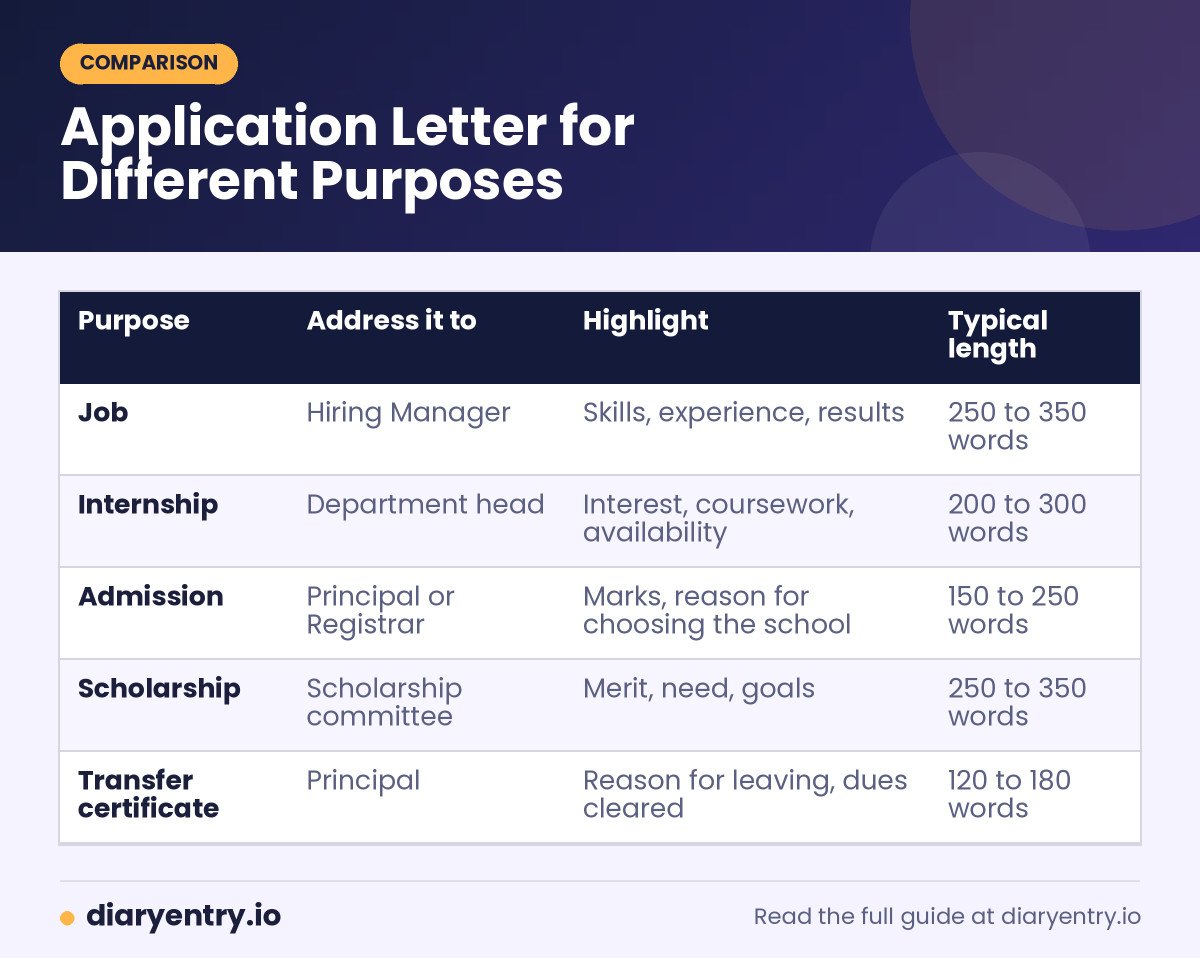
The skeleton stays the same, but the emphasis changes with the purpose. This table shows what to highlight.
| Purpose | Address it to | Highlight | Typical length |
|---|---|---|---|
| Job | Hiring Manager | Skills, experience, results | 250 to 350 words |
| Internship | Department head | Interest, coursework, availability | 200 to 300 words |
| Admission | Principal or Registrar | Marks, reason for choosing the school | 150 to 250 words |
| Scholarship | Scholarship committee | Merit, need, goals | 250 to 350 words |
| Transfer certificate | Principal | Reason for leaving, dues cleared | 120 to 180 words |
For an internship, say what you want to learn and how many hours you can offer. For a scholarship, be honest about your financial situation and clear about what you intend to do with the opportunity. If your letter is part of a class 10 paper, our page on letter writing for Class 10 shows how marks are usually allotted to format, content and expression.
Language and Tone Tips
Formal does not mean stiff. A good application letter sounds like a polite, confident person speaking clearly.
- Use active verbs. Write I managed, I organised, I completed rather than I was responsible for.
- Be specific. Replace hard-working with a fact, such as I handled forty customer queries a day.
- Keep sentences short. Aim for one idea per sentence and two to four sentences per paragraph.
- Avoid slang and contractions. Write I am rather than I’m in a formal letter.
- Do not exaggerate. Claims that cannot be checked or supported weaken the whole letter.
- Match the organisation. A letter to a creative agency can be a little warmer than a letter to a bank, but it should still stay respectful.
Common Mistakes to Avoid
Many applications are set aside for small, avoidable reasons. Check your letter against this list before you send it.
- Using a generic opening such as To whom it may concern when the name was easy to find.
- Copying a sample letter word for word, including its example details.
- Repeating your entire resume instead of highlighting the strongest points.
- Writing a letter that runs beyond one page.
- Forgetting the subject line or the enclosure note.
- Mixing closings, such as Dear Sir with Yours sincerely, instead of following the right pairing.
- Spelling the organisation’s or the reader’s name wrongly.
- Sending the letter without proofreading.
Yours Faithfully or Yours Sincerely?
This small point costs marks in exams and creates a poor impression at work. The rule is simple. If you begin with Dear Sir or Madam, end with Yours faithfully. If you begin with a name, such as Dear Mr Rao, end with Yours sincerely. In Indian school letters, Yours obediently is also accepted for a letter to a headmaster. Whichever form you choose, keep the closing consistent with the salutation.
Sending Your Application by Email
Most applications are now sent by email, and the same principles apply. Put the post name in the subject line, such as Application for Junior Accountant: Rohan Mehta. Paste the letter into the body or attach it as a PDF, and name the attachment clearly, for example Rohan-Mehta-Application-Letter.pdf. Keep the email polite and brief, and mention any attachments in the text. For layout details, see our guide to the email writing format.
A Quick Pre-Send Checklist
Run through these questions before you press send or hand in the letter.
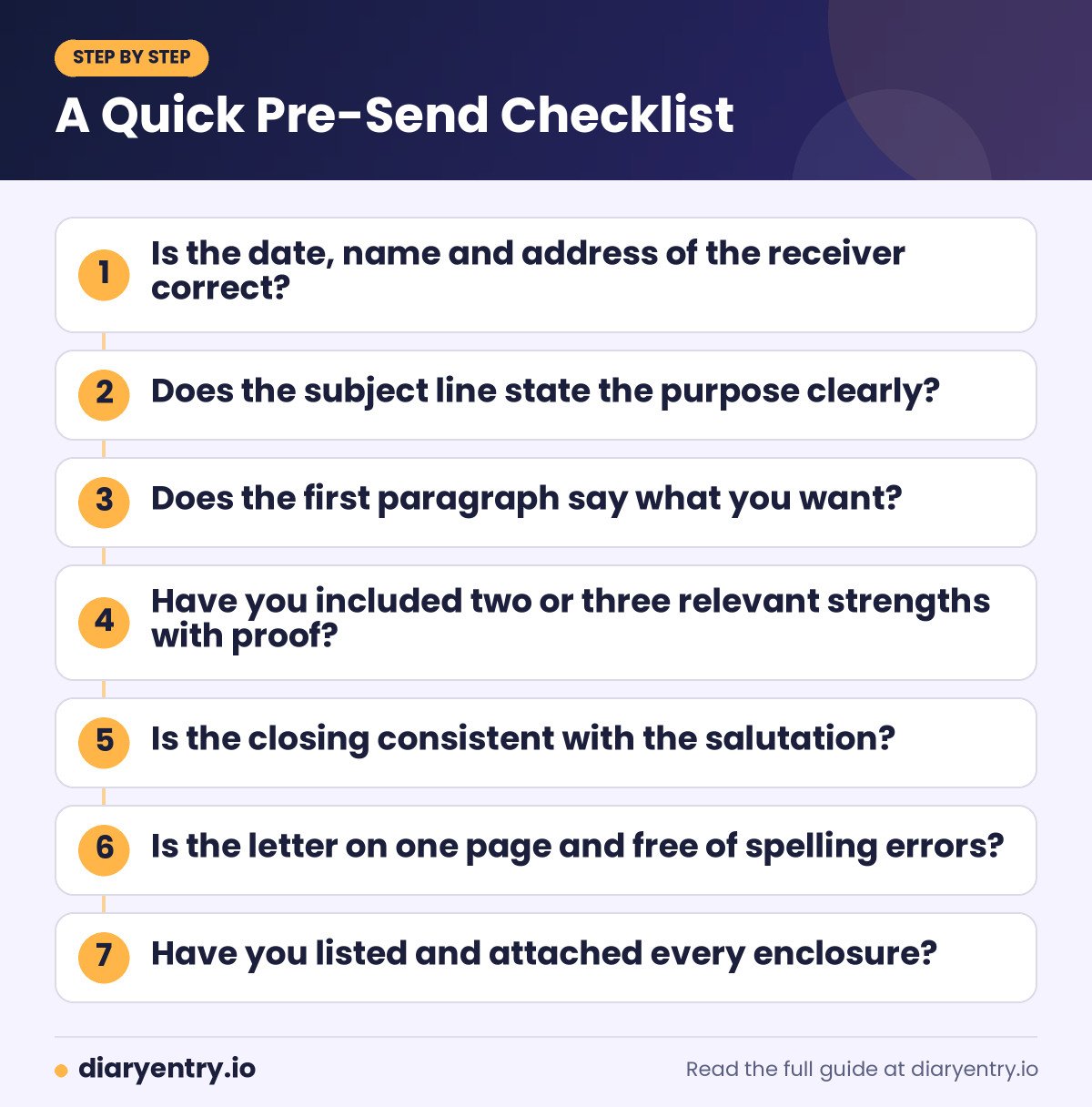
- Is the date, name and address of the receiver correct?
- Does the subject line state the purpose clearly?
- Does the first paragraph say what you want?
- Have you included two or three relevant strengths with proof?
- Is the closing consistent with the salutation?
- Is the letter on one page and free of spelling errors?
- Have you listed and attached every enclosure?
Frequently Asked Questions
What is the difference between an application letter and a cover letter?
In everyday use they mean almost the same thing. A cover letter accompanies a resume and highlights your fit for a job, whereas an application letter can also be the main request for admission, a leave or a scholarship.
How long should an application letter be?
Aim for one page, which is roughly 250 to 350 words for a job and fewer for a school request. Shorter letters are read more often than long ones.
Should I use Yours faithfully or Yours sincerely?
Use Yours faithfully when you start with Dear Sir or Madam and Yours sincerely when you start with a named person. Be consistent from salutation to closing.
Do I need a subject line in an application letter?
Yes. A subject line tells the reader the purpose at a glance and is expected in formal letters and in most school exam answers.
Can I use the same application letter for several jobs?
You can reuse the structure, but you should change the post name, the organisation and the examples you highlight. A letter tailored to the role is far more convincing.
Is an application letter handwritten or typed?
Typed letters are standard for jobs. In school exams, you write by hand, so neat handwriting and a clear layout matter.
Do I sign an emailed application letter?
A typed name at the end is enough for an email. If you attach a PDF and want a personal touch, you can add a scanned signature.
Conclusion: Make Your Application Letter Format Work for You
A strong application letter format is not about fancy words. It is about order, clarity and respect for the reader’s time. Put your address and date in place, state your purpose in the subject, make your case in a few short paragraphs, and close politely. Once you know this structure, you can adapt it to a job, an admission or a scholarship in minutes. If you also want to build a steady writing habit that makes letters like this easier, the 4-Week Diary Entry Course at diaryentry.io offers a gentle daily practice routine. And if you are preparing a short personal profile to go with your application, read our guide to the bio sketch format next.