
Report writing format for Class 12 follows a fixed pattern: a short heading, a byline with the reporter’s name, the place and date, and a body of two to four paragraphs in the third person and past tense. The report answers who, what, when, where, why and how, and it stays factual, objective and within the word limit given in the question. If your paper also asks for a short announcement or a talk, compare this format with our notice writing for Class 12 and speech writing format guides.
Report Writing Format Class 12: The Quick Answer
In Class 12 English, a report is a formal, factual account of an event that has already happened, usually for a newspaper or a school magazine. The standard format is: heading, byline, place and date, then the body paragraphs. The language should be formal, the tense past, and the voice mostly passive.
Word limits and marks change between boards and exam years, so always check your latest sample paper or syllabus. As a practice target, many Class 12 report answers run to roughly 120 to 150 words, but the number in your question always takes priority.
- Heading: short, catchy and in capital letters or title case.
- Byline: “By Reporter’s Name” (use the name given in the question, or a neutral name).
- Place and date: for example “New Delhi, 5 November”.
- Body: introduction, details and conclusion in separate short paragraphs.
- Style: third person, past tense, passive voice where it suits, no personal opinions.
What Is a Report in Class 12 English?
A report is a written account of an event, incident or situation based on facts. It is meant to inform readers who were not present. Unlike an article, a report does not argue a point or share personal views. Unlike a diary entry, it is not private or emotional. It is impersonal and structured.
Class 12 reports usually cover school or community events such as an annual day, a seminar, a workshop, a fair, a rally, a sports meet, a blood donation camp or an accident. The question tells you the occasion and often gives a few facts, which you must use without inventing wild details. If you are a year or two earlier in school, the report writing format for Class 10 shows the same structure at a simpler level.
The Standard Report Writing Format for Class 12
Every good report follows the same skeleton. Learn it once and you can apply it to any topic.
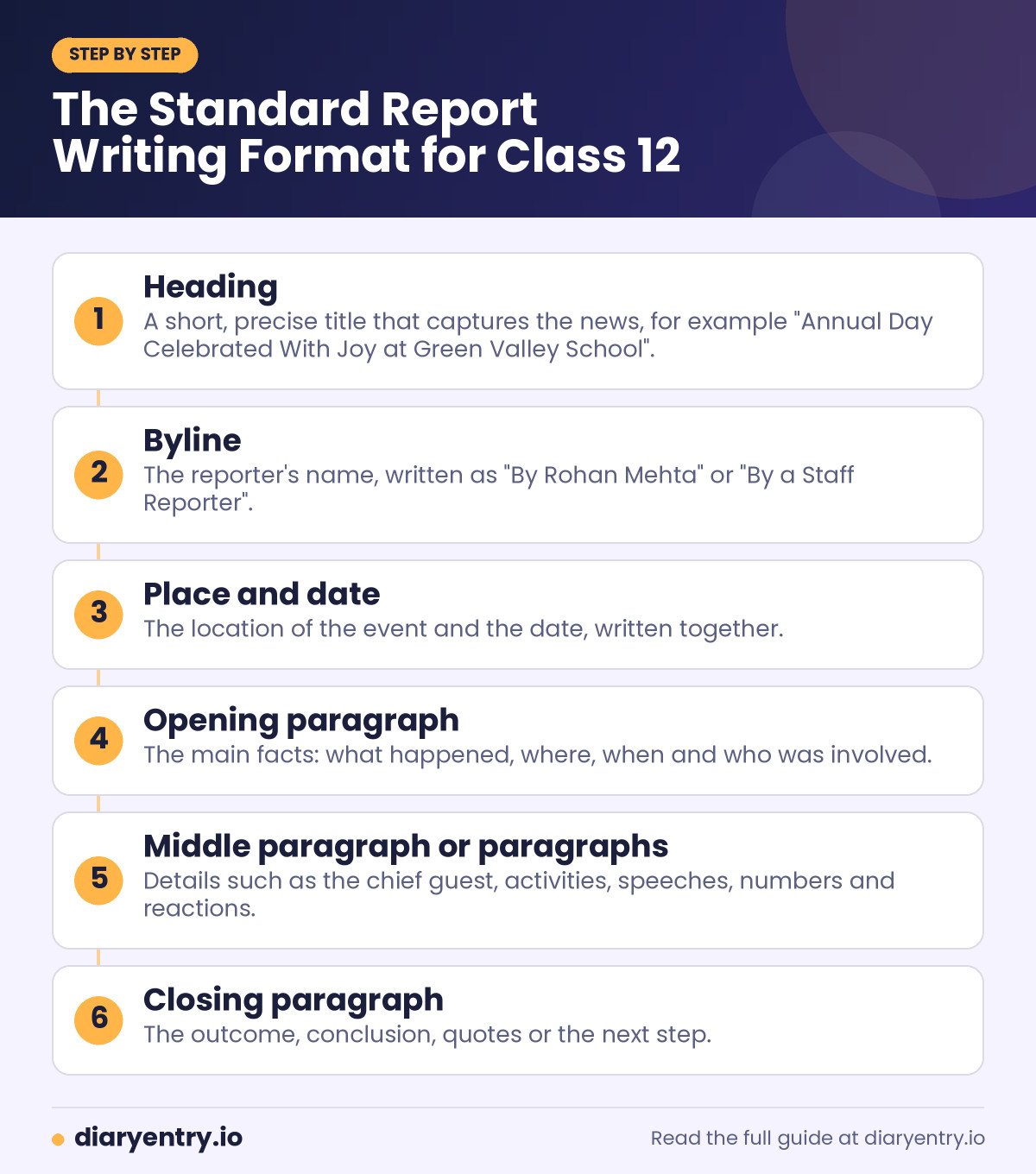
- Heading: A short, precise title that captures the news, for example “Annual Day Celebrated With Joy at Green Valley School”.
- Byline: The reporter’s name, written as “By Rohan Mehta” or “By a Staff Reporter”.
- Place and date: The location of the event and the date, written together.
- Opening paragraph: The main facts: what happened, where, when and who was involved.
- Middle paragraph or paragraphs: Details such as the chief guest, activities, speeches, numbers and reactions.
- Closing paragraph: The outcome, conclusion, quotes or the next step.
Report Writing Format Class 12: At a Glance
The table below compares the elements of a report so you can revise quickly before the exam.
| Element | What to write | Example |
|---|---|---|
| Heading | Short, factual, catchy | “Blood Donation Camp Draws 200 Donors” |
| Byline | Reporter’s name | “By Priya Sharma” |
| Place and date | Where and when | “Jaipur, 12 March” |
| Introduction | The key facts in 2 to 3 lines | Event, venue, time, organiser |
| Body | Details in logical order | Speakers, activities, responses |
| Conclusion | Outcome or closing remark | Vote of thanks, results, next steps |
| Language | Formal, past tense, third person | “The function was inaugurated by…” |
Heading: How to Write a Strong Report Title
The heading is the first thing the examiner reads. It should be short, about five to ten words, and it should tell the reader what the report is about. Use a verb in the passive or a strong noun phrase.
Good headings: “Inter-School Quiz Held at DPS”, “Road Accident Injures Five on Highway”, “Science Exhibition Inspires Young Minds”.
Weak headings: “A Report on the Science Exhibition” or “Exhibition”, because they are flat or too vague.
Byline, Place and Date
After the heading, write the byline on the next line, for example “By Aman Verma”. If the question names the reporter, use that name. If not, many sample answers use a neutral name or “By Staff Reporter”. Do not use your real name or your school’s real name unless the question specifically asks, and do not use a roll number.
Next, write the place and the date together, for example “Pune, 3 November”. Write the date of the report, not necessarily the date of the event, but keep it close to the event date given in the question.
Writing the Introduction
The introduction should answer the main questions in one or two sentences: what happened, where, when and who was involved. A reader should understand the news even if they stop here.
Example: “The annual sports meet of Sunrise Public School was held on 2 November at the school ground. Over 400 students from Classes 6 to 12 took part in track and field events.”
Writing the Body Paragraphs
The body adds detail in a logical order. Use one paragraph for the programme, one for the main events or speeches, and one for reactions or results if space allows.
- Mention the chief guest or main speaker and what they said, in indirect speech.
- Name the main events in the order they occurred.
- Include numbers only if they are given in the question.
- Use time expressions such as “later”, “after that” and “at the end” to keep the flow.
Writing the Conclusion
End with a factual closing: the result, the vote of thanks, a decision, or what will follow. Avoid dramatic phrases and personal opinions such as “I think it was wonderful”. A neutral ending like “The programme concluded with a vote of thanks by the school captain” is ideal.
Tense, Voice and Tone in a Report
Reports describe events that have already happened, so use the past tense. The passive voice is common because the action matters more than the doer, for example “The event was inaugurated by the principal” instead of “The principal inaugurated the event”.
Keep the tone formal and objective. Avoid contractions such as “didn’t” and slang. Do not use the word “I” unless the question wants a first-person account, which is rare.
Newspaper Report vs Magazine Report
Class 12 questions may ask for a report for a newspaper or for a school magazine. The structure is the same, but the style changes slightly.
| Feature | Newspaper report | School magazine report |
|---|---|---|
| Audience | General public | Students, teachers, parents |
| Heading | Short, news style | Slightly descriptive |
| Byline | Reporter’s name | Student reporter’s name |
| Tone | Neutral and factual | Formal, a little warm |
| Content | Key facts and quotes | Programme details and achievements |
Sample Report 1: School Event (About 120 Words)
Annual Day Celebrated With Enthusiasm at Green Valley School
By Rohan Mehta
Lucknow, 4 November
The annual day of Green Valley School was celebrated on 3 November in the school auditorium. The chief guest, Dr Meena Kapoor, a noted educationist, inaugurated the programme by lighting the lamp. Around 600 students, parents and teachers attended.
The evening featured a welcome dance, a short play on environmental protection and a musical performance by the senior choir. Students who had excelled in academics and sports were awarded certificates and trophies.
In her address, Dr Kapoor praised the students for their discipline and creativity. The programme concluded with a vote of thanks by the head girl, followed by the national anthem.
Sample Report 2: Accident or Incident (About 110 Words)
Five Injured as Bus Hits Divider on Highway
By a Staff Reporter
Jaipur, 6 November
Five passengers were injured when a private bus hit a road divider near the city bypass early on Tuesday morning. The bus was travelling from Ajmer to Jaipur when the driver reportedly lost control while avoiding a stray animal.
Local residents rushed to the spot and took the injured to the nearest hospital. Police reached the site within twenty minutes and cleared the road for traffic. According to the doctors, all five passengers are out of danger.
The police have registered a case and started an inquiry. The bus owner has been asked to submit the vehicle documents for examination.
How to Plan a Report in Three Minutes
In the exam, you can save time by planning before you write.
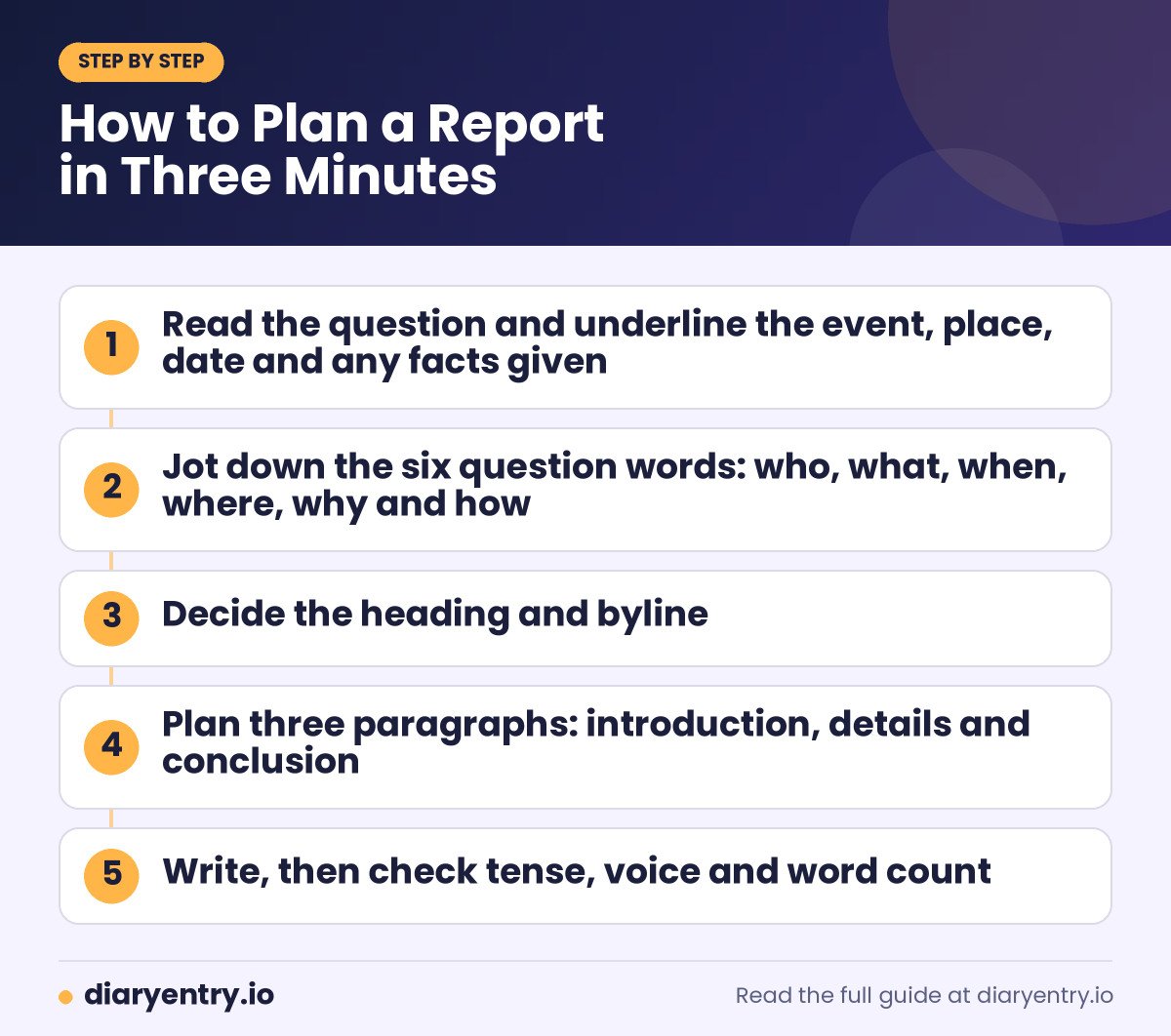
- Read the question and underline the event, place, date and any facts given.
- Jot down the six question words: who, what, when, where, why and how.
- Decide the heading and byline.
- Plan three paragraphs: introduction, details and conclusion.
- Write, then check tense, voice and word count.
This simple routine keeps your answer organised and prevents you from forgetting key elements.
Common Mistakes in Class 12 Report Writing
Most students lose marks because of a few avoidable slips.
- Writing in the first person or giving personal opinions.
- Using the present or future tense for a finished event.
- Forgetting the byline or the place and date line.
- Writing a long, vague heading.
- Writing one big paragraph instead of short ones.
- Adding invented facts that contradict the question.
- Exceeding the word limit and losing the conclusion.
If you find yourself running over the limit, the same trimming habits used for other short answers apply. Our guide on the diary entry word limit explains how to budget words across parts of a short answer, and the method works well for reports too.
Useful Words and Phrases for Reports
Using the right phrases makes your report sound formal and professional.
- Opening: “was organised”, “was held”, “took place”, “was inaugurated by”
- Linking: “later”, “meanwhile”, “subsequently”, “in the end”
- Reporting speech: “said that”, “stated that”, “emphasised that”, “urged the students to”
- Closing: “concluded with”, “ended on a note of”, “was followed by”
How Report Writing Differs From a Diary Entry
Students often mix report writing with other formats they have practised. The difference is mainly voice and purpose.
| Feature | Report | Diary entry |
|---|---|---|
| Person | Third person | First person |
| Tone | Formal, factual | Personal, emotional |
| Audience | Readers of a paper or magazine | Yourself |
| Opening | Heading and byline | Date and greeting |
| Feelings | Avoided | Encouraged |
If you have been practising diary writing, our page on the diary entry format for Class 6 to 10 shows how personal formats differ, which helps you keep them separate in the exam.
How to Practise Report Writing Effectively
Practice makes the format automatic. A simple weekly plan works well.
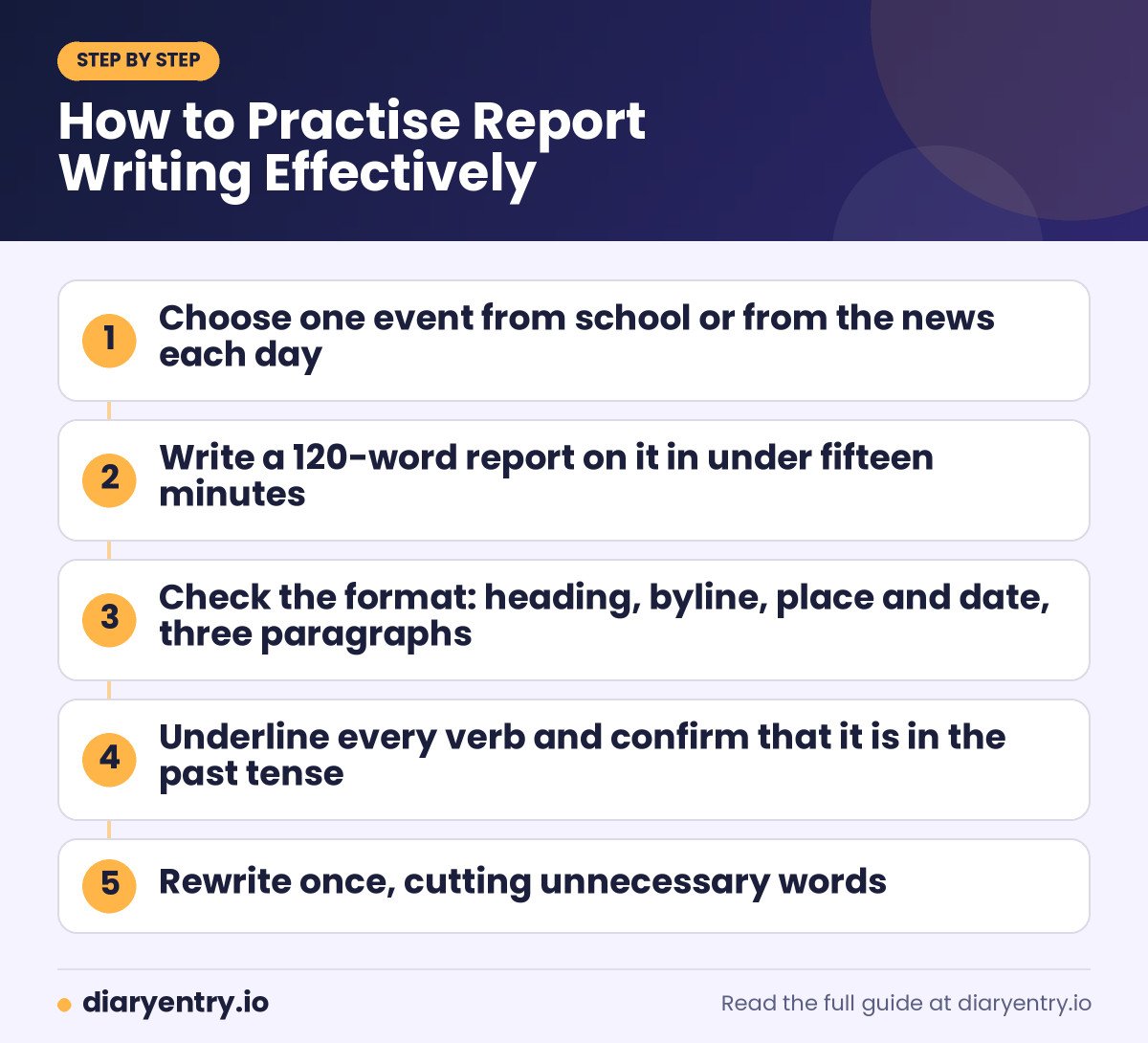
- Choose one event from school or from the news each day.
- Write a 120-word report on it in under fifteen minutes.
- Check the format: heading, byline, place and date, three paragraphs.
- Underline every verb and confirm that it is in the past tense.
- Rewrite once, cutting unnecessary words.
Writing regularly, even a few lines a day, builds both speed and accuracy. Our list of diary entry prompts for students can serve as a source of daily events to turn into reports, and a short daily writing habit helps you in every writing task. The 4-Week Diary Entry Course is one structured way to build that habit.
Frequently Asked Questions
What is the format of report writing for Class 12?
The format has a heading, a byline, the place and date, and a body in three short paragraphs: introduction, details and conclusion. Use the third person, the past tense and a formal tone.
How many words should a Class 12 report have?
Many sample answers run to about 120 to 150 words, but the limit depends on your board and the year. Always follow the word limit printed in your question paper.
Do I need a byline in a report?
Yes. The byline, written as “By” followed by the reporter’s name, is a standard part of the report format and is usually checked by examiners.
Should I use the passive voice in a report?
It is common and often preferred because it keeps the focus on the event, but it is not compulsory. Use whichever sounds clearer, as long as the tense stays in the past.
Can I invent details in a report?
You may add small, believable details such as the number of participants if the question allows, but never contradict the facts given. Avoid exaggerated or dramatic invention.
What is the difference between a report and an article?
A report states facts about an event that has happened and avoids opinion. An article can express views, argue a point and address the reader directly.
Conclusion
Mastering the report writing format for Class 12 comes down to remembering a simple order: heading, byline, place and date, then three tidy paragraphs in the third person and past tense. Keep your language formal, your facts clear and your word count in check. With a few timed practice reports each week, the format will become second nature, and you will write with confidence on exam day.