

Journal prompts for teens are short questions or sentence starters that give you something to write about when your mind is blank. A good prompt turns “I do not know what to write” into a few honest lines about your day, your feelings, your friends, your goals, or your future. This guide gives you more than 60 prompts, sorted by theme, plus simple tips for getting started and sticking with it.
You do not need a special notebook, perfect handwriting, or hours of free time. Five minutes and one prompt are enough. Younger siblings can start with our journal prompts for kids and middle school students. Pick a prompt that catches your eye, write whatever comes, and stop when you feel done.
What Are Journal Prompts for Teens?
A journal prompt is a question or an unfinished sentence that starts your writing. Instead of facing a blank page, you respond to something specific, such as “What is one thing I wish adults understood about my life?”
Teens use prompts for many reasons: to sort out feelings, to prepare for exams, to track goals, to be creative, or simply to have a private place to think. Writing is also a safe way to say things you are not ready to say out loud. If you have never kept a journal before, our guide on how to start a journal walks you through the basics in simple steps. For a kinder inner voice, these journal prompts for self love are a good next step.
Why journaling can help teens
Many people find that writing regularly helps them in practical ways. These are common experiences, not guarantees, and results differ from person to person.
- Clearer thinking: Seeing worries on paper can make them feel smaller and easier to sort.
- Better self-knowledge: Over time, you notice patterns in your moods, habits, and choices.
- Stronger writing: Short, regular writing makes school essays easier.
- A private space: A journal does not judge you, so you can be completely honest.
- A record to look back on: Reading old entries shows how much you have grown.
How to Use These Prompts
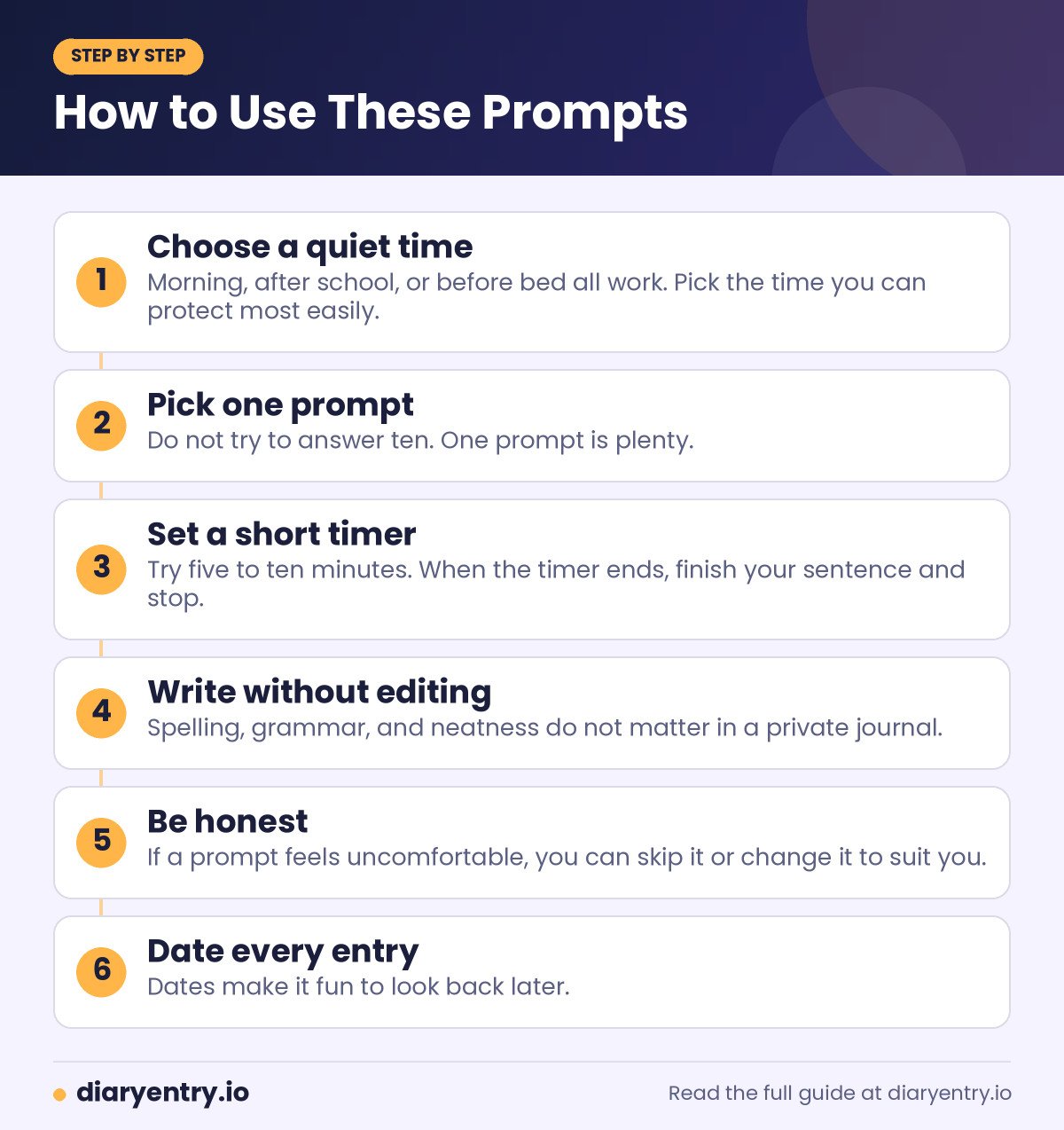
There is no wrong way to use a prompt, but these steps make the habit easier to keep.
- Choose a quiet time. Morning, after school, or before bed all work. Pick the time you can protect most easily. If mornings suit you, our morning journal prompts give you a ready-made start.
- Pick one prompt. Do not try to answer ten. One prompt is plenty.
- Set a short timer. Try five to ten minutes. When the timer ends, finish your sentence and stop.
- Write without editing. Spelling, grammar, and neatness do not matter in a private journal.
- Be honest. If a prompt feels uncomfortable, you can skip it or change it to suit you.
- Date every entry. Dates make it fun to look back later.
Paper or digital?
Both work. Paper feels personal and has no notifications, while a phone or laptop is quicker and easy to keep private with a password. Choose whichever you will actually use.
| Option | Good for | Watch out for |
|---|---|---|
| Paper notebook | Calm, focused writing; drawing and doodling | Privacy if others find it; carrying it around |
| Phone notes app | Quick entries anywhere | Distractions and notifications |
| Laptop document | Longer entries and typing speed | Needing a quiet place and a password |
| Voice notes | Thinking out loud | Finding a private moment to record |
Journal Prompts for Teens: Self-Discovery
These prompts help you understand who you are and what matters to you.
- What are three words my best friend would use to describe me, and do I agree?
- What am I proud of that I have never told anyone?
- What makes me feel most like myself?
- If I could change one thing about my daily routine, what would it be?
- What is something I believed a year ago that I no longer believe?
- What do I do well that does not show up on a report card?
- Which of my habits do I want to keep, and which do I want to change?
- What kind of friend do I want to be?
- What would I do tomorrow if I were not afraid of being judged?
- What do I need more of in my life right now? What do I need less of?
Journal Prompts for Teens: Feelings and Stress
Writing about emotions can help you name them. Remember that a journal is a helpful tool, not a replacement for support from people you trust.
- Right now I feel ___, and I think it is because ___.
- What is one thing worrying me this week, and what is one small step I can take?
- Describe a moment today when I felt calm.
- What does my body feel like when I am stressed? What helps?
- Write a letter to myself about a mistake I am still thinking about, using the kind words I would say to a friend.
- Who is someone I can talk to when things feel heavy?
- What is something I am carrying that I could ask for help with?
- What is a song, place, or activity that makes me feel better?
- Today I felt proud when ___.
- What would I tell a younger version of myself about handling hard days?
If your feelings ever seem too big to handle alone, please speak with a parent, a school counsellor, a doctor, or another adult you trust. Journaling can sit alongside that support, but it is not a treatment for mental health difficulties.
For a simple way to keep track of how you feel from day to day, try a mood tracker next to your journal.
Journal Prompts for Teens: School and Study
School takes up a large part of the day, so it deserves space in your journal.
- What was the best part of my school day, and what was the hardest?
- Which subject do I enjoy most, and why?
- What is one study habit that works for me? What is one that does not?
- How do I feel before a test? What could help me feel more prepared?
- What teacher has helped me most, and what did they do?
- If I could design my perfect school day, what would it look like?
- What did I learn today that surprised me?
- What goal do I have for this term, and what three steps will help me reach it?
- Write about a time I failed at something at school and what I learnt.
If you like writing in a school-style format, our list of diary entry prompts for students has fifty more ideas with examples.
Journal Prompts for Teens: Friends, Family, and Relationships
Relationships can be exciting and confusing. These prompts help you think through them calmly.
- Who in my life makes me feel supported? How can I thank them?
- What do I value most in a friendship?
- Describe a disagreement I had recently. How did I feel, and what could I do differently next time?
- What is one thing I wish my parents or guardians understood about me?
- What is one thing I appreciate about my family?
- How do I act differently around different groups of people? Am I comfortable with that?
- What does being a good listener look like to me?
- Write about a time I stood up for someone, or wish I had.
- How do I want to be remembered by my friends?
Journal Prompts for Teens: Goals and Future
Looking ahead can feel scary or exciting. Prompts make it easier to explore without pressure.
- What are three things I want to try in the next year?
- What kind of job or life do I picture at age 25? What would a normal day look like?
- What skill would I like to learn, and how could I begin this month?
- What would I do if I knew I could not fail?
- Which small action can I take today to move toward a bigger goal?
- What are my top five values, such as honesty, kindness, or curiosity?
- If I could ask my future self one question, what would it be?
- Write a letter to myself to open one year from now.
- Where would I like to travel, and why?
Journal Prompts for Teens: Gratitude and Positivity
Gratitude prompts train your attention to notice the good things around you. Many people find this a gentle way to end the day.
- Three small things I am grateful for today are ___.
- Who made me smile this week?
- What is a place that makes me feel happy and safe?
- What is something I own that I would miss if I lost it, and why?
- What is a challenge that taught me something useful?
- What is one thing about my body or mind that I appreciate?
- Write about a kind thing someone did for me.
You can go deeper with our guide to the gratitude journal, which explains how to keep one without it feeling forced.
Journal Prompts for Teens: Creative and Fun
Not every prompt has to be serious. These ones are meant to be playful.
- Describe my perfect weekend, hour by hour.
- Invent a new holiday. What is it called and how do people celebrate?
- Write a short story that starts with, “The door was open, and nobody was home.”
- If I could live in any book, movie, or game world for a week, which would I choose?
- Make a list of ten things that make me laugh.
- If I had a superpower for one day, what would I do with it?
- Write a conversation between two objects on my desk.
- Describe my room as if I were a tour guide.
- Create the menu for a restaurant that only serves my favourite foods.
Quick Weekly Prompt Plan
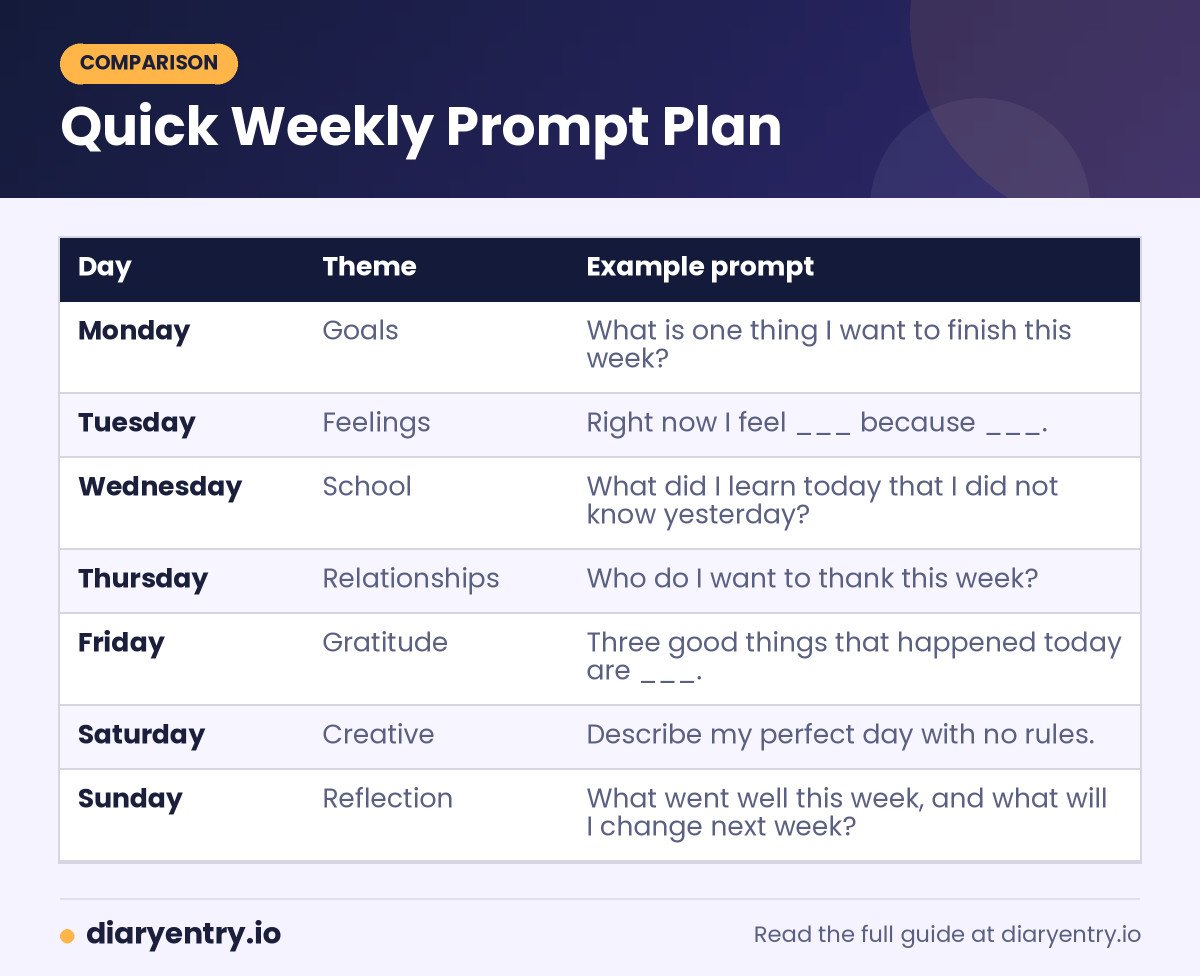
If choosing a prompt feels like another decision, use a simple weekly plan.
| Day | Theme | Example prompt |
|---|---|---|
| Monday | Goals | What is one thing I want to finish this week? |
| Tuesday | Feelings | Right now I feel ___ because ___. |
| Wednesday | School | What did I learn today that I did not know yesterday? |
| Thursday | Relationships | Who do I want to thank this week? |
| Friday | Gratitude | Three good things that happened today are ___. |
| Saturday | Creative | Describe my perfect day with no rules. |
| Sunday | Reflection | What went well this week, and what will I change next week? |
Tips to Keep Journaling
Starting is easy. Continuing takes a few smart habits.
- Start tiny. Write just three sentences a day. Small habits stick better than big plans.
- Link it to a routine. Journal after brushing your teeth or right after you get home.
- Keep your journal visible. A notebook on your pillow is a reminder.
- Forgive missed days. Do not try to catch up. Just write the next entry.
- Keep it private. Choose a hiding spot or a password so you feel free to be honest.
- Experiment. Use lists, drawings, bullet points, or voice notes if full sentences feel heavy.
If you want a ready-made routine, the daily journaling habit guide shows how to build the habit over four weeks. The diaryentry.io 4-Week Diary Entry Course is another gentle option if you prefer guided practice.
Common Mistakes Teens Make When Journaling
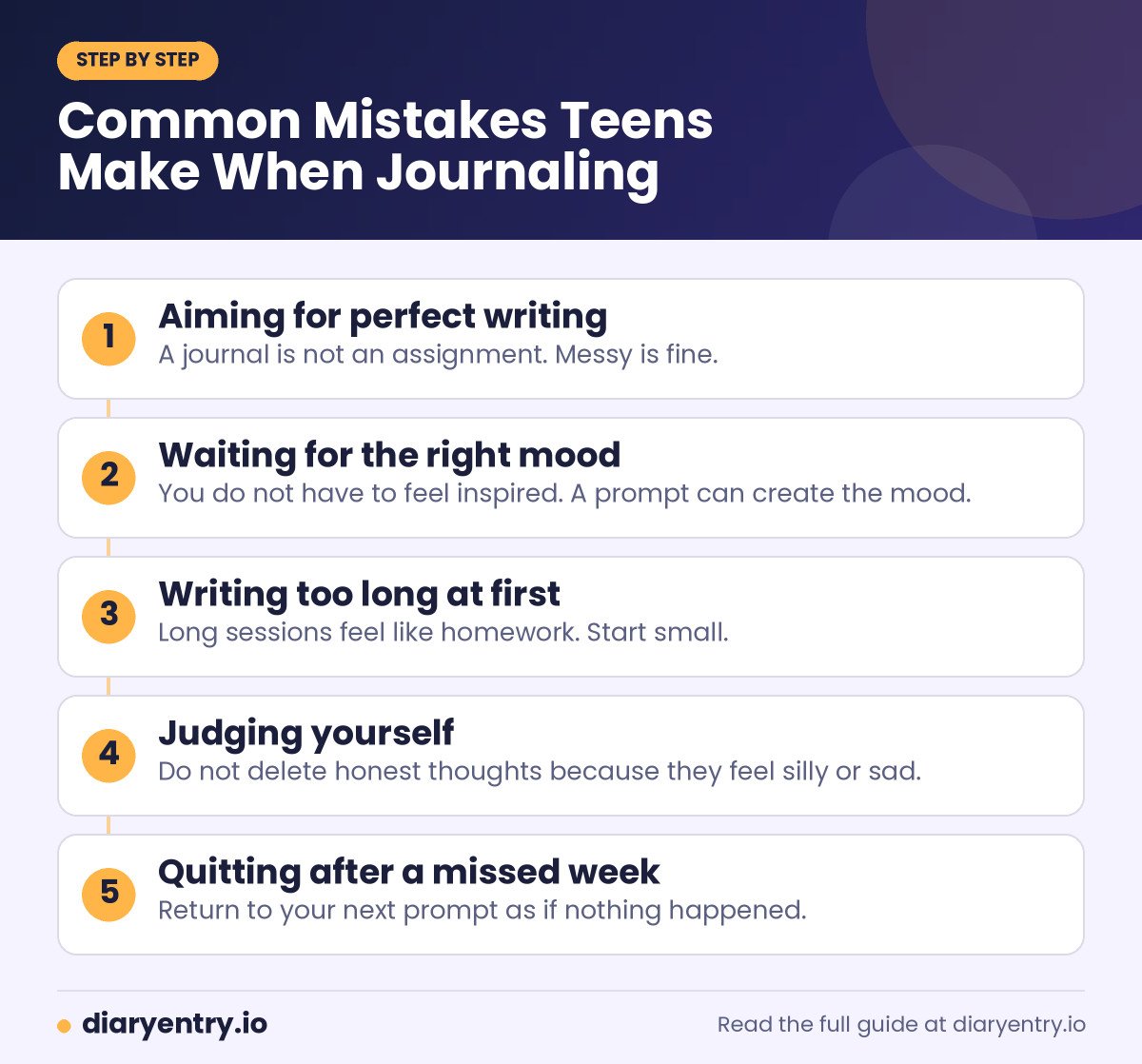
A few simple traps stop many people in the first week.
- Aiming for perfect writing. A journal is not an assignment. Messy is fine.
- Waiting for the right mood. You do not have to feel inspired. A prompt can create the mood.
- Writing too long at first. Long sessions feel like homework. Start small.
- Judging yourself. Do not delete honest thoughts because they feel silly or sad.
- Quitting after a missed week. Return to your next prompt as if nothing happened.
Frequently Asked Questions
What are good journal prompts for teens?
Good prompts are specific, open-ended, and easy to start. Examples include “What is one thing I am proud of this week?” and “What would I tell my younger self?” Choose prompts that match what you want to explore, such as feelings, school, or goals.
How often should a teen journal?
Even two or three times a week is a good start. Daily writing builds the habit faster, but the best schedule is the one you can keep without stress.
How long should a journal entry be?
A few sentences are enough. Many people write for five to ten minutes. Stop when you have said what you needed to say.
Can journaling help with stress?
Many people find that writing about their feelings helps them understand and calm them. It is not a medical treatment, so talk to a trusted adult or professional if stress feels overwhelming.
Should I write by hand or on a device?
Either works. Handwriting feels slower and more personal, while typing is faster and easy to protect with a password. Pick the option you will use most often.
What if I do not know what to write?
Use a prompt, write a list, or describe your day in five sentences. You can also finish the sentence “Right now, I am thinking about…” and keep going.
How do I keep my journal private?
Use a notebook with a lock, keep it in a safe spot, or write in a password-protected app or document. Telling family that your journal is private can also help them respect it.
Conclusion
Journal prompts for teens make writing easy, personal, and useful. Choose one prompt from the lists above, write for five minutes, and repeat it a few times a week. If you want more ideas for different kinds of journals, see our journal examples for sample entries you can copy and adapt. Over time, your entries become a record of who you are, what you care about, and how far you have come.