

A work diary is a short, regular record of what you did, learned and decided at work. Keeping one takes about five minutes a day, and it gives you proof of your progress, a calmer mind at the end of the day and much better answers when someone asks, “So what have you been working on?”
This guide explains what a work diary is, why professionals keep one, and exactly how to start. You will find a copy-and-paste template, sample entries for different jobs, a comparison of formats and the common mistakes that make people quit after a week.
What Is a Work Diary? (Quick Answer)
A work diary is a daily or weekly log in which you note your tasks, results, problems, decisions and lessons from your job. Unlike a to-do list, which looks forward, a work diary looks back at what actually happened. Unlike a personal diary, it stays focused on your professional life, although it can include how you felt about it.
People also call it a work journal, a work log, a daily work record or a career diary. The names differ, but the purpose is the same: capture the details of your working life before you forget them. If you are new to the wider idea, our guide on what a diary is and the main types gives helpful background.
Why Keep a Work Diary? 7 Practical Benefits
Most people start a work diary because they are tired of forgetting things. The benefits go well beyond memory.
- Evidence for reviews and raises. When appraisal season arrives, you have dated examples of projects delivered, problems solved and feedback received instead of vague impressions.
- Better handovers and reports. Weekly summaries are easy to write when the raw material is already in your diary.
- Faster learning. Writing down what went wrong and why turns mistakes into reusable lessons.
- Less mental clutter. Moving open loops from your head to a page makes it easier to switch off in the evening.
- Clearer priorities. Seeing where your hours actually go shows you which tasks deserve less time.
- Protection in disputes. A dated record of instructions, agreements and conversations can help clarify what was said and decided.
- Stronger CVs and interviews. Specific achievements are far easier to describe when you wrote them down at the time.

None of this requires beautiful handwriting or long entries. Consistency matters far more than length, a point we also make in our guide to building a daily journaling habit in four weeks.
Work Diary vs Work Journal vs To-Do List
These tools overlap, which causes confusion. The table below shows how they differ so you can decide what you actually need.
| Feature | Work diary | Work journal | To-do list |
|---|---|---|---|
| Main purpose | Record what happened | Reflect on what it means | Plan what to do next |
| Time focus | Past and present | Past, with insight | Future |
| Typical length | 3 to 10 lines a day | One paragraph or more | A checklist |
| Best for | Evidence, reports, reviews | Growth, decisions, stress | Daily execution |
| Review rhythm | Weekly | Monthly | Daily |
In practice, many people blend the first two: a short factual log with one reflective line at the end. That hybrid is what the template below uses.
How to Keep a Work Diary: 7 Simple Steps
- Choose your format. Pick one place: a notebook, a notes app, a document or a dedicated tool. The best format is the one you will open every day.
- Set a fixed time. Attach the habit to something you already do, such as the last five minutes before you close your laptop, or the first five minutes after your morning coffee.
- Use a repeatable structure. A fixed template removes the “what should I write?” friction. Use the template in the next section.
- Write facts first. Note what you did, who was involved and what the outcome was. Add numbers where you can: tickets closed, calls made, pages written.
- Capture one lesson or one win. A single line is enough. Over months, these lines become your most valuable content.
- Review weekly. Spend ten minutes every Friday reading the week, pulling out highlights and planning the next one.
- Archive monthly. Copy your best entries into a “wins” file for performance reviews, promotion cases and your CV.

Free Work Diary Template You Can Copy
Copy the structure below into any notebook or app. Each daily entry should take under five minutes. For more layouts to adapt, see our diary template guide with free formats.
Daily Work Diary Template
- Date and day: Tuesday, 3 November
- Top three priorities: What mattered most today?
- What I completed: Tasks finished, with outcomes or numbers.
- What is still open: Items carried over and why.
- Meetings and decisions: Who, what was agreed, any deadlines.
- Problems or blockers: What slowed me down, and who can help.
- Lesson or win of the day: One sentence.
- Tomorrow’s first task: The one thing to start with.
Weekly Review Template
- Biggest achievement this week:
- What took longer than expected:
- What I would do differently:
- Feedback received:
- Top three goals for next week:
If you are comfortable with digital tools, the same structure works well in a notes app. Our overview of online journaling and keeping a digital diary covers the pros and cons of each approach.
Work Diary Examples for Different Jobs
Seeing real-looking entries makes the habit easier to copy. The examples below are fictional and deliberately short. Notice how each one records facts, an outcome and a next step.
Example 1: Office or Operations Role
Monday, 2 November. Priorities: finish vendor invoice reconciliation, prepare Thursday’s team update, reply to the audit query. Completed: reconciled 42 of 45 invoices; three are waiting on vendor confirmation. Sent the audit reply after checking figures with finance. Blocker: the shared tracker was overwritten twice, so I will ask IT about version history. Lesson: reconcile in smaller batches to catch errors earlier. Tomorrow: chase the three vendors first thing.
Example 2: Software Developer
Wednesday, 4 November. Fixed the login timeout bug (ticket reference noted in tracker); root cause was a session setting that differed between environments. Reviewed two pull requests. Spent 90 minutes on a flaky test that turned out to be a timing issue. Decision agreed in stand-up: move the reporting feature to next sprint. Lesson: check environment configuration before debugging code. Tomorrow: write the missing tests for the login fix.
Example 3: Teacher
Thursday, 5 November. Taught fractions to Class 5; about a third of the class struggled with equivalent fractions. Used paper strips in the second half and understanding improved visibly. Marked 28 notebooks. Parent meeting with one family about reading practice; agreed a 10-minute daily routine. Lesson: show the physical model before the rule. Tomorrow: repeat the strips activity with the group that needs it.
Example 4: Freelancer or Consultant
Friday, 6 November. Delivered draft two of the client report, two days ahead of schedule. Client requested a change to the scope; I noted it in writing and sent a short confirmation email. Billed 6.5 hours on this project. Lesson: confirm scope changes in writing the same day. Next week: invoice, then start the second project.
Paper, Digital or Hybrid: Which Work Diary Format Is Best?
There is no universal winner. Choose based on how you work and how you plan to use the entries later.
- Paper notebook: Fast, distraction-free and good for people who think better by hand. The downside is that it is hard to search and easy to forget at home.
- Notes app or document: Searchable, backed up and accessible on every device. It works best if you create one note per week with a consistent heading.
- Spreadsheet: Ideal if you track numbers such as hours, tickets or sales. Less comfortable for longer reflections.
- Hybrid: Jot quick notes on paper during the day and type a short summary at the end. Many people find this the most sustainable option.
If you are weighing up digital options, our guide to the electronic diary and its best options explains what to look for in an app, including privacy and backup features. For a side-by-side look at specific tools, see our comparison of the best journaling software.
What to Write (and What to Leave Out)
A good work diary is specific. Instead of “worked on report”, write “drafted sections 1 to 3 of the quarterly report; waiting on sales data from Priya”. Specifics make entries useful months later.
Worth Recording
- Tasks completed and measurable results
- Decisions, who made them and why
- Instructions or requests received, with dates
- Problems encountered and how you solved them
- Positive feedback, in the person’s own words where possible
- Ideas you want to revisit
- Skills you practised or learned
Better Left Out or Kept Private
- Passwords, access codes and other credentials
- Confidential client or customer data that your employer’s policy forbids copying
- Personal remarks about colleagues that you would not want read aloud
- Anything your contract or company policy says must not leave company systems
If your diary lives on a work laptop or company account, assume your employer may be able to access it. When in doubt, check your policy, and keep emotional venting in a separate private journal. If you are a student or researcher, you may prefer an academic diary instead.
Using Your Work Diary for Performance Reviews and Career Growth
The real payoff arrives months later. Here is a simple way to turn entries into career assets.
Build a Wins File
Each month, scan your entries and copy the three strongest achievements into a separate “wins” document. Use the format: situation, action, result. For example: “The monthly report took two days to prepare. I built a reusable template and shortened it to half a day.” This is the structure interviewers often look for in answers.
Prepare for Appraisals in Minutes
Before a review, read your weekly summaries and highlight patterns: what you delivered, where you grew and what support you need. Bring two or three concrete examples for each goal rather than a general claim.
Spot Patterns in Your Time
If the same blocker appears in five entries, it is no longer bad luck, it is a process problem worth raising. Similarly, if your best work consistently happens in the morning, protect that time. Pairing your diary with a goal-focused habit helps too; see our page on the goal-setting diary for ideas on linking daily notes to bigger objectives.
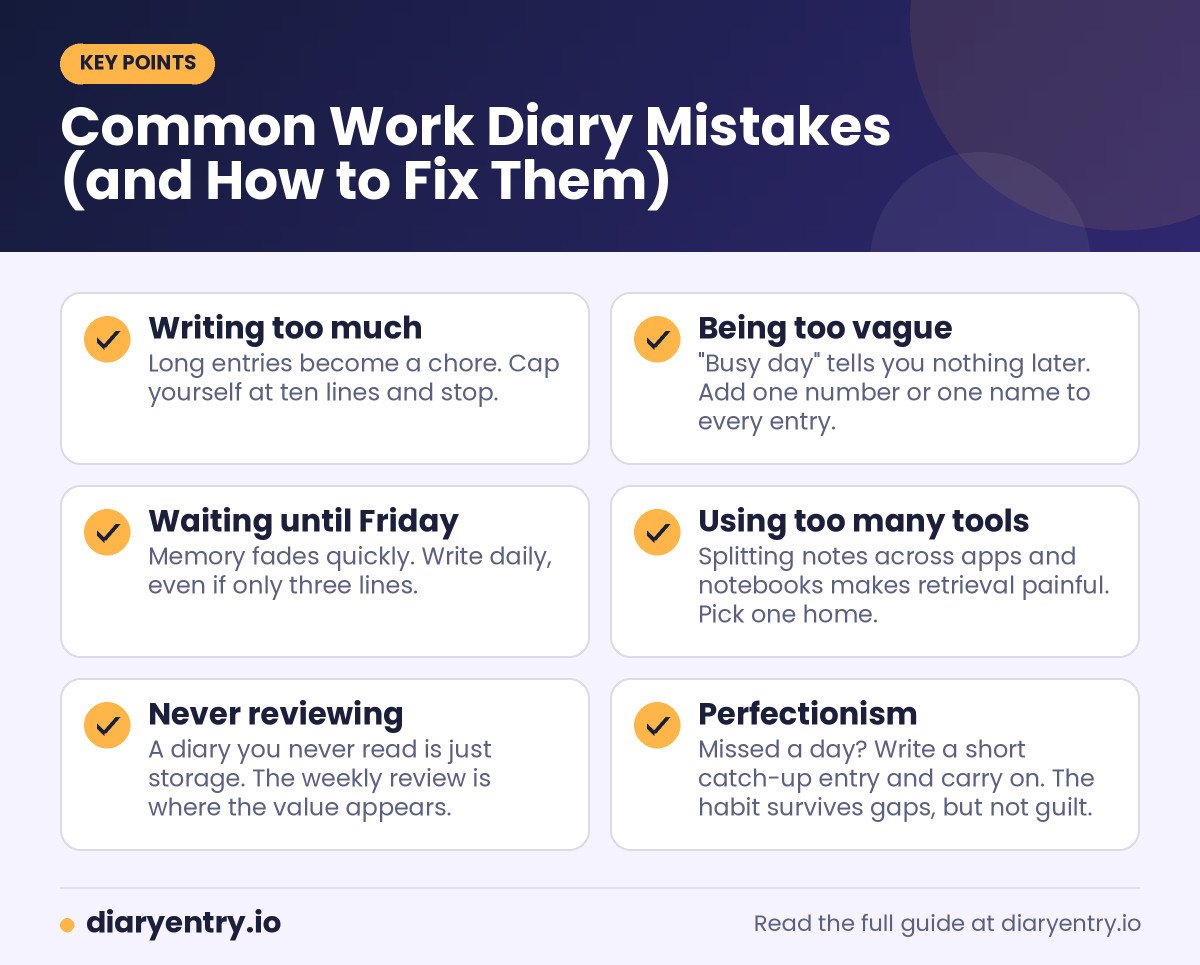
Common Work Diary Mistakes (and How to Fix Them)
- Writing too much. Long entries become a chore. Cap yourself at ten lines and stop.
- Being too vague. “Busy day” tells you nothing later. Add one number or one name to every entry.
- Waiting until Friday. Memory fades quickly. Write daily, even if only three lines.
- Using too many tools. Splitting notes across apps and notebooks makes retrieval painful. Pick one home.
- Never reviewing. A diary you never read is just storage. The weekly review is where the value appears.
- Perfectionism. Missed a day? Write a short catch-up entry and carry on. The habit survives gaps, but not guilt.
How to Make the Work Diary Habit Stick
Habit research consistently suggests that small, repeated actions tied to an existing routine are easier to maintain than ambitious plans. Apply that to your work diary with a few tactics. For the wider benefits of writing every day, see our list of the benefits of keeping a daily journal.
- Start with two minutes a day for the first week, then grow only if you want to.
- Keep the diary visible: pin the note, or leave the notebook on top of your keyboard.
- Set a recurring calendar reminder labelled “Diary” for the same time each day.
- Use the same opening line every day, such as “Today I…” to remove the blank-page problem.
- Reward the weekly review with something small, like a coffee away from your desk.
If you would like structure and gentle accountability, the 4-Week Diary Entry Course walks through building a daily writing habit step by step. The skills carry over directly to keeping a clear, useful work diary.
Frequently Asked Questions About Keeping a Work Diary
What is a work diary?
A work diary is a regular log of your professional activities, including tasks completed, decisions made, problems faced and lessons learned. It acts as a personal record of your working life that you can use for reviews, reports and reflection.
How often should I write in a work diary?
Daily is ideal because details are fresh, and five minutes is enough. If that feels like too much, write three times a week and add a longer weekly review. Regularity matters more than length.
What should I include in a work diary entry?
Include the date, your main priorities, what you completed, anything left open, key meetings or decisions, blockers and one lesson or win. Add numbers and names wherever possible to make entries specific.
Can a work diary be used as evidence?
Dated, consistent, contemporaneous notes can help you recall and explain events, and they are sometimes used to support a point in a workplace discussion. How much weight they carry depends on your country and situation, so for formal or legal matters, seek advice from a qualified professional.
Is a work diary different from a time sheet?
Yes. A timesheet records hours for payroll or billing. A work diary records what you did and learned, including outcomes and reflections. Some people combine them in one spreadsheet, but their purposes differ.
Should I keep my work diary on paper or digitally?
Choose whichever you will actually use. Digital notes are searchable and easy to back up, while paper can feel faster and calmer. A hybrid of quick paper notes and a typed daily summary suits many people.
How long should a work diary entry be?
Three to ten lines is plenty. A short, specific entry that you write every day is far more useful than a long one you write once a month.
Conclusion: Start Your Work Diary Today
A work diary does not need to be elaborate to be powerful. Pick a format, use the template above, write for five minutes at the end of today and review it on Friday. Within a month you will have a searchable record of your achievements, a clearer view of how you spend your time and far less trouble remembering what you did. If you prefer a longer view, a five year journal adds just one line a day across several years.
Start small, keep it specific and be kind to yourself when you miss a day. If you would like extra guidance on building the writing habit itself, you can explore our 4-Week Diary Entry Course, or browse more journal examples for every type of journal for inspiration.