

Your first journal entry does not need to be clever, long or well written. It only needs to exist. This guide shows you exactly what to write in a first journal entry, with a simple structure, ready-to-copy examples, 30 opening lines and answers to the questions beginners ask most.
Quick answer: for a first journal entry, write the date, say why you are starting, describe how you feel and what happened today in a few honest sentences, and end with one thing you hope to get from journaling. Five to ten minutes is plenty.
Why the First Journal Entry Feels So Hard
A blank page can feel like a test. You may worry that your handwriting is messy, your life is boring or your sentences are not good enough. Those worries are common, and they are the main reason people buy a beautiful notebook and then leave it empty.
The fix is to lower the stakes. Your first entry is a warm-up, not a performance. Nobody is grading it, and you are the only reader. Treat it as a short conversation with yourself.
If you want a broader walkthrough of setting up the habit, our guide on how to start a journal covers tools, timing and routines. This page focuses only on that very first entry.
What to Write in Your First Journal Entry: A Simple Structure
You do not have to follow a formula, but a structure removes the fear of the blank page. Use these six steps as a starting frame.
- Write today’s date and, if you like, the time and place.
- State why you are starting a journal in one or two sentences.
- Describe how you feel right now, in plain words.
- Record what happened today, or what is on your mind.
- Note one thing you are grateful for or looking forward to.
- Finish with a sentence about what you hope journaling will do for you.
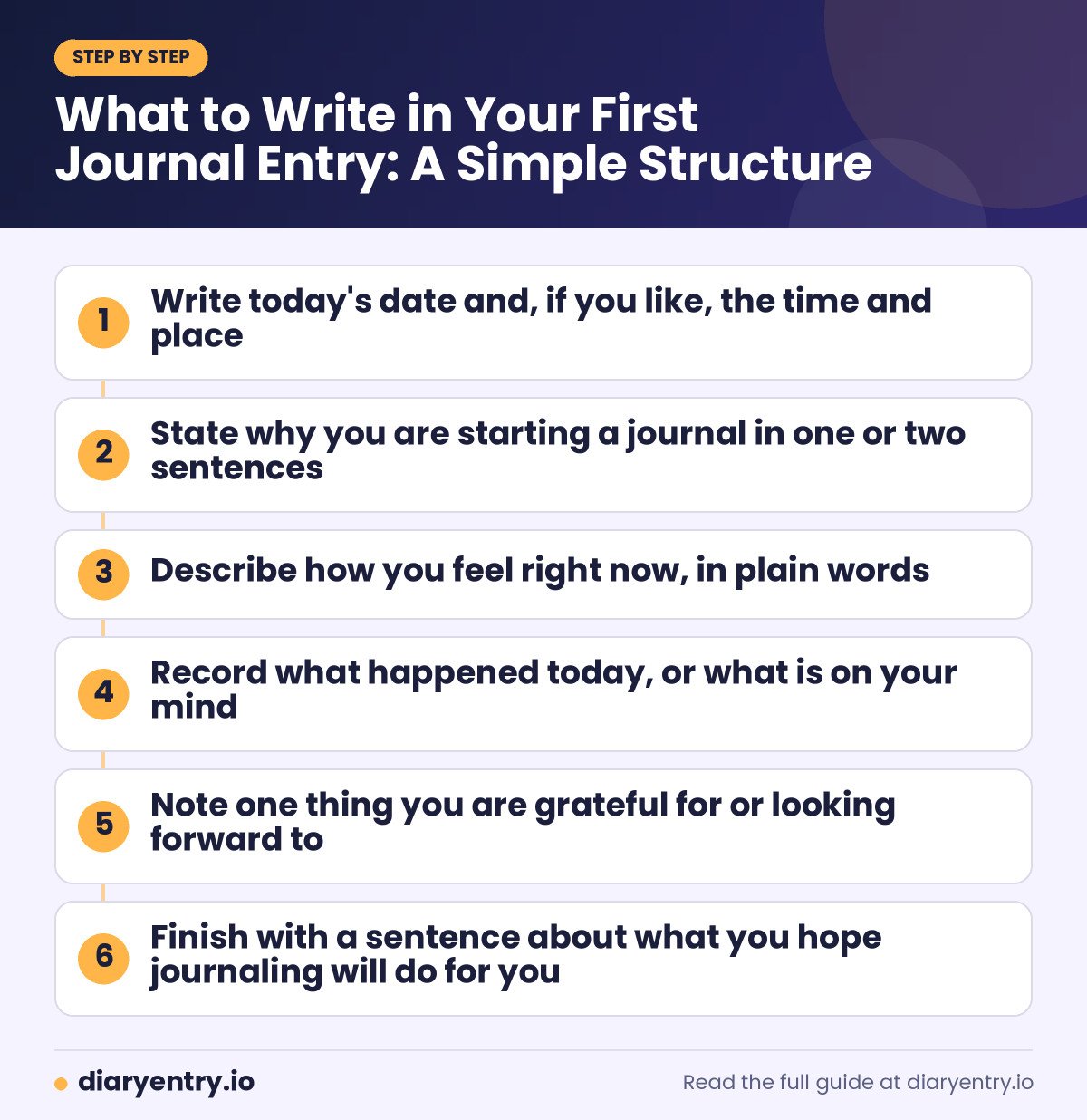
That is a complete entry. Many first entries run to about half a page, and that is perfect.
Step-by-Step: Writing Your First Entry in Ten Minutes
Here is the same idea as a short routine you can follow without thinking.
- Minute 0-1: Sit somewhere comfortable, open the page and write the date.
- Minute 1-3: Write why you are here. “I want to understand my days better” is enough.
- Minute 3-6: Describe your day or your mood. Do not edit or cross things out.
- Minute 6-8: Add one detail that made today feel like today, such as a conversation, a smell or a small win.
- Minute 8-10: Close with a hope or intention for your journaling habit.
Set a timer if it helps. When it rings, you may stop, even mid-thought. Stopping on time makes it easier to come back tomorrow.
First Journal Entry Examples You Can Adapt
Examples make the idea concrete. Read these, then write your own version in your own words.
Example 1: The Simple Starter
“1 February. I am starting this journal because my days blur together and I want to remember them. Right now I feel a little nervous and a little hopeful. Today I worked, walked home, and cooked pasta. The best part was the quiet evening. I am grateful for a warm kitchen. I hope this journal helps me slow down.”
Example 2: The Reflective Starter
“I have wanted to journal for years and kept putting it off. Today I finally sat down. I feel tired but relieved to be writing. Lately I have been thinking about changing jobs, and I do not know who to talk to. Maybe this page can be that place. I will write for five minutes and see what comes out.”
Example 3: The Gratitude Starter
“Date: Monday. Three things I am thankful for today: my sister’s phone call, an unexpectedly sunny afternoon, and finishing a hard task. I feel calm. I want to practise noticing good things more often, and I think writing them down will help.”
Example 4: The Student Starter
“Dear Diary, today was my first day of the new term. I met my new teacher and sat next to someone friendly. I felt shy at first, but lunch was fun. I want to use this diary to track my goals this year. Tomorrow I will write about my timetable.”
Example 5: The Honest-and-Messy Starter
“I do not know what to write. I feel silly. Writing this still feels odd, but I read that it helps to start anyway. So here I am. Today was fine. Nothing special. Maybe that is a good thing to start with.”
Notice that none of these is polished. Each one is specific, personal and short. That is the standard to aim for.
30 Ways to Open Your First Journal Entry
If you are stuck at the very first sentence, borrow one of these and keep going.
- Today I decided to start journaling because…
- Right now, I am sitting in… and I can hear…
- The thing on my mind most is…
- If someone asked how I am really doing, I would say…
- One thing I want to remember about this season of my life is…
- I am a little afraid of writing this because…
- Something small that made me smile today was…
- Lately I have been feeling…
- If I could change one thing about this week, it would be…
- Three words that describe today are…
- A conversation I keep replaying is…
- Something I am proud of, even if it is small, is…
- I wish I had more time for…
- What I want my life to look like in a year is…
- Today I learned that…
- The hardest part of today was…
- The best part of today was…
- My body feels…
- A worry I would like to put down on paper is…
- Someone I am grateful for is…
- If today were a weather forecast, it would be…
- I am curious about…
- A habit I want to build is…
- Something I have been avoiding is…
- Right now I need…
- I want this journal to be a place where…
- A memory that came to me today is…
- I am looking forward to…
- If I could tell my future self one thing, it would be…
- Here is what I know about myself so far…
You can also use these as prompts on later days. The morning journal prompts page has more ideas for starting your day with a few lines.
Comparison: Types of First Entries and When to Use Them
Different goals call for different first entries. This table helps you choose.
| Type of first entry | Best for | Length | Main benefit |
|---|---|---|---|
| Introduction to yourself | General diary or personal journal | Half a page | Sets a baseline you can compare later |
| Gratitude list | Beginners who want a positive start | 3-5 lines | Quick, low-pressure habit |
| Brain dump | Busy or stressed minds | 5-10 minutes | Clears racing thoughts |
| Goal statement | Goal-setting or productivity journals | Short paragraph | Gives the journal a clear purpose |
| Letter to future self | Long-term or milestone journals | One page | Creates a time capsule to reread |
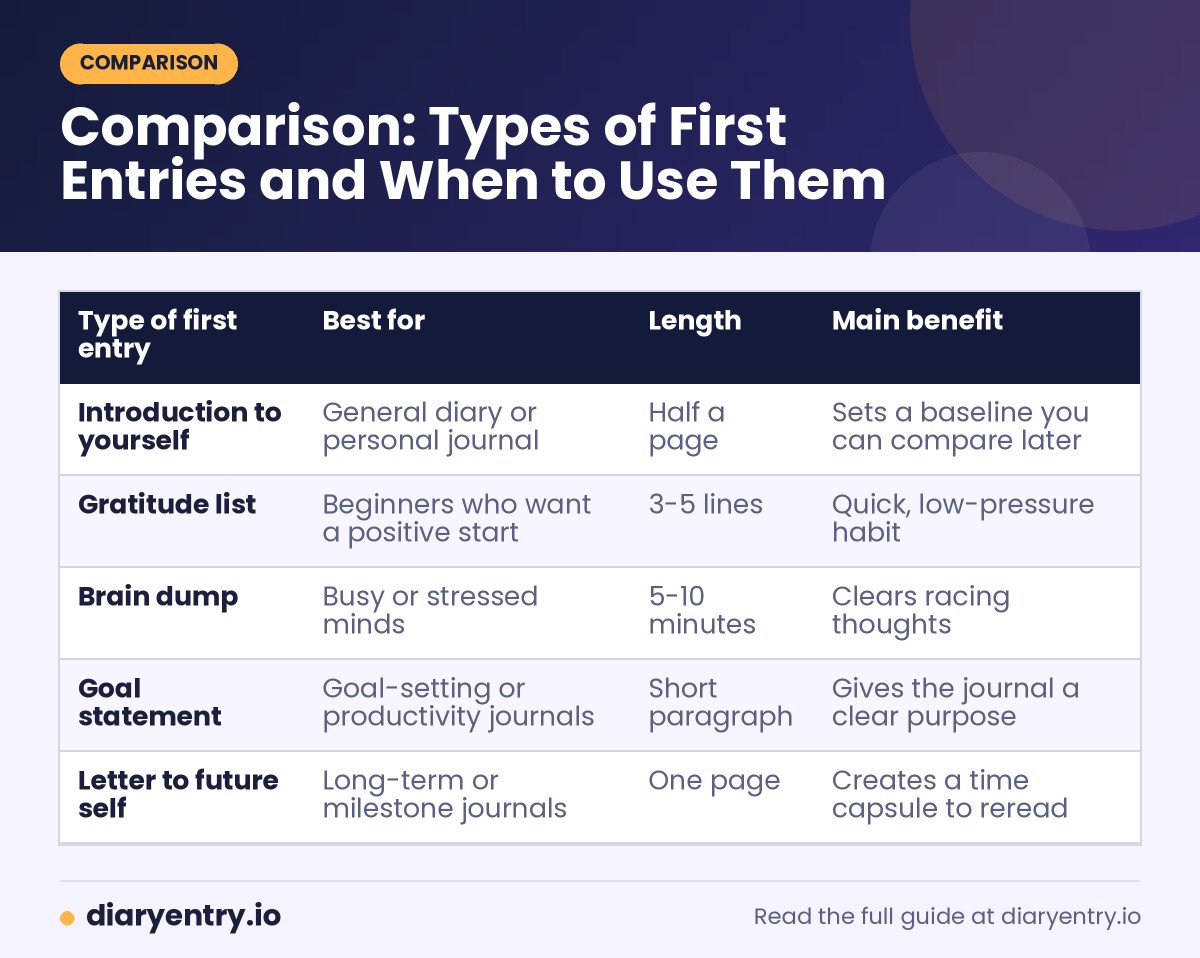
You can combine two types. A short introduction plus a gratitude line is a gentle, effective way to begin.
What to Write If Your Day Was Boring
A dull day is still a good first entry. Write about the texture of the day instead of events. Describe what you ate, what you saw from a window, one overheard sentence or how your energy rose and fell. Specific details turn an ordinary day into something you may enjoy rereading in a year.
If nothing comes to mind, write about why nothing is coming. “I am tired and my mind is blank” is a real entry and often unlocks a few more lines.
First Entry Ideas for Different Types of Journals
Your first entry can match the type of journal you want to keep. Here are quick angles for popular formats.
- Gratitude journal: list three small things and one person you appreciate. Our gratitude journal guide has more starter ideas.
- Travel journal: note where you are, one sensory detail and what you hope to see.
- Pregnancy journal: record how you feel, what you have told others and a hope for your baby.
- Work or productivity journal: list today’s top task, what blocked you and one lesson.
- Dream journal: write down the last dream you remember, even in fragments.
- School diary: record the date, what you learned and one thing to improve tomorrow.
For more format ideas, browse journal examples for every type of journal and pick the style that fits your life.
Common Mistakes to Avoid in Your First Entry
Beginners often trip over the same few things. A little awareness helps you skip them.
- Trying to write a masterpiece. Aim for honest, not impressive.
- Writing too much. A huge first entry can make the second feel like a chore.
- Judging your handwriting or grammar. Fix nothing. Mistakes are part of the record.
- Waiting for the perfect notebook or time. Start with whatever you have in the next ten minutes.
- Only writing about problems. Include something neutral or good so the habit feels balanced.
- Skipping the date. A date makes every later entry easier to place.
- Giving up after one missed day. Start again with the next entry. No apology needed.
Pen and Paper or Digital: Which Is Better for a First Entry?
Both work. Handwriting slows you down and is satisfying for many people. Typing is faster and easier to search, back up and keep private.
If you are unsure, try both on separate days and keep whichever feels natural. If you lean digital, read our overview of online journaling to see how a digital habit can work. The best format is the one you will actually open.
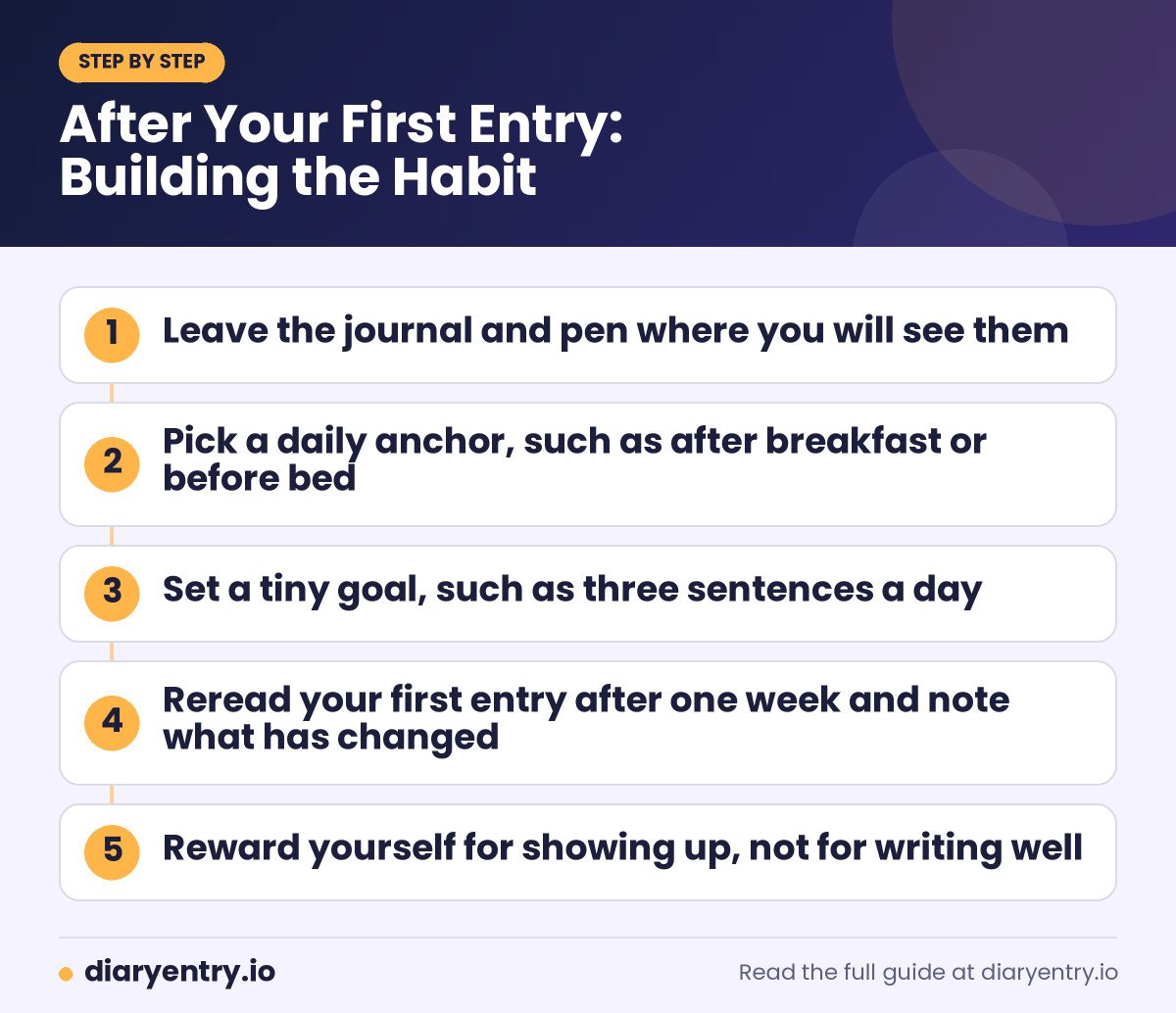
After Your First Entry: Building the Habit
Writing once is a win, and the next step is to make a second entry easy.
- Leave the journal and pen where you will see them.
- Pick a daily anchor, such as after breakfast or before bed.
- Set a tiny goal, such as three sentences a day.
- Reread your first entry after one week and note what has changed.
- Reward yourself for showing up, not for writing well.
A short structured programme can help if you like guidance. The 4-week Diary Entry Course walks you through daily writing, and it is entirely optional if you prefer to go on your own.
Frequently Asked Questions
What should I write in my first journal entry?
Write the date, why you are starting, how you feel and what happened today. End with one hope for your journaling. A few honest sentences are enough.
How long should a first journal entry be?
Anywhere from three sentences to a page. Most beginners do well with five to ten minutes of writing, which usually fills half a page.
Do I have to write every day?
No. Daily writing builds the habit fastest, but three or four times a week still works. Choose a rhythm you can keep without guilt.
What if I do not know what to write about?
Use an opening line from the list above, describe your surroundings or write about why you cannot think of anything. Any honest sentence counts as an entry.
Should my first journal entry be private?
Yes, for most people. Writing as if nobody will read it lets you be honest. You can always choose to share an entry later.
Is a diary entry the same as a journal entry?
They overlap. A diary entry usually records personal events and feelings, while a journal entry can also include goals, ideas, prompts and reflections. For a first entry, the difference does not matter.
What is a good first journal entry for a student?
A student can write the date, what they learned, how they felt about the day and one goal for tomorrow. Keeping it short makes it easier to repeat.
Conclusion: Just Write the First Line
A first journal entry is simply the first page of a long conversation with yourself. Date the page, say why you are here, describe how you feel and note one small thing from your day. That is all it takes.
Use the structure, the examples and the opening lines above whenever you feel stuck. The best first journal entry is the one you write today, imperfect and honest, so open your notebook and start.