

Quick Answer
The types of adjectives are descriptive (quality), quantitative, demonstrative, possessive, interrogative, distributive, numeral, proper and compound adjectives. An adjective is a word that describes or limits a noun or pronoun, answering questions such as what kind, how many, which one or whose. Knowing each type helps you write clearer, more precise sentences.
Key Takeaways
- An adjective modifies a noun or pronoun and tells us what kind, how many, which or whose.
- The main types are descriptive, quantitative, demonstrative, possessive, interrogative, distributive, numeral, proper and compound.
- Adjectives usually come before the noun, or after a linking verb such as “be” or “seem”.
- When several adjectives appear together, English follows a natural order: opinion, size, age, shape, colour, origin, material, purpose.
- Many words, such as “this” or “some”, can work as adjectives or as pronouns depending on their position.
What Is an Adjective?
An adjective is a word that gives more information about a noun or pronoun. It can describe a quality (“a tall building”), give a quantity (“three apples”), point to a particular thing (“that book”) or show ownership (“my bag”). Adjectives answer four main questions: What kind? How many or how much? Which one? Whose?
Adjectives are one of the eight classic parts of speech. If you would like to see where they sit in the big picture, our guide to the parts of speech with definitions and examples explains how adjectives work with nouns, verbs and adverbs.
Adjectives do not change form for singular or plural, and in English they do not change for gender. We say “a tall boy” and “tall boys,” “a tall girl” and “tall girls.” The only forms that change are the comparative and superlative, which you can study in our guide to degrees of comparison with rules and examples.
Types of Adjectives at a Glance
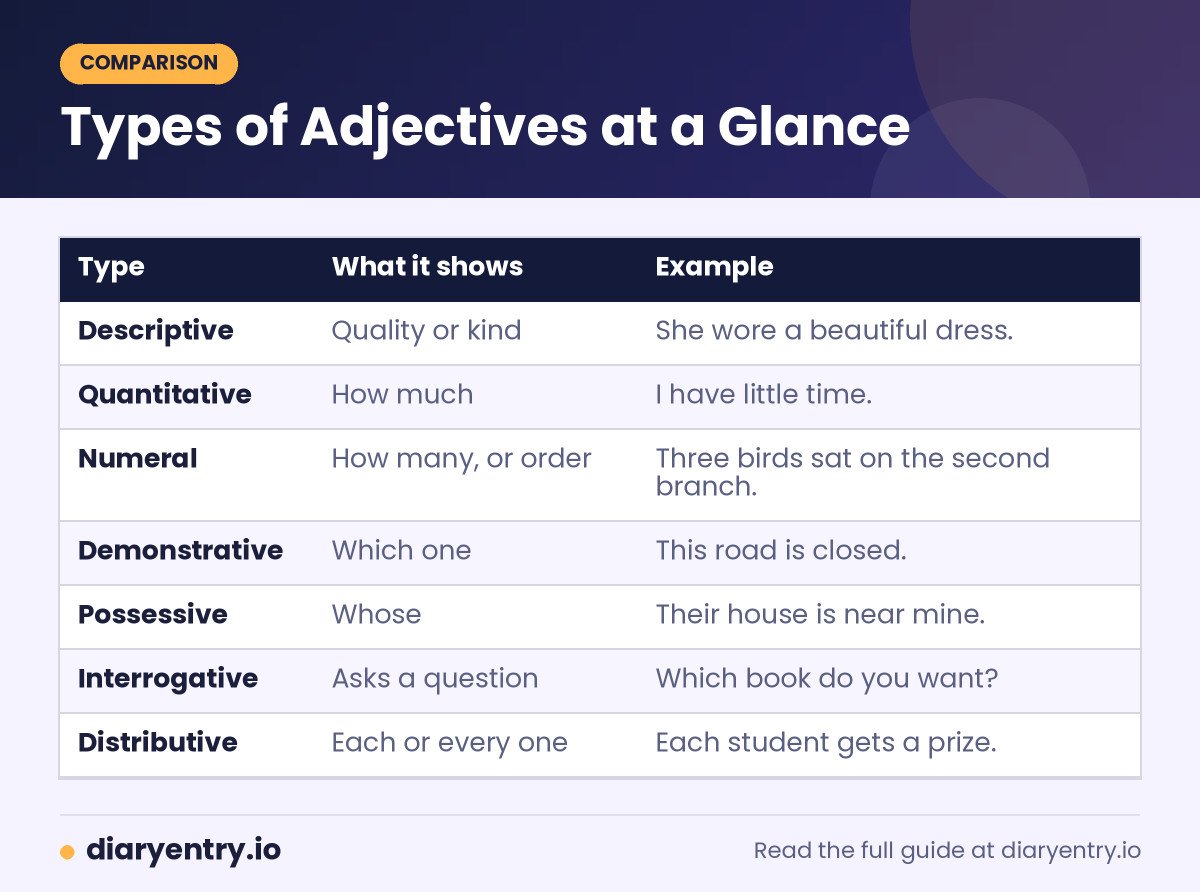
This table gives a one-glance summary of the types of adjectives with a sample sentence for each.
| Type | What it shows | Example |
|---|---|---|
| Descriptive | Quality or kind | She wore a beautiful dress. |
| Quantitative | How much | I have little time. |
| Numeral | How many, or order | Three birds sat on the second branch. |
| Demonstrative | Which one | This road is closed. |
| Possessive | Whose | Their house is near mine. |
| Interrogative | Asks a question | Which book do you want? |
| Distributive | Each or every one | Each student gets a prize. |
| Proper | Comes from a proper noun | She enjoys Indian food. |
| Compound | Two or more words joined | He is a well-known writer. |
1. Descriptive Adjectives (Adjectives of Quality)
Descriptive adjectives are the most common type. They describe the quality, size, shape, colour, age, condition or feeling of a noun. They answer the question “What kind?”
- A brave soldier
- A tiny kitten
- The old temple
- A bright red kite
- She feels happy.
Descriptive adjectives can be placed before the noun (attributive position) or after a linking verb (predicative position).
- Attributive: The cold wind blew all night.
- Predicative: The wind was cold.
This is the type that makes your writing vivid. If you want to put descriptive adjectives to work, see how they are used in our guide to descriptive writing with techniques and examples.
2. Quantitative Adjectives (Adjectives of Quantity)
Quantitative adjectives tell us how much of something there is. They are used with uncountable nouns and answer the question “How much?”
- Common words: some, any, much, little, enough, all, whole, no, several, half
- I drank some water.
- There is not much sugar left.
- She has little patience.
- We have enough food for everyone.
Some quantity words, such as “some,” “any,” “all” and “no,” can also be used with plural countable nouns. For example, “some books” and “all students” are both correct.
3. Numeral Adjectives (Adjectives of Number)
Numeral adjectives tell us how many or in what order. They are used with countable nouns and answer the question “How many?” There are two kinds.
Definite numerals
These give an exact number.
- Cardinal numbers: one, two, ten, a hundred (Ten students passed.)
- Ordinal numbers: first, second, third (This is the third chapter.)
Indefinite numerals
These give an unspecified number.
- few, many, several, some, a few, a number of
- Many people attended the fair.
- A few students were absent.
Note the difference between “few” and “a few.” “Few” means almost none, and it has a negative feeling: “Few people know the answer.” “A few” means some, and it has a positive feeling: “A few people know the answer.”
4. Demonstrative Adjectives
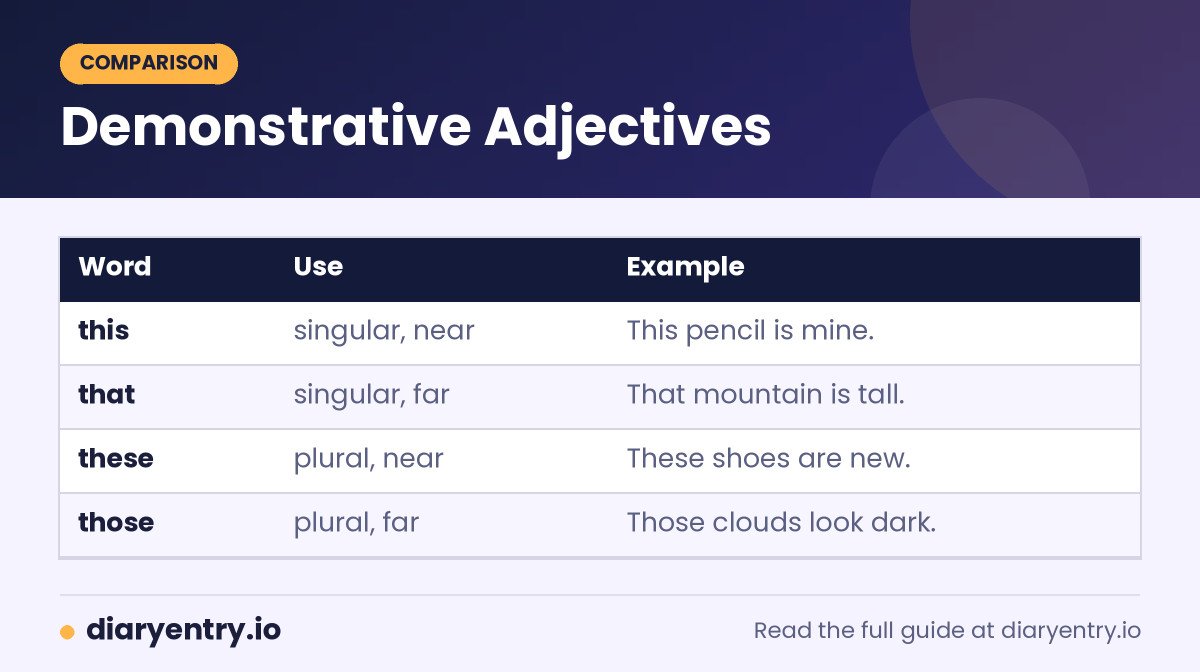
Demonstrative adjectives point out a particular noun. The four demonstratives are this, that, these and those.
| Word | Use | Example |
|---|---|---|
| this | singular, near | This pencil is mine. |
| that | singular, far | That mountain is tall. |
| these | plural, near | These shoes are new. |
| those | plural, far | Those clouds look dark. |
The word must be followed by a noun to be an adjective. In “This is my bag,” “this” is a pronoun. In “This bag is mine,” “this” is an adjective. For more on how these words behave, see our guide to determiners with types and examples, where demonstratives are one of the main groups. Articles belong to the same family, and our guide to articles a, an, the with rules and examples explains how to choose between them.
5. Possessive Adjectives
Possessive adjectives show who owns something. They always come before a noun.
- my, your, his, her, its, our, their
- My brother plays chess.
- Her teacher is kind.
- The dog wagged its tail.
- Our school has a large library.
Do not confuse possessive adjectives with possessive pronouns such as mine, yours, hers, ours and theirs. A possessive pronoun stands alone: “This book is mine.” You can read more in our guide to the types of pronouns with definitions and examples.
A common mistake is writing “it’s” for “its.” “It’s” means “it is.” “Its” shows possession.
6. Interrogative Adjectives
Interrogative adjectives are used to ask questions about a noun. The three interrogative adjectives are what, which and whose, and each must be followed by a noun.
- What colour do you like?
- Which road leads to the station?
- Whose bag is this?
If the word is not followed by a noun, it is a pronoun: “Which is yours?”
7. Distributive Adjectives
Distributive adjectives refer to members of a group one at a time. The common distributive adjectives are each, every, either, neither and any. They are followed by singular nouns and singular verbs.
- Each child received a gift.
- Every student must sign the register.
- You can take either road.
- Neither answer is correct.
Remember that “every” means all of the group, while “each” stresses the individual members.
8. Proper Adjectives
Proper adjectives are formed from proper nouns, and they always start with a capital letter.
| Proper noun | Proper adjective | Example |
|---|---|---|
| India | Indian | Indian cuisine is popular worldwide. |
| France | French | She studies French literature. |
| Shakespeare | Shakespearean | We read a Shakespearean play. |
| Japan | Japanese | He bought a Japanese camera. |
| Mughal | Mughal | They toured a Mughal fort. |
Some proper adjectives keep the same spelling as the noun, such as “Mughal.” Others change the ending, such as “India” to “Indian.” Always capitalise them.
9. Compound Adjectives
Compound adjectives are made of two or more words joined, usually by a hyphen, to act as one adjective before a noun.
- a well-known author
- a five-year-old child
- a long-term plan
- an old-fashioned clock
- a part-time job
Note that when the compound adjective is used after the noun, the hyphen is often dropped. We say “a well-known author,” but “The author is well known.” In “a five-year-old child,” the noun inside the compound stays singular: not “five-years-old.”
Order of Adjectives in a Sentence
When you use more than one adjective before a noun, native speakers follow a natural order. The widely taught order is: opinion, size, age, shape, colour, origin, material, purpose.
| Order | Category | Example |
|---|---|---|
| 1 | Opinion | lovely |
| 2 | Size | large |
| 3 | Age | old |
| 4 | Shape | round |
| 5 | Colour | brown |
| 6 | Origin | Italian |
| 7 | Material | wooden |
| 8 | Purpose | dining (table) |
So we say “a lovely old brown wooden table,” not “a wooden brown old lovely table.” In real writing, you rarely need more than two or three adjectives together, and using fewer often sounds better.
Adjectives vs Adverbs vs Pronouns
Students often confuse adjectives with other word classes. These quick checks help.
- Adjectives modify nouns and pronouns: a quick answer.
- Adverbs modify verbs, adjectives or other adverbs: She answered quickly. Our guide to the types of adverbs covers each kind.
- Many words change class by position. In “This is mine,” “this” is a pronoun. In “This book is mine,” “this” is an adjective.
- Nouns can also act as adjectives when they come before another noun: a school bag, a chicken sandwich. These are called noun adjuncts or attributive nouns.
A useful test is to ask whether the word describes or limits a noun. If it does, it is working as an adjective.
Adjectives Formed from Other Words
Many adjectives are made by adding endings to nouns and verbs. Recognising these endings helps in vocabulary tasks.
| Ending | Example | Formed from |
|---|---|---|
| -ful | helpful, beautiful | help, beauty |
| -less | careless, hopeless | care, hope |
| -ous | famous, dangerous | fame, danger |
| -able / -ible | readable, possible | read, possible |
| -al | national, musical | nation, music |
| -ive | creative, active | create, act |
| -y | rainy, sunny | rain, sun |
| -ic | heroic, artistic | hero, art |
Common Mistakes with Adjectives
Watch out for these frequent errors.
- Using an adjective instead of an adverb: “She sings beautiful” should be “She sings beautifully.”
- Adding “s” to adjectives: “two reds apples” should be “two red apples.”
- Mixing up “few” and “little”: use “few” with countable nouns and “little” with uncountable nouns.
- Confusing “its” and “it’s.”
- Using double comparatives: “more better” should be “better.”
- Putting adjectives in the wrong order: “a wooden old chair” should be “an old wooden chair.”
- Using “much” with countable nouns: “much books” should be “many books.”
- Dropping the capital letter on proper adjectives: “indian food” should be “Indian food.”
Worked Examples with Explanations
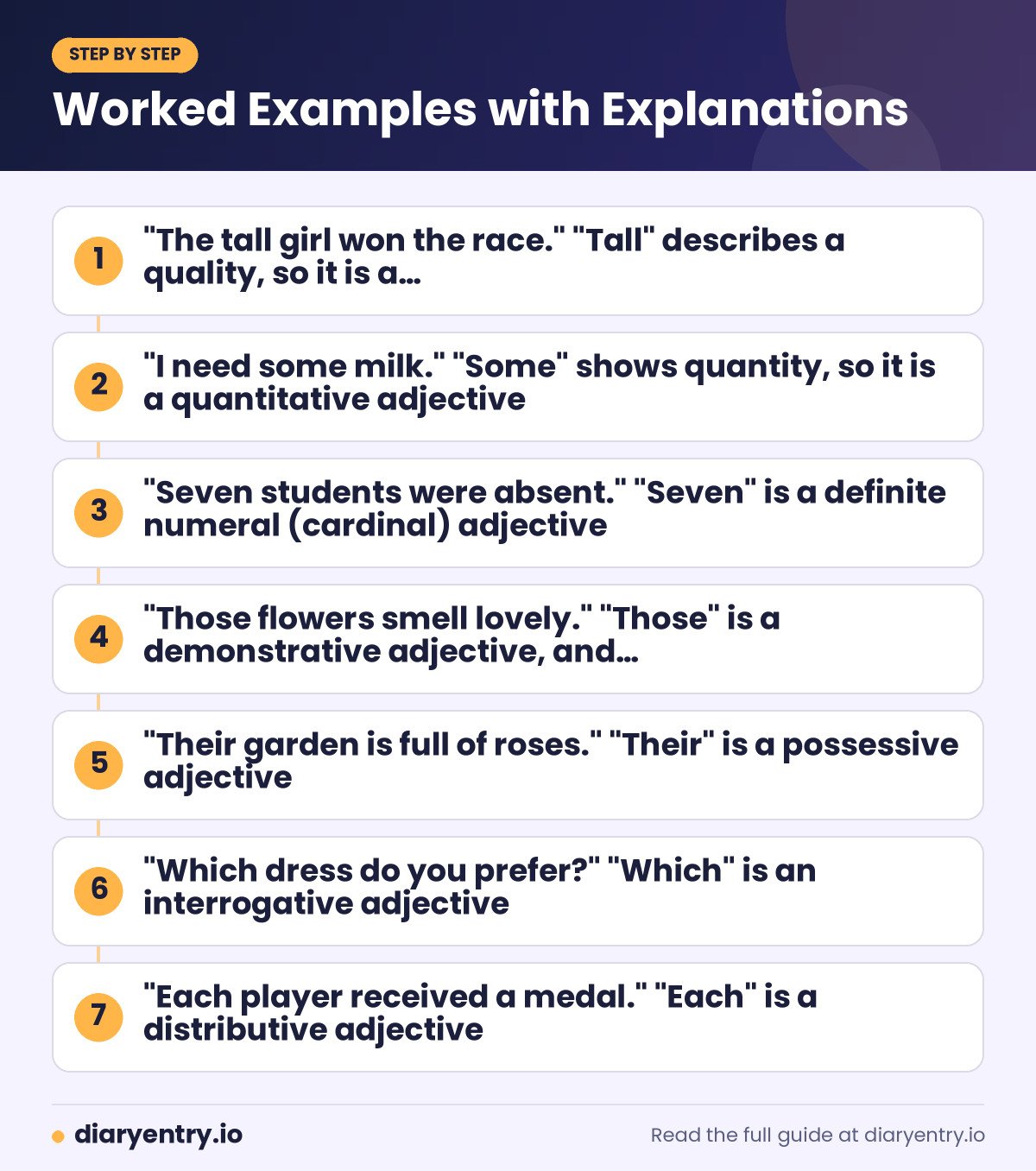
Identify the adjective and its type in each sentence.
- “The tall girl won the race.” “Tall” describes a quality, so it is a descriptive adjective.
- “I need some milk.” “Some” shows quantity, so it is a quantitative adjective.
- “Seven students were absent.” “Seven” is a definite numeral (cardinal) adjective.
- “Those flowers smell lovely.” “Those” is a demonstrative adjective, and “lovely” is a descriptive adjective used after a linking verb.
- “Their garden is full of roses.” “Their” is a possessive adjective.
- “Which dress do you prefer?” “Which” is an interrogative adjective.
- “Each player received a medal.” “Each” is a distributive adjective.
- “We watched an Italian film.” “Italian” comes from “Italy,” so it is a proper adjective.
- “She is a hard-working student.” “Hard-working” is a compound adjective.
Practice Exercise
Find the adjective in each sentence and name its type. The answers follow the list.
- Every child needs love.
- This phone is expensive.
- He has little money.
- She is a kind teacher.
- Whose pen is this?
- We saw a Chinese lantern.
- A well-known singer visited our school.
- Several visitors arrived early.
Answers: 1 every (distributive); 2 this (demonstrative), expensive (descriptive); 3 little (quantitative); 4 kind (descriptive); 5 whose (interrogative); 6 Chinese (proper); 7 well-known (compound); 8 several (numeral, indefinite).
Tips for Using Adjectives Well
Adjectives bring writing to life, but too many can weigh a sentence down. These habits help.
- Choose one strong adjective instead of two weak ones: “a freezing morning” is stronger than “a very cold morning.”
- Avoid empty adjectives such as “nice,” “good” and “bad” when a more precise word exists.
- Show, do not just tell. Instead of “The room was messy,” try “Clothes covered the chair and cups crowded the desk.”
- Read your sentences aloud to check the order of adjectives.
- Keep a short list of new descriptive words you meet while reading.
A daily writing habit is one of the easiest ways to grow your vocabulary. The 4-Week Diary Entry Course guides you through short daily entries where you can practise precise, descriptive language.
Frequently Asked Questions About Types of Adjectives
How many types of adjectives are there?
Most school grammar books list eight to nine main types: descriptive (quality), quantitative, numeral, demonstrative, possessive, interrogative, distributive, proper and compound. Some books group them differently, so the count can vary slightly.
What is the most common type of adjective?
Descriptive adjectives, also called adjectives of quality, are the most common. They describe what kind of person, place or thing we mean.
What is the difference between an adjective and an adverb?
An adjective modifies a noun or pronoun, as in “a quick reply.” An adverb modifies a verb, adjective or another adverb, as in “She replied quickly.”
What is the difference between “few” and “a few”?
“Few” means hardly any and carries a negative tone. “A few” means some and carries a positive tone. Both are used with plural countable nouns.
Can a noun be used as an adjective?
Yes. When a noun comes before another noun to describe it, it acts like an adjective, as in “a school bus” or “a garden chair.”
What is the correct order of adjectives?
The usual order is opinion, size, age, shape, colour, origin, material and purpose, for example “a beautiful small old round red Chinese silk lantern.” In practice, use only two or three adjectives at a time.
What are possessive adjectives?
Possessive adjectives show ownership and come before a noun. They are my, your, his, her, its, our and their.
Conclusion
The types of adjectives may look like a long list, but each type simply answers a question about a noun: what kind, how many, which one, whose, or how much. Learn to spot the type, watch for position and order, and avoid the common mistakes. With a little practice, you will use adjectives with confidence, and your sentences will become clearer and more vivid.