

Quick Answer
The types of adverbs are words that describe how, where, when, how often or to what extent an action happens. The main types of adverbs are manner, place, time, frequency, degree, purpose, interrogative, relative and conjunctive. Each type changes or adds detail to a verb, adjective, another adverb or a whole sentence.
Key Takeaways
- An adverb modifies a verb, an adjective, another adverb or a complete sentence.
- The five types students meet most often are manner, place, time, frequency and degree.
- Many adverbs end in -ly, but plenty do not, such as fast, very, here, often and soon.
- The question an adverb answers (how, where, when, how often, how much) tells you its type.
- Position matters: frequency adverbs usually sit before the main verb, while manner and place adverbs usually follow it.
What Is an Adverb?
An adverb is a word that adds information to another word or to a whole clause. It usually tells us how something happens, where it happens, when it happens, how often it happens or how strongly it happens. In “She walked slowly”, the word slowly is an adverb because it describes the verb walked.
Adverbs are one of the eight parts of speech, and they are easiest to understand once you know what the other parts do. If you want the full picture first, our guide to parts of speech with definitions and examples shows where adverbs fit. This article goes deeper and explains every major kind of adverb with examples you can copy into your own notes.
An adverb can do four jobs. It can modify a verb (“He spoke softly”), an adjective (“The soup is extremely hot”), another adverb (“She finished remarkably quickly”) or an entire sentence (“Fortunately, nobody was hurt”). Keeping these four jobs in mind will help you spot adverbs even when they do not end in -ly.
Types of Adverbs at a Glance
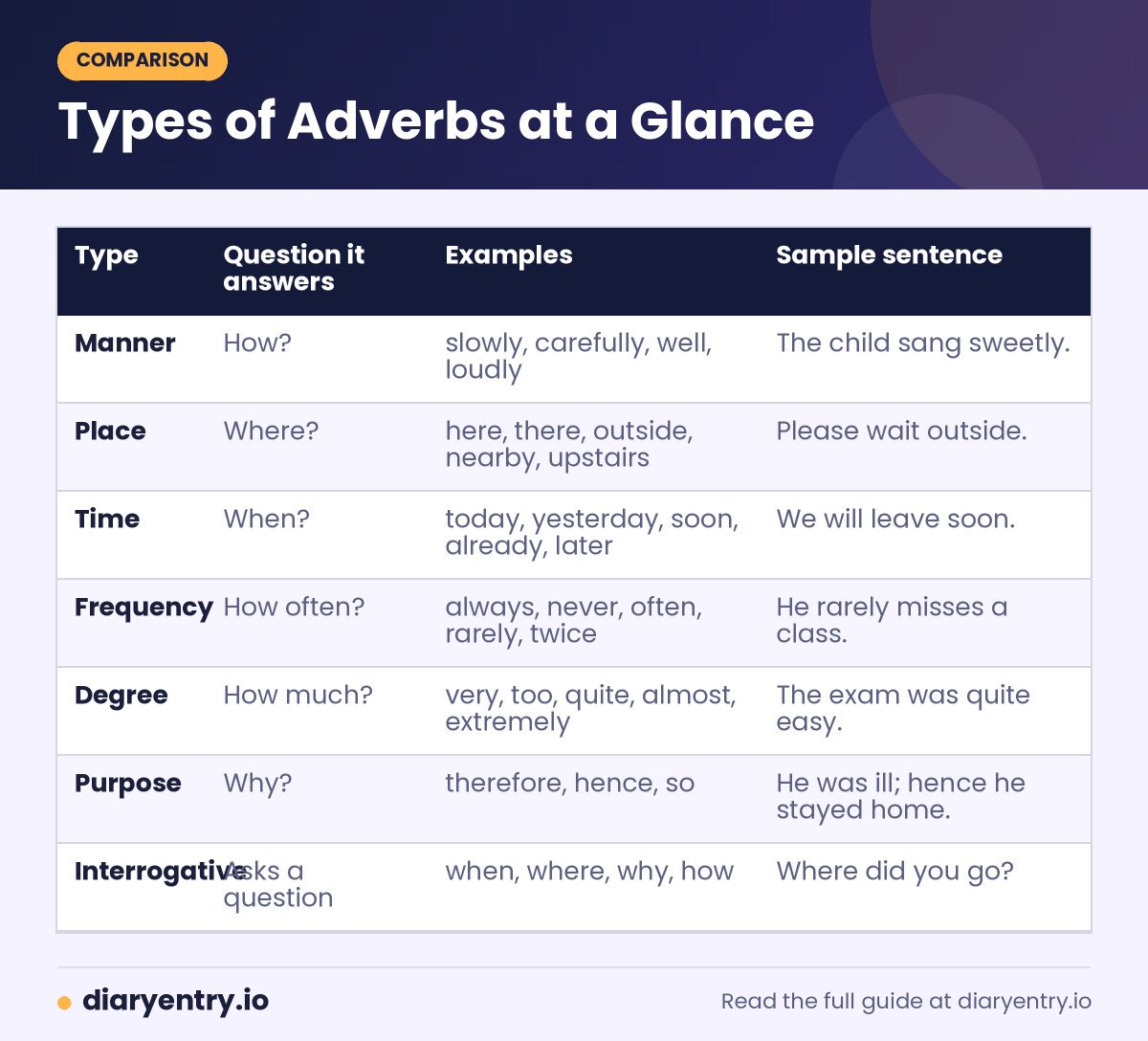
The table below summarises each type, the question it answers and a few typical examples. Use it as a quick revision chart before an exam.
| Type | Question it answers | Examples | Sample sentence |
|---|---|---|---|
| Manner | How? | slowly, carefully, well, loudly | The child sang sweetly. |
| Place | Where? | here, there, outside, nearby, upstairs | Please wait outside. |
| Time | When? | today, yesterday, soon, already, later | We will leave soon. |
| Frequency | How often? | always, never, often, rarely, twice | He rarely misses a class. |
| Degree | How much? | very, too, quite, almost, extremely | The exam was quite easy. |
| Purpose | Why? | therefore, hence, so | He was ill; hence he stayed home. |
| Interrogative | Asks a question | when, where, why, how | Where did you go? |
| Relative | Joins clauses | when, where, why | This is the house where I grew up. |
Adverbs of Manner
Adverbs of manner describe how an action is done. They answer the question “How?” and are the group most people think of first. Common examples include quickly, quietly, carefully, badly, well, happily and politely.
Examples: “The students listened attentively.” “She answered the question correctly.” “He drove carefully through the fog.” Manner adverbs normally come after the verb or after the object: “She wrote the letter neatly.”
Be careful with the pair good and well. Good is an adjective and well is the adverb. We say “She is a good singer” but “She sings well”. The only common exception is that well can also be an adjective meaning healthy: “I am not feeling well.”
Adverbs of Place
Adverbs of place tell us where something happens or in which direction it moves. They answer “Where?” Typical examples are here, there, everywhere, nowhere, inside, outside, above, below, nearby, abroad, upstairs, downstairs, forward and backward.
Examples: “The children are playing outside.” “Look up!” “Move forward, please.” These adverbs usually come after the main verb or after the object. Do not confuse them with prepositions. In “She waited outside”, outside is an adverb because nothing follows it. In “She waited outside the office”, outside is a preposition because it has an object. Our guide to prepositions with rules and examples explains that difference in more detail.
Adverbs of Time
Adverbs of time tell us when something happens. They answer “When?” or “For how long?” Examples include now, today, tomorrow, yesterday, soon, later, already, yet, still, recently, early and late.
Examples: “I finished my homework yesterday.” “The train has already left.” “Have you eaten yet?” Time adverbs often sit at the end of a sentence, but they can also open it for emphasis: “Tomorrow, we begin the project.” Words such as yet and still need special care. Yet is used mostly in questions and negatives (“She has not replied yet”), while still shows that something continues (“He is still waiting”).
Adverbs of Frequency
Adverbs of frequency say how often something happens. They answer “How often?” They fall into two groups. Indefinite frequency adverbs such as always, usually, often, sometimes, rarely, seldom and never give a rough idea. Definite frequency adverbs such as daily, weekly, monthly, yearly, once and twice give an exact count or interval.
Examples: “My brother always wakes up early.” “We visit our grandparents twice a year.” “She never eats before noon.” Indefinite frequency adverbs normally sit before the main verb but after the verb to be: “He is always on time.” With auxiliary verbs they sit between the auxiliary and the main verb: “I have never seen that film.”
Adverbs of Degree
Adverbs of degree show how much, how little or to what extent. They answer “How much?” or “To what degree?” Examples are very, too, quite, rather, fairly, almost, nearly, extremely, absolutely, barely, hardly and enough.
Examples: “The tea is too hot.” “She is fairly confident.” “I can hardly hear you.” Degree adverbs almost always come directly before the adjective or adverb they modify. The one big exception is enough, which comes after: “He is tall enough.” If you want to practise comparing adjectives and adverbs, read our explanation of degrees of comparison.
Other Types of Adverbs
Interrogative Adverbs
Interrogative adverbs introduce questions. The four common ones are when, where, why and how. “Why are you late?” “How did you solve it?” They always appear at the start of the question.
Relative Adverbs
Relative adverbs (when, where and why) introduce a relative clause and refer back to a noun. “I remember the day when we met.” “This is the school where he studied.” They work like conjunctions, so it helps to know how clauses are joined. Our guide to conjunctions, their types and rules covers that.
Adverbs of Reason and Purpose
These adverbs show why something happened or what result followed. Examples are therefore, hence, consequently and thus. “The road was blocked; therefore, we took another route.”
Sentence Adverbs and Conjunctive Adverbs
A sentence adverb comments on the whole statement, not just one word: “Luckily, the bus was on time.” “Honestly, I did not expect that.” A conjunctive adverb links two independent clauses and shows a relationship such as contrast or result: however, moreover, meanwhile, otherwise, nevertheless. “She studied hard; however, the paper was difficult.” Place a semicolon before the conjunctive adverb and a comma after it.
How to Identify the Type of Adverb: Step by Step
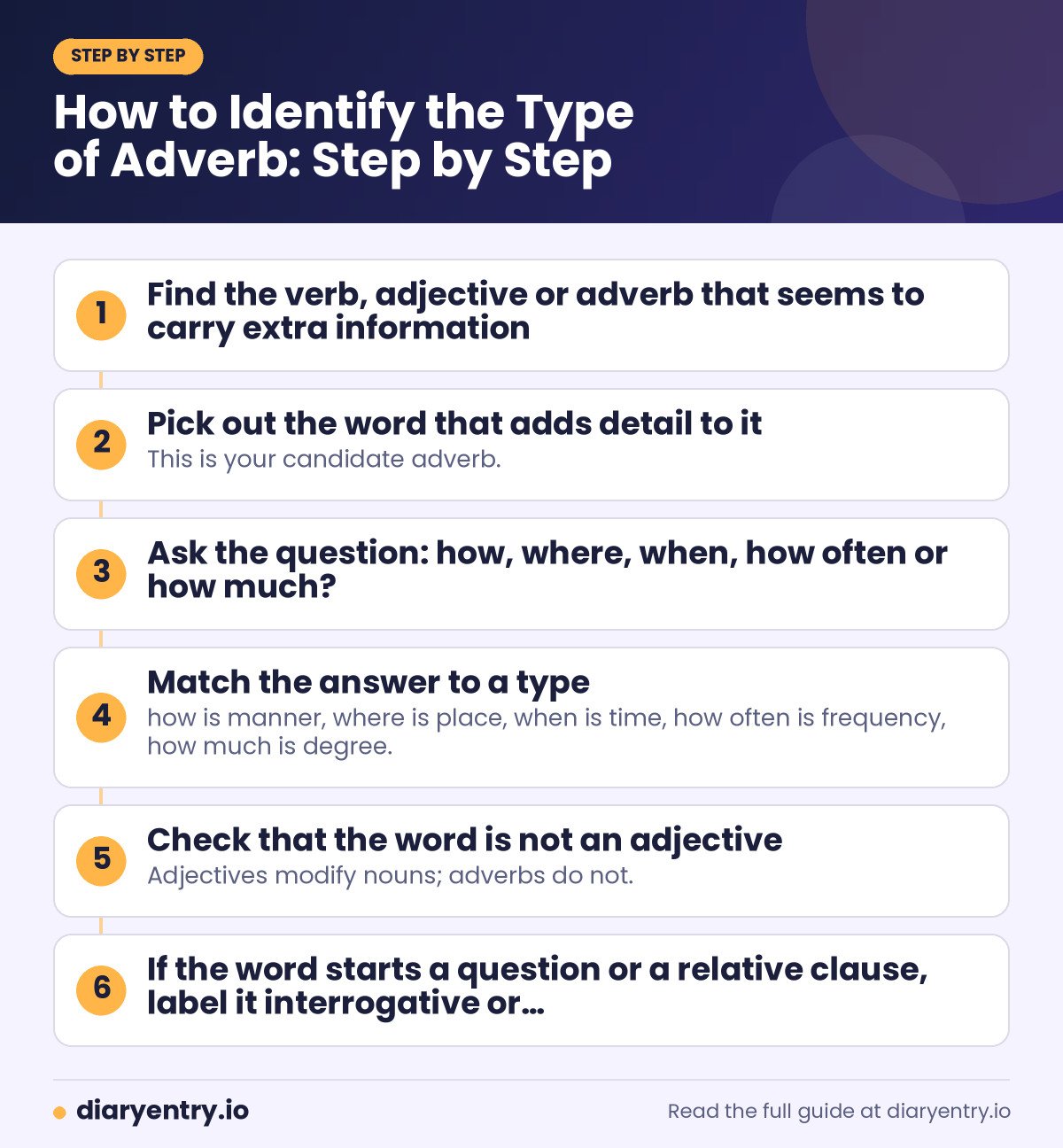
When an exercise asks you to name the type of adverb, follow these steps. They work for almost every sentence.
- Find the verb, adjective or adverb that seems to carry extra information.
- Pick out the word that adds detail to it. This is your candidate adverb.
- Ask the question: how, where, when, how often or how much?
- Match the answer to a type: how is manner, where is place, when is time, how often is frequency, how much is degree.
- Check that the word is not an adjective. Adjectives modify nouns; adverbs do not.
- If the word starts a question or a relative clause, label it interrogative or relative.
Try it with “The team practised daily near the lake.” Daily answers how often, so it is a frequency adverb. Near the lake is a prepositional phrase that answers where, which behaves like a place adverbial.
Position of Adverbs in a Sentence
Adverbs can move around more than most other words, but each type has a usual position. Placing an adverb well makes a sentence clearer, and a misplaced one can change the meaning. Compare “Only she ate the cake” with “She only ate the cake.”
| Type | Usual position | Example |
|---|---|---|
| Manner | After the verb or object | She closed the door gently. |
| Place | After the verb or object | They searched everywhere. |
| Time | End of sentence, or start for emphasis | We met yesterday. |
| Frequency | Before the main verb, after to be | He often cycles to school. |
| Degree | Before the adjective or adverb | The film was extremely long. |
| Sentence adverb | Start of the sentence | Sadly, the shop has closed. |
When a sentence contains more than one adverb at the end, a common order is manner, then place, then time: “She sang beautifully at the concert last night.” This is a habit of English, not a strict law, so follow what sounds natural.
Forming Adverbs From Adjectives
Most manner adverbs are made by adding -ly to an adjective: quick becomes quickly, careful becomes carefully. A few spelling rules apply.
- Adjectives ending in y change y to i: happy becomes happily, easy becomes easily.
- Adjectives ending in -le drop the e: gentle becomes gently, simple becomes simply.
- Adjectives ending in -ic usually add -ally: basic becomes basically, tragic becomes tragically.
- Adjectives ending in -ful keep the l and add -ly: careful becomes carefully.
Some adverbs have the same form as the adjective: fast, hard, late, early, daily and weekly. “He runs fast” uses fast as an adverb, while “a fast runner” uses it as an adjective. Others change meaning with -ly. Hard means with effort (“She works hard”), but hardly means almost not (“She hardly works”). Late means after the expected time, while lately means recently.
Adverb or Adjective? How to Tell the Difference
The word ending -ly is not a reliable test. Friendly, lovely, lonely and elderly are adjectives, while soon, often, very and always are adverbs. The safest check is to ask what the word modifies. If it describes a noun or pronoun, it is an adjective. If it describes a verb, an adjective, another adverb or a sentence, it is an adverb.
“The lonely boy waited” (lonely describes the noun boy, so it is an adjective). “The boy waited patiently” (patiently describes the verb waited, so it is an adverb). For a full list of adjective kinds, see our guide to the types of adjectives.
Common Mistakes With Adverbs
- Using an adjective instead of an adverb. Wrong: “He plays real well.” Right: “He plays really well.”
- Confusing good and well. Wrong: “She did good in the test.” Right: “She did well in the test.”
- Double negatives. Wrong: “I can’t hardly see.” Right: “I can hardly see.” Hardly already carries a negative sense.
- Misplacing only, almost and nearly. Put them right before the word they modify.
- Overusing very. Choose a stronger word instead: very tired can often be exhausted.
- Splitting too many verbs. Avoid placing a long adverb between to and the verb when it makes the sentence awkward.
Worked Examples and Practice
Identify the adverb and its type in each sentence, then check the answers below.
- The old man walked slowly across the bridge.
- We are meeting the principal tomorrow.
- The children searched everywhere for the lost kitten.
- My sister never forgets a birthday.
- The soup was far too salty.
- Why did the bus stop here?
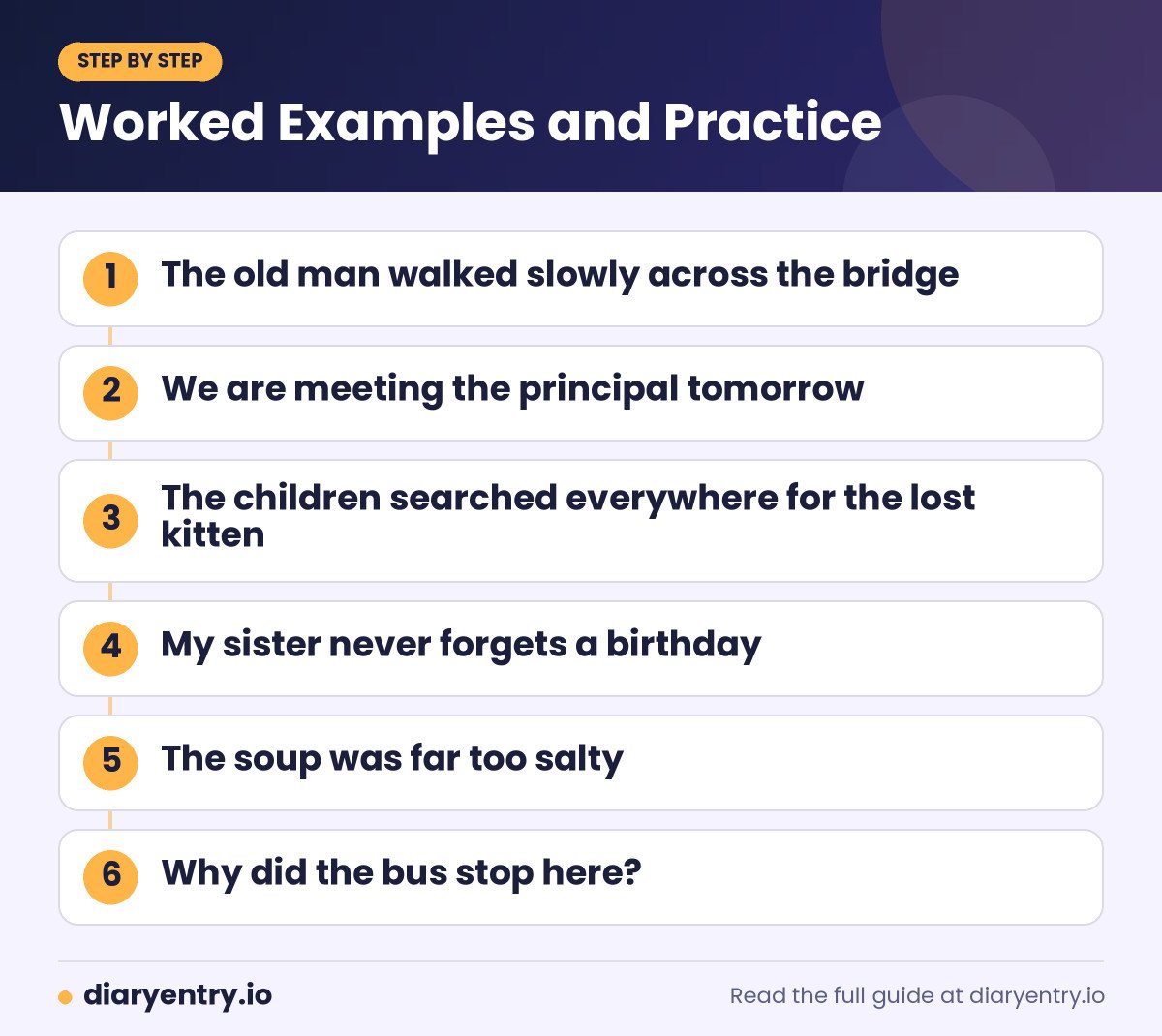
Answers: (1) slowly, manner. (2) tomorrow, time. (3) everywhere, place. (4) never, frequency. (5) too, degree (modifying salty), and far, degree (modifying too). (6) Why, interrogative, and here, place.
Now a short rewrite exercise. Take the plain sentence “He opened the letter” and add one adverb of each kind: “He nervously opened the letter” (manner), “He opened the letter inside” (place), “He opened the letter immediately” (time), “He always opened the letter first” (frequency) and “He very carefully opened the letter” (degree plus manner). Notice how each addition changes the picture the reader forms.
Using Adverbs in Diary and Journal Writing
Adverbs make personal writing vivid. A diary line such as “I walked home” becomes “I walked home slowly, still thinking about the match” and instantly shows mood and timing. Frequency adverbs also help you describe habits and patterns (“I usually write before bed”), which is useful when you review a journal later. If you are practising English through daily writing, our guide on how to write a diary entry shows the format, and the 4-Week Diary Entry Course turns it into a daily habit where you can use new grammar in real sentences.
Frequently Asked Questions
How many types of adverbs are there?
Most school grammar books list five main types: manner, place, time, frequency and degree. Many also add interrogative, relative, purpose and conjunctive adverbs, which brings the total to eight or nine depending on the book.
What is the difference between an adverb and an adjective?
An adjective describes a noun or pronoun, while an adverb describes a verb, an adjective, another adverb or a whole sentence. “A quick reply” uses an adjective; “She replied quickly” uses an adverb.
Do all adverbs end in -ly?
No. Words such as very, soon, here, never, fast, well and often are adverbs without -ly. Some -ly words, such as friendly and lovely, are adjectives.
What are the examples of adverbs of frequency?
Always, usually, often, sometimes, rarely, seldom and never are indefinite frequency adverbs. Daily, weekly, monthly, once and twice are definite frequency adverbs.
Where does an adverb go in a sentence?
It depends on the type. Manner and place adverbs usually follow the verb or object, time adverbs often come at the end, frequency adverbs go before the main verb, and degree adverbs go before the word they modify.
Can an adverb modify another adverb?
Yes. In “She spoke very softly”, very is an adverb of degree modifying the adverb softly.
Conclusion
Knowing the types of adverbs gives you a simple test for any sentence: ask how, where, when, how often or how much, and the answer names the type. Revise the chart, practise with the examples above, and watch for common slips such as good versus well. Once adverbs feel natural, the next step is to see how they sit inside whole sentences, which our guide to the types of sentences explains.