

Quick Answer
Homophones are words that sound the same but have different meanings and often different spellings, such as “to”, “too”, and “two”, or “their”, “there”, and “they’re”. They cause many spelling mistakes in writing because the ear cannot tell them apart. Context and memory tricks help you choose the right one.
Key Takeaways
- Homophones share a pronunciation but differ in meaning, and usually in spelling.
- Homographs share spelling, and homonyms share both spelling and sound, so the three terms are not the same.
- Spell checkers often miss homophone errors because each word is a real word.
- Memory tricks, such as linking “stationery” with “envelope”, fix the most common mix-ups.
- Reading your writing aloud will not catch homophones, but reading it slowly with meaning in mind will.
What Are Homophones?
The word homophone comes from Greek: “homo” means same and “phone” means sound. So a homophone is simply a “same-sound” word. Pairs like “right” and “write”, “see” and “sea”, or “knight” and “night” are pronounced identically, yet nobody would swap their meanings.
English is full of homophones because its spelling grew from many languages and has changed a lot over time, while pronunciation shifted separately. The result is that many different spellings now map onto the same sound. For learners this is confusing, and even native speakers slip up when they write quickly.
Since homophones are all about how words function, it helps to know the basics of parts of speech. Often the grammar gives the answer: after “a” or “the” you need a noun, so you choose “sea” rather than “see”.
Homophones vs Homonyms vs Homographs
These three terms sound alike and are often mixed up. Here is how to keep them apart.
| Term | Sound | Spelling | Meaning | Example |
|---|---|---|---|---|
| Homophone | Same | Usually different | Different | flour / flower |
| Homograph | May differ | Same | Different | lead (to guide) / lead (metal) |
| Homonym | Same | Same | Different | bat (animal) / bat (cricket) |
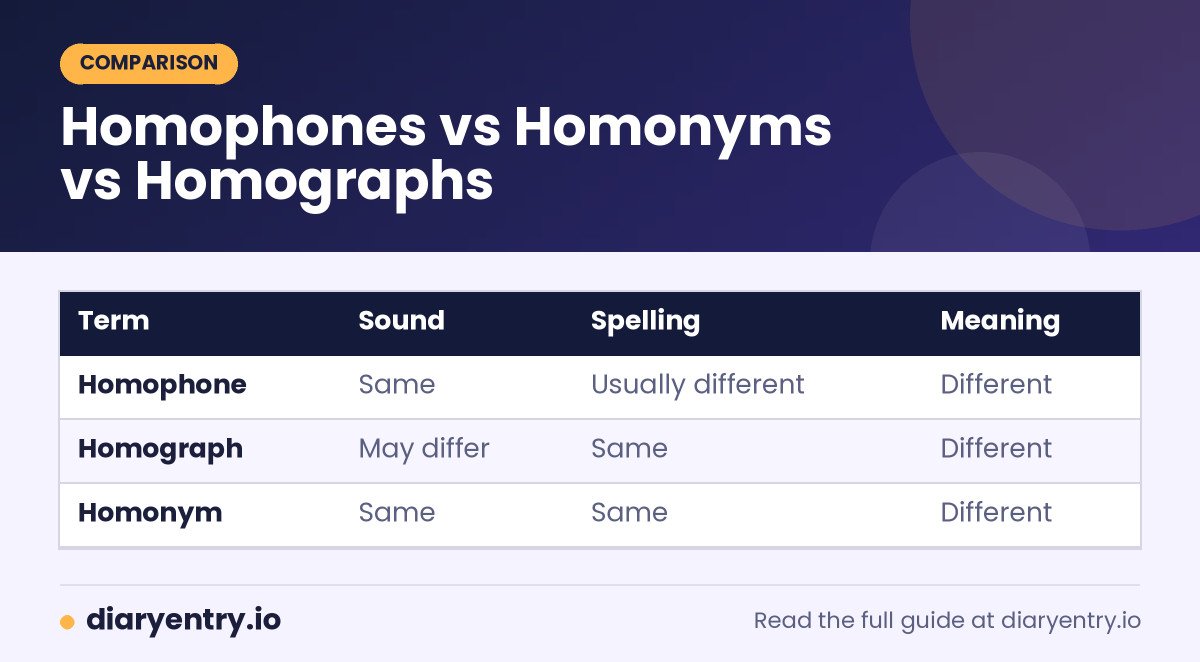
Some sources count homonyms as a type of homophone, because both sound the same. Others reserve “homonym” for words with identical spelling and sound only. For school exams, check the definition your textbook uses, and keep the table above as a safe guide.
Common Homophones List With Meanings
The list below covers pairs and trios that appear most often in school writing and everyday messages. Each one comes with a short sentence.
| Homophones | Meanings and examples |
|---|---|
| their / there / they’re | Their = belonging to them (Their bags are heavy). There = a place (Put it there). They’re = they are (They’re late). |
| to / too / two | To = direction (Go to school). Too = also, or excessively (Me too; too hot). Two = the number 2. |
| your / you’re | Your = belonging to you (Your pen). You’re = you are (You’re early). |
| its / it’s | Its = belonging to it (The dog wagged its tail). It’s = it is or it has (It’s raining). |
| write / right | Write = put words on paper. Right = correct, or the opposite of left. |
| see / sea | See = notice with eyes. Sea = a large body of salt water. |
| buy / by / bye | Buy = purchase. By = near or through. Bye = goodbye. |
| hear / here | Hear = listen. Here = in this place. |
| new / knew | New = not old. Knew = past tense of know. |
| no / know | No = the opposite of yes. Know = to have knowledge. |
| one / won | One = the number 1. Won = past tense of win. |
| son / sun | Son = a male child. Sun = the star at the centre of our solar system. |
| flour / flower | Flour = ground grain for baking. Flower = a blossom. |
| weather / whether | Weather = rain, sun, wind. Whether = if. |
| whole / hole | Whole = complete. Hole = an opening. |
| piece / peace | Piece = a part of something. Peace = calm, no war. |
| stair / stare | Stair = a step. Stare = look fixedly. |
| mail / male | Mail = letters. Male = a man or boy. |
| plain / plane | Plain = simple, or flat land. Plane = an aircraft. |
| principal / principle | Principal = head of a school, or main. Principle = a rule or belief. |
Homophones Grouped by Type
Pairs
Most homophones come in pairs: ate / eight, bare / bear, blue / blew, cell / sell, dear / deer, fair / fare, hair / hare, meat / meet, pair / pear, tail / tale, wait / weight, wear / where.
Triples
Some sets have three members: to / too / two, their / there / they’re, for / four / fore, and read / red / reed, where “read” in the past tense sounds like “red”.
Contractions and Possessives
These are the pairs that cause the most mistakes in everyday writing: it’s / its, you’re / your, they’re / their, who’s / whose. In each pair, the version with an apostrophe is a shortened form of two words, while the version without is possessive.
How to Tell Homophones Apart: Step by Step
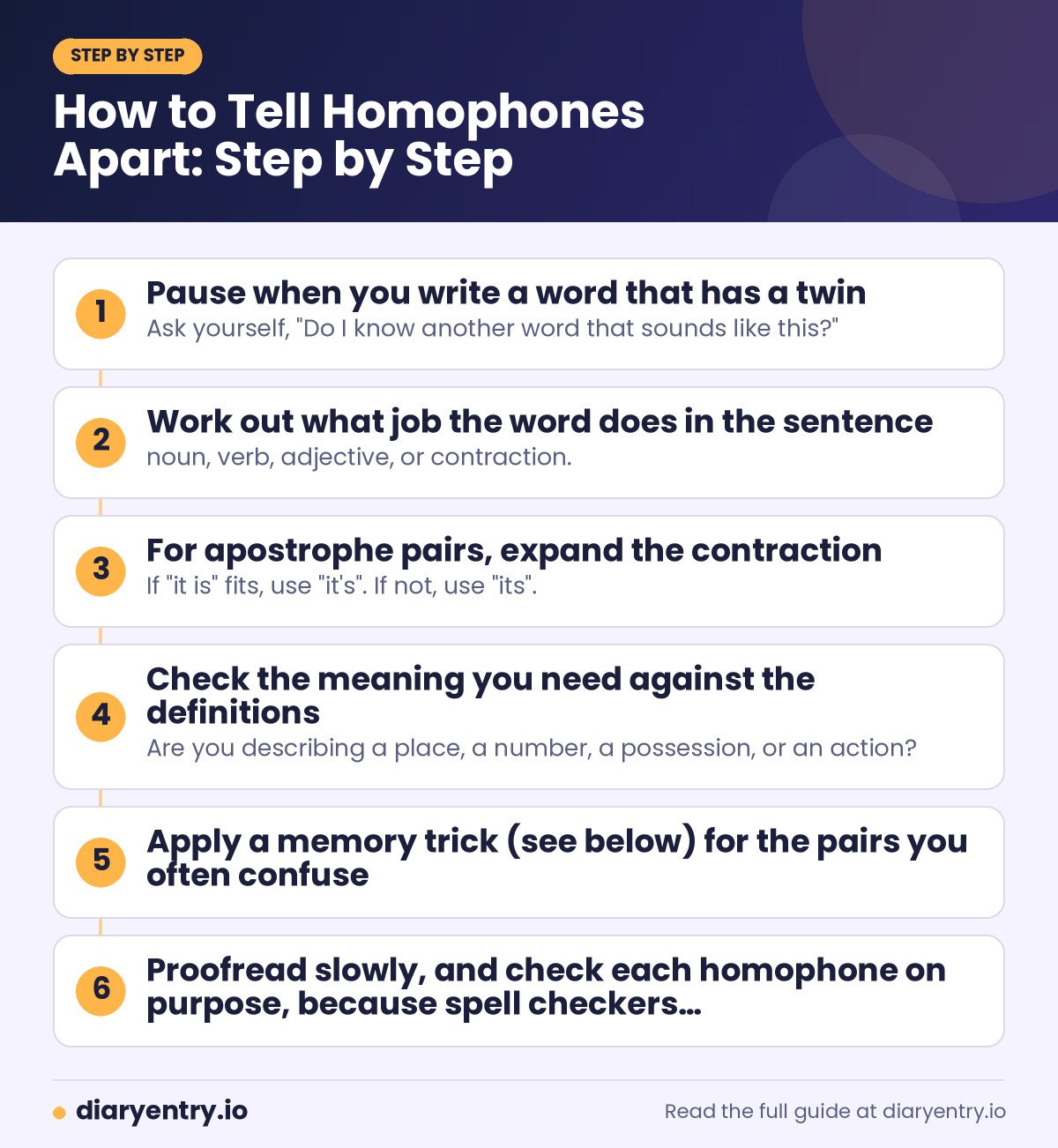
- Pause when you write a word that has a twin. Ask yourself, “Do I know another word that sounds like this?”
- Work out what job the word does in the sentence: noun, verb, adjective, or contraction.
- For apostrophe pairs, expand the contraction. If “it is” fits, use “it’s”. If not, use “its”.
- Check the meaning you need against the definitions. Are you describing a place, a number, a possession, or an action?
- Apply a memory trick (see below) for the pairs you often confuse.
- Proofread slowly, and check each homophone on purpose, because spell checkers will not flag it.
Memory Tricks for Confusing Homophones
- There: it contains “here”, and both are places. “Here” and “there” end in the same letters.
- Their: it contains “heir”, someone who inherits, which belongs to a person.
- Stationery vs stationary: stationery with an “e” is for envelopes and paper. Stationary with an “a” means standing still.
- Principal vs principle: the principal is your “pal”. A principle is a rule, and both “principle” and “rule” end in “le”.
- Weather vs whether: weather has “eat” in it, as in “eat lunch outside if the weather is fine”. Whether has “he” in it, as in “he must decide whether to go”.
- Desert vs dessert: dessert has a double “s” because you want a second helping.
- Piece vs peace: a piece of pie. Peace is calm, and “peace” contains “ace”, a top card.
Solved Examples
Pick the correct word in each sentence.
| Sentence | Correct word | Why |
|---|---|---|
| We went (to / too / two) the market. | to | Shows direction. |
| (Their / There / They’re) going to be late. | They’re | “They are” fits. |
| The dog hurt (its / it’s) paw. | its | Possessive, not “it is”. |
| I can’t (hear / here) you. | hear | Means to listen. |
| The (principal / principle) addressed the school. | principal | Head of a school. |
| Please (right / write) your name. | write | Means to put words on paper. |
Practice Questions
- She is (to / too / two) tired to walk.
- I will (meet / meat) you at the station.
- The (whole / hole) class passed.
- (Your / You’re) welcome to join us.
- We watched the (son / sun) set.
- The (weather / whether) is lovely today.
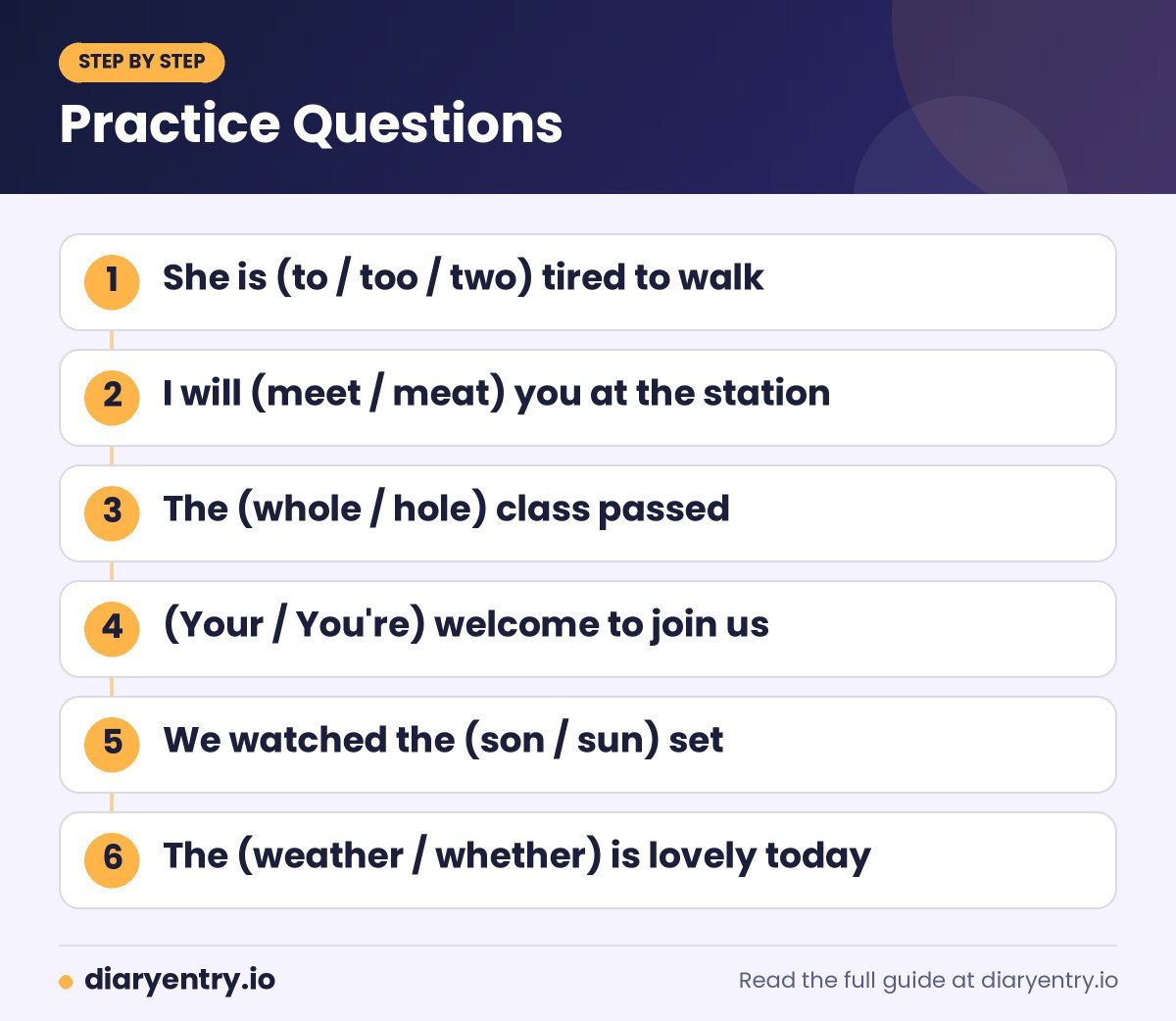
Answers: 1. too; 2. meet; 3. whole; 4. You’re; 5. sun; 6. weather.
Common Mistakes With Homophones
Trusting spell check. “I want to by a new bag” has no misspelled word, so the checker stays silent. Only you can catch it.
Mixing up its and it’s. This is the most frequent apostrophe error. Replace it with “it is”. If the sentence still makes sense, use the apostrophe.
Using “then” for “than”. These are close in sound for many speakers. “Than” compares; “then” refers to time. “She is taller than me”, but “First eat, then play”.
Writing “alot” or “should of”. These come from sound. The correct forms are “a lot” and “should have”, and “should’ve” is the spoken contraction.
Mixing up “lose” and “loose”. They are not true homophones, but they trip people up in the same way. Lose means to misplace or fail to win; loose means not tight.
Why Homophones Matter in Real Writing
A homophone error can change the meaning of a sentence or make the writer look careless. In an exam, it can cost marks. In a job application, it can weaken an otherwise strong letter. That is why careful proofreading matters for formal writing, as you will see in our formal letter format guide and our application letter format samples.
In a diary, homophones are less risky, but they are still worth fixing. When you reread entries months later, clean spelling makes them easier and more pleasant to read. Our guide on how to write a diary entry shows how a short daily review can help you spot and fix patterns like these.
Homophones also play a creative role. Puns depend on them: “Time flies like an arrow; fruit flies like a banana” and “I used to be a banker, but I lost interest” use sound-alike or double meanings for humour. They are also tied to figures of speech, which you can explore in our figures of speech guide.
Tips to Master Homophones
- Keep a “trouble list”. Write down the pairs you personally mix up and review them weekly.
- Learn in sentences. A word learned inside a sentence sticks better than a word learned alone.
- Make flashcards. Put the sentence with a blank on one side and the answer on the other.
- Proofread backwards. Reading from the last sentence to the first makes errors stand out.
- Write a little every day. Regular practice builds spelling memory. The 4-Week Diary Entry Course is designed to make that habit easy.
Frequently Asked Questions About Homophones
What is a homophone in simple words?
A homophone is a word that sounds exactly like another word but has a different meaning and, usually, a different spelling. “Pair” and “pear” are an example.
What are 10 examples of homophones?
Ten common examples are: to/too/two, their/there/they’re, write/right, see/sea, buy/by/bye, hear/here, new/knew, flour/flower, whole/hole, and piece/peace.
What is the difference between homophones and homonyms?
Homophones sound the same but are usually spelled differently. Homonyms are spelled and pronounced the same but have different meanings, like “bat” the animal and “bat” for cricket.
What is the difference between homophones and homographs?
Homographs share spelling but have different meanings, and may be pronounced differently, such as “tear” (a drop) and “tear” (to rip). Homophones share sound.
Why are there so many homophones in English?
English borrowed words from many languages, and its spelling and pronunciation changed at different times. That left many different spellings pointing to the same sound.
Do homophones sound exactly the same in every accent?
Not always. Some pairs, such as “caught” and “cot”, sound the same in some accents but different in others. Whether two words count as homophones can depend on the accent.
How can I stop confusing homophones when I write?
Keep a list of your own problem pairs, use memory tricks, and proofread with meaning in mind rather than relying on spell check.
Conclusion
Homophones are a normal part of English, and learning them is mostly a matter of attention and practice. Know the difference between homophones, homonyms, and homographs, memorise the pairs you most often confuse, and always check each one while proofreading. A little daily writing makes the correct spelling feel natural, and the 4-Week Diary Entry Course is a gentle way to build that routine.