
Quick Answer
Summary writing format is a method of condensing a passage into a short version of about one-third of its length, written in your own words, in the third person and present tense. A good summary keeps the main ideas, drops examples and opinions, and follows the original order.
Key Takeaways
- A summary is usually one-third the length of the original passage, unless the question sets a word limit.
- Always write it in your own words, in the third person and the present tense.
- Keep the main idea and key supporting points, and leave out examples, quotations and repetition.
- Do not add your own opinions, and keep the original order of ideas.
- Give the summary a short, suitable title if the question asks for one.
What Is Summary Writing?
Summary writing is the skill of reading a passage, understanding its central message and then restating that message briefly and accurately. It is different from copying a few lines or shortening each sentence. A true summary captures the heart of the passage in a fresh, compact form that a reader who has not seen the original can still follow.
The skill matters well beyond the exam hall. Students use it to prepare notes, professionals use it to write meeting minutes and reports, and researchers use it to review sources. Learning the summary writing format now gives you a tool you will use for years.
Summary Writing Format: Step by Step
Follow this process whenever you are given a passage to summarise. It works for prose, news reports, speeches and even short stories.
- Read the whole passage once without writing anything, just to get the overall idea.
- Read again and underline the key points. Look for topic sentences, which often appear at the start of paragraphs.
- Identify the main idea and write it down in a single sentence of your own.
- Cross out the details you can drop, such as examples, statistics, repeated ideas, quotations and descriptions.
- Make short notes in your own words for each remaining point.
- Write the first draft, joining the points with linking words such as “also”, “however” and “as a result”.
- Check the length. Aim for about one-third of the original or the word limit given.
- Revise. Confirm that you have not copied sentences, added opinions or changed the meaning.

Rules of Summary Writing
- Write in the third person, even if the passage uses “I” or “we”.
- Use the present tense for ideas and the past tense only for clear historical events.
- Use indirect speech instead of quoting the speaker’s exact words.
- Write one connected paragraph, not a list of bullet points, unless told otherwise.
- Do not begin with phrases such as “The passage says that” more than once, and do not comment on the quality of the passage.
- Keep the logical order of the original, so the summary reads like a small version of the passage.
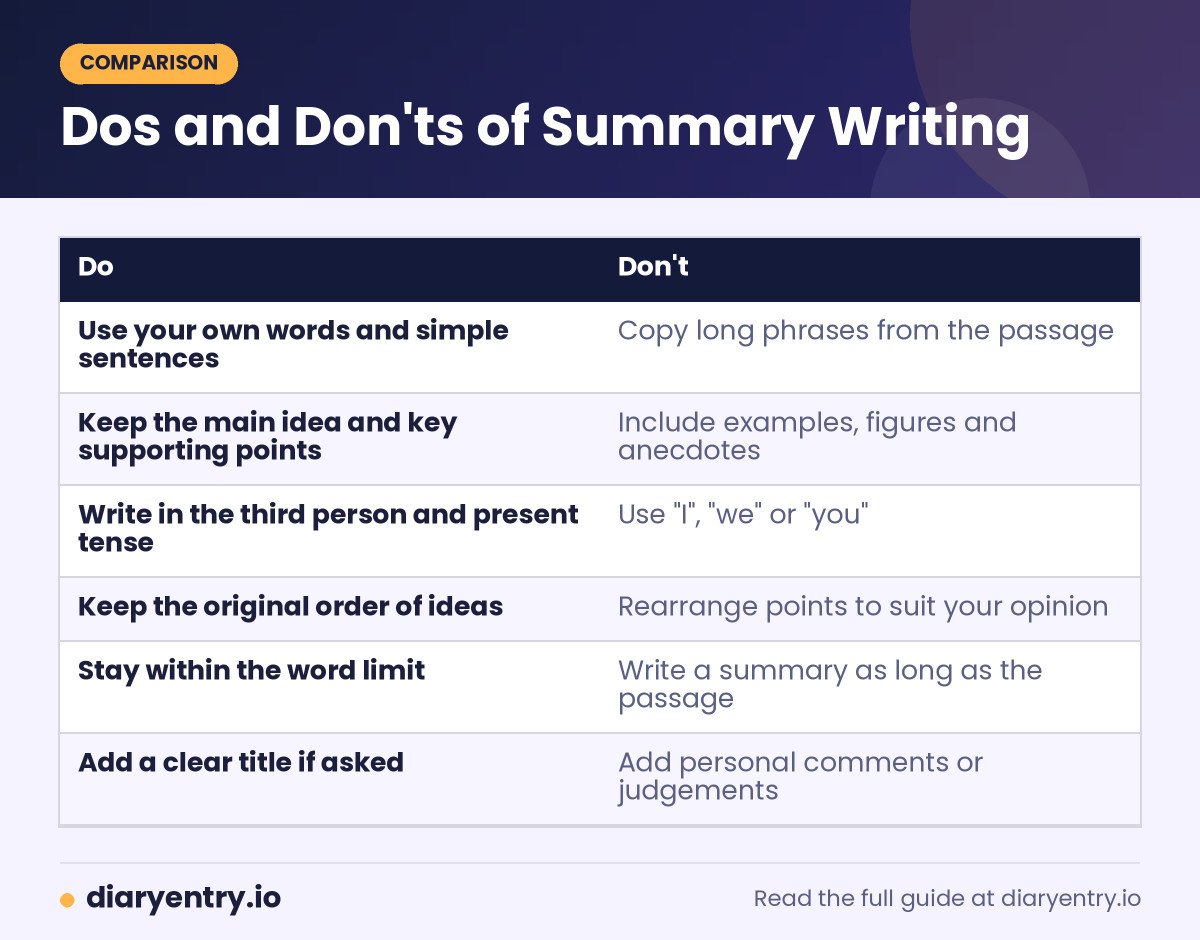
Dos and Don’ts of Summary Writing
| Do | Don’t |
|---|---|
| Use your own words and simple sentences | Copy long phrases from the passage |
| Keep the main idea and key supporting points | Include examples, figures and anecdotes |
| Write in the third person and present tense | Use “I”, “we” or “you” |
| Keep the original order of ideas | Rearrange points to suit your opinion |
| Stay within the word limit | Write a summary as long as the passage |
| Add a clear title if asked | Add personal comments or judgements |
Solved Example 1: A Short Passage
Passage. Reading is one of the most useful habits a student can build. When we read regularly, we meet new words and see how good writers put their thoughts together, which quietly improves our own speaking and writing. A habit of reading also trains the mind to focus. In a world full of quick distractions, sitting with a book for even twenty minutes teaches patience and concentration. Reading is also a source of knowledge. Through books we learn about history, science, other cultures and people whose lives are very different from ours, and this broadens our understanding of the world. Finally, reading is a pleasure in itself. A good story can comfort us after a tiring day and give us a place to rest our thoughts. Teachers therefore encourage students to read a little every day, whether it is a novel, a newspaper or a magazine, because small daily efforts build a lasting habit.
Notes. Main idea: reading is a valuable habit. Points: improves language, builds focus, gives knowledge, offers pleasure, practise daily.
Summary (Title: The Value of Reading). The passage explains that regular reading is a valuable habit for students. It improves language skills, builds concentration and patience, increases knowledge of the world and provides relaxation. Teachers therefore urge students to read a little daily to make it a lasting habit.
Notice that the summary has about 45 words, roughly one-third of the passage. It drops the example about twenty minutes, the list of subjects and the kinds of reading material, but keeps the main idea and every key benefit.
Solved Example 2: A Speech or News Passage
Passage. At the annual prize distribution, the principal told the students that success is not the result of talent alone. She said that she had seen many gifted children fall behind because they relied on ability and stopped working hard. By contrast, students who practised every day, listened to feedback and were not afraid of mistakes slowly overtook them. She urged the audience to treat failure as a teacher, not an enemy, and to remember that every champion was once a beginner. She also thanked the parents for their support and the teachers for their patience, and wished the students a bright future.
Summary. The principal advised students that hard work matters more than talent. She said that gifted students who stop working fall behind, while those who practise, accept feedback and learn from mistakes succeed. She encouraged them to see failure as a lesson and thanked parents and teachers.
Here the direct speech has been changed to reported speech, the third person is used throughout, and the final wishes are condensed into a short closing clause. If you need help with converting speeches into reported form, our guide to speech writing format shows how speeches are structured, which makes them easier to summarise. For the tense and pronoun changes involved, see our direct and indirect speech rules.
Summary vs Paraphrase vs Precis
Students often use these terms interchangeably, but they are not the same. A paraphrase restates a passage in different words and is usually about the same length as the original. A summary shortens the passage and keeps only the main points. A precis is a more formal, strictly shortened version of a passage, usually limited to a fixed fraction of the original, and it is common in higher classes and competitive exams. In school English papers, the word “summary” generally means the shortened version with a clear word limit.
Summaries also differ from reports and articles. A report gathers facts for a purpose, as our report writing format for Class 10 explains, while an article develops an argument. A summary only shortens something that already exists, and it adds nothing new.
How to Summarise Different Types of Passages
Factual or Informative Passages
Look for the topic sentence, then keep the causes, effects or steps and drop the numbers and examples. Keep the sequence intact so the logic of the passage survives.
Descriptive Passages
Concentrate on what is being described and its main qualities. Leave out decorative adjectives and sensory details unless they are essential to the point. The techniques in our descriptive writing guide can help you recognise which details are decoration and which carry the meaning.
Stories and Narratives
Pick out the main characters, the problem, the key events and the ending. Skip small conversations and minor characters. For more on how stories are built, read the narrative writing format guide.
Argumentative or Opinion Passages
State the writer’s position and the strongest two or three reasons. Avoid saying whether you agree. The summary should reflect the writer’s view, not yours.
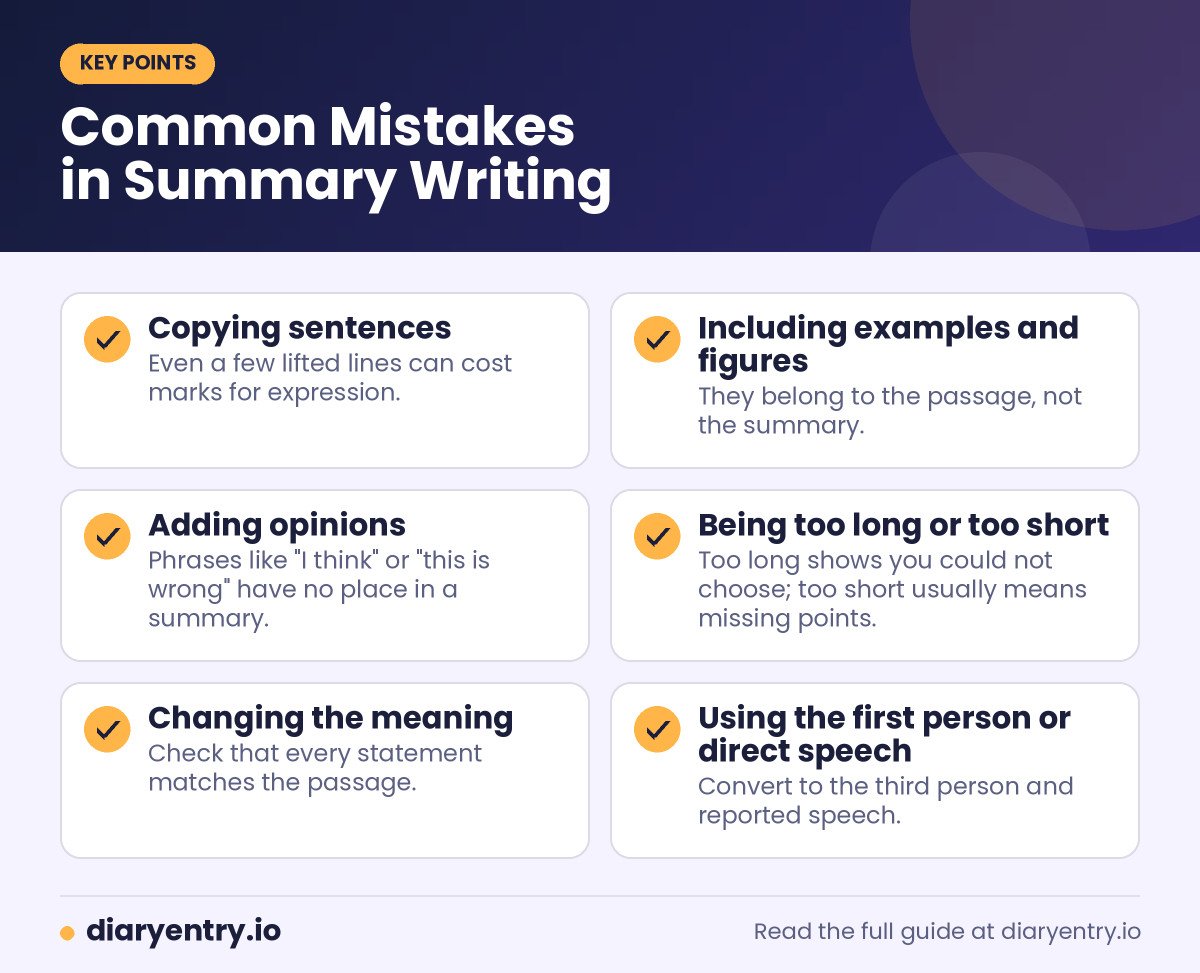
Common Mistakes in Summary Writing
- Copying sentences. Even a few lifted lines can cost marks for expression.
- Including examples and figures. They belong to the passage, not the summary.
- Adding opinions. Phrases like “I think” or “this is wrong” have no place in a summary.
- Being too long or too short. Too long shows you could not choose; too short usually means missing points.
- Changing the meaning. Check that every statement matches the passage.
- Using the first person or direct speech. Convert to the third person and reported speech.
Useful Linking Words and Phrases
Good summaries read smoothly because the points are linked. Keep a short list of connectors in mind: “firstly”, “in addition”, “moreover”, “however”, “although”, “as a result”, “therefore”, “for this reason” and “finally”. Use them sparingly, because a summary should still be compact. Reporting verbs also help you avoid repetition. Instead of repeating “says”, try “explains”, “points out”, “argues”, “suggests”, “warns”, “describes” and “concludes”.
Practice Passage for You
Try this exercise on your own, then compare your attempt with a friend or teacher.
Passage. Keeping a daily journal is a simple habit with many benefits. Writing about the events of the day helps a person understand their own feelings, because putting a worry into words often makes it feel smaller. A journal also becomes a record of memories, so that years later one can read about small moments that would otherwise be forgotten. Writers say that regular practice improves expression, as the writer learns to choose words with care. In addition, a journal can help in setting goals, since writing a plan down makes it more real and easier to follow. All it requires is a notebook and a few quiet minutes, which is why many teachers suggest it to students.
Write a summary of about 45 words with a suitable title. Check that you have used the third person, kept the main benefits and left out the small details.
Since the passage is about journaling, you may enjoy exploring our guide on how to write a diary entry or joining the 4-Week Diary Entry Course. Recording and then summarising your own day is an excellent way to practise this very skill.
Tips to Score Full Marks
Time is the biggest challenge, so divide it sensibly. Spend about a third of your time reading and underlining, a third on notes and drafting, and the rest on revision. Practise with passages from newspapers, textbooks and magazines, and time yourself. After each attempt, compare your summary with the passage and ask: did I keep the main idea, avoid copying and stay within the limit?
Another useful habit is to write a one-sentence summary of every paragraph while reading. When you join those sentences and trim them, you already have a strong first draft. Finally, build your vocabulary. A larger stock of synonyms makes it much easier to restate ideas in your own words without changing their meaning.
Frequently Asked Questions
What is the format of summary writing?
A summary has a short title (if required) and one paragraph written in the third person and present tense. It states the main idea first, adds the key supporting points in order, and avoids examples and opinions.
How long should a summary be?
Usually about one-third of the original passage. If the question gives a word limit, follow that instead.
Should a summary be in the present or past tense?
Use the present tense for the writer’s ideas and arguments, for example “The writer argues”. Use the past tense only when summarising events that clearly happened in the past, such as in a story or a news report. If you need a refresher on verb forms, our tenses chart lists all twelve tenses.
Can I use quotations in a summary?
It is better to avoid them. Convert direct speech into reported speech and state the idea in your own words.
Do I need to give a title to a summary?
Only if the question asks for one. When it does, choose a short title of a few words that captures the main idea of the passage.
What is the difference between a summary and a paraphrase?
A paraphrase rewrites the passage in different words at roughly the same length. A summary shortens the passage by keeping only the main points.
How can I improve my summary writing quickly?
Practise daily with short passages, underline topic sentences, write one-line notes for each paragraph, and revise your drafts for length and accuracy. Reading widely also helps.
Conclusion
Once you know the summary writing format, the task becomes a clear routine: read, underline, note, draft and revise. Keep your sentences original, stay in the third person and present tense, and never add opinions. With regular practice on the passages above and others you find, you will be able to condense any text confidently and within the word limit.