
Quick Answer
Conditional sentences are sentences that describe a possible situation and its result, usually built with “if”. Each one has an if-clause (the condition) and a main clause (the result). English has four main types: zero, first, second and third conditionals, plus mixed conditionals that blend past and present.
Key Takeaways
- A conditional sentence has two parts: the if-clause states the condition and the main clause states the result.
- The zero conditional states general truths, the first deals with real future possibilities, the second with unreal present situations and the third with unreal past situations.
- Will and would are normally used in the main clause, not in the if-clause.
- Mixed conditionals combine a past condition with a present result, or the other way around.
- When the if-clause comes first, put a comma after it; when it comes second, no comma is needed.
What Are Conditional Sentences?
Conditional sentences talk about what happens, will happen, would happen or would have happened if something else is true. They link a condition to a result. “If it rains, the match will be cancelled” is a good example. The rain is the condition and the cancellation is the result.
Structurally, every conditional sentence is a complex sentence made of two clauses. The if-clause is a dependent adverb clause, and the main clause is independent. If you want to revisit that idea, our guide to types of clauses explains how the two fit together.
The basic structure
There are two possible orders, and both mean the same.
- If you study hard, you will pass. (if-clause first, comma needed)
- You will pass if you study hard. (main clause first, no comma)
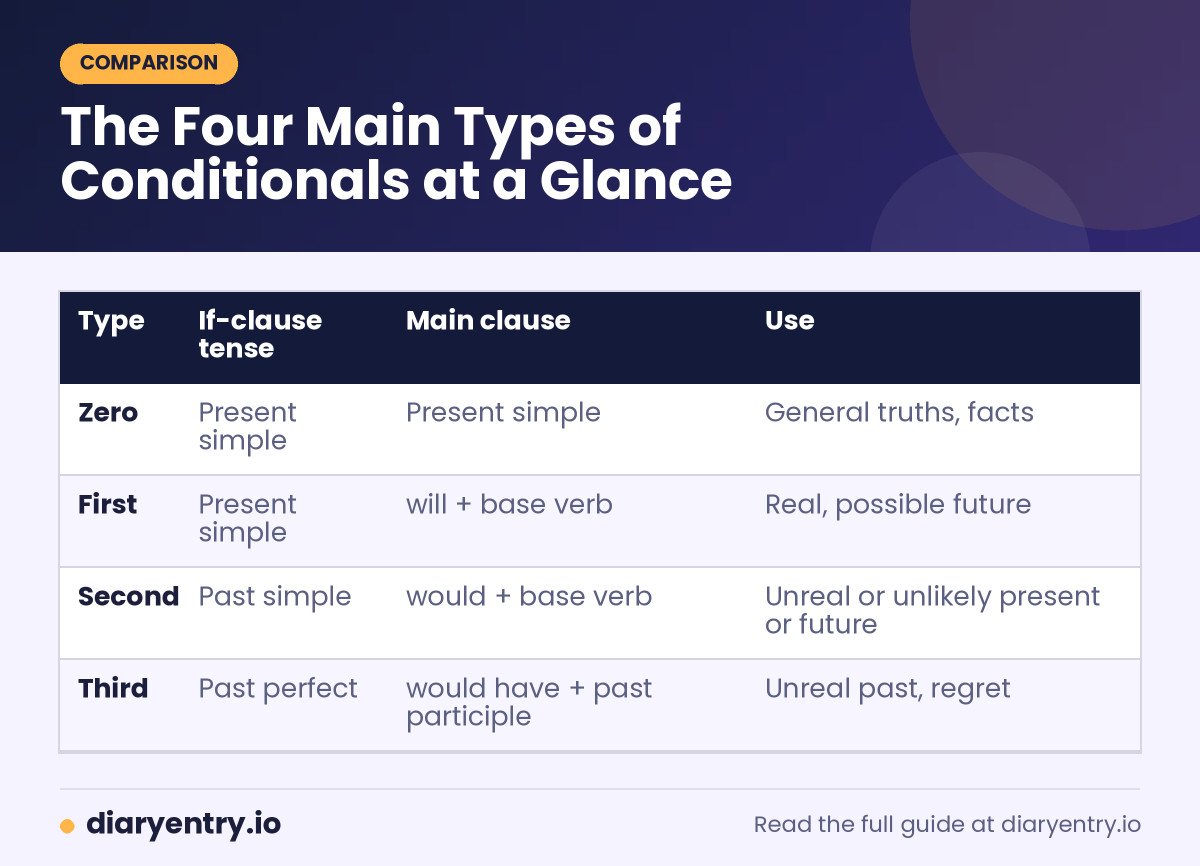
The Four Main Types of Conditionals at a Glance
This table shows the pattern for each type. Keep it handy while you read the rest of the page.
| Type | If-clause tense | Main clause | Use | Example |
|---|---|---|---|---|
| Zero | Present simple | Present simple | General truths, facts | If you heat water to 100 degrees, it boils. |
| First | Present simple | will + base verb | Real, possible future | If it rains, we will stay home. |
| Second | Past simple | would + base verb | Unreal or unlikely present or future | If I had a car, I would drive to work. |
| Third | Past perfect | would have + past participle | Unreal past, regret | If she had left earlier, she would have caught the train. |
Zero Conditional
The zero conditional describes things that are always true, such as scientific facts, rules and habits. Because the result always follows the condition, “if” can usually be replaced with “when” without changing the meaning.
Structure: If + present simple, present simple.
- If you mix red and blue, you get purple.
- If the alarm rings, everyone leaves the building.
- Plants die if they get no water.
This type can also use an imperative in the main clause: “If you feel dizzy, sit down.”
First Conditional
The first conditional talks about a real or likely situation in the future. The speaker thinks the condition could really happen.
Structure: If + present simple, will + base verb.
- If I finish early, I will call you.
- If the weather is good, they will go for a picnic.
- She will be happy if you visit her.
Other modals in the first conditional
You are not limited to “will”. Other modals can express different shades of meaning in the main clause. Our guide to modals in English grammar lists all of them.
- If you hurry, you can catch the bus. (ability or possibility)
- If you feel unwell, you should rest. (advice)
- If you are late, you must inform the office. (obligation)
- If the sky clears, we might go out. (weak possibility)
Never use will in the if-clause
A very common mistake is to put “will” right after “if”. Say “If it rains tomorrow, we will stay in”, not “If it will rain tomorrow, we will stay in”. The future idea is already in the main clause. (There is one exception, when “will” expresses willingness or a polite request, such as “If you will wait here, the doctor will see you shortly.”)
Second Conditional
The second conditional is for situations that are unreal, imaginary or unlikely right now or in the future. It is also used for polite advice and for wishes.
Structure: If + past simple, would + base verb.
- If I won the lottery, I would travel the world.
- If she knew the answer, she would tell us.
- Would you accept the job if they offered it?
“Were” for all subjects
In formal English, the verb “be” in the if-clause takes “were” for every subject, including I, he, she and it. This is called the subjunctive mood.
- If I were you, I would apologise.
- If he were taller, he could play basketball.
In casual speech, “was” is common with I, he and she, but “were” is the safer choice in exams and formal writing.
Giving advice with “If I were you”
“If I were you, I would…” is the standard way to offer gentle advice in English. For instance: “If I were you, I would keep a journal to track my goals.”
Third Conditional
The third conditional looks back at the past and imagines a different result. The situation is now impossible to change, so it often expresses regret, relief or criticism.
Structure: If + past perfect, would have + past participle.
- If we had left earlier, we would have reached on time.
- If he had studied, he would have passed the exam.
- I would not have been late if the bus had come on time.
Other modals in the third conditional
You can swap “would” for “could” or “might” to change the meaning.
- If she had asked, I could have helped her. (ability)
- If it had rained, the match might have been cancelled. (possibility)
Mixed Conditionals
Mixed conditionals join two different time frames. They are used when the condition and the result do not belong to the same time.
| Type | Structure | Example |
|---|---|---|
| Past condition, present result | If + past perfect, would + base verb | If I had taken that job, I would be living in Delhi now. |
| Present condition, past result | If + past simple, would have + past participle | If I were braver, I would have spoken up yesterday. |
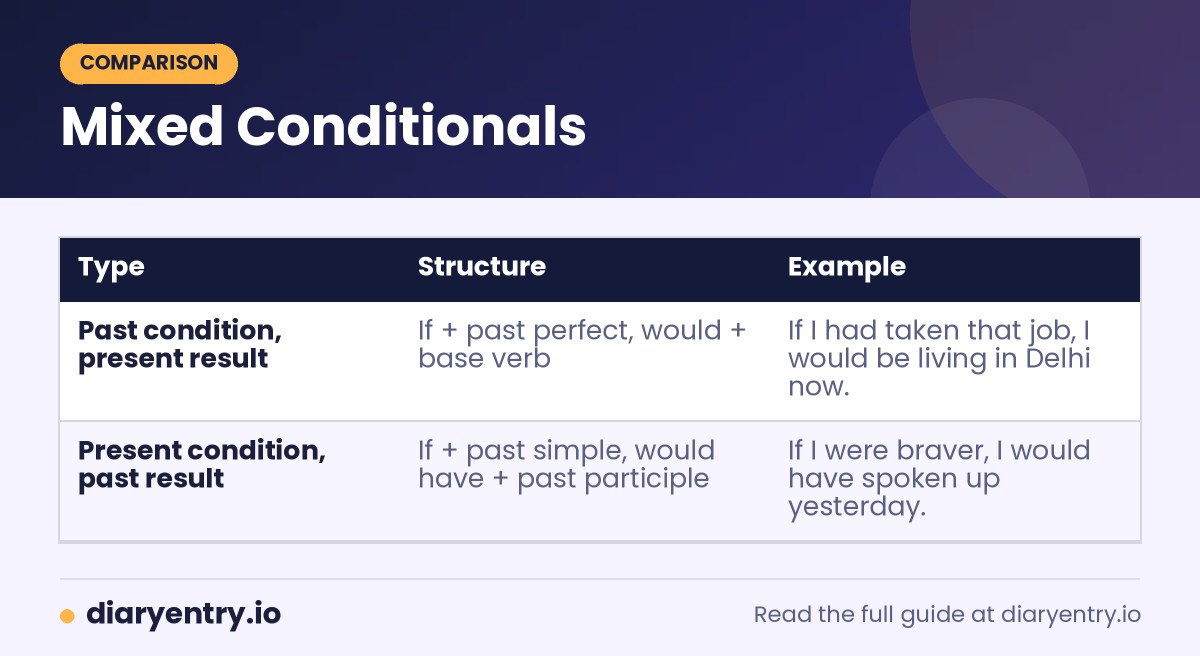
The first pattern is more common. It says: because of something that did or did not happen in the past, the situation today is different.
Other Words That Can Replace “If”
“If” is not the only word that can introduce a condition. These alternatives are useful in formal writing, and our page on conjunctions lists more joining words.
| Word | Meaning | Example |
|---|---|---|
| unless | if not | Unless you hurry, you will miss the train. |
| provided that / providing | only if | You can go provided that you return by nine. |
| as long as | only if | I will help as long as you try. |
| in case | as a precaution | Take an umbrella in case it rains. |
| suppose / supposing | imagine that | Suppose you won, what would you do? |
| otherwise | if not | Leave now; otherwise, you will be late. |
Unless vs if not
“Unless” already carries a negative meaning, so do not add another one. “Unless you study, you will fail” means the same as “If you do not study, you will fail”. Avoid “Unless you do not study”.
Inversion in Formal Conditionals
In formal English, you can drop “if” and swap the order of the subject and the auxiliary verb. This is called inversion and is common in writing.
- Had I known, I would have helped. (Third conditional: If I had known)
- Were she here, she would agree. (Second conditional: If she were here)
- Should you need help, please call us. (First conditional: If you should need help)
Conditionals in Reported Speech
When conditionals are reported, the tense often moves back, following the rules in our guide to direct and indirect speech. First conditionals usually become second conditionals: “If it rains, I will stay home” becomes “She said that if it rained, she would stay home”. Second and third conditionals usually stay the same, because they are already in unreal forms.
Conditional Sentences and Sentence Types
Conditionals are complex sentences, so they fit neatly into the structures described in our types of sentences guide. You can also have a compound-complex sentence, for example: “If you call, I will answer, and we can plan the trip.” Knowing the pattern helps you vary your writing.
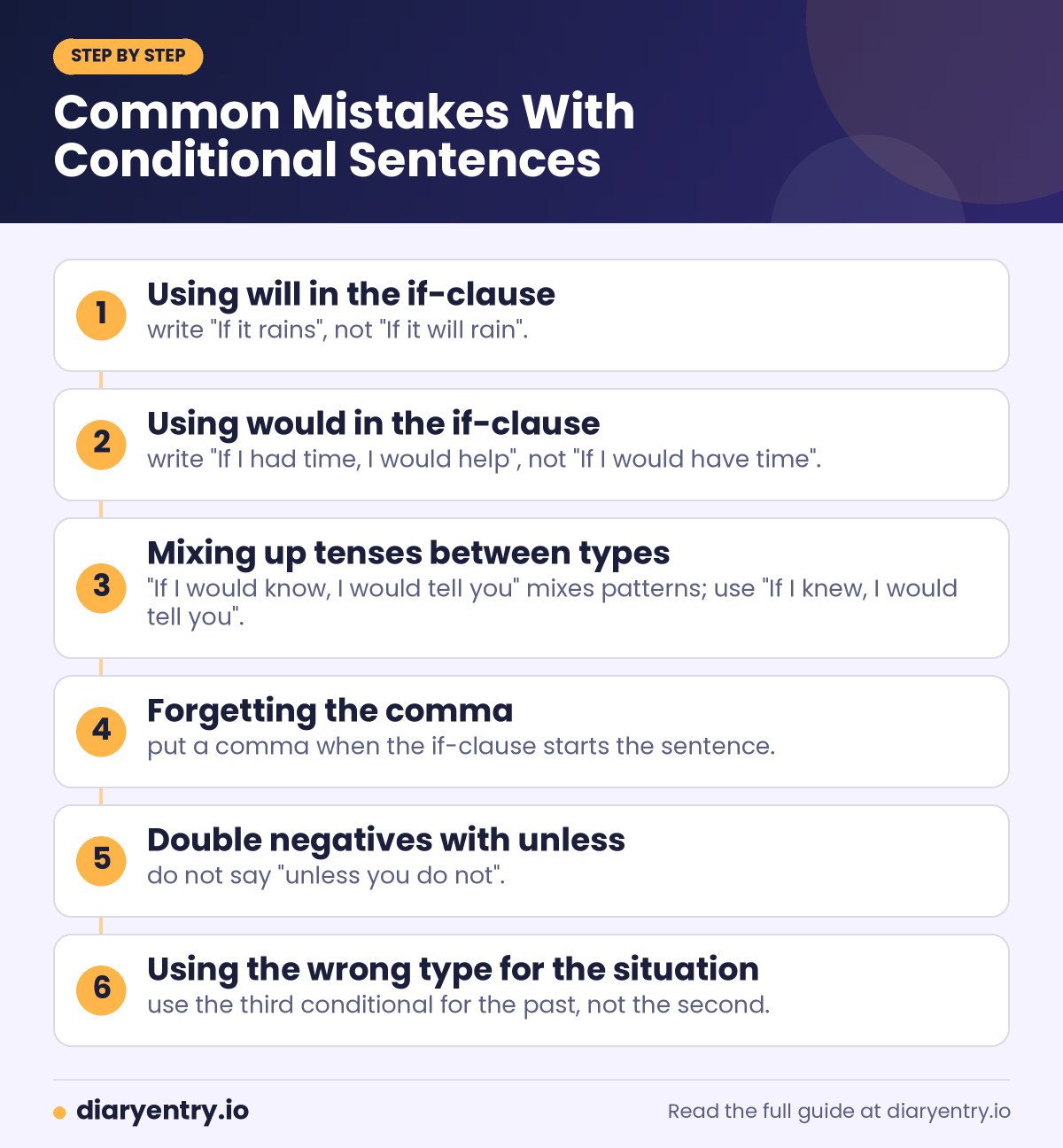
Common Mistakes With Conditional Sentences
Watch out for these frequent errors, and check your own writing for them.
- Using will in the if-clause: write “If it rains”, not “If it will rain”.
- Using would in the if-clause: write “If I had time, I would help”, not “If I would have time”.
- Mixing up tenses between types: “If I would know, I would tell you” mixes patterns; use “If I knew, I would tell you”.
- Forgetting the comma: put a comma when the if-clause starts the sentence.
- Double negatives with unless: do not say “unless you do not”.
- Using the wrong type for the situation: use the third conditional for the past, not the second.
Quick Practice: Complete the Sentences
Fill the blanks, then compare with the answers.
- If you ___ (heat) ice, it melts.
- If it ___ (rain) tomorrow, we will cancel the trip.
- If I ___ (be) you, I would talk to the teacher.
- If they ___ (leave) sooner, they would have caught the flight.
- If she had saved money, she ___ (be) comfortable now.
Answers: 1 heat, 2 rains, 3 were, 4 had left, 5 would be.
Real-Life Examples You Can Use in Your Diary
Conditionals are perfect for reflective writing, which is why they appear so often in journals. They let you explore plans, regrets and dreams.
- First conditional (plans): “If I wake up at six, I will have time to exercise before work.”
- Second conditional (dreams): “If I had more free time, I would learn the guitar.”
- Third conditional (reflection): “If I had planned better last week, I would not have felt so stressed.”
Writing a few of these each day makes the patterns automatic. The 4-Week Diary Entry Course is a gentle way to build that daily writing habit, and while it is not a grammar course, it gives you a regular reason to practise structures like these.
Tips to Remember the Four Conditionals
These memory tricks help the patterns stick.
- Zero: think “fact”, because both verbs are in the present.
- First: think “future”, because will appears in the result.
- Second: think “dream”, because the situation is imaginary.
- Third: think “regret”, because the past cannot be changed.
- Remember “past in the if-clause means one step further from reality”.
Frequently Asked Questions About Conditional Sentences
What are the four types of conditional sentences?
The four main types are zero, first, second and third conditionals. Zero covers facts, first covers real future possibilities, second covers unreal present or future situations and third covers unreal past situations.
What is the difference between the first and second conditional?
The first conditional describes something that could really happen, using present simple and will. The second conditional describes something unlikely or imaginary, using past simple and would.
Can I use “would” in the if-clause?
Usually no. Say “If I had more time, I would help”. The only common exception is polite requests, such as “I would be grateful if you would reply soon”.
What is a mixed conditional?
A mixed conditional joins two different times, for example a past condition with a present result: “If I had studied medicine, I would be a doctor now”.
Is a comma always needed in a conditional sentence?
Use a comma when the if-clause comes first. When the main clause comes first, no comma is needed.
What is the difference between “unless” and “if not”?
They usually mean the same. “Unless” is a single word that already means “if not”, so you should not add another negative after it.
Which conditional is used for giving advice?
The second conditional with “If I were you” is the most common way to give polite advice. The first conditional with should also works well: “If you feel tired, you should rest”.
Conclusion
Conditional sentences help you talk about facts, plans, dreams and regrets with precision. Remember the pairing of tenses for each type, keep will and would out of the if-clause, and use mixed conditionals when the past shapes the present. Write three conditional sentences today, one for a plan, one for a dream and one for a regret, and you will see how quickly the structures become natural.