
Quick Answer
The types of sentences are grouped in two ways. By function, a sentence is declarative, interrogative, imperative or exclamatory. By structure, it is simple, compound, complex or compound-complex. Function tells you what the sentence does, such as state or ask, while structure tells you how many clauses it contains and how they connect.
Key Takeaways
- There are four types of sentences by function: declarative, interrogative, imperative and exclamatory.
- There are four types by structure: simple, compound, complex and compound-complex.
- Every sentence has both a function and a structure, so one sentence can be, for example, declarative and complex at the same time.
- Structure depends on independent clauses (which can stand alone) and dependent clauses (which cannot).
- Mixing sentence types in your writing makes it easier to read and more engaging.
What Is a Sentence?
A sentence is a group of words that expresses a complete thought. It begins with a capital letter, ends with a full stop, question mark or exclamation mark, and normally contains a subject and a verb. “Birds sing” is a complete sentence, while “Because it was raining” is not, because it leaves the thought unfinished.
Sentences are built from the eight parts of speech, so it helps to know the building blocks first. Our guide to parts of speech with definitions and examples is a good starting point. Once you can recognise a noun, a verb and a conjunction, the types of sentences become much easier to see.
Types of Sentences at a Glance
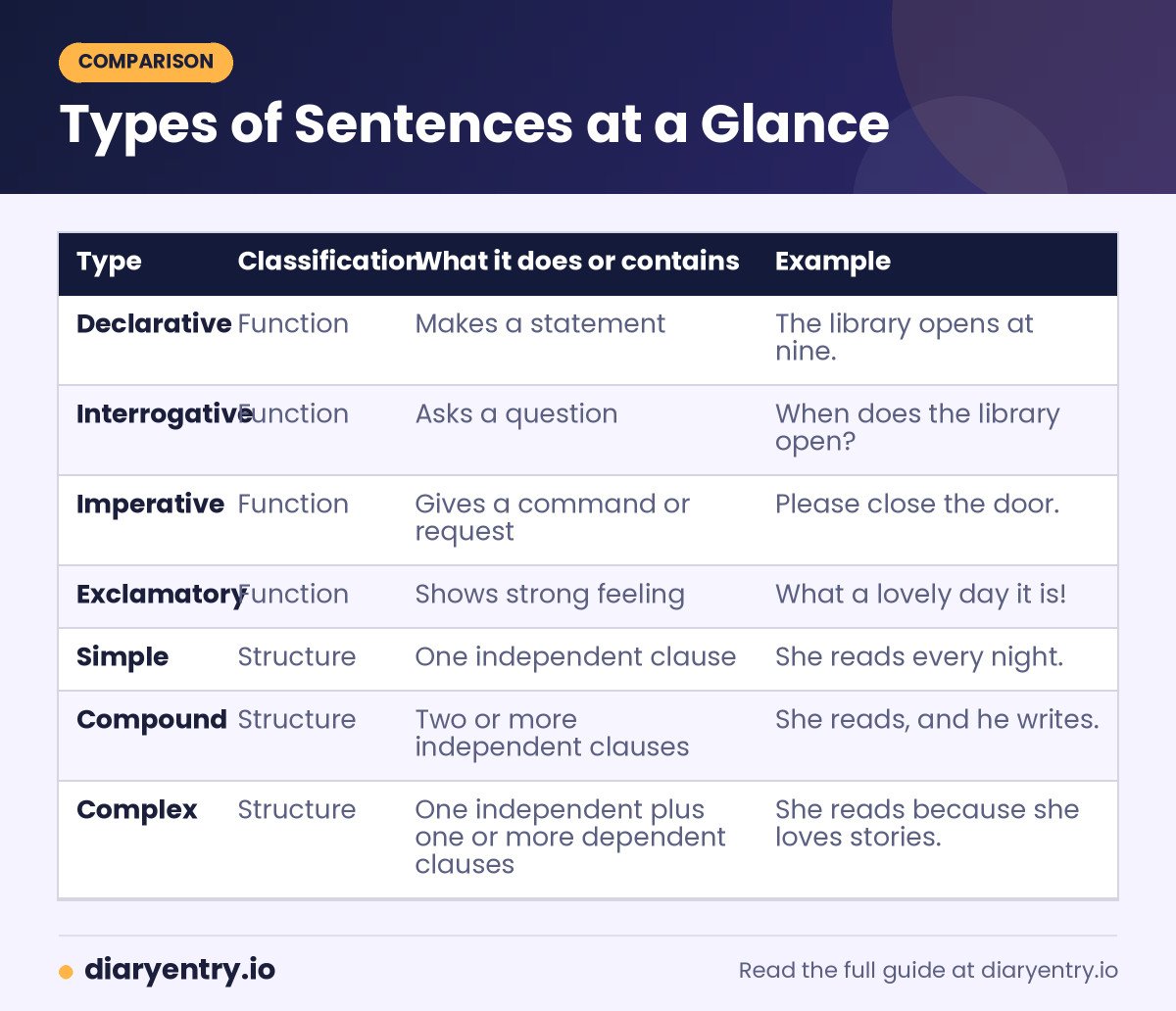
Use this chart to revise both classifications. The first four rows describe function and the last four describe structure.
| Type | Classification | What it does or contains | Example |
|---|---|---|---|
| Declarative | Function | Makes a statement | The library opens at nine. |
| Interrogative | Function | Asks a question | When does the library open? |
| Imperative | Function | Gives a command or request | Please close the door. |
| Exclamatory | Function | Shows strong feeling | What a lovely day it is! |
| Simple | Structure | One independent clause | She reads every night. |
| Compound | Structure | Two or more independent clauses | She reads, and he writes. |
| Complex | Structure | One independent plus one or more dependent clauses | She reads because she loves stories. |
| Compound-complex | Structure | Two or more independent plus at least one dependent clause | She reads while he writes, and then they talk. |
Types of Sentences by Function
Sentences classified by function are sorted by their purpose. Every sentence you speak or write fits one of the four kinds below.
Declarative Sentences
A declarative sentence makes a statement, gives information or expresses an opinion. It ends with a full stop and is the most common type in writing. Examples: “The train arrives at six.” “I enjoy writing in my diary.” “Honey never spoils.” Declarative sentences can be positive or negative: “He likes tea” and “He does not like tea” are both declarative.
Interrogative Sentences
An interrogative sentence asks a question and ends with a question mark. Some begin with a question word (who, what, where, when, why, how): “Where did you park the car?” Others begin with an auxiliary verb and expect yes or no: “Have you finished the report?” Tag questions such as “You are coming, aren’t you?” are also interrogative. Our explainer on question tags with rules and examples covers that pattern.
Imperative Sentences
An imperative sentence gives a command, makes a request, offers advice or gives instructions. The subject you is usually hidden: “Open your books.” “Please sit down.” “Turn left at the corner.” Imperatives normally end with a full stop, but a strong command may end with an exclamation mark: “Stop!” Recipes, road signs and exam instructions are all full of imperative sentences.
Exclamatory Sentences
An exclamatory sentence expresses strong emotion such as surprise, joy, anger or admiration. It ends with an exclamation mark. Many begin with what or how: “What a beautiful painting!” “How quickly time flies!” A plain declarative sentence can also become exclamatory with the right punctuation: “I won the prize!” Use them sparingly, because too many exclamation marks weaken their effect.
Types of Sentences by Structure
To classify by structure you need two terms. An independent clause has a subject and a verb and can stand alone as a sentence. A dependent clause also has a subject and a verb, but it begins with a word such as because, although, when, if or who, and it cannot stand alone.
Simple Sentences
A simple sentence contains exactly one independent clause and no dependent clause. It may be short or long. “Birds fly.” “The tired travellers rested under the old banyan tree.” A simple sentence can even have a compound subject or verb: “Riya and Arjun sang and danced.” It is still simple because it has only one clause.
Compound Sentences
A compound sentence joins two or more independent clauses. The clauses are linked by a coordinating conjunction (for, and, nor, but, or, yet, so) with a comma, by a semicolon, or by a conjunctive adverb. “I wanted to go out, but it was raining.” “The shop was closed; we went home.” The seven coordinating conjunctions are explained in detail in our guide to conjunctions, their types and rules.
Complex Sentences
A complex sentence contains one independent clause and at least one dependent clause. The dependent clause starts with a subordinating conjunction (because, although, since, if, when, while, unless) or a relative pronoun (who, which, that). “Although she was tired, she finished the homework.” “The book that you lent me was wonderful.” When the dependent clause comes first, put a comma after it. When it comes second, a comma is usually unnecessary.
Compound-Complex Sentences
A compound-complex sentence has at least two independent clauses and at least one dependent clause. “When the bell rang, the students left, and the teacher locked the room.” Here “When the bell rang” is dependent, while “the students left” and “the teacher locked the room” are independent. Writers use these sentences to show several linked ideas at once, but too many make a text hard to follow.
How to Identify the Type of a Sentence: Step by Step
Follow these steps whenever you are asked to name the type of a sentence. Do the function first, then the structure.
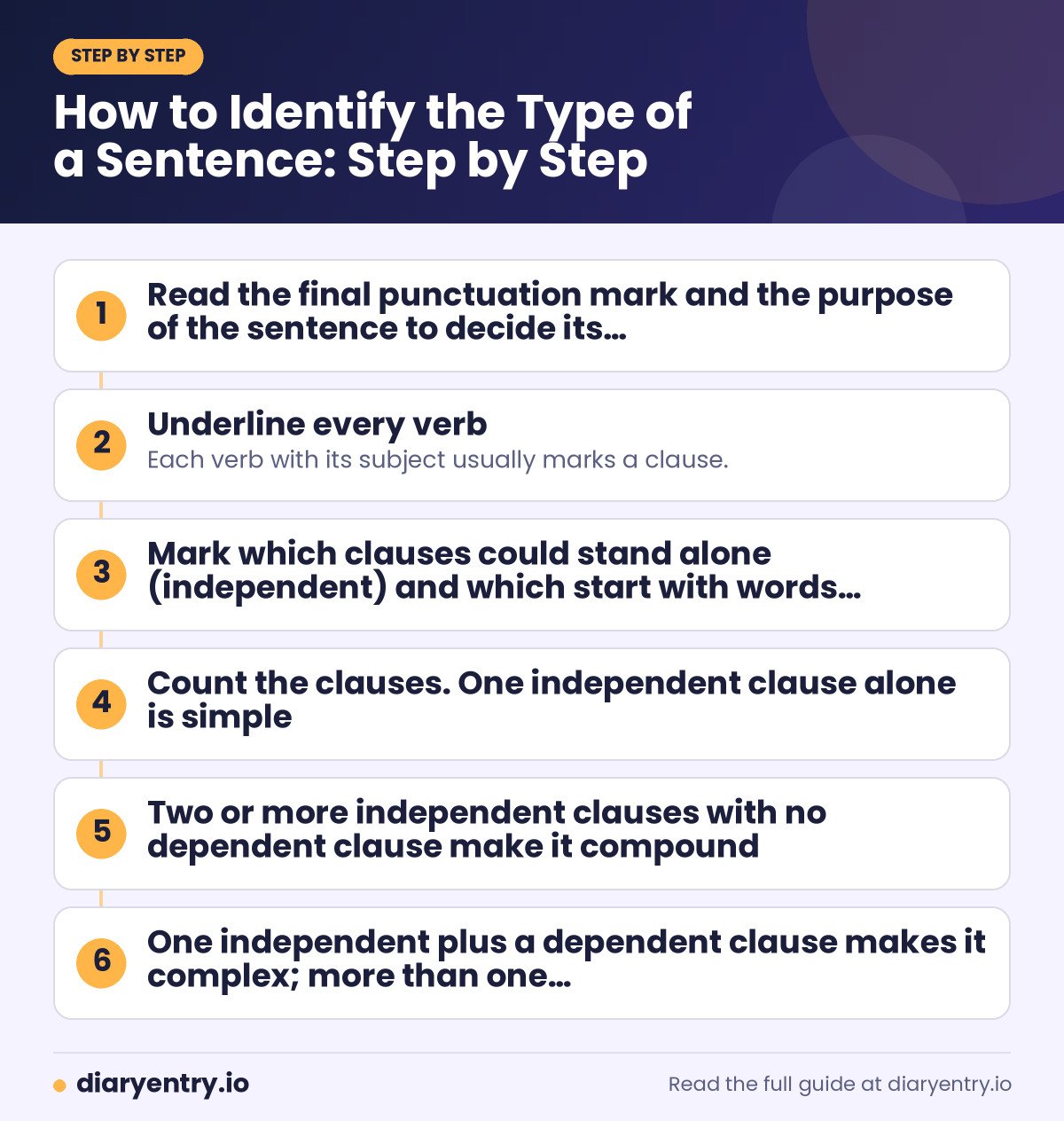
- Read the final punctuation mark and the purpose of the sentence to decide its function: statement, question, command or exclamation.
- Underline every verb. Each verb with its subject usually marks a clause.
- Mark which clauses could stand alone (independent) and which start with words like because, if, when or who (dependent).
- Count the clauses. One independent clause alone is simple.
- Two or more independent clauses with no dependent clause make it compound.
- One independent plus a dependent clause makes it complex; more than one independent plus a dependent makes it compound-complex.
Try this one: “If you study daily, you will improve, and your confidence will grow.” Function: declarative. Clauses: “If you study daily” (dependent), “you will improve” (independent), “your confidence will grow” (independent). Structure: compound-complex.
Function and Structure Together
The two classifications are independent of each other, so a sentence has one label from each. The table shows how they combine.
| Sentence | Function | Structure |
|---|---|---|
| The dog barked. | Declarative | Simple |
| Did you call, or did he? | Interrogative | Compound |
| Close the window because it is cold. | Imperative | Complex |
| How tall she has grown since we last met! | Exclamatory | Complex |
| I called, but nobody answered because they had left. | Declarative | Compound-complex |
Other Ways Sentences Are Classified
Some school syllabuses add other categories. By meaning, a sentence can be affirmative (“She plays chess”) or negative (“She does not play chess”). By the position of the main idea, a sentence can be loose (main idea first, details after), periodic (main idea saved for the end) or balanced (two equal parts). These labels are less common than the eight above, but they help when you analyse an author’s style.
Sentences are also affected by voice and tense. A passive sentence flips the focus from the doer to the receiver, as explained in our guide to active and passive voice rules. Any of the eight types can be written in either voice.
Common Mistakes With Sentence Types
- Sentence fragments. “Because she was late.” is a dependent clause, not a sentence. Add an independent clause: “Because she was late, she missed the bus.”
- Comma splices. “I was tired, I went to bed.” joins two independent clauses with only a comma. Use a conjunction, a semicolon or a full stop.
- Run-on sentences. Two independent clauses with no punctuation or conjunction at all need to be separated or joined properly.
- Confusing compound and complex. Compound uses coordinating conjunctions between equal clauses; complex uses subordinating conjunctions to make one clause depend on another.
- Calling a long sentence complex. Length does not decide the type. Count clauses instead.
- Missing question marks. Every interrogative sentence needs one, even in a long question.
Practice: Identify the Sentence Types
Name the function and the structure of each sentence, then compare with the answers.
- The monsoon arrived early this year.
- Will you join us, or are you busy?
- Submit your notebooks before you leave.
- What a brilliant goal that was!
- Although it was late, we kept working, and the team finished the report.
- My sister, who lives in Pune, called me.
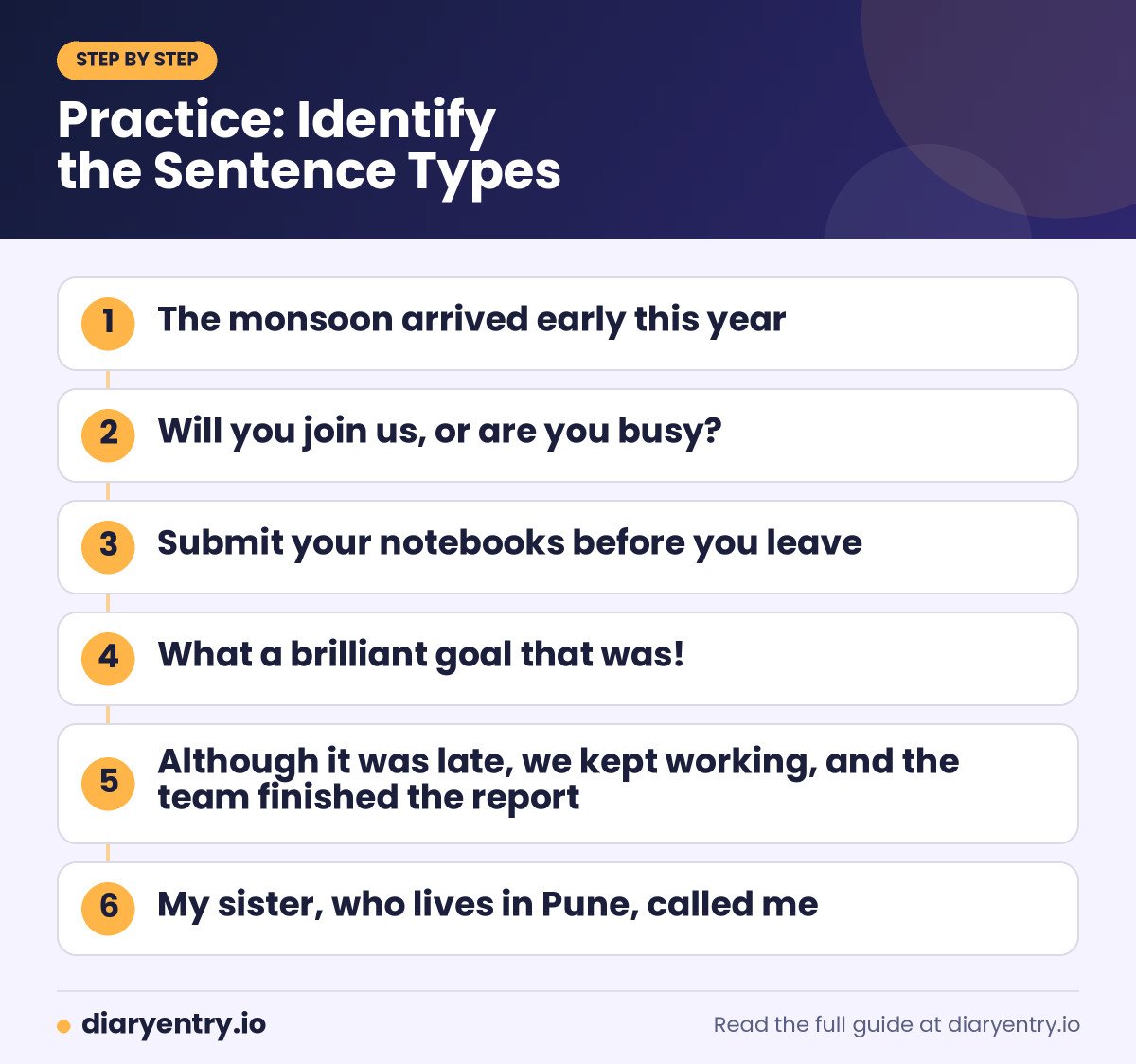
Answers: (1) declarative, simple. (2) interrogative, compound. (3) imperative, complex, because “before you leave” is a dependent clause. (4) exclamatory, simple. (5) declarative, compound-complex. (6) declarative, complex, because “who lives in Pune” is a dependent clause.
For an extra exercise, take the simple sentence “He opened the gate” and expand it: “He opened the gate, and the dog ran out” (compound), “When he opened the gate, the dog ran out” (complex) and “When he opened the gate, the dog ran out, and the children laughed” (compound-complex). Practising this transformation is one of the fastest ways to master structure.
Why Varying Sentence Types Improves Your Writing
A paragraph made only of simple sentences feels choppy, while one made only of long compound-complex sentences feels heavy. Good writers mix them. Use short simple sentences for emphasis, compound sentences to link equal ideas, and complex sentences to explain reasons and conditions. Add an occasional question or exclamation to speak directly to the reader.
A diary is an ideal place to practise this variety. Write a few lines each night and deliberately try one simple, one compound and one complex sentence. Our guide on how to write a diary entry gives you a format to follow, and the 4-Week Diary Entry Course builds a daily writing habit that naturally improves your sentence control.
Frequently Asked Questions
How many types of sentences are there?
There are four types by function (declarative, interrogative, imperative, exclamatory) and four types by structure (simple, compound, complex, compound-complex), so eight in total when both classifications are counted.
What are the 4 types of sentences with examples?
Declarative: “I like tea.” Interrogative: “Do you like tea?” Imperative: “Drink your tea.” Exclamatory: “What lovely tea this is!”
What is the difference between compound and complex sentences?
A compound sentence joins equal independent clauses, usually with and, but or so. A complex sentence joins an independent clause to a dependent clause with a word such as because, although or if.
Can a sentence be both interrogative and complex?
Yes. Function and structure are separate. “Do you know where the station is?” asks a question (interrogative) and contains a dependent clause (complex).
Is a one-word sentence possible?
Yes. Imperatives such as “Stop!” and “Come.” are complete sentences because the subject you is understood.
Which type of sentence is most common in writing?
Declarative sentences are the most common by function, and simple and complex sentences are the most common by structure, though skilled writers mix all of them.
Conclusion
The types of sentences come down to two simple questions. What is the sentence for (statement, question, command or exclamation), and how many clauses does it have (one, two or more, with or without a dependent clause)? Answer both and you can label any sentence correctly. Keep practising with your own writing, and then explore how individual words work inside those sentences, starting with the types of adverbs.