
Quick Answer
Conjunctions are words that join words, phrases, or clauses in a sentence. English has three main types: coordinating conjunctions (for, and, nor, but, or, yet, so), subordinating conjunctions (because, although, when), and correlative conjunctions (either…or, neither…nor). Each type links ideas in a different way.
Key Takeaways
- A conjunction connects words, phrases, or clauses so that a sentence reads smoothly.
- The seven coordinating conjunctions can be remembered with FANBOYS: for, and, nor, but, or, yet, so.
- Subordinating conjunctions begin a dependent clause that cannot stand alone as a sentence.
- Correlative conjunctions work in pairs, and the words after each half should follow the same pattern.
- Most punctuation mistakes with conjunctions come from comma use, so learn the comma rules for each type.
What Are Conjunctions?
A conjunction is a small word with a big job. It links one part of a sentence to another and tells the reader how the two parts relate. Without conjunctions, writing would be a string of short, choppy statements: “I was tired. I finished my homework. I wanted to sleep.” With them, the same idea flows: “I was tired, but I finished my homework before I went to sleep.”
Conjunctions are one of the eight word classes covered in our guide to parts of speech. Unlike nouns or verbs, they carry no picture or action of their own. Their meaning lies in the relationship they create: addition, contrast, choice, reason, time, condition, or result.
The word itself comes from Latin and simply means “joining together”. That is a good way to remember what conjunctions do. They join:
- Words: “She bought apples and oranges.”
- Phrases: “He walked through the park and along the river.”
- Clauses: “I wanted to call you, but my phone had died.”
Why Conjunctions Matter in Writing
Good writers use conjunctions to control rhythm and logic. A well-chosen conjunction shows the reader exactly how two ideas connect, so they never have to guess. “She stayed home because it rained” gives a reason. “She stayed home although it rained” shows a surprise. One word changes the whole meaning.
Conjunctions also help you build longer, more mature sentences. Students who rely only on short sentences often sound repetitive, while students who combine ideas with the right connectors sound clear and confident. This matters in exams, in emails, and in everyday writing such as a diary or a letter.
Types of Conjunctions
Grammar books usually divide conjunctions into three main types, with a fourth group, conjunctive adverbs, that behaves like a conjunction in practice. Let us look at each one.
Coordinating Conjunctions (FANBOYS)
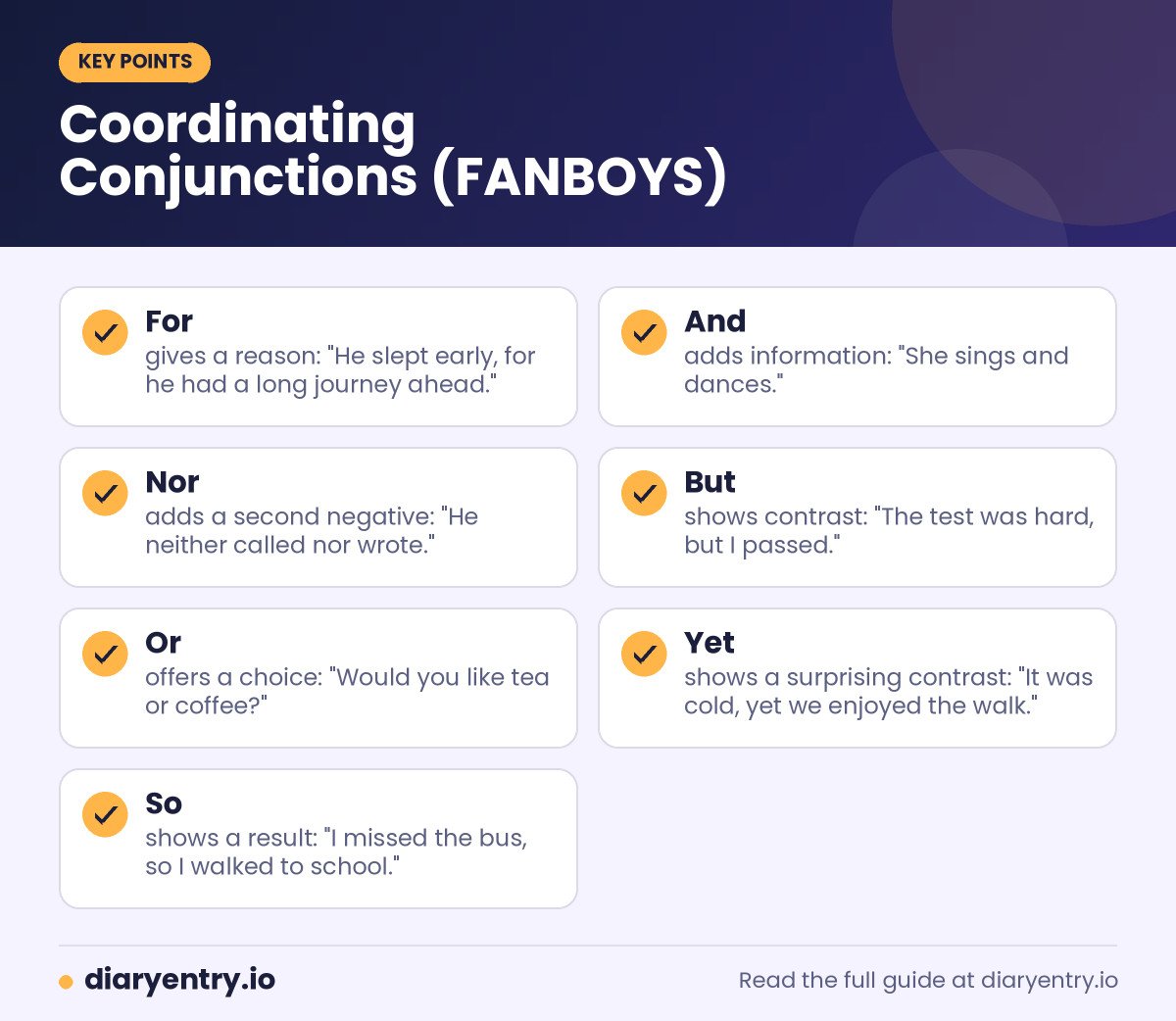
Coordinating conjunctions join elements of equal rank: two words, two phrases, or two independent clauses. There are only seven, and the memory trick FANBOYS covers them all.
- For gives a reason: “He slept early, for he had a long journey ahead.”
- And adds information: “She sings and dances.”
- Nor adds a second negative: “He neither called nor wrote.”
- But shows contrast: “The test was hard, but I passed.”
- Or offers a choice: “Would you like tea or coffee?”
- Yet shows a surprising contrast: “It was cold, yet we enjoyed the walk.”
- So shows a result: “I missed the bus, so I walked to school.”
When a coordinating conjunction joins two independent clauses, place a comma before it. When it joins only two words or two short phrases, no comma is needed. Compare: “I like tea, and she likes coffee” (two clauses, comma) with “I like tea and coffee” (two nouns, no comma).
Subordinating Conjunctions
Subordinating conjunctions introduce a dependent (subordinate) clause and link it to a main clause. A dependent clause has a subject and a verb but cannot stand alone as a full sentence. Common subordinating conjunctions group by meaning:
- Time: when, while, before, after, until, since, as soon as
- Reason: because, since, as
- Contrast: although, though, even though, whereas, while
- Condition: if, unless, provided that, as long as
- Purpose: so that, in order that
- Place: where, wherever
The comma rule here depends on word order. When the dependent clause comes first, add a comma after it: “Although it was raining, we played outside.” When the main clause comes first, you usually need no comma: “We played outside although it was raining.” How clauses combine also decides whether a sentence is simple, compound or complex, as explained in our guide to the types of sentences.
Correlative Conjunctions
Correlative conjunctions are pairs that work together to join equal elements. The common pairs are:
- either…or: “You can either stay here or come with us.”
- neither…nor: “Neither the teacher nor the students noticed the noise.”
- both…and: “She is both clever and kind.”
- not only…but also: “He not only wrote the report but also presented it.”
- whether…or: “I don’t know whether to laugh or cry.”
- as…as: “She runs as fast as her brother.” The same pattern is explained in degrees of comparison.
The key rule is parallel structure. The words that follow each half of the pair must have the same grammatical form. “She likes both swimming and to cycle” is faulty. “She likes both swimming and cycling” is correct.
Conjunctive Adverbs
Words such as however, therefore, moreover, otherwise, consequently, and meanwhile are conjunctive adverbs. They connect two independent clauses and show the logical link between them, but they need stronger punctuation than FANBOYS words. Use a semicolon before them and a comma after them: “The match was cancelled; however, the tickets remain valid.”
Types of Conjunctions at a Glance
| Type | What it joins | Examples | Sample sentence |
|---|---|---|---|
| Coordinating | Equal elements (words, phrases, independent clauses) | for, and, nor, but, or, yet, so | I was tired, but I kept working. |
| Subordinating | A dependent clause to a main clause | because, although, when, if, unless | We stayed in because it was raining. |
| Correlative | Equal elements, using a pair | either…or, neither…nor, both…and | Both Maya and Ravi passed the test. |
| Conjunctive adverb | Two independent clauses, with a semicolon | however, therefore, moreover | It rained; therefore, the match was delayed. |
How to Use Conjunctions Correctly: Step by Step
Follow these steps whenever you need to join two ideas in a sentence.
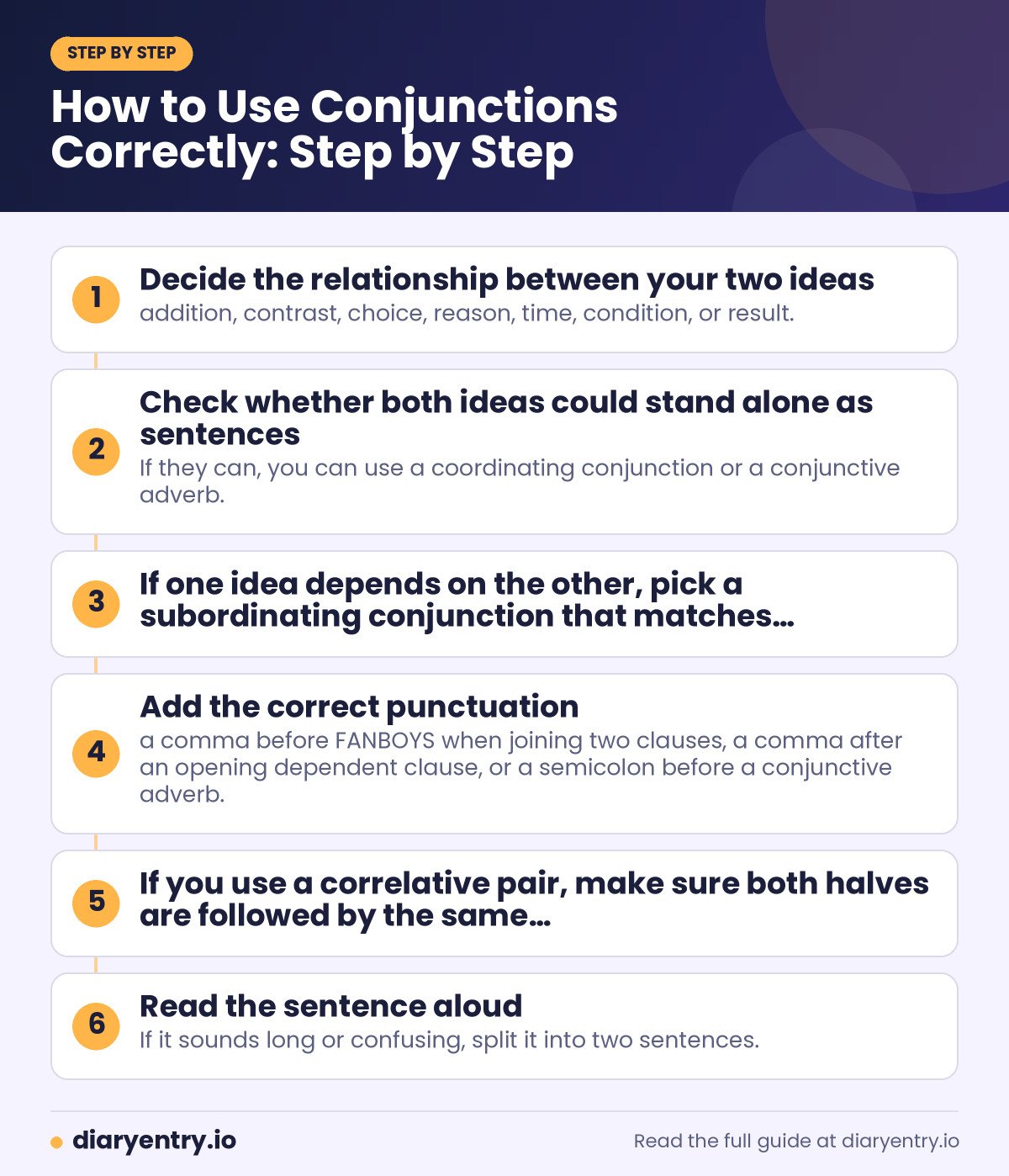
- Decide the relationship between your two ideas: addition, contrast, choice, reason, time, condition, or result.
- Check whether both ideas could stand alone as sentences. If they can, you can use a coordinating conjunction or a conjunctive adverb.
- If one idea depends on the other, pick a subordinating conjunction that matches the relationship, such as because for reason or although for contrast.
- Add the correct punctuation: a comma before FANBOYS when joining two clauses, a comma after an opening dependent clause, or a semicolon before a conjunctive adverb.
- If you use a correlative pair, make sure both halves are followed by the same grammatical form.
- Read the sentence aloud. If it sounds long or confusing, split it into two sentences.
Important Rules for Conjunctions
Can You Start a Sentence With a Conjunction?
Yes. The old rule that you must never begin a sentence with “and” or “but” is a myth. Careful writers do it for emphasis and rhythm. Use it sparingly, and make sure the sentence is complete. In formal exam answers, prefer a stronger connector such as however or in addition.
Avoid Using Two Conjunctions for One Job
A common error is stacking connectors that mean the same thing. “Although it was cold, but we went out” is wrong. Choose one: “Although it was cold, we went out” or “It was cold, but we went out.”
Keep Verb Agreement With Paired Subjects
With “either…or” and “neither…nor”, the verb agrees with the subject closest to it. “Neither the students nor the teacher is late” uses a singular verb because “teacher” is nearer. “Neither the teacher nor the students are late” uses a plural verb for the same reason. With “both…and”, the subject is always plural. The full set of rules is in our guide to subject verb agreement.
Match Tense Across Joined Clauses
Conjunctions often join clauses with different verbs, so tense consistency matters. If you are unsure how tenses work together, review our tenses chart with rules and examples, then apply the same logic across the clauses you join.
Conjunctions vs Prepositions
Some words, such as before, after, since, until, and as, can be either conjunctions or prepositions. The difference is what follows them. A conjunction introduces a clause with its own subject and verb. A preposition is followed by a noun or pronoun.
| Word | As a conjunction | As a preposition |
|---|---|---|
| before | Call me before you leave. | Call me before lunch. |
| after | We left after the bell rang. | We left after the lesson. |
| since | I have been here since you arrived. | I have been here since Monday. |
| until | Wait until she finishes. | Wait until noon. |
For a full look at the other group, see our guide to prepositions with definitions, types and examples.
Common Mistakes With Conjunctions
Comma splices. Joining two independent clauses with only a comma is an error: “I was tired, I kept working.” Fix it with a conjunction (“I was tired, but I kept working”), a semicolon, or a full stop.
Sentence fragments. A dependent clause alone is not a sentence: “Because I was late.” Attach it to a main clause: “I apologised because I was late.”
Faulty parallelism. “He is not only smart but also works hard” mixes an adjective with a verb phrase. Write “He not only is smart but also works hard”, or better, “He is not only smart but also hardworking.”
Confusing “because” with “so”. “Because” introduces the reason; “so” introduces the result. “I was hungry, so I ate” and “I ate because I was hungry” say the same thing in opposite orders.
Overusing “and”. A paragraph in which every sentence is joined with “and” feels flat. Vary your connectors with because, although, while, and however.
Solved Examples
Identify the conjunction and its type in each sentence.
| Sentence | Conjunction | Type |
|---|---|---|
| She wanted to play, but she had homework. | but | Coordinating |
| Unless you hurry, you will miss the train. | unless | Subordinating |
| Neither the pen nor the pencil worked. | neither…nor | Correlative |
| He was ill; therefore, he stayed home. | therefore | Conjunctive adverb |
| I will wait until you return. | until | Subordinating |
Practice: Fill in the Blank
Choose the best conjunction for each blank: although, because, or, so, both.
- I took an umbrella ______ the sky looked dark.
- ______ he was tired, he finished the race.
- Do you want rice ______ noodles?
- The shop was closed, ______ we went home.
- She is ______ a singer and a painter.
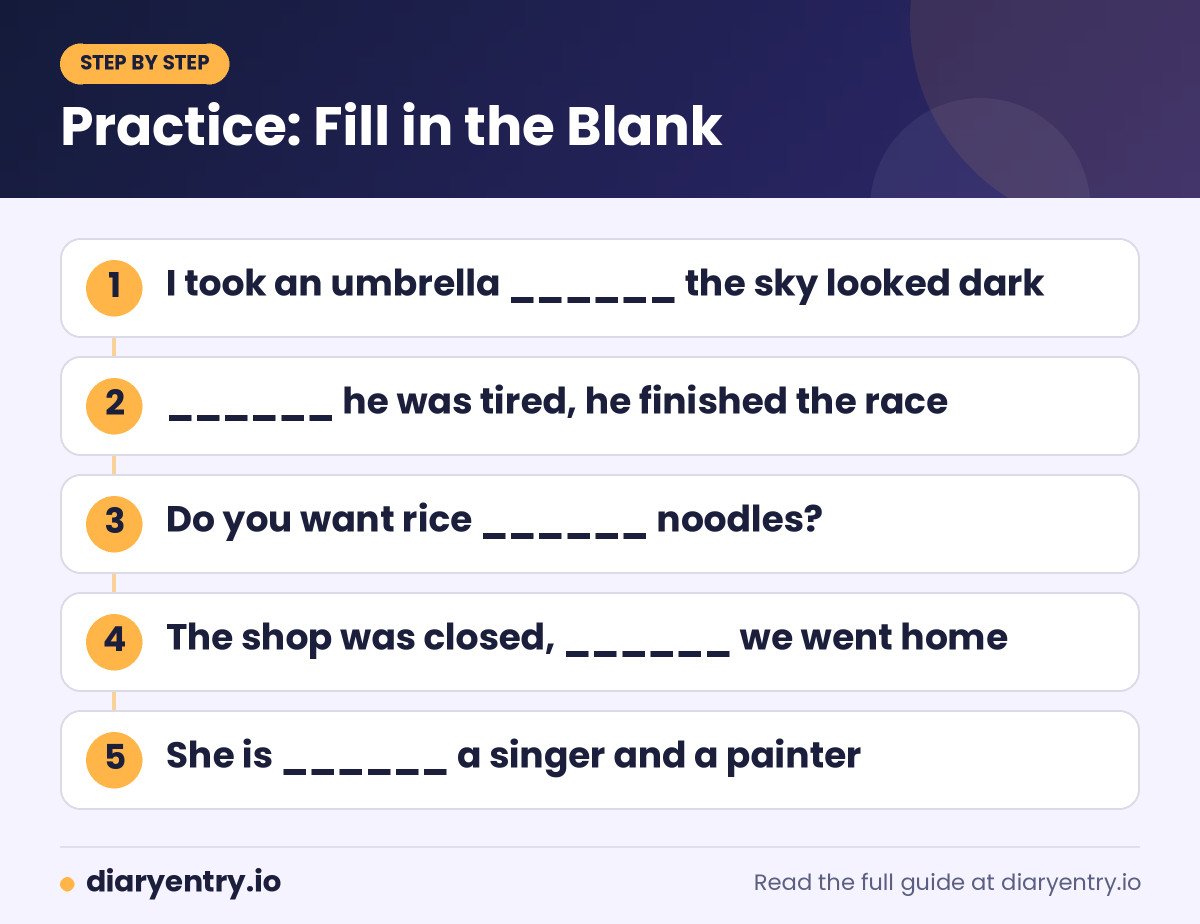
Answers: 1. because; 2. Although; 3. or; 4. so; 5. both.
Practice: Combine the Sentences
Join each pair using the conjunction in brackets.
- It was raining. We played football. (although)
- Meera studied hard. She topped the class. (so)
- You can walk. You can take a taxi. (either…or)
Sample answers: 1. We played football although it was raining. 2. Meera studied hard, so she topped the class. 3. You can either walk or take a taxi.
Using Conjunctions in Everyday Writing
Conjunctions are most useful when you are writing about real events. In a diary, they help you explain why something happened and how you felt: “I felt nervous before the presentation, but it went better than I expected because I had practised twice.” If you keep a journal, our guide on how to write a diary entry shows how connected sentences make entries easier to read and more reflective.
They matter just as much in formal writing. A letter or application needs clear logic, and connectors such as therefore, however, and as a result make that logic visible. See our formal letter format guide for samples where these linking words do real work.
The same applies to paragraph writing. A strong paragraph moves from a topic sentence to supporting points, and conjunctions carry the reader between them. Our paragraph writing format guide explains that structure in more detail.
Tips to Master Conjunctions
- Learn FANBOYS first. Seven words cover most everyday sentence joining.
- Group subordinators by meaning. Memorise them as time, reason, contrast, and condition lists rather than one long list.
- Read with a pencil. Circle every conjunction in a news article and name its type.
- Rewrite your own sentences. Take three short sentences from something you wrote and combine them in two different ways.
- Write daily. A few lines a day gives you real practice. The 4-Week Diary Entry Course is built around that habit, and it is a natural place to practise sentence variety.
Frequently Asked Questions About Conjunctions
What are conjunctions in simple words?
Conjunctions are joining words. They connect words, phrases, or clauses, such as “and”, “but”, “because”, and “or”, so that sentences make sense together.
How many types of conjunctions are there?
There are three main types: coordinating, subordinating, and correlative. Many teachers also teach conjunctive adverbs, such as however and therefore, as a fourth group.
What does FANBOYS stand for?
FANBOYS is a memory aid for the seven coordinating conjunctions: for, and, nor, but, or, yet, and so.
Do I need a comma before a conjunction?
Put a comma before a coordinating conjunction when it joins two independent clauses. Do not use one when it joins just two words or phrases. For subordinating conjunctions, use a comma only when the dependent clause comes first.
Can a sentence begin with a conjunction?
Yes, it can. Starting with “but” or “and” is acceptable in modern English when used deliberately, though formal exam writing usually prefers words like however or moreover.
What is the difference between a conjunction and a preposition?
A conjunction introduces a clause with a subject and verb, while a preposition is followed by a noun or pronoun. Words like “before” and “after” can be either, depending on what follows.
What is a correlative conjunction example?
“Either…or” in “You can either read or write” is one. Other pairs include neither…nor, both…and, and not only…but also.
Conclusion
Conjunctions are the glue of English sentences. Once you know the three main types, the FANBOYS list, and the basic comma rules, you can join ideas clearly and avoid fragments and comma splices. Practise by combining short sentences, reading with an eye for connectors, and writing a little every day. If you want a steady routine to build that habit, the 4-Week Diary Entry Course is a gentle place to start.