
Quick Answer
Modals in English grammar are helping verbs such as can, could, may, might, shall, should, will, would and must. They sit before a main verb and add meaning like ability, permission, possibility, advice, obligation or prediction. A modal never changes form and is always followed by the base form of a verb.
Key Takeaways
- Modals are helping verbs that express ability, permission, possibility, advice, obligation and certainty.
- The nine core modals are can, could, may, might, shall, should, will, would and must.
- A modal is always followed by the base verb, so we say “she can swim”, never “she can swims” or “she can to swim”.
- Modals have no -s, -ing or -ed forms, and they form questions and negatives without do, does or did.
- Modal + have + past participle talks about the past, for example “he must have left”.
What Are Modals in English Grammar?
Modals, also called modal verbs or modal auxiliary verbs, are a small group of helping verbs. They do not describe an action by themselves. Instead, they tell us how the speaker sees the action: whether it is possible, allowed, required, advisable or certain.
Compare “She plays the piano” with “She can play the piano”. The first sentence states a fact. The second sentence tells us about her ability. The main verb “play” has stayed the same, and the modal has added the extra layer of meaning.
If you are still getting comfortable with the building blocks of a sentence, our guide to parts of speech explains where verbs, auxiliaries and other word classes fit.
The Main Modal Verbs List
English has nine core modal verbs. Learn them as a set, because they all follow the same grammar rules.
| Modal | Main meanings | Example |
|---|---|---|
| can | ability, permission, possibility | I can speak three languages. |
| could | past ability, polite request, weak possibility | Could you open the window? |
| may | permission, possibility | You may leave early today. |
| might | weak possibility | It might rain this evening. |
| shall | offers, suggestions, formal promises | Shall we begin? |
| should | advice, expectation | You should drink more water. |
| will | future, willingness, promise | I will call you tomorrow. |
| would | polite request, habit in the past, imagined situations | He would walk to school every day. |
| must | strong obligation, logical certainty | You must wear a seatbelt. |
Semi-modal verbs
Some verbs behave partly like modals. They are called semi-modals or marginal modals. The common ones are ought to, have to, need to, used to, had better and dare. Unlike the core modals, most of them change form: “she has to leave” uses “has” in the third person, and “he needed to leave” shows the past.
The Five Golden Rules for Using Modals
Almost every modal mistake comes from breaking one of these rules. Keep them in mind and your sentences will stay accurate.
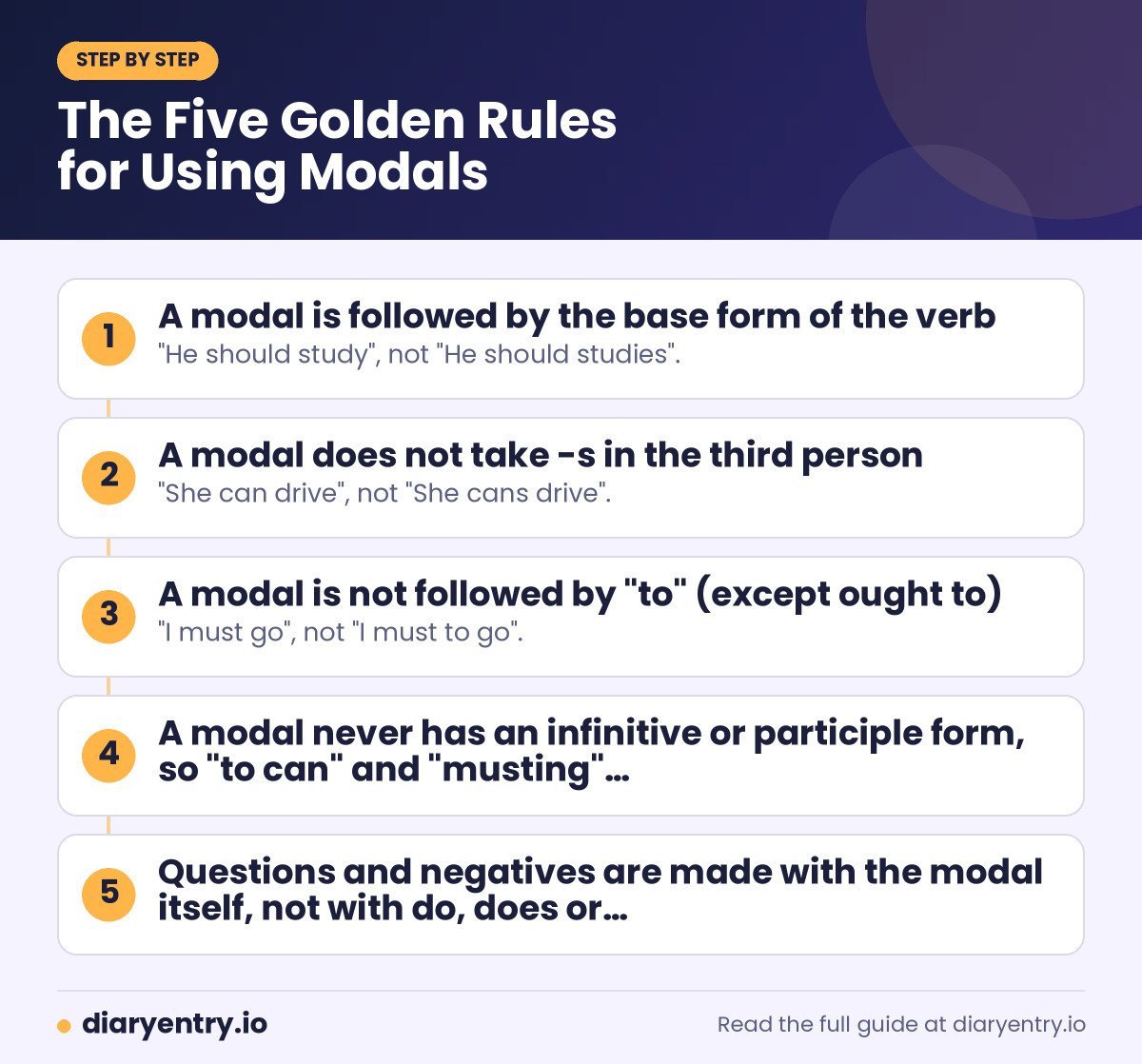
- A modal is followed by the base form of the verb: “He should study”, not “He should studies”.
- A modal does not take -s in the third person: “She can drive”, not “She cans drive”.
- A modal is not followed by “to” (except ought to): “I must go”, not “I must to go”.
- A modal never has an infinitive or participle form, so “to can” and “musting” do not exist.
- Questions and negatives are made with the modal itself, not with do, does or did: “Can you swim?” and “You cannot swim”.
Questions and negatives with modals
To make a question, move the modal before the subject: “You can come” becomes “Can you come?”. To make a negative, add “not” after the modal: “You should not worry”. Short forms are common in speech: can’t, couldn’t, won’t, wouldn’t, shouldn’t, mustn’t, mightn’t.
This same pattern is what makes question tags work. In “You can swim, can’t you?” the modal is repeated in the tag. Our page on question tags covers this in more detail.
Uses of Modal Verbs With Examples
A single modal can have several meanings, and context decides which one is correct. Here are the main functions, with examples you can reuse in your own writing.
1. Ability
Use can for present ability and could for past ability.
- She can solve these puzzles in minutes.
- When I was ten, I could run for an hour without stopping.
To talk about one specific success in the past, English prefers “was able to”: “After three tries, he was able to fix the bike.”
2. Permission
Can, could and may all ask for or give permission. May is the most formal, and can is the most casual.
- Can I borrow your pen?
- Could I leave a little early today?
- May I come in, please?
- You may use a dictionary during the test.
3. Possibility and probability
Use may, might and could for things that are possible but not certain. Might usually sounds a little less certain than may.
- It may snow tonight.
- She might be at the library.
- That could be the answer.
4. Advice and recommendation
Should and ought to give advice. Had better gives stronger advice with a hint of warning.
- You should revise before the exam.
- You ought to see a doctor about that cough.
- You had better leave now, or you will miss the train.
5. Obligation and necessity
Must expresses strong obligation that often comes from the speaker. Have to usually shows an external rule.
- I must finish this report tonight.
- Students have to wear a uniform.
6. Prohibition
Must not and cannot show that something is forbidden. Note that “must not” means “do not”, while “do not have to” means “it is not necessary”.
- You must not touch the wires.
- Visitors cannot park here.
7. Requests, offers and suggestions
Will, would, could and shall are common in polite speech.
- Would you mind closing the door?
- Shall I carry that bag for you?
- Shall we try a different route?
8. Predictions and promises
Will is the standard modal for predictions and promises about the future. You can read more about future forms in our tenses chart.
- I will always remember this day.
- Tomorrow will be sunnier than today.
9. Habits and repeated actions in the past
Would and used to describe past habits that no longer happen.
- Every summer, we would visit my grandparents.
- She used to write in a diary every night.
Modals in the Past: Modal + Have + Past Participle
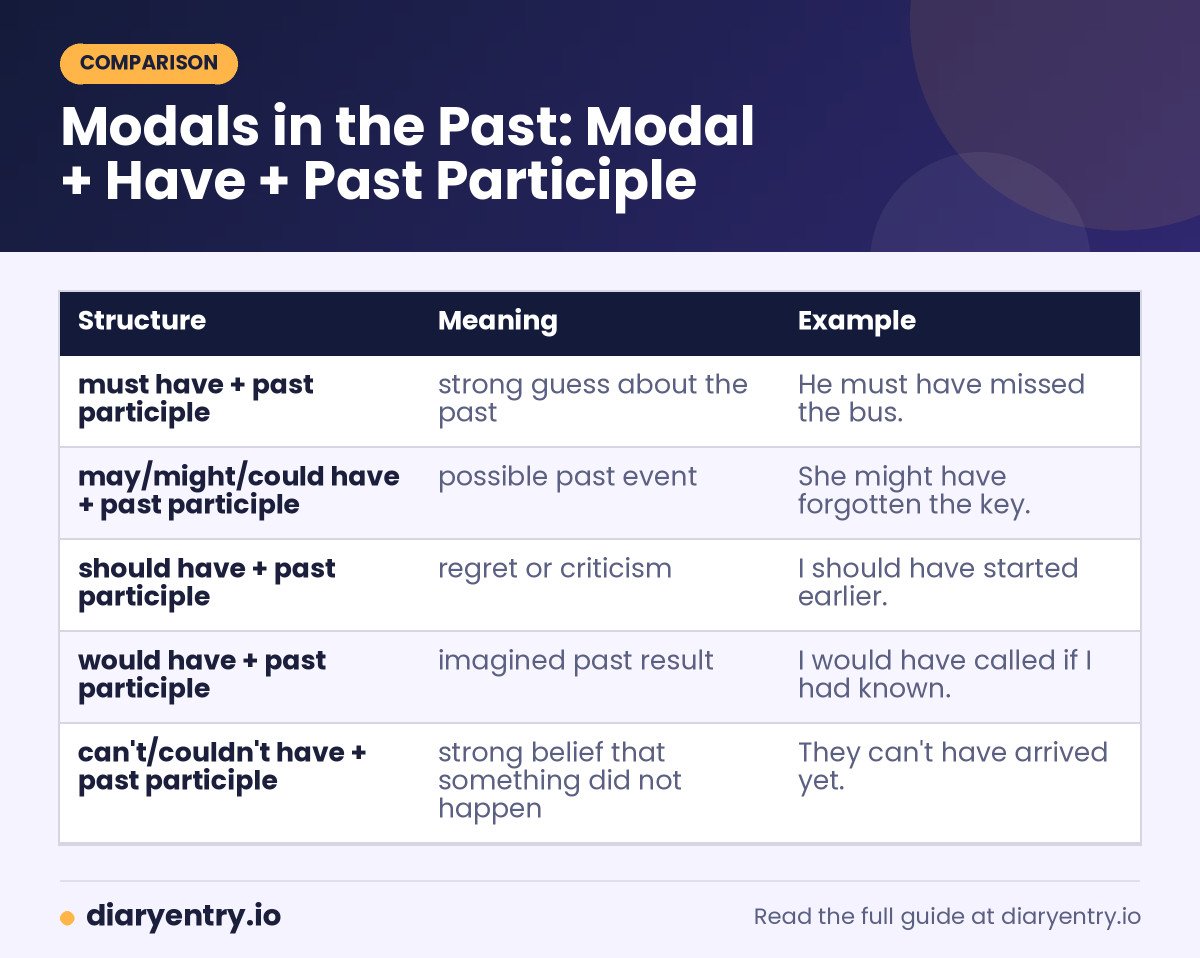
When we look back at the past, we use modal + have + past participle. These perfect modals cover guesses, regrets and imagined results.
| Structure | Meaning | Example |
|---|---|---|
| must have + past participle | strong guess about the past | He must have missed the bus. |
| may/might/could have + past participle | possible past event | She might have forgotten the key. |
| should have + past participle | regret or criticism | I should have started earlier. |
| would have + past participle | imagined past result | I would have called if I had known. |
| can’t/couldn’t have + past participle | strong belief that something did not happen | They can’t have arrived yet. |
These forms often appear in “if” sentences about the past. If you want to see how they fit together, read our guide to conditional sentences.
Modals in Passive Voice
Modals fit easily into passive sentences. The pattern is modal + be + past participle.
- The homework must be submitted by Friday.
- The results will be announced tomorrow.
- This problem could have been avoided.
If passive sentences are new to you, the active and passive voice rules page shows how to convert sentences step by step.
Modals in Reported Speech
When we report what someone said, some modals shift to a past form.
| Direct speech | Reported speech |
|---|---|
| “I will help you.” | She said she would help me. |
| “I can swim.” | He said he could swim. |
| “It may rain.” | They said it might rain. |
| “You must finish today.” | She said I had to finish that day. |
Modals that are already in a past form, such as could, would, should, might and ought to, usually stay the same. Our page on direct and indirect speech rules gives the full chart.
Modals and Subject-Verb Agreement
Because modals never change with the subject, they make subject-verb agreement simpler. “He can”, “they can” and “the teachers can” all use the same modal. The only agreement issue appears in the semi-modals: “she has to”, “they have to”. The rules for the main verb are explained in subject verb agreement.
Can vs Could vs May vs Might
These four are the most confused. A quick comparison helps.
| Pair | Key difference | Example |
|---|---|---|
| can vs may | can is casual, may is formal | Can I sit here? / May I sit here? |
| can vs could | could is more polite and also past | Could you help me? |
| may vs might | might is less certain | It may rain. / It might rain. |
| must vs have to | must comes from the speaker, have to from a rule | I must call her. / I have to wear a helmet. |
| should vs must | should is advice, must is stronger | You should rest. / You must rest. |
Common Mistakes With Modals
Even advanced learners slip on these. Check your own writing for them.
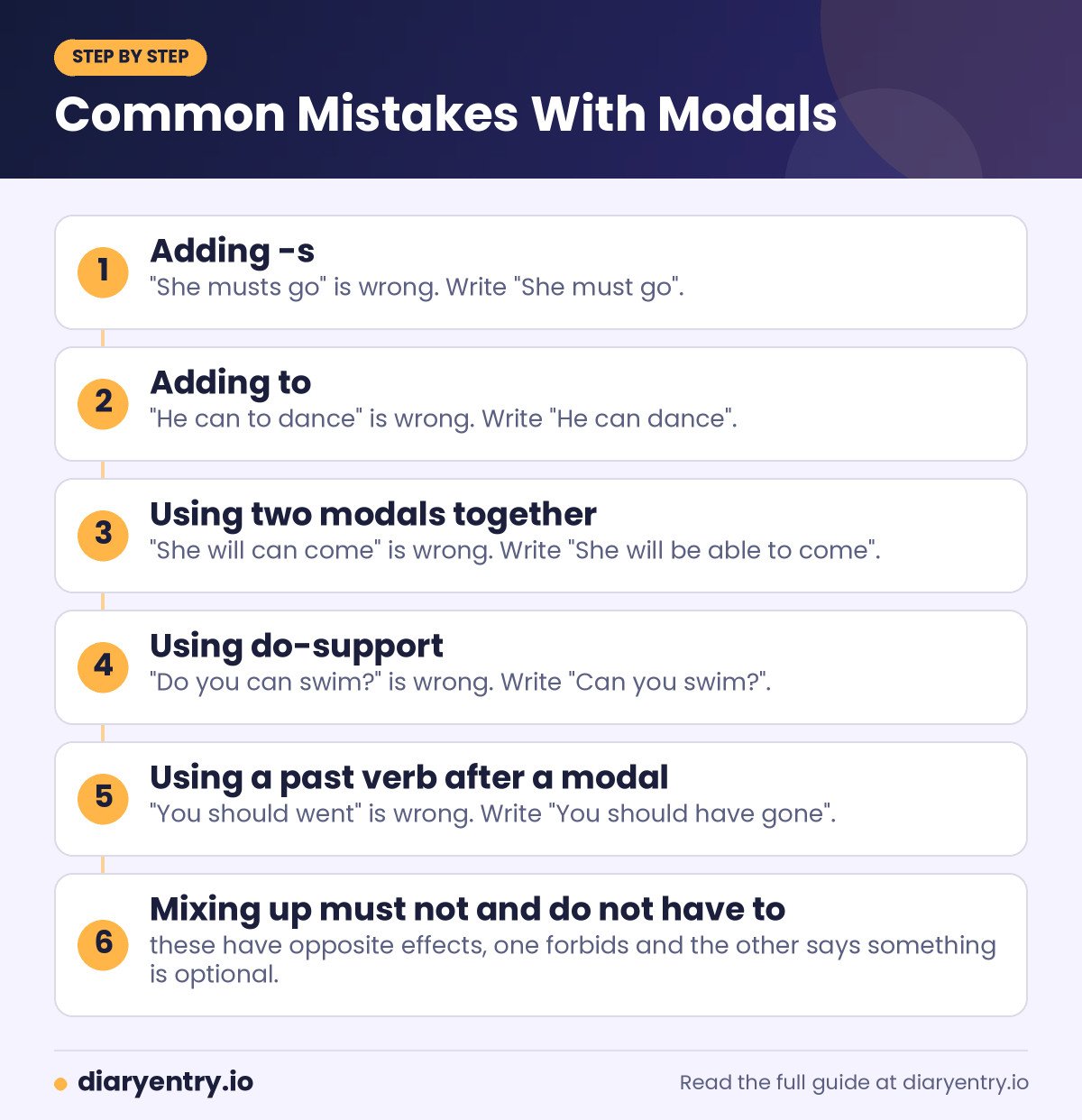
- Adding -s: “She musts go” is wrong. Write “She must go”.
- Adding to: “He can to dance” is wrong. Write “He can dance”.
- Using two modals together: “She will can come” is wrong. Write “She will be able to come”.
- Using do-support: “Do you can swim?” is wrong. Write “Can you swim?”.
- Using a past verb after a modal: “You should went” is wrong. Write “You should have gone”.
- Mixing up must not and do not have to: these have opposite effects, one forbids and the other says something is optional.
Practice: Choose the Right Modal
Try these sentences before checking the answers underneath.
- You ___ stop at a red light. (obligation)
- ___ I use your phone? (polite permission)
- She ___ be at home; her lights are on. (logical guess)
- We ___ have booked earlier. (regret)
- He ___ speak four languages when he was twelve. (past ability)
Answers: 1 must, 2 May or Could, 3 must, 4 should, 5 could.
How to Learn Modals Faster
Reading rules is a start, but modals become natural when you use them in your own sentences. A simple habit works well: write three short sentences each day that use a different modal. A daily diary page is perfect for this, because you can describe plans with will, regrets with should have, and guesses with might.
If you would like structure and feedback, the 4-Week Diary Entry Course builds a steady writing habit, and regular writing is one of the best ways to make grammar stick. It will not replace a grammar textbook, but it gives you real practice.
Frequently Asked Questions About Modals
How many modal verbs are there in English?
There are nine core modal verbs: can, could, may, might, shall, should, will, would and must. Ought to and need are often added as semi-modals.
Can a sentence have two modals?
In standard English, no. You cannot say “will can”. Use a substitute such as “will be able to” instead.
What is the difference between can and may?
Both can ask for permission. Can is more casual and also expresses ability, while may is more formal and also expresses possibility.
Is “should” stronger than “must”?
No. Should gives advice or says what is expected, while must expresses strong obligation or a firm conclusion.
Do modals have a past tense?
Not in the usual sense. Could, would, might and should started as past forms but are now used for present and future meanings too. To talk about the past, use modal + have + past participle.
Why is there no -s after he, she or it with a modal?
Modals come from an older group of verbs that lost their endings. Today they simply stay the same for every subject.
Are modals the same as auxiliary verbs?
Modals are one kind of auxiliary verb. Other auxiliaries, such as be, do and have, change form and can also work as main verbs.
Conclusion
Modals in English grammar may be a small family of words, but they carry a great deal of meaning. Remember the golden rules: base verb after the modal, no -s, no to, and no do-support. Practise the main functions of ability, permission, possibility, advice and obligation, and the confusing pairs will soon feel easy. Choose one modal today and use it in three sentences of your own.