

Quick Answer
Debate writing format is the fixed structure used to present a written argument for or against a motion: a title, a salutation, an opening that states your stance, a body of two or three supported points, a rebuttal, and a closing appeal. In school exams it is usually 120 to 150 words.
Key Takeaways
- A written debate always starts with the motion and a clear stance, either “for” or “against”.
- The standard parts are the heading, salutation, opening, body arguments, rebuttal, conclusion and a courteous close.
- Each argument needs a reason plus an example, fact or observation, not just an opinion.
- Anticipating and answering the opposing side makes the piece more convincing.
- Staying within the word limit and a formal, respectful tone matters as much as content.
What Is Debate Writing?
Debate writing is a formal writing task in which you present your view on a controversial or discussable topic, called the motion. You are asked to argue either in favour of it or against it. Unlike a casual opinion post, a written debate follows a set structure and relies on logic, evidence and a respectful tone.
In board-style English papers, debate writing appears in the writing section for senior classes. You are typically given a motion such as “Mobile phones should be banned in schools” and about 150 words to write a speech-like piece that persuades the reader. Examiners look at format, content, fluency and accuracy.
If you have already practised the speech writing format, you will find debate writing familiar. Both are written for an audience, but a debate piece must also acknowledge the opposite view and answer it.
Debate Writing vs Speech Writing vs Essay
Students often mix these three tasks up. The table below shows how they differ.
| Feature | Debate writing | Speech writing | Essay |
|---|---|---|---|
| Purpose | Persuade by arguing for or against a motion | Inform or inspire a live audience | Explain or argue a topic in depth |
| Opening | “Respected chairperson, judges and fellow debaters” | “Good morning everyone” | Introduction paragraph |
| Stance | Always one clear side | Can be neutral or inspirational | Can be neutral |
| Rebuttal | Required | Not required | Optional |
| Typical length | 120-150 words | 150-200 words | 250-500 words |

Debate Writing Format Step by Step
The debate writing format is easiest to learn as a checklist. Follow these steps in order and you will rarely miss a mark.
- Read the motion and decide your side before you write a single line.
- Write the title: “Debate: [motion]” or just the motion in capitals.
- Add the salutation addressing the chairperson, judges and audience.
- Open with a one or two sentence statement of your stance.
- Present two or three arguments, each in its own short paragraph.
- Add a rebuttal that answers the strongest point of the other side.
- Close with a summary and a clear appeal, then thank the audience.

Step 1: Understand the Motion
Underline the keywords in the motion. A motion like “Homework should be abolished” is about all homework, not just excess homework, so your argument must cover the whole idea. Misreading the motion is the most common reason students lose marks.
Step 2: Choose a Side You Can Defend
You do not have to believe the side you argue, but you must be able to support it with at least three reasons. Spend a minute listing reasons for both sides, then pick the side with the stronger, easier-to-illustrate points.
Step 3: Write the Heading and Salutation
The heading states the motion. The salutation is formal. A standard version is: “Respected Chairperson, honourable judges, my worthy opponents and dear friends.”
Step 4: Write a Strong Opening
The opening should state your stance in the first two sentences and, if possible, hook the listener. You can use a short question, a surprising fact you are sure of, or a bold statement. Avoid long background paragraphs, because you only have about 150 words.
Step 5: Build the Body Arguments
Each argument should follow a simple pattern: claim, reason, example. For instance, “Mobile phones distract students (claim). A buzzing notification breaks concentration in the middle of a lesson (reason). Many teachers see students checking messages under the desk (example).”
Step 6: Add a Rebuttal
A rebuttal is a short paragraph where you name an opposing point and explain why it is weak or incomplete. Use phrases such as “My opponents argue that… however…”. This shows you have thought about both sides.
Step 7: Conclude with an Appeal
Restate your stance in fresh words and end with a call to the audience, such as asking them to support the motion. Finish with “Thank you.”
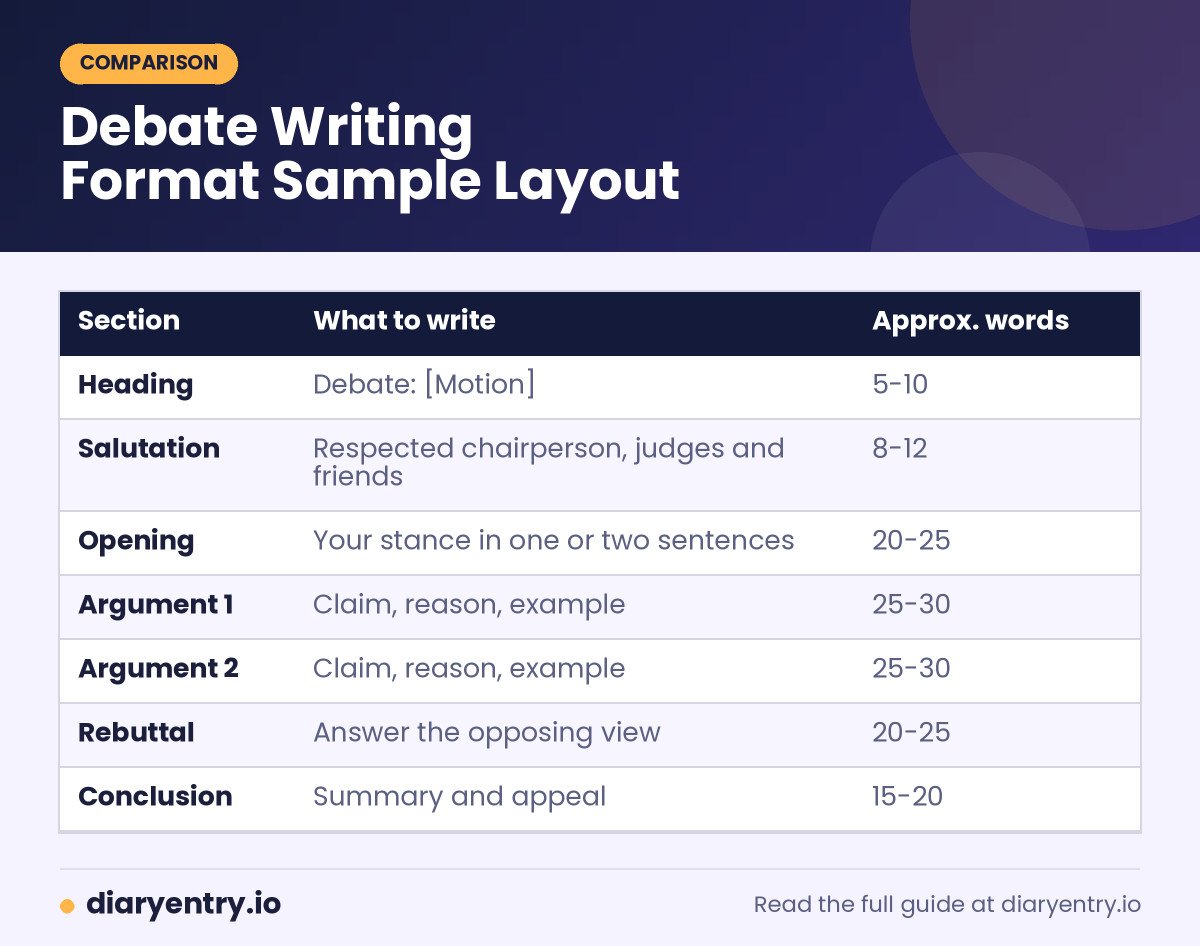
Debate Writing Format Sample Layout
Use this layout as a template. Replace the brackets with your own content.
| Section | What to write | Approx. words |
|---|---|---|
| Heading | Debate: [Motion] | 5-10 |
| Salutation | Respected chairperson, judges and friends | 8-12 |
| Opening | Your stance in one or two sentences | 20-25 |
| Argument 1 | Claim, reason, example | 25-30 |
| Argument 2 | Claim, reason, example | 25-30 |
| Rebuttal | Answer the opposing view | 20-25 |
| Conclusion | Summary and appeal | 15-20 |
Debate Writing Examples
Sample 1: For the Motion
Motion: “Mobile phones should be allowed in schools.”
Respected chairperson, honourable judges and dear friends. I stand in favour of the motion that mobile phones should be allowed in schools. In today’s world, a phone is not only a gadget but a learning tool.
First, phones give instant access to dictionaries, encyclopaedias and educational apps. A student who does not understand a concept can clarify it in seconds. Second, phones help safety. A child stuck without transport can call a parent immediately.
My opponents say phones distract students. However, distraction comes from lack of rules, not from technology. A school that sets clear guidelines can enjoy the benefits without the problems. Therefore, I urge you to support the motion. Thank you.
Sample 2: Against the Motion
Motion: “Homework should be abolished.”
Respected chairperson, honourable judges and friends. I strongly oppose the motion that homework should be abolished. Homework builds habits that classrooms alone cannot.
First, homework gives students time to revise what they learned during the day. Without revision, concepts fade quickly. Second, it teaches responsibility and time management, skills every adult needs.
My opponents claim that homework causes stress. Yet the answer is better homework, not no homework. Short, meaningful tasks reduce stress while keeping learning alive. I therefore request you to reject the motion. Thank you.
Useful Phrases for Debate Writing
The right connectors make your arguments flow. Here are phrases grouped by purpose.
- To open: “I stand firmly in favour of…”, “I rise to oppose…”, “The motion before us today is…”
- To add a point: “Moreover…”, “In addition…”, “Furthermore…”
- To give evidence: “For instance…”, “Consider the case of…”, “Research suggests…” (only use this if you can name a real basis).
- To rebut: “My opponents argue that… but they overlook…”, “It is true that… however…”
- To conclude: “In conclusion…”, “To sum up…”, “I urge the house to…”
Common Debate Topics for Practice
Practising with varied topics builds speed. Try the following motions and write a 150-word piece for each side.
- Social media does more harm than good to teenagers.
- Online classes can replace classroom teaching.
- Competitive exams should be abolished.
- Uniforms should be compulsory in schools.
- Cities should ban private cars on weekdays.
- Students should be allowed to choose all of their subjects.
A good habit is to keep a short notebook where you jot one argument a day. Many students use a daily writing habit for this, and our guide on how to build a daily journaling habit shows how five minutes of writing a day improves fluency. You can also borrow ideas from the diary entry prompts for students to find fresh topics.
Common Mistakes to Avoid in Debate Writing
Even strong students lose marks to a few repeated errors. Check your draft against this list.
- Sitting on the fence: choose one side and stay with it throughout.
- Skipping the rebuttal: without it, the piece reads like a plain essay.
- Using emotional language instead of reasons: keep a firm but polite tone.
- Inventing statistics: use only facts you are sure of, or general observations.
- Exceeding the word limit: examiners mark the first part within the limit and may deduct marks for length.
- Forgetting the salutation or the closing “Thank you”.
Tips to Score Full Marks
Good structure earns the format marks, but the following habits raise the content and expression marks.
Plan in 60 Seconds
Write the motion, your side, and three keywords for your arguments in the margin. A short plan prevents rambling and keeps you within the word limit.
Keep Sentences Short and Clear
In a debate, clarity wins. Short sentences are easier to read and reduce grammar errors. Aim for an average of 12 to 15 words per sentence.
Use a Confident but Respectful Tone
Say “I firmly believe” rather than “I think maybe”. Avoid personal attacks on opponents. Attack the idea, never the person.
Revise in the Last Two Minutes
Check spellings, tenses and the word count. If you have time, add one relevant example to your strongest point. For more on structuring paragraphs inside your arguments, see our paragraph writing format guide.
How to Analyse a Sample Debate Piece
Reading a sample is useful only if you study how it works. Take the “against homework abolition” piece above and break it into parts. The first two sentences give the salutation and the stance. The next paragraph gives two arguments, each introduced with “First” and “Second” so the reader can follow the order easily. The third paragraph is the rebuttal, which begins with “My opponents claim” and ends with a counter-idea. The final lines give the appeal and thank the audience.
Notice also what the sample avoids. It has no long story, no list of statistics and no insults. Every sentence either states a position, gives a reason, or answers the opposite view. When you practise, try labelling each sentence of your own draft as stance, reason, example, rebuttal or appeal. If a sentence fits none of these labels, it is probably filler and can be cut to save words.
Adjusting the Format for Different Classes
For Class 9 and 10, a simple three-paragraph piece with one rebuttal line is usually enough. For Class 11 and 12, examiners expect sharper reasoning, a more formal vocabulary and a clearer rebuttal. For college or inter-school events, the same structure holds but you may add one or two extra arguments and a stronger opening hook.
Debate Writing in the Classroom and Beyond
Debate writing is more than an exam task. It trains you to organise your thoughts, listen to other views and communicate calmly under pressure. These are skills used in group discussions, interviews, essay writing and later in professional life.
Teachers often combine written debate with real classroom debates. Students first write their piece, then present it aloud, and finally respond to questions. This cycle helps shy students gain confidence because the written draft acts as a safety net. If you are preparing for an inter-school event, the sample in our notice writing for Class 12 guide even shows how a debate competition is announced.
Students who want to develop a regular practice can also try the diaryentry.io 4-Week Diary Entry Course, which builds daily writing fluency in small steps. Fluency in everyday writing carries over into formal tasks such as debates and speeches.
Frequently Asked Questions
What is the format of debate writing?
The format has a title with the motion, a salutation, an opening statement of stance, two or three supported arguments, a rebuttal, a conclusion and a closing thank-you. It is usually 120 to 150 words for school exams.
How many words should a debate writing be?
Most boards expect about 120 to 150 words. Check your syllabus or sample paper, because the exact limit can differ by class and board.
What is a rebuttal in debate writing?
A rebuttal is a short section where you mention an argument made by the opposing side and explain why it is weak, incomplete or wrong. It strengthens your own position.
Do I have to believe in the side I argue?
No. The task tests your ability to build a logical argument, not your personal belief. Choose the side you can support best with reasons and examples.
How is debate writing different from an essay?
A debate piece takes one clear side, addresses an audience directly, and includes a rebuttal. An essay may be neutral and is usually longer. You can compare it with our essay writing format guide.
Can I use statistics in a debate?
Yes, but only if you are sure they are accurate. If you are unsure, use general, verifiable observations instead of specific numbers.
How do I start a debate writing piece?
Begin with a formal salutation, then state your stance in one or two sentences. A short question or a strong statement works well as a hook.
Conclusion
Mastering the debate writing format comes down to a few repeatable habits: pick a side, support it with two or three reasoned points, answer the opposing view, and close with a confident appeal. Practise with a new motion every few days, keep within the word limit, and your debate writing will improve quickly. If you would like to build the daily writing habit that supports all of this, take a look at our 4-Week Diary Entry Course.