
Speech writing format is the fixed structure used to write a speech for an audience: a heading, a greeting, an opening hook, a body of two or three points, a closing and a thank-you. In Class 11 and 12 English papers, a speech question usually gives a topic, an occasion and an audience, and asks for an answer of about 120 to 150 words. This guide explains the format, a step-by-step method and four full samples.
Quick Answer: What Is the Speech Writing Format?
A speech is written to be spoken, so it combines the structure of a short essay with the rhythm of conversation. The standard speech writing format has six parts: a title or topic, a salutation that greets the audience, an introduction that introduces you and the subject, a body that develops the main points, a conclusion that sums up, and a closing line that thanks the listeners.
Word limits and marks differ between boards and years, so always follow the number given in your question and check your latest sample paper. The layout below suits almost every school speech question.
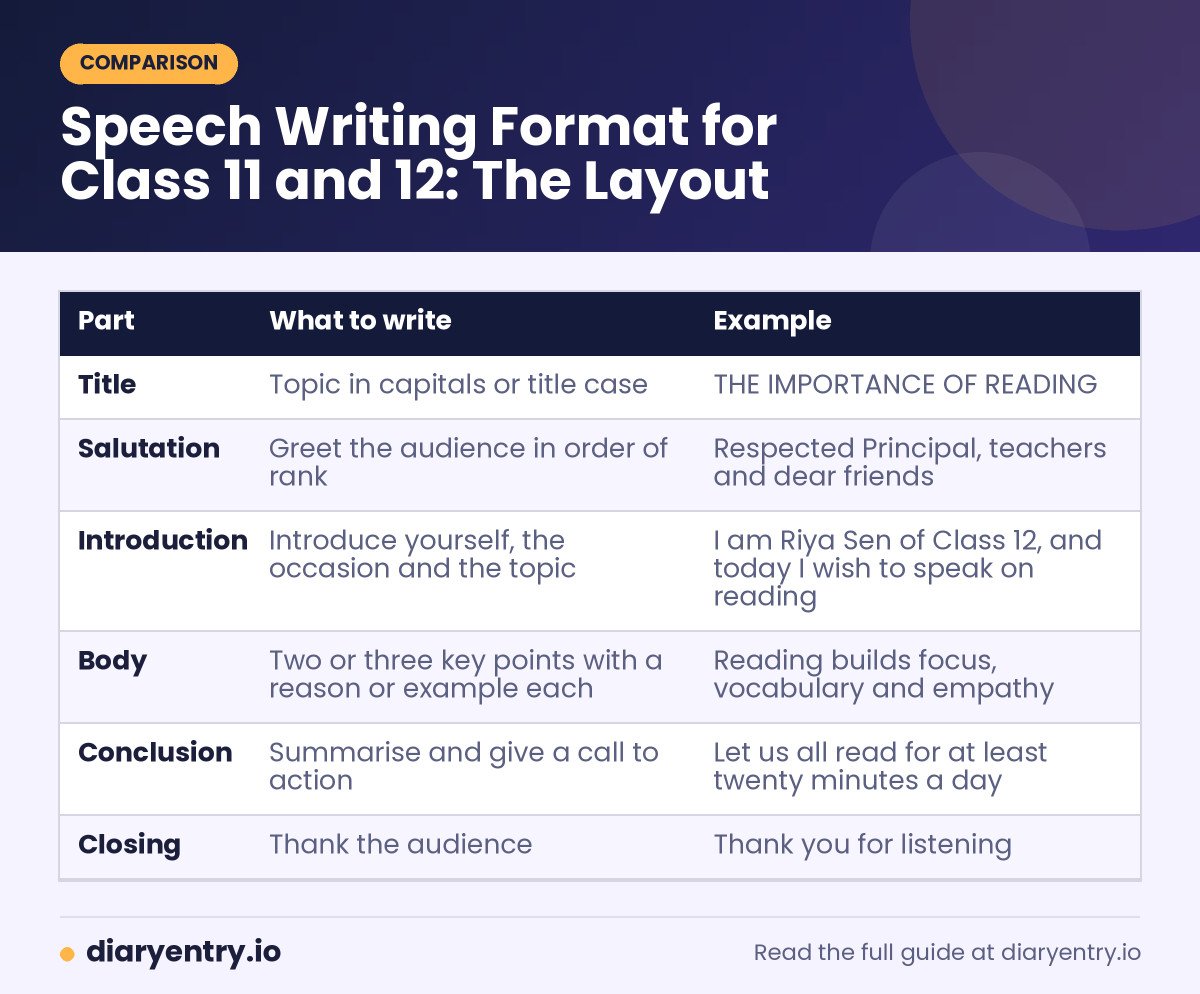
Speech Writing Format for Class 11 and 12: The Layout
Use this skeleton every time. Once you know the order, you can fill in any topic in a few minutes.
| Part | What to write | Example |
|---|---|---|
| Title | Topic in capitals or title case | THE IMPORTANCE OF READING |
| Salutation | Greet the audience in order of rank | Respected Principal, teachers and dear friends |
| Introduction | Introduce yourself, the occasion and the topic | I am Riya Sen of Class 12, and today I wish to speak on reading |
| Body | Two or three key points with a reason or example each | Reading builds focus, vocabulary and empathy |
| Conclusion | Summarise and give a call to action | Let us all read for at least twenty minutes a day |
| Closing | Thank the audience | Thank you for listening |
The title
Write a short title above the speech. It tells the examiner you understood the topic, and it takes only a few seconds. Do not add a date or an address, because a speech does not need them.
The salutation
Greet the audience in the correct order: the most senior person first. A school example is “Respected Principal, esteemed teachers and my dear friends”. At a public event you might say “Honourable guests, ladies and gentlemen”. Match the greeting to the audience given in the question.
The introduction
State who you are and why you are speaking. Then use a hook to catch attention, such as a question, a short fact you are sure of, a brief story or a bold statement. Avoid made-up statistics. A simple question such as “When did you last finish a book?” works well.
The body
The body carries your argument. Choose two or three points, each in its own short paragraph, and support each with a reason or an example. Use signpost phrases such as “First of all”, “Moreover” and “Finally” so listeners can follow you.
The conclusion and closing
Summarise the main idea in a sentence, give a call to action or a thought to remember, and finish with “Thank you”. Never add new points in the conclusion.
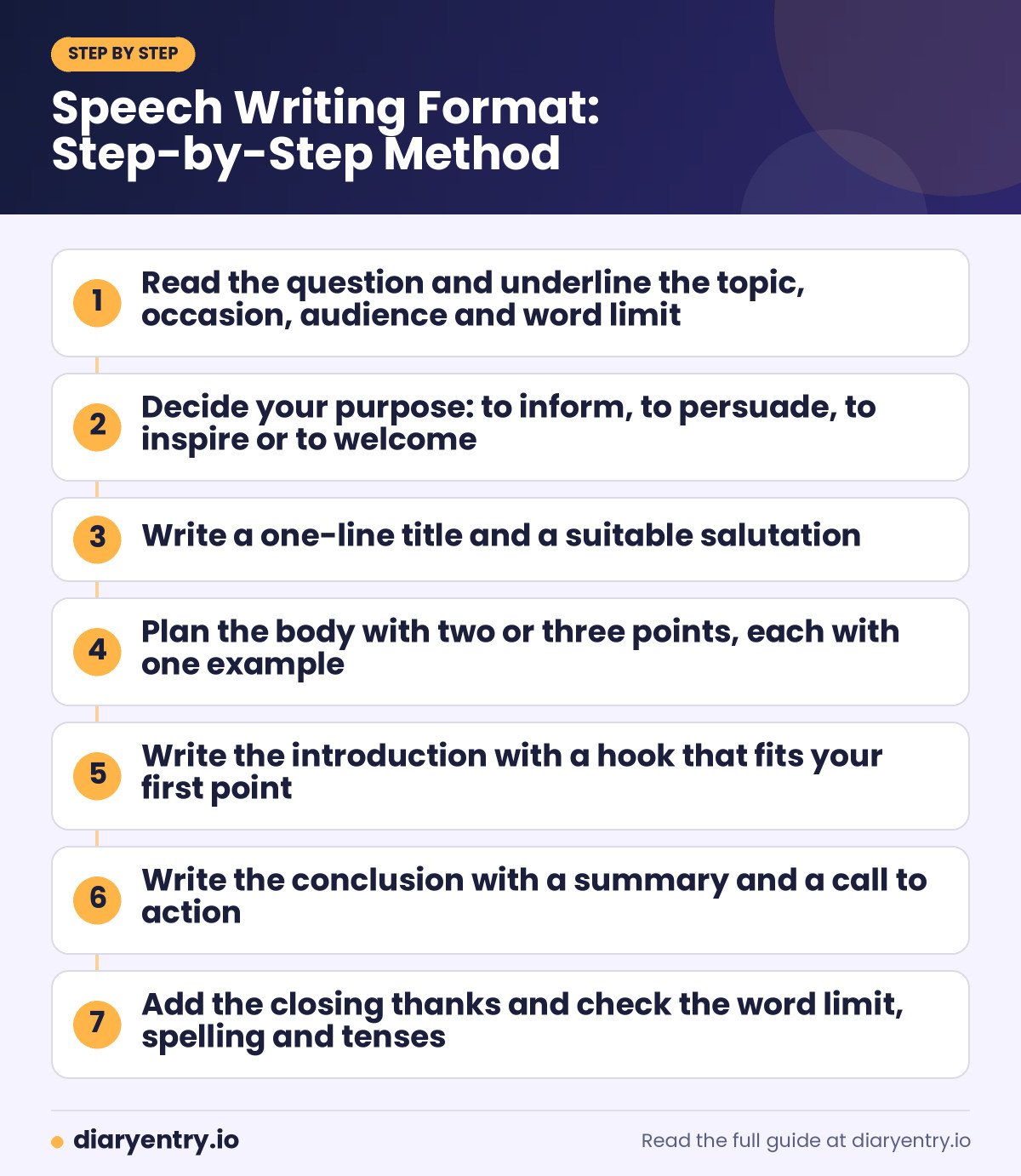
Speech Writing Format: Step-by-Step Method
A fixed method saves time in the exam and keeps your speech organised. Follow these steps.
- Read the question and underline the topic, occasion, audience and word limit.
- Decide your purpose: to inform, to persuade, to inspire or to welcome.
- Write a one-line title and a suitable salutation.
- Plan the body with two or three points, each with one example.
- Write the introduction with a hook that fits your first point.
- Write the conclusion with a summary and a call to action.
- Add the closing thanks and check the word limit, spelling and tenses.
Spend about two minutes planning and the rest writing. A planned speech sounds confident even when it is short. Short announcements follow a different layout, which you can see in our notice writing for Class 12 guide.
Types of Speeches You May Be Asked to Write
The format stays the same, but the tone and content change with the occasion. Practise at least one of each type.
Informative or awareness speech
An informative speech explains a topic, such as water conservation, road safety or digital habits. Use facts you are sure about, give clear examples and finish with practical advice.
Persuasive speech
A persuasive speech tries to change the audience’s mind or action. For example, you might urge classmates to reduce plastic use. State your opinion clearly, give reasons and end with a firm call to action.
Welcome and farewell speech
A welcome speech greets chief guests and parents at a school function. A farewell speech thanks teachers and juniors on the last day. Keep the tone warm and the language simple.
Debate speech
In a debate, you speak “for” or “against” a motion. Begin by stating your side, give two or three strong reasons and close by repeating your stand.
Inspirational or motivational speech
An inspirational speech encourages the audience to take up a challenge, such as working hard before exams or standing for honesty. Short stories and rhetorical questions suit this type.
Language Tips for a Strong Speech
Because a speech is heard and not read, the language should be clear and natural. These habits raise your marks.
- Use short, direct sentences that are easy to say aloud.
- Address the audience with “we”, “us” and “you” to make them feel included.
- Use rhetorical questions to keep listeners thinking.
- Repeat a key word or phrase for emphasis, but do not overdo it.
- Use a formal yet friendly tone, and avoid slang.
- Link ideas with simple connectors such as “therefore”, “in addition” and “above all”.
- Keep to the tense that suits the content, usually the present for general ideas.
Useful phrases
For openings, try “Good morning everyone, today I stand before you to speak on”, “I am honoured to address you” or “Imagine a world where”. For transitions, use “Let us now consider”, “Another important point is” and “Moving on”. For endings, use “To sum up”, “Let us pledge to” and “Thank you for your patient hearing”.
Sample 1: Speech on the Importance of Reading
Question: You are Riya Sen, school captain. Write a speech to be delivered in the morning assembly on the importance of reading habits among students. (Word limit: about 150 words)
THE IMPORTANCE OF READING
Respected Principal, esteemed teachers and my dear friends,
Good morning to everyone. I am Riya Sen of Class 12, and today I wish to speak on a habit that can change our lives: reading.
When did you last finish a book that was not part of your syllabus? Reading sharpens our focus, widens our vocabulary and helps us understand people who are different from us. A student who reads regularly writes better and speaks with more confidence.
Reading also gives us a calm break from screens. Twenty minutes with a good book can relax the mind better than an hour of scrolling.
Let us make a small promise today. Let us read for at least twenty minutes every day and visit our school library each week.
Thank you for listening.
Sample 2: Speech on Road Safety
Question: Write a speech to be given at a school function on the need for road safety. You are the head of the school’s safety club. (About 150 words)
ROAD SAFETY: A RESPONSIBILITY WE ALL SHARE
Respected Principal, honourable guests, teachers and dear students,
A very good afternoon to all of you. As the head of the safety club, I am grateful for the chance to speak on a matter that concerns every one of us.
Every day, many accidents happen because of speeding, careless driving and ignoring traffic rules. Most of them could have been avoided with a little patience.
First of all, always wear a helmet or a seat belt. Secondly, follow signals and never use a phone while driving or crossing the road. Finally, teach younger children to walk on the pavement and use zebra crossings.
Rules are not meant to limit us. They are meant to protect us. Let us pledge today to follow them, so that every journey ends safely.
Thank you.
Sample 3: Farewell Speech by a Student
Question: You are the head boy of Class 12. Write a farewell speech to be delivered on behalf of the outgoing batch. (About 150 words)
FAREWELL SPEECH
Respected Principal, dear teachers and my juniors,
Good morning. It is hard to believe that this is our last day in these corridors. Today I speak on behalf of the Class 12 batch with a heart full of gratitude.
To our teachers, thank you for your patience, for correcting our mistakes and for believing in us even when we did not. You gave us more than lessons; you gave us values.
To our juniors, work hard, respect your teachers and enjoy every moment, because school days pass quickly.
We may be leaving, but we will carry the memories of this school wherever we go. Please remember us with a smile, as we will remember you.
Thank you, and goodbye.
Sample 4: Persuasive Speech on Reducing Plastic Use
Question: Write a speech to persuade your classmates to reduce the use of single-use plastic. (About 150 words)
SAY NO TO SINGLE-USE PLASTIC
Respected teachers and my dear friends,
Good morning. I stand before you today to speak about something we use every day without thinking: plastic bags, bottles and wrappers.
Plastic takes a very long time to break down, and much of it ends up in drains, rivers and fields. Animals suffer when they mistake it for food, and our cities suffer from blocked drains.
The solution begins with small steps. Carry a cloth bag, use a steel bottle and say no to plastic cutlery. If each of us makes this change, our school can become a plastic-free campus.
The future of our planet is in our hands. Let us act today, not tomorrow.
Thank you.
Speech Writing vs Article, Report and Letter
Students often mix up the different writing tasks. The difference lies in the reader and the voice.
| Feature | Speech | Article | Report | Formal letter |
|---|---|---|---|---|
| Reader | A live audience | General readers | Readers of a paper or a board | A named person or office |
| Voice | Spoken, personal | Informative, engaging | Factual, past tense | Polite, direct |
| Opening | Salutation | Heading and byline | Heading and byline | Address and subject line |
| Ending | Thank you | Conclusion | Closing paragraph | Yours faithfully |
If you also practise reports, see our report writing format for Class 12 to compare the structure. For letters, the Class 10 letter writing guide and the informal letter format show how the voice changes for a personal reader.
Common Mistakes in Speech Writing
A few errors cost students marks again and again. Check your answer against this list before you finish.
- Starting without a salutation or forgetting to greet the chief guest.
- Writing like an essay, with long, complex sentences that are hard to speak.
- Skipping the introduction, so the audience does not know who is speaking.
- Adding invented facts or statistics, which can mislead the examiner.
- Going far over or under the word limit.
- Adding new ideas in the conclusion.
- Forgetting to thank the audience at the end.
- Using slang or an informal tone in a formal setting.
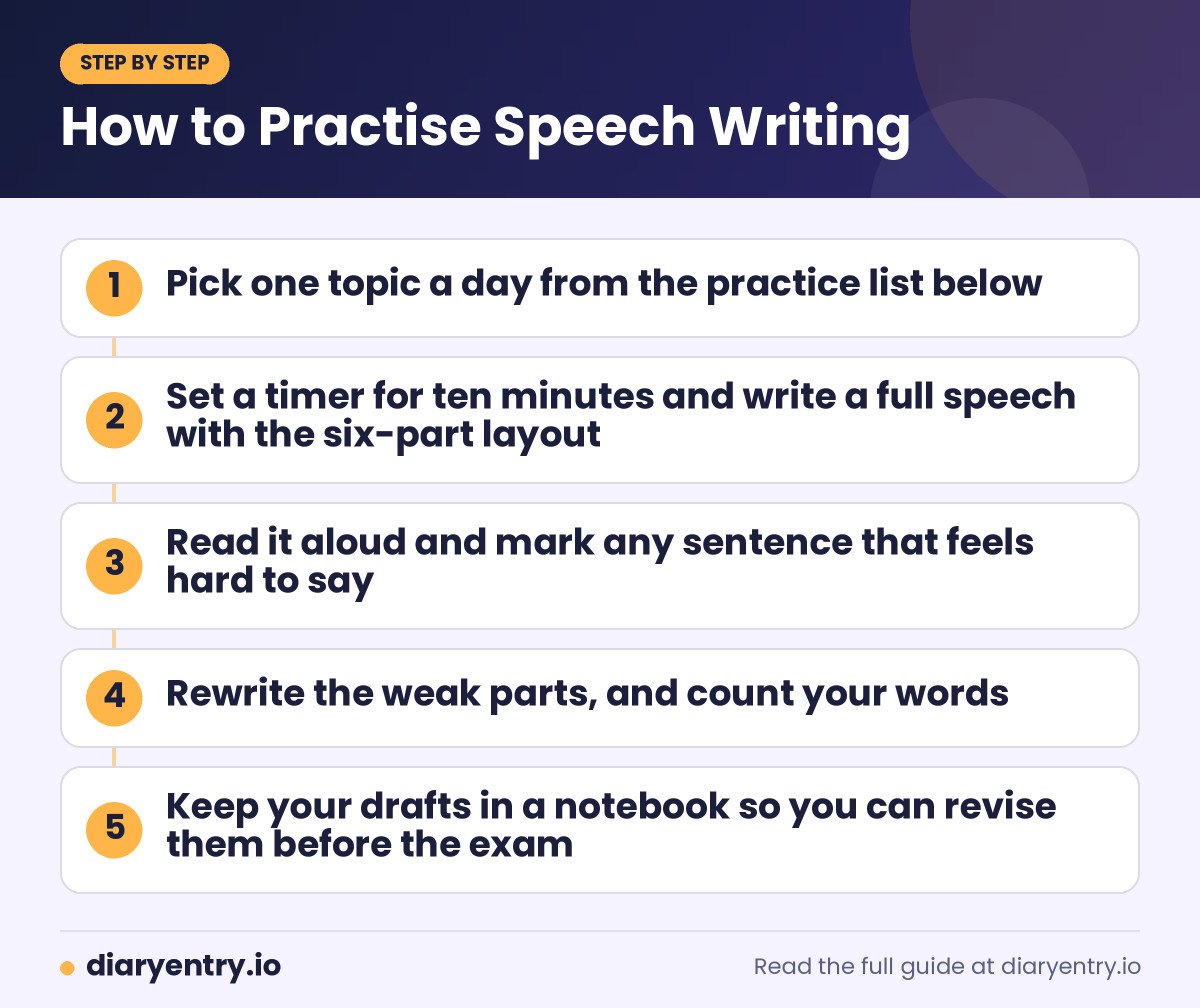
How to Practise Speech Writing
Good speeches come from regular practice, not last-minute cramming. Try these simple routines.
- Pick one topic a day from the practice list below.
- Set a timer for ten minutes and write a full speech with the six-part layout.
- Read it aloud and mark any sentence that feels hard to say.
- Rewrite the weak parts, and count your words.
- Keep your drafts in a notebook so you can revise them before the exam.
Writing a little every day makes the format automatic. If you find it hard to keep a routine, a short daily writing habit helps, and the 4-Week Diary Entry Course is one option for building that habit. Our guide to the diary entry word limit by class also shows how to plan length for short answers.
Practice Topics for Speech Writing
Use these prompts to build your own samples.
- The importance of time management for students.
- The role of sports in a healthy life.
- Why we should protect our local environment.
- The dangers of excessive screen time.
- A welcome speech for the chief guest at the annual day.
- The value of honesty in daily life.
- How to prepare calmly for board exams.
- The need for a clean and green school campus.
Frequently Asked Questions
What is the word limit for a speech in Class 11 and 12?
Most school and board-style papers ask for about 120 to 150 words, but the limit in your question always takes priority. Check the latest sample paper for your board.
Do I need to write the date and address in a speech?
No. A speech does not use a date or an address. It begins with a title and a salutation to the audience.
How do I start a speech?
Greet the audience in order of rank, introduce yourself and the topic, and use a hook such as a question or a short story to catch attention.
How do I end a speech?
Summarise your main idea, give a call to action or a final thought, and finish by thanking the audience.
Should I use headings inside the speech?
No. Write the speech in short paragraphs without sub-headings. Only a title at the top is needed.
What is the difference between a speech and an essay?
An essay is written to be read, while a speech is written to be spoken. A speech uses a salutation, shorter sentences, direct address and a thank-you at the end.
Is speech writing part of the Class 12 syllabus?
This depends on your board and the year. Speech writing appears in many school and board-style papers, but you should always check your own syllabus and sample papers.
Conclusion
The speech writing format is simple once you know the six parts: title, salutation, introduction, body, conclusion and thanks. Plan two or three strong points, write in short sentences that are easy to say aloud, and stay within the word limit. Practise with the sample topics above, read your drafts aloud, and revise them. With regular practice, speech writing becomes one of the most enjoyable parts of the English paper.