

Learning how to write a diary entry for Class 5 is easier than most students expect. A diary entry is a private, personal record of your day, written in the first person and the past tense, with a date at the top, a greeting, a few paragraphs about what happened and how you felt, and a short closing line. Follow that pattern and you can write a neat entry on almost any topic. Once you are comfortable, the diary entry format for Class 9 shows how the same layout grows in later classes.
This guide gives you the exact format, a step-by-step method, four sample entries, a list of topics, and the mistakes that cost marks. It is written for Class 5 students, and it is also useful for parents and teachers who help children practise at home.
What Is a Diary Entry in Class 5?
A diary entry is a short piece of writing in which you describe something that happened to you, together with your feelings about it. Unlike a letter, you are not writing to another person. You are talking to your diary, so you can be honest and friendly.
In Class 5, teachers use diary entries to check three things: whether you can follow a format, whether you can describe events in the right order, and whether you can express feelings in simple words. If you want a broader introduction first, read our guide on how to write a diary entry.
Diary entry vs. letter vs. story
Students often mix these three forms. The table below shows the main differences.
| Feature | Diary entry | Letter | Story |
|---|---|---|---|
| Who reads it | Only you | Another person | Any reader |
| Starts with | Date and “Dear Diary” | Address, date, “Dear …” | A title or opening line |
| Voice | First person (“I”) | First person (“I”, “you”) | Usually third person |
| Feelings | Always included | Sometimes | Shown through characters |
| Ends with | Short closing line and name | “Yours lovingly” and name | An ending or a lesson |
The Class 5 Diary Entry Format
Almost every school uses the same basic format. Learn it once and use it for every topic.
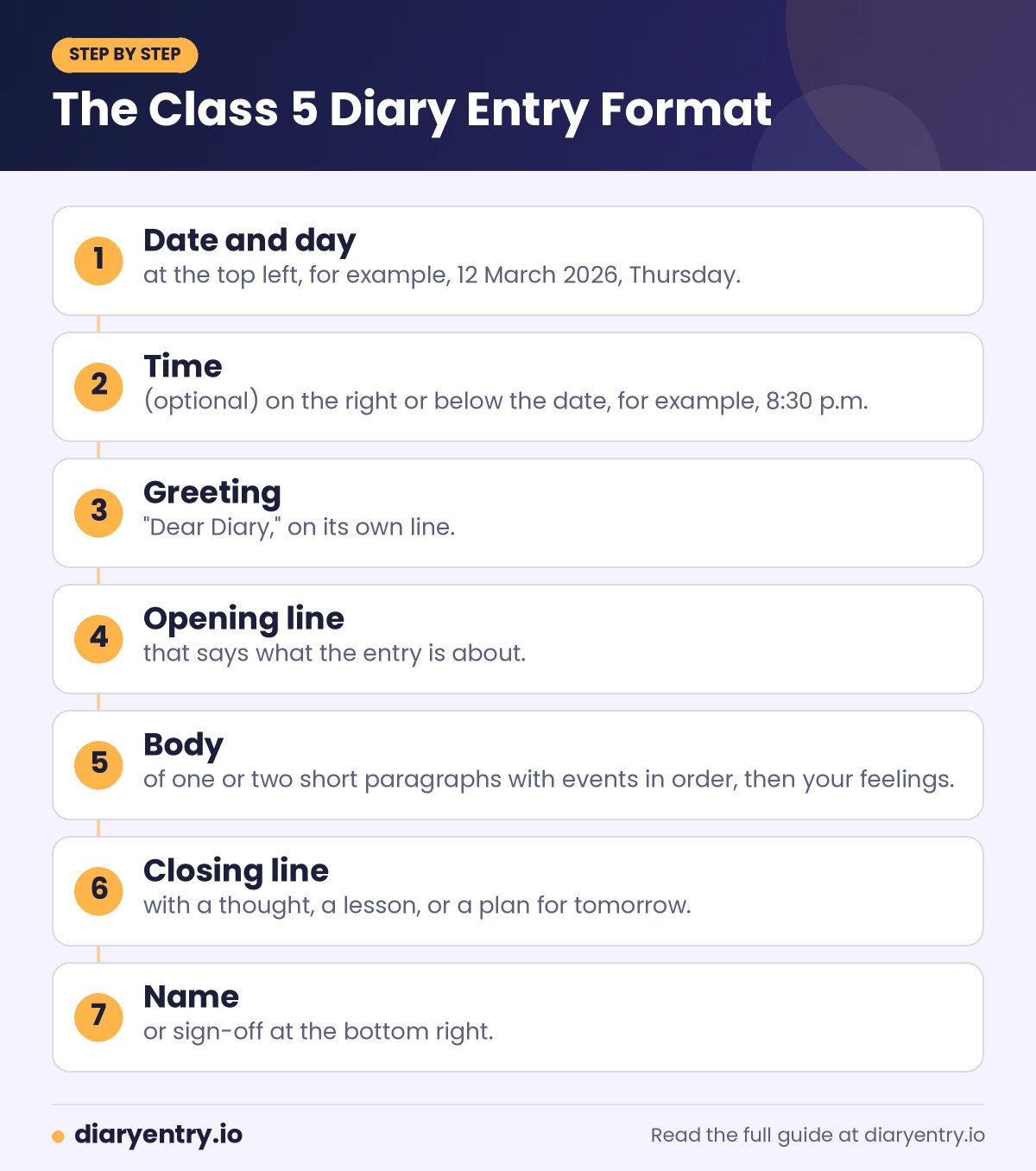
- Date and day at the top left, for example, 12 March 2026, Thursday.
- Time (optional) on the right or below the date, for example, 8:30 p.m.
- Greeting: “Dear Diary,” on its own line.
- Opening line that says what the entry is about.
- Body of one or two short paragraphs with events in order, then your feelings.
- Closing line with a thought, a lesson, or a plan for tomorrow.
- Name or sign-off at the bottom right.
Some teachers like a fixed greeting and sign-off, while others only want the date. Always follow the pattern your teacher has shown in class.
Layout at a glance
Think of the entry as a small sandwich. The date and greeting are the top slice, the events and feelings are the filling, and the closing line is the bottom slice. If one slice is missing, the sandwich feels unfinished.
Word Limit for a Class 5 Diary Entry
Class 5 diary entries are short. Many teachers ask for around 50 to 100 words, but the exact limit depends on your school and textbook, so check your worksheet or ask your teacher. Writing a little under or over the limit is usually fine, as long as the entry is complete.
For limits across classes, see our guide to the diary entry word limit by class. It helps you see how the length grows as you move up through school.
How to Write a Diary Entry for Class 5: Step by Step
Use these six steps every time. They work for homework, class tests, and your own private diary.
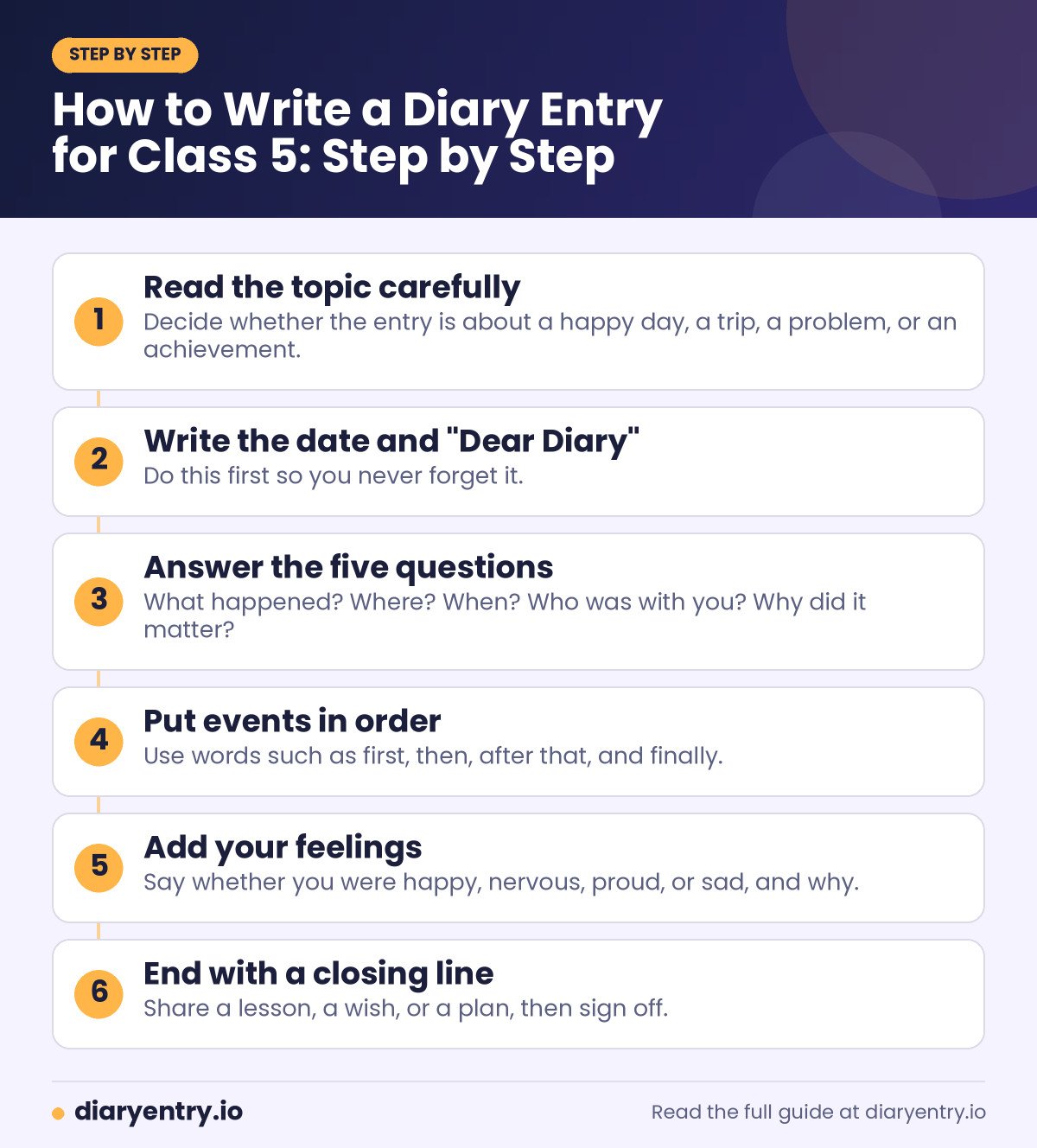
- Read the topic carefully. Decide whether the entry is about a happy day, a trip, a problem, or an achievement.
- Write the date and “Dear Diary”. Do this first so you never forget it.
- Answer the five questions. What happened? Where? When? Who was with you? Why did it matter?
- Put events in order. Use words such as first, then, after that, and finally.
- Add your feelings. Say whether you were happy, nervous, proud, or sad, and why.
- End with a closing line. Share a lesson, a wish, or a plan, then sign off.
Use feeling words, not only action words
A weak entry only lists actions: “I went to the park. I played. I came home.” A strong entry adds feelings: “I felt nervous when the swing went high, but my brother’s cheer made me laugh.” Feelings make your diary entry personal, and personal writing earns better marks.
Useful words for Class 5 diary entries
- Time words: this morning, after lunch, later, in the evening, at last
- Feeling words: delighted, excited, nervous, proud, disappointed, relieved
- Linking words: because, so, but, however, although
- Closing phrases: I will never forget this day, I hope tomorrow is better, I learnt something new today
Sample Diary Entries for Class 5
Read the samples below, then try writing your own on the same topic without looking.
Sample 1: A day at the school annual function
Friday, 14 February 2026
8:00 p.m.
Dear Diary,
Today was the happiest day of my school year. Our annual function took place in the school hall, and I had a part in the class dance.
I was nervous before going on stage, and my hands felt cold. But when the music began, I remembered all the steps and smiled at my friends. The audience clapped loudly at the end, and my teacher said, “Well done!”
I felt proud of myself and of my whole class. I hope we get another chance like this soon.
Aarav
Sample 2: A visit to my grandparents’ house
Sunday, 2 March 2026
9:15 p.m.
Dear Diary,
We spent the whole day at my grandparents’ house, and it was wonderful. We reached there at ten o’clock, and Grandma had already made my favourite sweets.
After lunch, Grandpa told me a story about his school days. Then I helped Grandma water the plants in the garden. We also played carrom in the evening, and I won two games.
I was sad when it was time to leave. I promised to visit again during the holidays.
Meera
Sample 3: A rainy day
Tuesday, 8 July 2025
Dear Diary,
It rained heavily today, and our school bus was late. I stood under my umbrella with my friends and watched puddles form on the road.
When I reached home, Mother gave me hot soup and a warm towel. We sat near the window and listened to the rain. I felt cosy and happy.
I wish it would rain on holidays too, so I could play in it.
Riya
Sample 4: When I lost my pencil box
Wednesday, 19 November 2025
Dear Diary,
Today I lost my favourite pencil box in school. I looked in my bag, under my desk, and in the playground, but I could not find it.
I felt very worried and almost cried. Then my friend Kabir told me to ask the class teacher. She had kept it safely after finding it near the library.
I was relieved and thanked both of them. From tomorrow, I will write my name on all my things.
Kabir’s friend, Dev
Topics for Class 5 Diary Entries
Teachers often pick everyday topics. Here are ideas you can practise with, grouped by theme.
- School life: my first day in Class 5, a sports day, a test I was nervous about, a day I helped a friend
- Home and family: a birthday celebration, a festival at home, a family picnic, a day without electricity
- Nature and travel: a visit to the zoo, a trip to the beach, a day in the hills, a thunderstorm
- Feelings and achievements: a day I felt proud, a time I was afraid, a mistake I learnt from, a prize I won
- Fun and hobbies: a day I learnt to ride a bicycle, a cooking attempt, a day I read a great book
For fifty more ideas with examples, browse our diary entry prompts for students.
Common Mistakes in Class 5 Diary Entries
Most lost marks come from a few small habits. Check this list before you hand in your notebook.
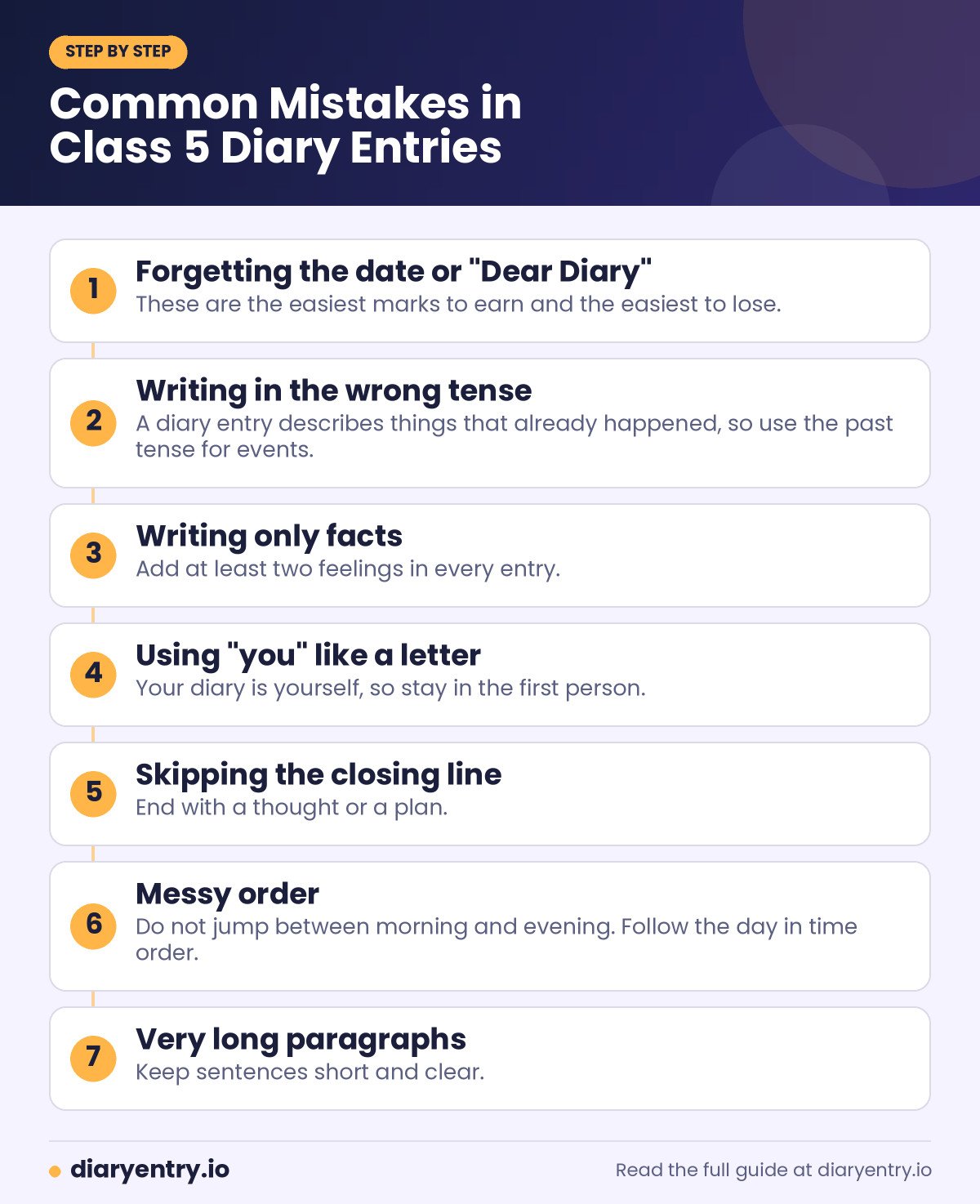
- Forgetting the date or “Dear Diary”. These are the easiest marks to earn and the easiest to lose.
- Writing in the wrong tense. A diary entry describes things that already happened, so use the past tense for events.
- Writing only facts. Add at least two feelings in every entry.
- Using “you” like a letter. Your diary is yourself, so stay in the first person.
- Skipping the closing line. End with a thought or a plan.
- Messy order. Do not jump between morning and evening. Follow the day in time order.
- Very long paragraphs. Keep sentences short and clear.
Tips to Score Better
Small improvements make a big difference in a school notebook.
- Use one new feeling word in every entry so your vocabulary grows.
- Read your entry aloud once. If a sentence sounds odd, rewrite it.
- Keep your handwriting neat and leave a blank line between the greeting and the body.
- Check spelling of names, days, and months.
- Practise one entry every week. Short, regular practice beats a long session before an exam.
How to end your entry
A good closing line is brief, honest, and connected to the day. If you want ready-made ideas, our guide to the ending format of a diary entry has many examples you can adapt.
How Parents and Teachers Can Help
Children write better when diary writing feels like a game instead of homework. Here are simple ways to support them.
- Ask your child to tell you about the day first. Speaking out loud helps them find words for writing.
- Give them a small notebook that belongs only to them.
- Praise effort and honest feelings rather than perfect spelling.
- Use a simple checklist: date, greeting, events, feelings, closing, name.
- Do not read the diary without permission. Privacy makes children feel safe and write more truthfully.
Once a Class 5 student is confident, the next step is a longer and more detailed entry. The diary entry format for Class 6 to 10 shows how the same structure grows as the topics become more complex.
If your child wants to turn diary writing into a lasting habit, the diaryentry.io 4-Week Diary Entry Course offers a gentle, step-by-step routine for building a daily writing practice.
Frequently Asked Questions
How do I start a diary entry in Class 5?
Start with the date and day at the top, then write “Dear Diary,” on the next line. After that, write one opening sentence that says what the entry is about.
How many words should a Class 5 diary entry have?
Many teachers ask for around 50 to 100 words, but the limit depends on your school. Check your worksheet or ask your teacher, and make sure the entry feels complete.
Should a diary entry be in the past tense?
Yes. You are writing about things that already happened, so use the past tense for events. You can use the present or future tense for feelings and plans, such as “I feel proud” or “I will practise tomorrow.”
Do I need to write “Dear Diary” in every entry?
Most schools expect it in the Class 5 format, so include it unless your teacher says otherwise. It marks the entry as a diary entry and not a letter.
What is the difference between a diary entry and a letter?
A diary entry is private and written to yourself, while a letter is written to another person. A diary entry begins with the date and “Dear Diary,” while a letter has an address, a salutation, and a formal or friendly sign-off.
Can I write about my feelings in a diary entry?
Yes, you should. Feelings are the heart of a diary entry, and a short sentence about why you felt that way makes your writing stronger.
How often should I practise writing diary entries?
Once or twice a week is a good start. Short, regular practice helps you remember the format and write faster in exams.
Conclusion
Knowing how to write a diary entry for Class 5 comes down to a simple routine: date, greeting, events in order, honest feelings, and a closing line. Use the samples above as models, practise on the suggested topics, and avoid the common mistakes. With a few weeks of regular practice, writing a clear, neat diary entry will feel natural. When you are ready for more, explore our other guides on diary writing and keep your habit going.