

The diary entry format for Class 9 is a fixed layout: date and day at the top, a greeting such as “Dear Diary”, a body of two or three short paragraphs written in the first person and past tense, and a closing line with your name or a sign-off. Learn this layout once and you can handle almost any diary entry question in your English paper. If your exam also asks for a personal letter, compare it with the informal letter format.
This guide explains the Class 9 diary entry format step by step, shows a clean template, gives three worked samples, lists topics to practise, and points out the mistakes that quietly cost marks. Syllabus details and word limits can change, so always compare what you read here with your own board’s current sample papers.
What Is a Diary Entry in Class 9?
A diary entry is a personal record of something that happened to you, written in your own voice. In a Class 9 English paper it is a short writing task where you imagine or recall an event, such as a school trip, a surprise, a win, a worry or an act of kindness, and describe both the event and how you felt.
A diary entry is different from a report or an article because it is private and emotional. You are not informing a crowd. You are talking to yourself, so the tone is natural, honest and reflective.
If you want a wider introduction to the idea before the class-specific rules, read How to Write a Diary Entry: Format, Steps and Examples.
Diary Entry Format for Class 9 (Step by Step)
Every good Class 9 diary entry follows the same skeleton. Examiners look for it first, because it shows that you know the format before they read a single sentence of content.
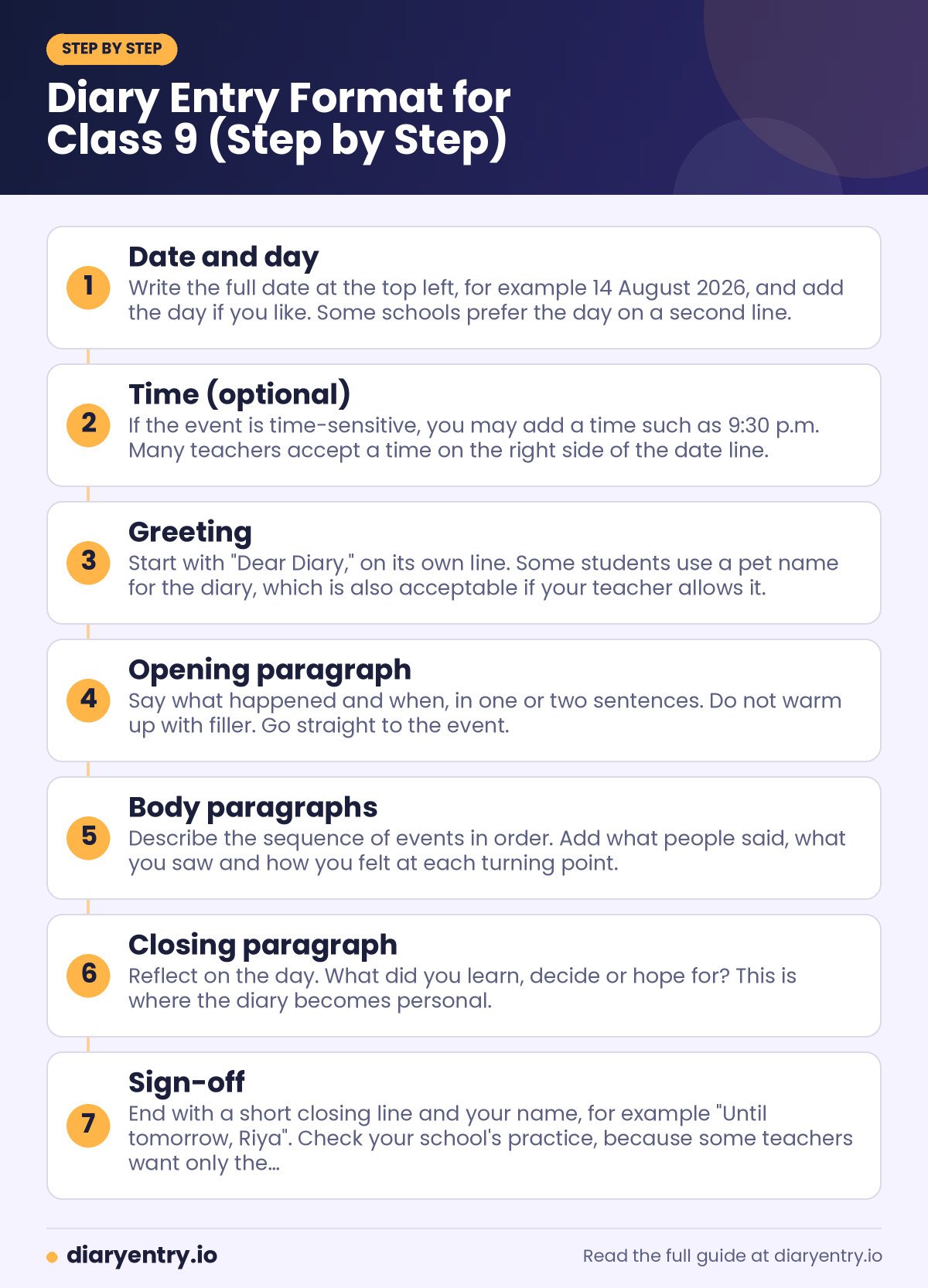
- Date and day: Write the full date at the top left, for example 14 August 2026, and add the day if you like. Some schools prefer the day on a second line.
- Time (optional): If the event is time-sensitive, you may add a time such as 9:30 p.m. Many teachers accept a time on the right side of the date line.
- Greeting: Start with “Dear Diary,” on its own line. Some students use a pet name for the diary, which is also acceptable if your teacher allows it.
- Opening paragraph: Say what happened and when, in one or two sentences. Do not warm up with filler. Go straight to the event.
- Body paragraphs: Describe the sequence of events in order. Add what people said, what you saw and how you felt at each turning point.
- Closing paragraph: Reflect on the day. What did you learn, decide or hope for? This is where the diary becomes personal.
- Sign-off: End with a short closing line and your name, for example “Until tomorrow, Riya”. Check your school’s practice, because some teachers want only the name.
Diary entry format at a glance
| Part | Where it goes | What to write |
|---|---|---|
| Date | Top left | Full date, such as 14 August 2026 |
| Day or time | Under or beside the date | Friday, 9:30 p.m. (optional) |
| Greeting | Next line | Dear Diary, |
| Opening | First paragraph | What happened, in one or two sentences |
| Body | Middle paragraphs | Events in order, with feelings |
| Closing | Last paragraph | Reflection, lesson or plan |
| Sign-off | Bottom | Short farewell and your name |
Quick Answer: How Do You Write a Diary Entry for Class 9?
Write the date at the top, begin with “Dear Diary”, describe the event in the first person and past tense across two or three short paragraphs, include your feelings, close with a reflection, and sign off with your name. Keep within the word limit your question gives.
Rules to Follow in a Class 9 Diary Entry
The format is only half of the task. The language rules decide how polished the entry feels.
- Use the first person. Write “I”, “my” and “we”. A diary entry written as “he” or “she” is not a diary entry.
- Use the past tense for events. You are writing after something has happened, so use “I reached”, “we waited”, “she smiled”. Switch to the present or future only when you describe your feelings now or plans for tomorrow.
- Show feelings, not only facts. Write “my hands were shaking” instead of “I was nervous”. Small physical details make a diary feel real.
- Keep the tone informal but correct. You can use short sentences and contractions if your teacher allows them, but spelling and grammar must stay clean.
- Stay inside the word limit. If the question says about 100 words, aim for 90 to 110. Our guide on the diary entry word limit by class explains how limits usually change from class to class.
- Do not write a letter. There is no address, no “Yours sincerely” and no subject line.
- Stay on the topic. Everything you write should connect to the event in the question.
Class 9 Diary Entry Template You Can Copy
Use this skeleton as a practice frame. Replace the bracketed parts with your own details.
[Date], [Day]
Dear Diary,
[One or two sentences: what happened, where and when.]
[A paragraph on the main events in order, with who said or did what.]
[A paragraph on how you felt and what you noticed.]
[A closing line: what you learned, decided or hope for.]
[Sign-off], [Your name]
If you prefer to compare more layouts, see Diary Entry Format for Class 6 to 10: Template and Samples, which shows how the same skeleton grows from junior to senior classes.
Sample Diary Entry 1: A School Annual Day
This sample shows a cheerful event with a clear sequence, a bit of dialogue and a reflective close. It runs a little longer than a minimum answer so that you can see how each part works.
12 December 2026, Saturday
Dear Diary,
Today was our school’s Annual Day, and I still cannot stop smiling. For weeks, my classmates and I had been rehearsing a short play about the importance of saving water, and this evening we finally performed it on the main stage.
I reached school at three o’clock, much earlier than usual. The hall was already glowing with fairy lights, and the stage curtain was a deep maroon that I had never noticed before. My heart was thumping so hard that I was sure my friend Ananya could hear it. Our teacher, Mrs Kapoor, gathered us and said, “Forget the audience. Just tell the story.” Her words steadied me.
When the curtain rose, my first line slipped out of my mind for a second. I took a breath, looked at Ananya, and the line came back. After that, everything flowed. The audience laughed at the right moments, and when we took our bow, the applause felt like warm rain.
I have learned that nerves do not mean I am not ready. They mean that I care. I am going to remember that the next time I stand in front of a crowd.
Until tomorrow,
Meera
Sample Diary Entry 2: A Day That Taught You Something
Not every diary entry is about a celebration. This one handles a mistake honestly, which is exactly the kind of reflection teachers appreciate.
3 March 2026, Tuesday
Dear Diary,
Today I forgot to submit my science project, and I have never felt so embarrassed. I had finished the model last Sunday, but I left it on my study table while hurrying out this morning.
During the second period, our teacher asked everyone to place their projects on her desk. I searched my bag twice and then felt my face turn hot. I whispered to my friend Kabir, and he suggested I tell the truth at once. So I walked up and said, “Ma’am, I forgot it at home. I am sorry.”
To my surprise, she did not scold me. She said she was glad that I had told her directly and allowed me to submit the project tomorrow. I felt a heavy stone lift off my chest.
From tonight, I will pack my bag the evening before and keep a small checklist beside my bed. Honesty helped me more than any excuse could have.
Good night,
Aarav
Sample Diary Entry 3: A Family Outing
A shorter entry like this works when your question asks for about 100 words. Notice how the opening, middle and closing each take only a couple of sentences.
18 January 2026, Sunday
Dear Diary,
We spent today at the old fort on the edge of the city. Papa had promised the trip for months, and today it finally happened.
We climbed the worn stone steps and reached the top just as the sun was setting. The whole city looked golden, and Dadi said it reminded her of her childhood village. I took photographs, but I realised that some views are better kept in the mind.
On the way back, we shared hot corn and laughed about everything. I wish every Sunday could feel like this.
Goodnight,
Tanvi
Class 9 Diary Entry Topics for Practice
Practising with a range of themes helps you stay calm when the exam question surprises you. Try writing short entries on these topics, one every two or three days.
- A memorable school trip or picnic
- Your first day in Class 9
- A cultural festival at home or school
- A sports day victory or a close defeat
- A day you helped a stranger
- A frightening moment, such as getting lost in a crowd
- A day when you met a person you admire
- A surprise visit from a relative
- A rainy day with a power cut
- A time you apologised and it worked
- The result day of an exam
- A day spent volunteering or cleaning your neighbourhood
For more ideas, the list of 50 diary entry prompts for students gives you a longer menu with sample openings.
Common Mistakes Students Make in Diary Entries
Most lost marks come from habits, not from a lack of ideas. Check your practice work for these.
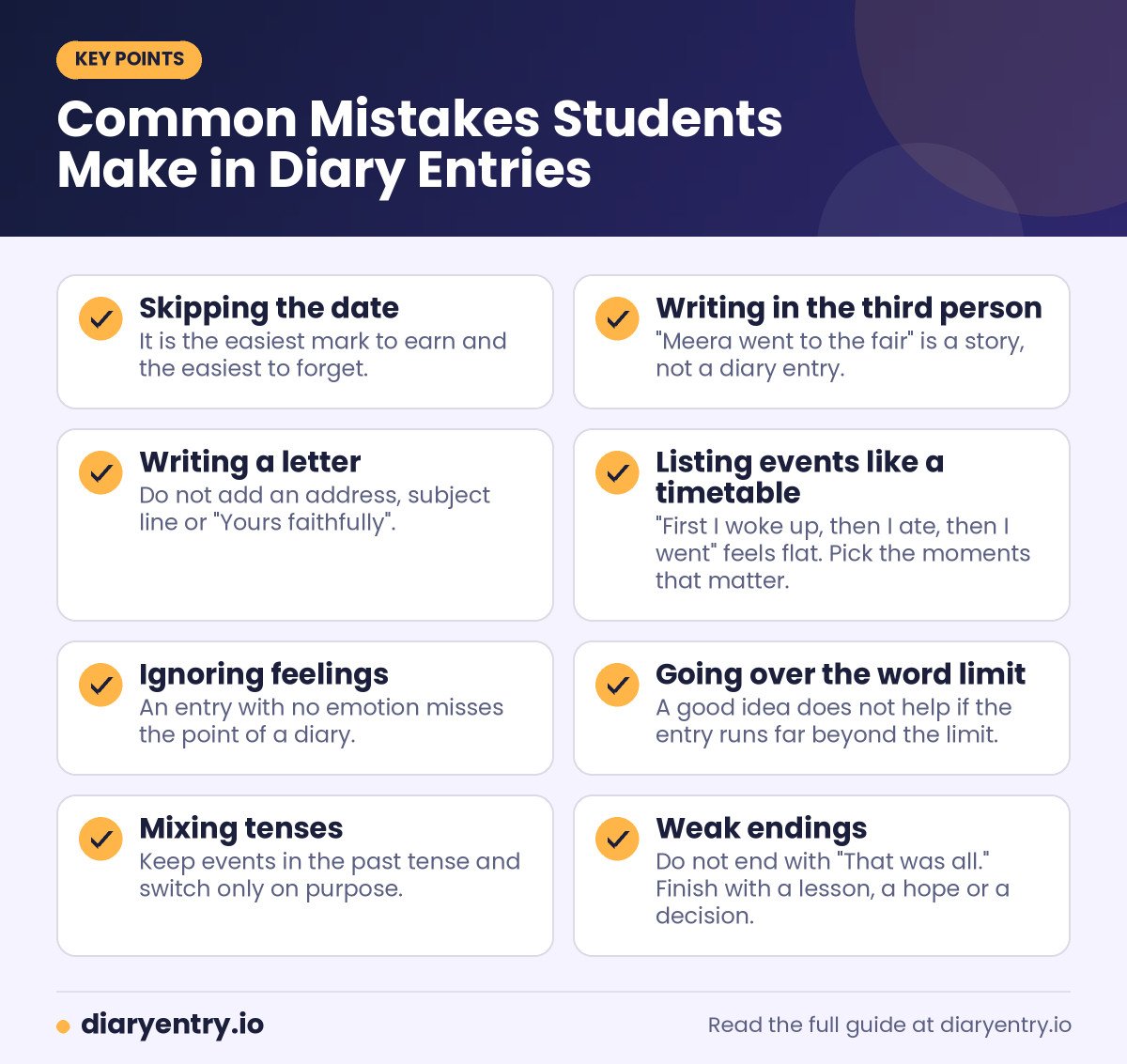
- Skipping the date. It is the easiest mark to earn and the easiest to forget.
- Writing in the third person. “Meera went to the fair” is a story, not a diary entry.
- Writing a letter. Do not add an address, subject line or “Yours faithfully”.
- Listing events like a timetable. “First I woke up, then I ate, then I went” feels flat. Pick the moments that matter.
- Ignoring feelings. An entry with no emotion misses the point of a diary.
- Going over the word limit. A good idea does not help if the entry runs far beyond the limit.
- Mixing tenses. Keep events in the past tense and switch only on purpose.
- Weak endings. Do not end with “That was all.” Finish with a lesson, a hope or a decision.
Diary Entry vs Letter vs Article: What Is the Difference?
Class 9 students often blur these three formats, so it helps to see them side by side.
| Feature | Diary entry | Letter | Article |
|---|---|---|---|
| Audience | Yourself | A named person or authority | General readers |
| Opening | Date and “Dear Diary” | Address, date, salutation | Title and byline |
| Voice | Personal and emotional | Polite and purposeful | Informative or persuasive |
| Tense | Mostly past | Depends on purpose | Mostly present |
| Closing | Reflection and name | Yours sincerely and name | Conclusion paragraph |
How to Practise the Class 9 Diary Entry Format
Good writing is built through short, regular practice rather than occasional long sessions. Here is a simple routine that fits around homework.
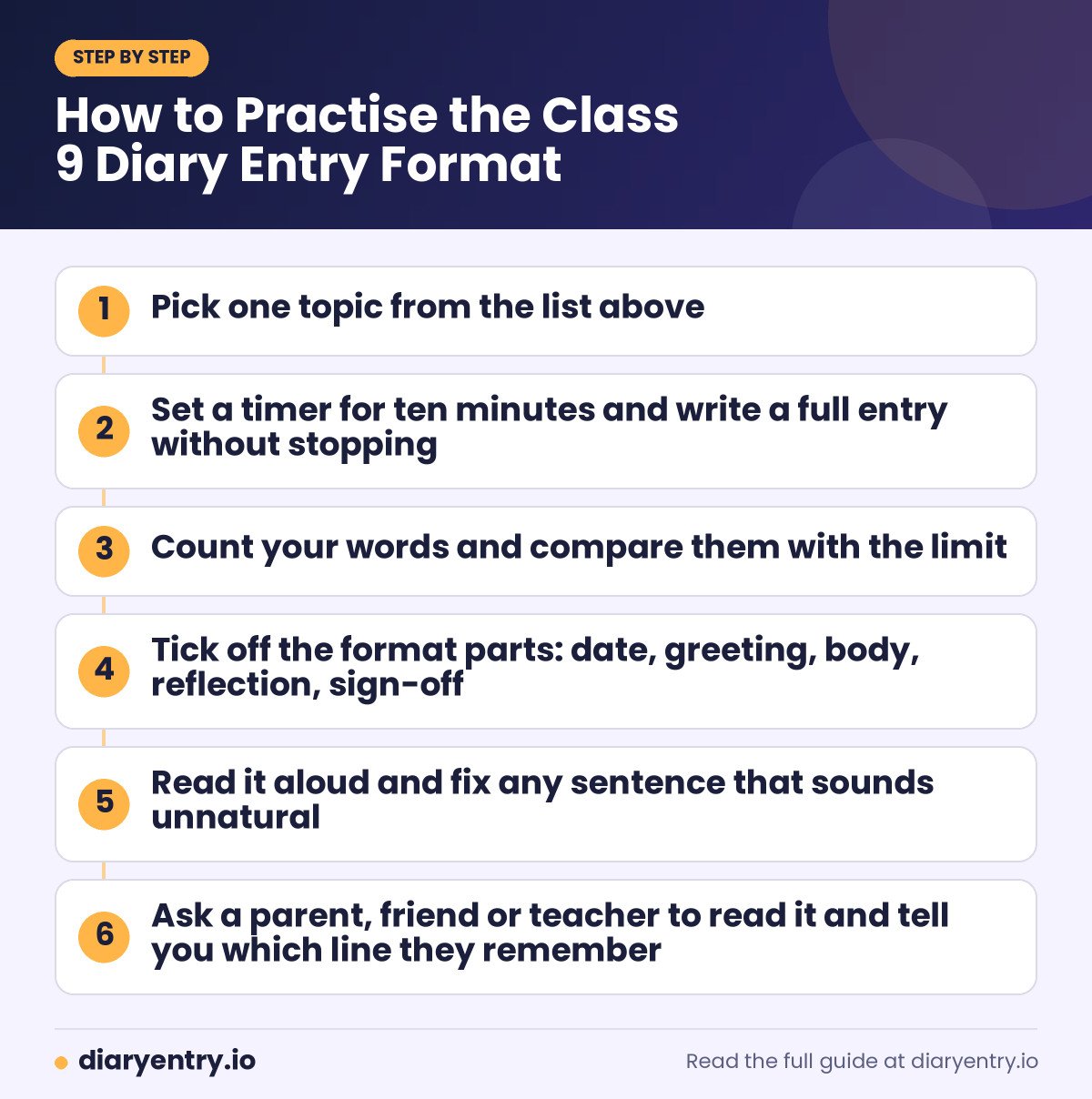
- Pick one topic from the list above.
- Set a timer for ten minutes and write a full entry without stopping.
- Count your words and compare them with the limit.
- Tick off the format parts: date, greeting, body, reflection, sign-off.
- Read it aloud and fix any sentence that sounds unnatural.
- Ask a parent, friend or teacher to read it and tell you which line they remember.
If you want a structured way to keep this going, the 4-Week Diary Entry Course at diaryentry.io is designed to build a daily writing habit step by step. It is optional, but it can help if you find it hard to practise regularly.
Tips to Make Your Diary Entry Stand Out
Format earns the base marks. Voice and detail earn the rest.
- Open with a hook. Start with a feeling or a surprising line, such as “I have never been so nervous in my life.”
- Add one sensory detail per paragraph. A smell, a sound or a texture makes the scene alive.
- Include one line of dialogue. A short quote breaks up the narration and adds realism.
- Show a change. Let the reader see how you felt before and after the event.
- Close with meaning. A small lesson or promise to yourself gives the entry a satisfying finish.
- Edit by cutting. Remove repeated words and vague phrases such as “very nice” or “a lot of fun”.
Frequently Asked Questions
What is the format of a diary entry for Class 9?
Write the date and day at the top, begin with “Dear Diary”, describe the event in two or three short paragraphs in the first person and past tense, add a reflection, and sign off with your name.
How many words should a Class 9 diary entry be?
It depends on the question and your board. Many school papers ask for roughly 80 to 150 words, but always follow the limit printed in your question paper or given by your teacher.
Should I write “Dear Diary” in a Class 9 diary entry?
Yes, in most school formats. It signals that you are writing a diary entry and not a letter or a story. Check your teacher’s preference in case a different greeting is accepted.
Do I need to write the time in a diary entry?
Usually not. The date and day are enough. Add a time only if the timing matters to the event or your teacher asks for it.
Can I use informal language in a diary entry?
You can use a natural, conversational tone, but grammar and spelling should remain correct. Avoid slang that you would not use in front of a teacher.
Is a diary entry written in the present or past tense?
Mostly the past tense, because you describe events that have already happened. Use the present tense for current feelings and the future tense for plans.
How is a diary entry different from a letter?
A diary entry is private, has no address and is addressed to yourself, while a letter is sent to someone else and follows address, salutation and closing rules.
Conclusion
The diary entry format for Class 9 is simple once you see it as a short sequence: date, greeting, event, feelings, reflection and sign-off. Practise it with a few real topics, keep to the word limit, and let your honest voice carry the entry.
Start with one of the samples above, rewrite it about your own day, and compare it with the checklist. For more models, revisit the diary entry format structure, rules and solved examples.