

Diary entry word limit is the number of words your exam paper or teacher allows for a diary entry answer. Most school papers ask for roughly 80 to 150 words, and the exact figure depends on your class, your board and the marks for the question. For a closer look at one grade, see our diary entry format for Class 9. The safest approach is to read the instruction printed in the question and aim to land within about ten percent of it. The same habit applies to a short notice or a speech; see our notice writing for Class 12 and speech writing format guides.
Diary Entry Word Limit: The Quick Answer
In most Indian school writing papers, a diary entry is a short answer worth a handful of marks. Typical limits you will see in textbooks, worksheets and sample papers are 80 to 100 words for lower middle classes, 100 to 120 words for classes 8 to 10, and 120 to 150 words for senior classes where a longer reflective entry is expected.
These ranges are common patterns, not a rule written into stone. Boards revise their writing sections, and individual teachers set their own limits for homework. Always treat the number printed on your own paper or worksheet as the final word, and use the ranges below only when you are practising without a fixed instruction.
- Classes 5 to 7: about 60 to 100 words
- Classes 8 to 10: about 100 to 120 words
- Classes 11 and 12 (where diary writing appears): about 120 to 150 words
If you are new to the format itself, start with our guide on how to write a diary entry, then come back here to fit that format inside a word count.
Diary Entry Word Limit by Class
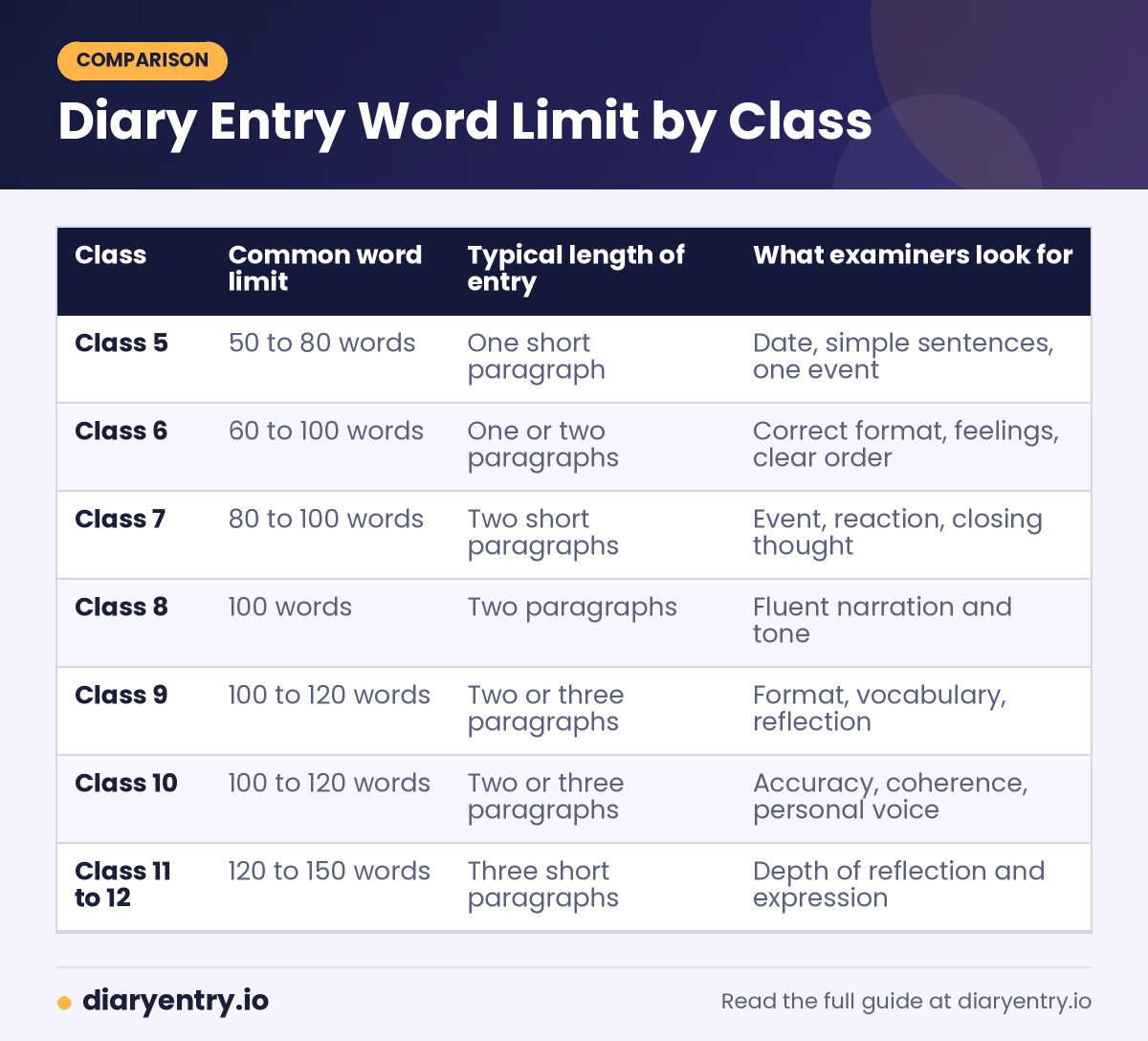
The table below summarises the ranges students most often meet. Use it as a planning guide, then check the real instruction on your paper.
| Class | Common word limit | Typical length of entry | What examiners look for |
|---|---|---|---|
| Class 5 | 50 to 80 words | One short paragraph | Date, simple sentences, one event |
| Class 6 | 60 to 100 words | One or two paragraphs | Correct format, feelings, clear order |
| Class 7 | 80 to 100 words | Two short paragraphs | Event, reaction, closing thought |
| Class 8 | 100 words | Two paragraphs | Fluent narration and tone |
| Class 9 | 100 to 120 words | Two or three paragraphs | Format, vocabulary, reflection |
| Class 10 | 100 to 120 words | Two or three paragraphs | Accuracy, coherence, personal voice |
| Class 11 to 12 | 120 to 150 words | Three short paragraphs | Depth of reflection and expression |
For class-wise layouts and sample answers, see our page on the diary entry format for Class 6 to 10. For the youngest writers, our guide on how to write a diary entry for Class 5 breaks the format down further.
Why the Word Limit Matters
A word limit is not just a rule to follow for its own sake. It tells you how much detail the examiner expects, and it affects your marks in three ways.
First, writing far below the limit usually means you have skipped content. A diary entry with one event and no feelings will look thin, so you may lose marks for content.
Second, writing far above the limit can cost you marks for expression or for not following instructions, and it eats time you need for other questions.
Third, staying close to the limit shows control. A well-trimmed 100-word entry usually reads better than a rambling 200-word one.
Is Going Over or Under the Word Limit Penalised?
Practice varies. Some markers are relaxed about a small difference, while others expect you to stay within the stated range. Because you cannot know in advance, the sensible habit is to stay inside the range.
A useful rule of thumb is to stay within ten percent of the stated number. For a 100-word limit, that means writing between about 90 and 110 words. If the paper gives a range such as 100 to 120, aim for the middle.
Never pad an entry with repeated sentences just to reach the number. Add one more feeling, one more detail or one more observation instead.
How to Count Words in a Diary Entry
Counting properly saves you from guessing. Here is the usual convention.
- Count every word in the body of the entry, including small words such as “a”, “the” and “of”.
- Treat contractions such as “didn’t” as one word.
- Count hyphenated words such as “well-known” as one word.
- Do not count the date, the greeting (“Dear Diary”) or the sign-off in most school papers, because these are format elements, though some teachers include them. If you are unsure, ask or keep a margin.
- Numbers written as digits, such as “12”, count as one word each.
On exam day, count lines instead of words. Measure how many words you usually fit in one line of your handwriting, then multiply by the number of lines. This gives a quick estimate without counting every word.
The Structure That Fits Inside 100 to 120 Words
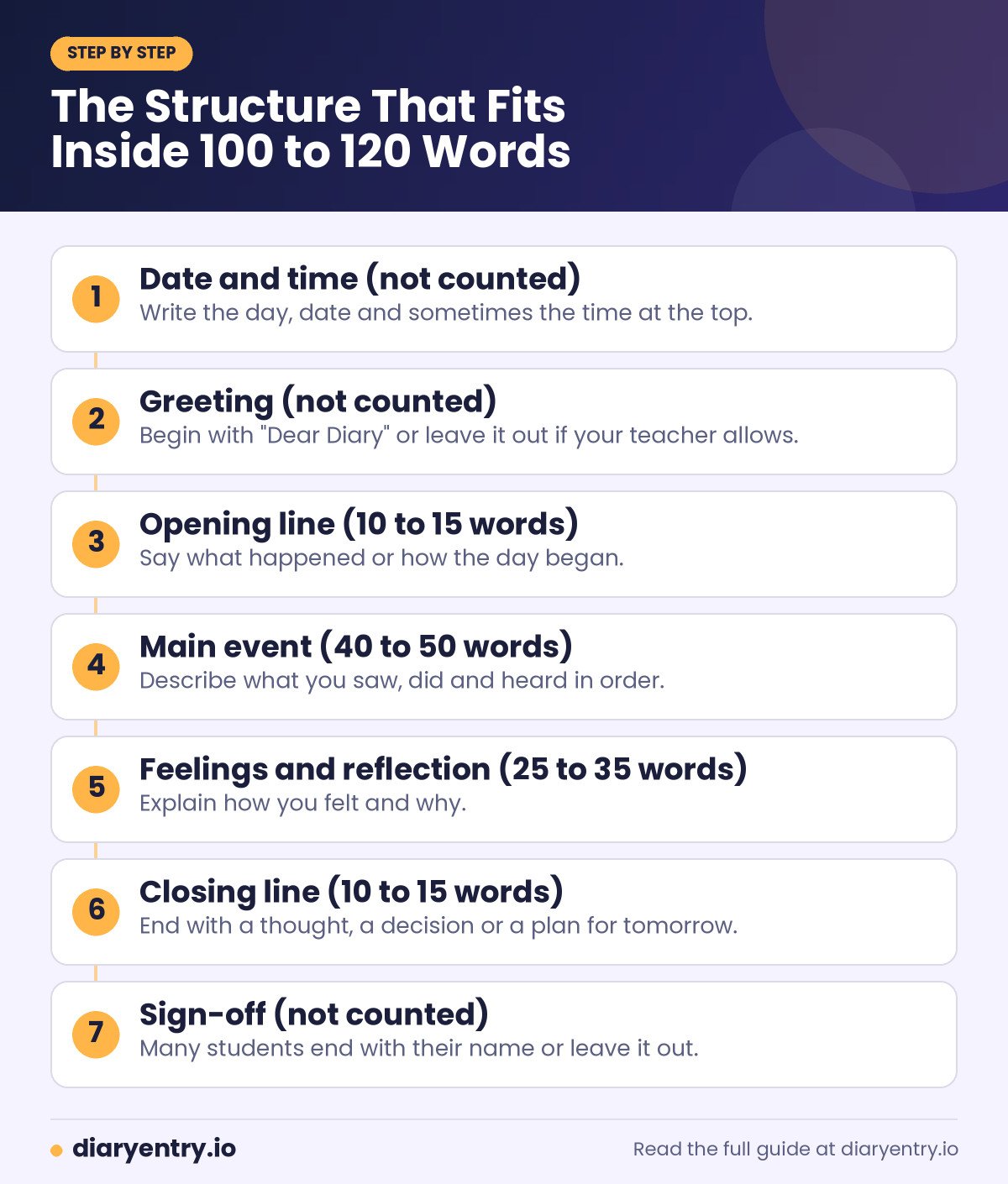
A diary entry has a fixed skeleton, and each part has a rough word budget. The numbered plan below works for a 100 to 120-word entry.
- Date and time (not counted): Write the day, date and sometimes the time at the top.
- Greeting (not counted): Begin with “Dear Diary” or leave it out if your teacher allows.
- Opening line (10 to 15 words): Say what happened or how the day began.
- Main event (40 to 50 words): Describe what you saw, did and heard in order.
- Feelings and reflection (25 to 35 words): Explain how you felt and why.
- Closing line (10 to 15 words): End with a thought, a decision or a plan for tomorrow.
- Sign-off (not counted): Many students end with their name or leave it out.
You can read more about each part in our detailed guide to diary entry format, structure and rules.
Sample Diary Entry in About 100 Words
Here is a model entry of roughly 100 words, the kind often asked in Class 7 and Class 8.
Thursday, 5 November 2026
9:30 p.m.
Dear Diary,
Today was the school sports day, and I could barely sleep last night because I was so nervous. In the 100-metre race I started badly, but I kept my eyes on the finish line and ran as fast as I could. When I crossed it, I was second! My friends cheered so loudly that my ears rang. I felt proud, tired and happy all at once. Our coach said that effort matters more than medals. I want to remember that lesson. Tomorrow I will thank my parents for coming.
Notice how every part of the skeleton is present, yet nothing is wasted. For the final lines, see the ending format of a diary entry.
Sample Diary Entry in About 150 Words
Senior classes may ask for a longer, more reflective entry. The example below runs close to 150 words.
Monday, 2 November 2026
10:00 p.m.
Dear Diary,
This evening our class presented its science project on rainwater harvesting, and I was the one who had to speak first. My hands felt cold and my voice shook for the first few seconds. Then I looked at my teammates and remembered how many afternoons we had spent building the model together.
The judges asked difficult questions, but we answered them calmly. One judge said our idea could really work in a school like ours. I could hardly hide my smile.
Looking back, I realise that nervousness did not mean I was unprepared. It meant I cared. Tonight I feel grateful for my team and surprised at how much I enjoyed standing in front of everyone. Next time, I will breathe slowly before I begin and trust the work I have done.
How to Shorten a Diary Entry That Is Too Long
If your draft runs over, trim in this order.
- Remove repeated ideas and keep the clearest version.
- Replace phrases with single words, for example “at this moment in time” with “now”.
- Cut extra adjectives and keep the strongest one.
- Merge two short sentences into one when they describe the same moment.
- Shorten the closing line before touching the feelings, because feelings earn marks.
How to Lengthen a Diary Entry That Is Too Short
If you are well under the limit, do not add filler. Add substance in one of these ways.
- Include one sensory detail, such as a sound, a smell or a colour.
- Add a short line of dialogue that you remember.
- Explain why you felt the way you did.
- Add a sentence about what you learned or what you plan to do next.
Common Mistakes Students Make
Most lost marks come from a short list of avoidable errors.
- Writing in the third person instead of the first person.
- Forgetting the date or writing it in the wrong place.
- Using a letter format such as “Yours sincerely”.
- Narrating only facts with no feelings.
- Ignoring the word limit entirely.
- Using future or present tense for events that have already happened.
Avoiding these mistakes matters more than adding fancy vocabulary. Our collection of diary entry prompts for students gives you topics to practise each of these skills under a time limit.
Word Limit for Different Diary Entry Types
Not every diary entry in school is the same. The word limit often changes with the task.
| Type of entry | Usual length | Notes |
|---|---|---|
| Daily or event diary entry | 80 to 120 words | Most common in exams |
| Travel or trip diary | 100 to 150 words | Include places and feelings |
| Reflective diary entry | 120 to 150 words | Needs a clear lesson |
| Imaginary or character diary | 100 to 150 words | Write in the character’s voice |
| Learning or academic diary | Varies | Often longer, used for coursework |
If you keep a diary for studying rather than for exams, see our guide to the academic diary, where length is flexible and the purpose is learning.
Time Management: How Long Should a Diary Entry Take in an Exam?
A diary entry is usually a short question, so it should not take more than about eight to ten minutes of exam time. A simple split works well: one minute to plan, five minutes to write, and two minutes to check the format, tense and word count.
During the planning minute, jot down three words in the margin: the event, the feeling and the closing thought. These three words become your three paragraphs or your three sentences. This habit stops you from drifting off topic, which is the main reason entries run over the limit.
In the checking minute, look for four things. Is the date at the top? Is every sentence in the first person? Are the verbs in the past tense for events that already happened? Did you end with a thought or a plan rather than stopping abruptly? A quick scan of these four points is worth more marks than another fancy sentence.
Tips to Practise Within a Word Limit
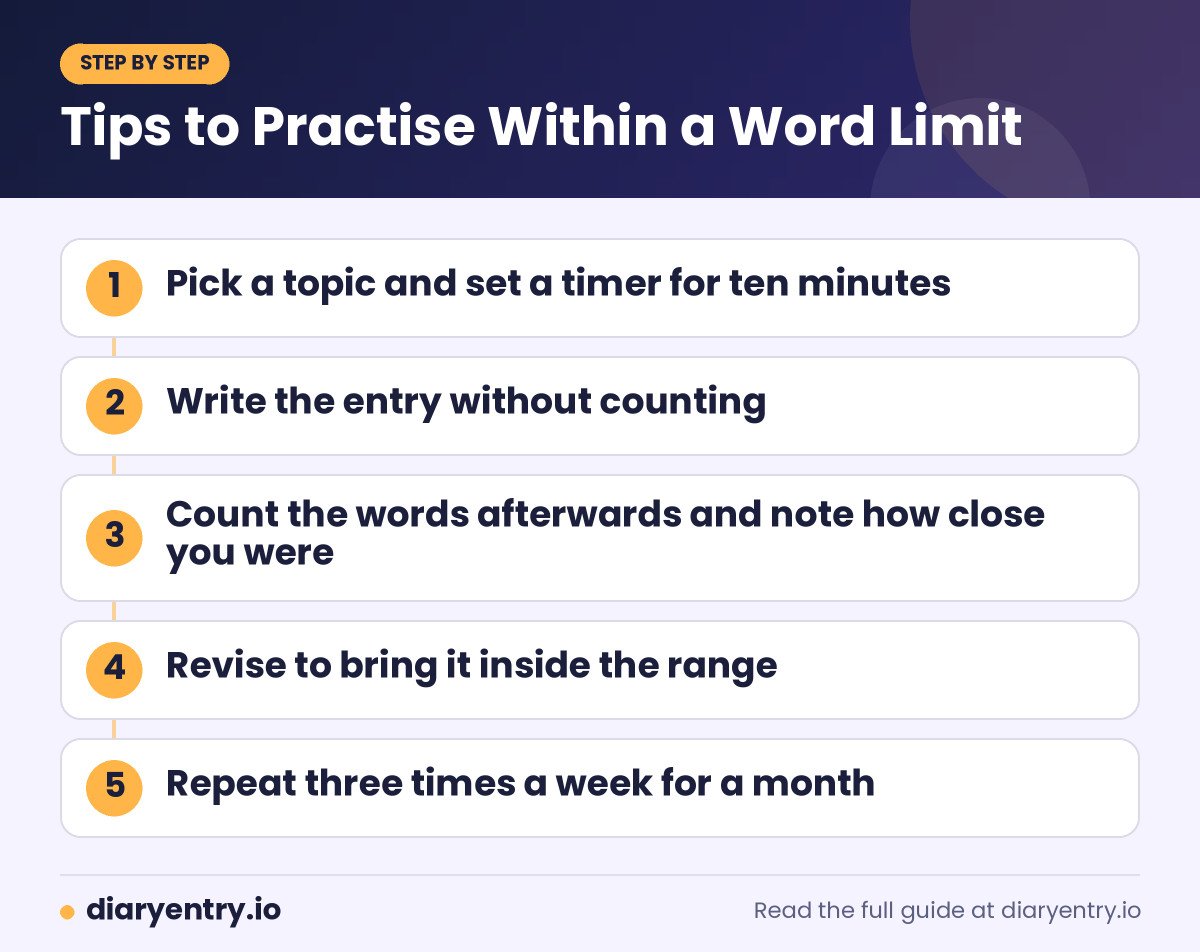
Practice builds the instinct for length. Try this simple routine.
- Pick a topic and set a timer for ten minutes.
- Write the entry without counting.
- Count the words afterwards and note how close you were.
- Revise to bring it inside the range.
- Repeat three times a week for a month.
Within a few weeks you will feel a 100-word entry in your hand without counting. If you want a structured routine for building the writing habit, the 4-Week Diary Entry Course walks through daily writing practice step by step.
Frequently Asked Questions
What is the word limit for a diary entry in Class 6?
It is commonly 60 to 100 words, but the number printed on your question paper or worksheet always overrides any general guideline.
What is the word limit for a diary entry in Class 9 and Class 10?
Many sample papers use about 100 to 120 words. Check your board’s latest sample paper because writing sections change from year to year.
Do the date and greeting count in the word limit?
In most school papers they do not count, since they are part of the format. If your teacher says otherwise, follow your teacher.
Is it bad to write more than the word limit?
A small excess is usually tolerated, but a large one may cost marks and time. Try to stay within ten percent of the stated number.
How many paragraphs should a 100-word diary entry have?
Two short paragraphs are enough: one for the event and one for feelings and a closing thought. A single paragraph is also acceptable for very short entries.
Can I write a diary entry shorter than the limit?
You can, but you risk leaving out content. If you are well below the range, add a feeling, a detail or a reflection.
Conclusion
The diary entry word limit is a practical guide to how much to write, not something to fear. For most classes the target is between 80 and 150 words, and the number on your paper always wins. Learn the structure, budget your words across it, and practise with a timer until the length feels natural. With steady practice, staying inside the limit becomes automatic, and you can spend your effort on voice and feeling instead of counting.