

Report writing format for Class 10 follows a fixed pattern: a short, factual heading, a byline with the reporter’s name, the place and date, and a body of two to four paragraphs written in the third person and the past tense. A report states what happened, who was involved, where, when, and why, without personal opinion or emotional language.
This guide explains the Class 10 report writing format step by step, with a checklist, a comparison with other writing formats, three solved samples, practice topics, and the mistakes that lose marks. One important note first: whether report writing is tested in Class 10 depends on your board and your school’s syllabus, so confirm with your teacher what your exam or internal assessment actually asks for.
What Is Report Writing in Class 10?
A report is a formal, factual account of an event, a situation, or an investigation. It is meant for readers who were not there, such as the readers of a newspaper or the members of a school community. Because the reader cannot see the event, the report must be accurate, clear, and complete.
In Class 10, report writing is a short writing task that checks your ability to organise facts and use formal language. It can appear as a newspaper report, a school event report, or a report on a social issue. Schools and boards differ on whether it appears in the final paper, in unit tests, or only in classroom practice, so always check your own syllabus and sample papers.
Report vs. diary entry vs. article vs. letter
Students often blend report writing with other formats. For a formal letter or a speech in the same paper, see our guides to letter writing for Class 10 and the speech writing format. The table below keeps them apart.
| Feature | Report | Diary entry | Article | Formal letter |
|---|---|---|---|---|
| Purpose | Inform about an event | Record personal thoughts | Share views or ideas | Request, complain or inform |
| Voice | Third person | First person | Usually first or third person | First person |
| Tone | Formal, impersonal | Personal, emotional | Formal or semi-formal | Formal |
| Tense | Past | Past, with present feelings | Mixed | Present or future |
| Opinions | None | Yes | Yes | Limited |
| Heading | Yes, plus byline | Date and greeting | Yes, plus byline | Subject line |
If you also practise personal writing, see our guide to the diary entry format for Class 6 to 10 and notice how different the voice is. A diary entry is private and emotional, while a report is public and neutral.
Report Writing Format for Class 10
Use this structure for every report. It works for school events, accidents, and social issues alike.
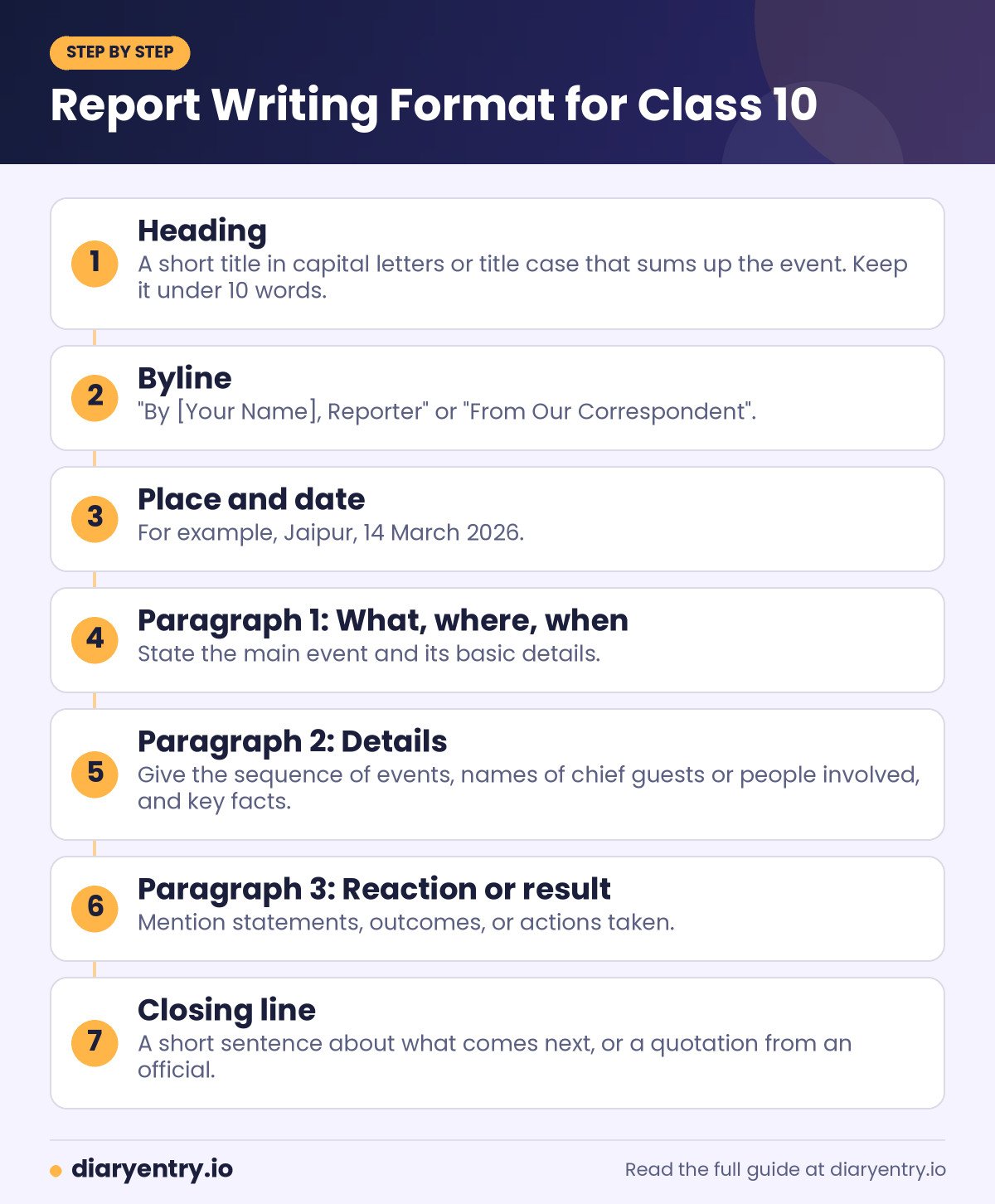
- Heading: A short title in capital letters or title case that sums up the event. Keep it under 10 words.
- Byline: “By [Your Name], Reporter” or “From Our Correspondent”.
- Place and date: For example, Jaipur, 14 March 2026.
- Paragraph 1: What, where, when. State the main event and its basic details.
- Paragraph 2: Details. Give the sequence of events, names of chief guests or people involved, and key facts.
- Paragraph 3: Reaction or result. Mention statements, outcomes, or actions taken.
- Closing line: A short sentence about what comes next, or a quotation from an official.
Format at a glance
| Part | What to write | Example |
|---|---|---|
| Heading | The event in a few words | Annual Sports Day Held at Green Valley School |
| Byline | Reporter’s name | By Riya Sharma, Reporter |
| Place and date | City and date | Pune, 3 February 2026 |
| Body | Two to four paragraphs, facts first | Who, what, where, when, why |
| Ending | Result or next step | The winners will represent the school at the district meet |
Word limit
Word limits vary by board and paper. Many school exercises ask for roughly 100 to 120 words, but your worksheet or teacher decides the exact figure. Writing one clear paragraph too many is a smaller mistake than leaving out key facts, so plan the paragraphs before you start.
How to Write a Report: Step by Step
Follow these steps in the exam hall and you will never be stuck for a structure.
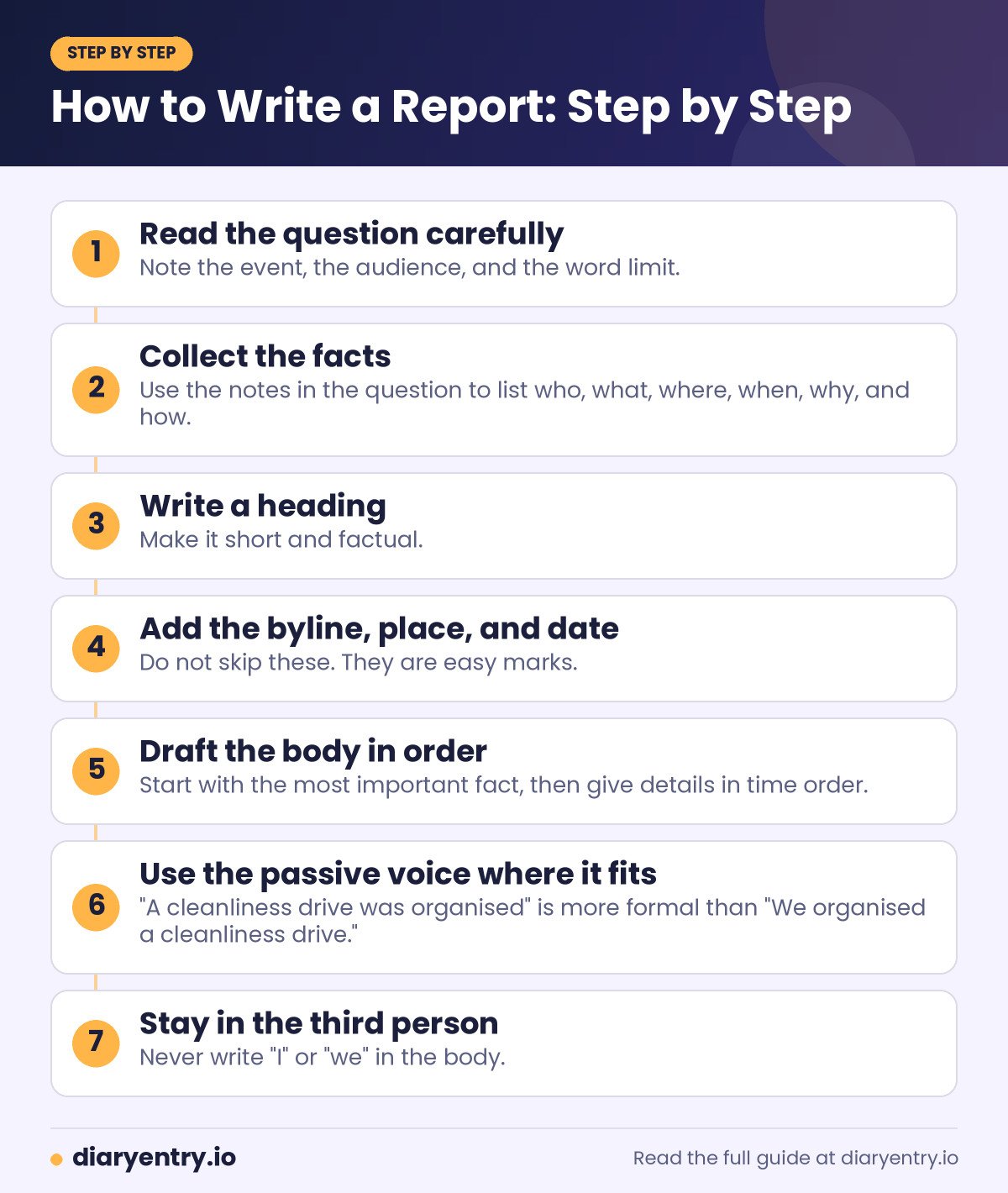
- Read the question carefully. Note the event, the audience, and the word limit.
- Collect the facts. Use the notes in the question to list who, what, where, when, why, and how.
- Write a heading. Make it short and factual.
- Add the byline, place, and date. Do not skip these. They are easy marks.
- Draft the body in order. Start with the most important fact, then give details in time order.
- Use the passive voice where it fits. “A cleanliness drive was organised” is more formal than “We organised a cleanliness drive.”
- Stay in the third person. Never write “I” or “we” in the body.
- Check and edit. Look at tense, spelling, names, and word count.
Language tips for a formal report
- Use the past tense for the event: was held, took place, was inaugurated.
- Use passive constructions for formality: it was decided, the programme was attended by.
- Avoid contractions such as “didn’t” and “wasn’t”.
- Avoid emotional words such as amazing, boring, or terrible. Use neutral words such as successful or well attended.
- Quote people only if the question gives you their words, and use quotation marks.
Sample Report Writing for Class 10
Study these three samples and notice how each answers the same set of questions.
Sample 1: A school event
ANNUAL SPORTS DAY CELEBRATED AT GREEN VALLEY SCHOOL
By Riya Sharma, Reporter
Pune, 3 February 2026
The annual sports day of Green Valley School was celebrated with great enthusiasm on 2 February in the school ground. The chief guest, a former national-level athlete, inaugurated the event by lighting the torch.
More than 400 students took part in track and field events, including relay races, long jump, and the 100-metre sprint. The house marches and a yoga display by Class 6 students were appreciated by the audience. Trophies were distributed at the end by the chief guest.
The principal thanked the staff, parents, and volunteers for their support. The winners will represent the school at the district meet next month.
Sample 2: A traffic accident
TRUCK OVERTURNS ON NATIONAL HIGHWAY, NO CASUALTIES
By Aman Verma, Staff Reporter
Nashik, 12 September 2025
A truck carrying vegetables overturned on the national highway near Nashik at about 6 a.m. on Thursday. The driver lost control of the vehicle after a tyre burst.
Traffic was blocked for nearly two hours. Police arrived at the spot and diverted vehicles through an alternate road. The driver and the helper escaped with minor injuries and were taken to a nearby hospital.
The police have registered a case and started an investigation. The highway was cleared by 9 a.m., and normal traffic resumed.
Sample 3: A social awareness campaign
STUDENTS LAUNCH PLASTIC-FREE CAMPUS DRIVE
By Neha Kapoor, Correspondent
Lucknow, 21 July 2025
Students of Class 10 at City Public School launched a plastic-free campus campaign on Monday. The drive was inaugurated by the principal during the morning assembly.
Volunteers distributed cloth bags to classmates and put up posters about the harm caused by single-use plastic. A short skit on waste management was also performed. Teachers appreciated the effort and encouraged other classes to join.
The school plans to hold a collection drive every month and recycle the waste collected. The student council will report the results at the end of the term.
How to Manage Your Time in the Exam
A report is a short answer, so it should not eat up the time you need for other questions. A simple plan helps.
- Spend the first two minutes reading the question and underlining the facts you must include.
- Spend about one minute planning the heading and the three paragraphs in rough.
- Write the final answer neatly, without long pauses.
- Keep the last minute for checking tense, spelling, names, and the word count.
If the question gives notes or a poster, use every point in it. Missing a point from the question is a bigger loss than a small language slip.
Common Topics for Class 10 Report Writing
Practise with topics like these, which appear often in textbooks and sample papers.
- School events: annual day, science exhibition, inter-house debate, farewell party, blood donation camp
- Social issues: cleanliness drive, plastic ban awareness, road safety week, tree plantation, health camp
- News events: a fire in a market, a flood in a nearby village, a local cricket tournament, an exhibition in town
- Community activities: a food drive for the needy, a book fair, a free eye-check-up camp
Pick one topic each week, write a 100 to 120 word report, and check it against the format above.
Common Mistakes in Report Writing
These small slips cost many students marks.
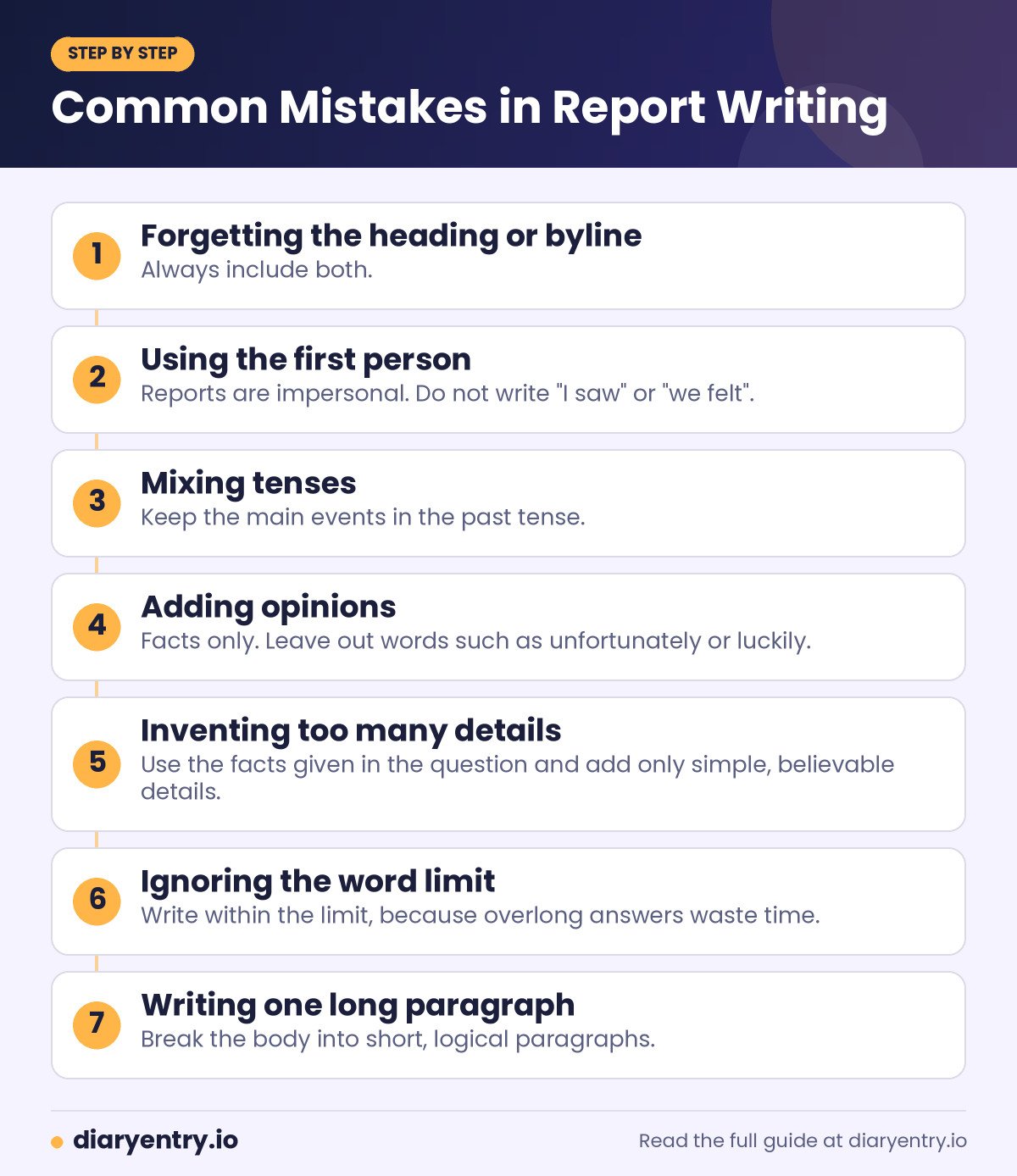
- Forgetting the heading or byline. Always include both.
- Using the first person. Reports are impersonal. Do not write “I saw” or “we felt”.
- Mixing tenses. Keep the main events in the past tense.
- Adding opinions. Facts only. Leave out words such as unfortunately or luckily.
- Inventing too many details. Use the facts given in the question and add only simple, believable details.
- Ignoring the word limit. Write within the limit, because overlong answers waste time.
- Writing one long paragraph. Break the body into short, logical paragraphs.
Report Writing Checklist
Run through this list before you finish.
- Is the heading short and factual?
- Is there a byline with the name and role?
- Are the place and date included?
- Does the first paragraph answer what, where, and when?
- Is the body in the third person and the past tense?
- Is there no personal opinion?
- Is the length within the limit?
Report Writing and Diary Writing: Build Both Skills
Reports and diary entries look very different, yet they train the same habit: noticing details and putting them in order. Regular short writing makes both easier. If your school also expects personal writing, the ending format of a diary entry shows how to close a personal piece, while a report closes with a result or a next step instead.
For students who keep a study diary, the academic diary guide explains how to record what you learn after each class, including the formats you have practised. Writing a one-line summary of each practice report in your diary can help you remember what to improve next time.
If you want to build a steady writing routine, the diaryentry.io 4-Week Diary Entry Course is a gentle way to practise writing daily. Class 12 students can also compare the report writing format for Class 12 to see how the same structure becomes more detailed.
Frequently Asked Questions
What is the report writing format for Class 10?
The format has a heading, a byline, the place and date, a body of two to four paragraphs, and a short closing line. The body is formal, factual, in the third person, and in the past tense.
How many words should a Class 10 report have?
Many school exercises ask for around 100 to 120 words, but limits vary by board and paper. Check your sample paper or ask your teacher for the exact limit.
Is report writing part of the Class 10 English syllabus?
It depends on your board and school. Some boards and schools test it, while others focus on different writing tasks. Check your latest syllabus and sample papers instead of relying on general advice.
Should a report be in the passive voice?
Not always, but the passive voice makes reports sound formal and objective. Use it where it feels natural, such as “A seminar was organised,” and keep sentences clear.
Can I use “I” in a report?
No. A report is impersonal, so use the third person. If you must refer to yourself, use the byline, for example “By Riya Sharma, Reporter”.
What is the difference between a report and an article?
A report presents facts about an event in a neutral tone. An article can share opinions, ideas, and suggestions, and it may use a more personal voice.
How can I improve my report writing quickly?
Practise one short report each week, use the checklist above, and ask your teacher to review it. Read newspaper reports to see how professionals structure their facts.
Conclusion
The report writing format for Class 10 is simple once you remember the order: heading, byline, place and date, a body in the third person and past tense, and a short ending. Use the samples above as models, avoid the common mistakes, and run the checklist before submitting. With regular practice, you can write a clear, factual report quickly and confidently, whichever topic appears in your paper.