

Quick Answer
Subject verb agreement means a verb must match its subject in number: a singular subject takes a singular verb, and a plural subject takes a plural verb. For example, “The student writes” is correct, while “The students writes” is not. Most errors happen when words come between the subject and the verb, or when the subject is a tricky noun.
Key Takeaways
- A singular subject takes a singular verb (“She walks”) and a plural subject takes a plural verb (“They walk”).
- Words that come between the subject and the verb, such as prepositional phrases, do not change the verb form.
- Subjects joined by “and” are usually plural, while subjects joined by “or” or “nor” agree with the nearer subject.
- Indefinite pronouns such as each, everyone and nobody take singular verbs, while few, many and several take plural verbs.
- Collective nouns and nouns like news or mathematics need special care because their form and meaning do not always match.
What Is Subject Verb Agreement?
Every sentence has a subject (the person or thing doing or being something) and a verb (the action or state). Subject verb agreement is the rule that these two must match in number. “Number” simply means singular (one) or plural (more than one). When the subject is one person or thing, the verb takes its singular form. When the subject is more than one, the verb takes its plural form.
In the present tense, the rule is easy to see because regular verbs add -s or -es for third person singular subjects: “He plays”, “She watches”, “The dog barks”. Plural subjects use the base verb: “They play”, “The dogs bark”. This is the opposite of what happens with nouns, where the -s ending marks the plural. That mismatch is one reason learners mix the two up.
Agreement is a part of basic sentence structure, and it connects closely with the word classes covered in our guide to parts of speech. If you can spot the noun or pronoun acting as the subject and the verb that follows, you can check agreement in any sentence.
The Basic Rule With Examples
The core rule fits in one line: match the verb to the true subject of the sentence. The table below shows how the verb changes with the subject in the simple present tense.
| Subject | Number | Correct verb form | Example |
|---|---|---|---|
| I | Singular | play | I play cricket every evening. |
| You | Singular or plural | play | You play very well. |
| He, She, It | Singular | plays | She plays the piano. |
| We | Plural | play | We play in the same team. |
| They | Plural | play | They play on Sundays. |
| The boy | Singular | plays | The boy plays in the park. |
| The boys | Plural | play | The boys play in the park. |
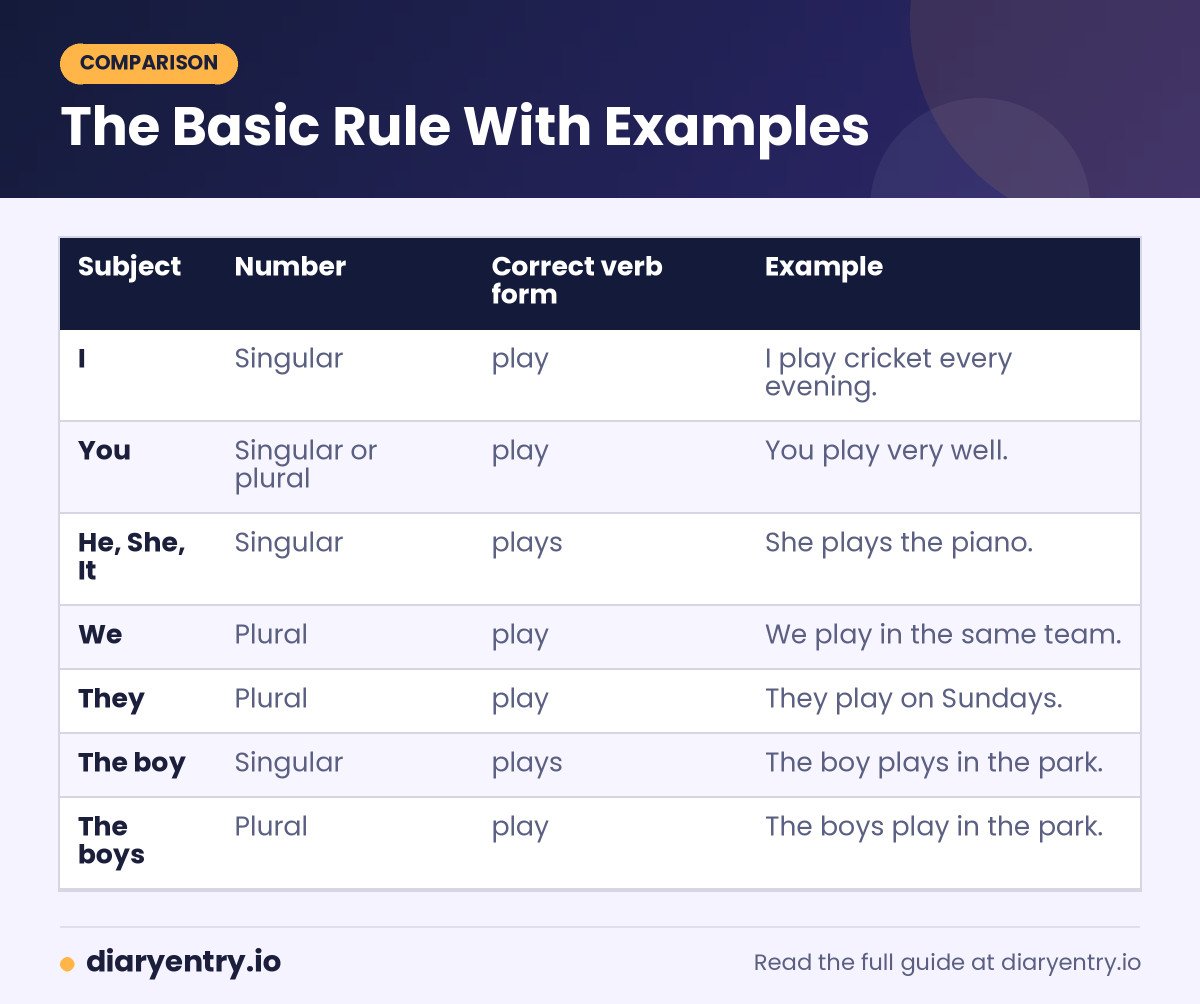
Notice that “I” and “you” are exceptions: they are singular in meaning but use the plural-looking verb form. The verb “to be” is the most irregular. It changes to am, is or are in the present and was or were in the past, so it deserves extra attention.
| Subject | Present of “be” | Past of “be” |
|---|---|---|
| I | am | was |
| He, She, It, singular nouns | is | was |
| You, We, They, plural nouns | are | were |
Subject Verb Agreement Rules You Need to Know
Rule 1: Ignore Words Between the Subject and the Verb
A phrase placed between the subject and the verb does not change the verb. The verb still agrees with the subject, not with the nearest noun. In “The box of chocolates is on the table”, the subject is “box”, so the verb is “is”. The word “chocolates” is part of a prepositional phrase and does not control the verb.
The same applies to phrases beginning with “along with”, “as well as”, “together with” and “in addition to”. “The teacher, along with her students, is visiting the museum” uses a singular verb because the subject is “teacher”. If you want to review how these small linking words work, see our guide to prepositions with definitions, types and examples.
Rule 2: Subjects Joined by “And” Are Plural
When two subjects are joined by “and”, the verb is plural. “Ravi and Meera are classmates.” There is one exception: when the two words name a single thing or idea, the verb is singular. “Bread and butter is my favourite breakfast.” “Rice and curry is ready.” Also, if “each” or “every” comes before the joined subjects, use a singular verb: “Every boy and girl is invited.”
Rule 3: Subjects Joined by “Or” or “Nor”
With “or”, “nor”, “either…or” and “neither…nor”, the verb agrees with the subject closest to it. “Neither the teacher nor the students are late” uses a plural verb because “students” is nearer. “Neither the students nor the teacher is late” uses a singular verb because “teacher” is nearer. When one subject is singular and the other plural, put the plural one last so the sentence sounds natural. This idea is also explained in our guide to conjunctions, which covers correlative pairs.
Rule 4: Indefinite Pronouns
Indefinite pronouns do not name a specific person or thing, and they follow fixed patterns. Some are always singular, some are always plural, and a few can be either.
| Group | Pronouns | Example |
|---|---|---|
| Always singular | each, either, neither, one, everyone, everybody, everything, someone, anyone, no one, nobody, nothing | Everyone has arrived. Each of the girls was given a prize. |
| Always plural | both, few, many, several, others | Both of the answers are correct. Few were present. |
| Singular or plural | all, any, most, some, none, more | Some of the cake is left. Some of the cookies are left. |
For the third group, look at the noun in the “of” phrase. If it is uncountable or singular (cake, water, information), use a singular verb. If it is plural (cookies, students), use a plural verb.
Rule 5: Collective Nouns
Collective nouns name a group: team, class, family, committee, audience, jury (our guide to types of nouns covers them in more detail). When the group acts as one unit, use a singular verb: “The class is writing a test.” When the members act individually, use a plural verb: “The class are arguing about the answers.” In everyday exam writing, the singular verb is the safer choice because it fits most sentences. In American English, the singular is more common; in British English, both appear.
Rule 6: Sentences Beginning With “There” or “Here”
In sentences that begin with “there is”, “there are”, “here is” or “here comes”, the subject comes after the verb. Find the real subject first, then match the verb. “There is a pen on the desk” (pen is singular). “There are three pens on the desk” (pens is plural). In casual speech, people say “There’s three pens”, but this is not accepted in formal writing or exams.
Rule 7: Nouns That Look Plural but Are Singular
Some nouns end in -s but take a singular verb. These include news, mathematics, physics, economics, politics, measles and ethics. “The news is encouraging.” “Mathematics is my favourite subject.” Other nouns, such as scissors, trousers, glasses and jeans, are plural even though they name one object: “My trousers are new.” To make them singular, use the phrase “a pair of”: “This pair of trousers is new.”
Rule 8: Expressions of Time, Money and Distance
Amounts of time, money, distance and weight are treated as a single unit and take a singular verb. “Ten kilometres is a long walk.” “Five hundred rupees is enough.” “Two hours is too short for this test.” Fractions and percentages follow the noun after “of”: “Half of the pizza is gone” but “Half of the students are absent.”
Rule 9: Titles and Names
The title of a book, film or organisation is singular even when it looks plural. “The Arabian Nights is a famous collection of stories.” “The United States has fifty states.” “Gulliver’s Travels was written by Jonathan Swift.”
Rule 10: Relative Pronouns
The verb after “who”, “which” or “that” agrees with the noun the pronoun refers to. “She is one of the students who have won awards.” Here “who” refers to “students”, so the verb is plural. In “She is the only one of the students who has won an award”, “who” refers to “one”, so the verb is singular.
Subject Verb Agreement in Different Tenses
Agreement shows up most clearly in the simple present, but it matters in other tenses too. In the present perfect, the helping verb must agree: “She has finished” and “They have finished”. In the present continuous, “be” changes: “He is reading” and “They are reading”. In the past simple, regular verbs do not change with number at all, which makes things easier: “He walked” and “They walked”. The exception is “was” and “were”.
| Tense | Singular example | Plural example |
|---|---|---|
| Simple present | The girl sings. | The girls sing. |
| Present continuous | The girl is singing. | The girls are singing. |
| Present perfect | The girl has sung. | The girls have sung. |
| Simple past (be) | The girl was late. | The girls were late. |
| Simple future | The girl will sing. | The girls will sing. |
Notice that the future tense never changes with number, because “will” stays the same for every subject. For the full picture of how helping verbs behave, see our tenses chart with rules and examples.
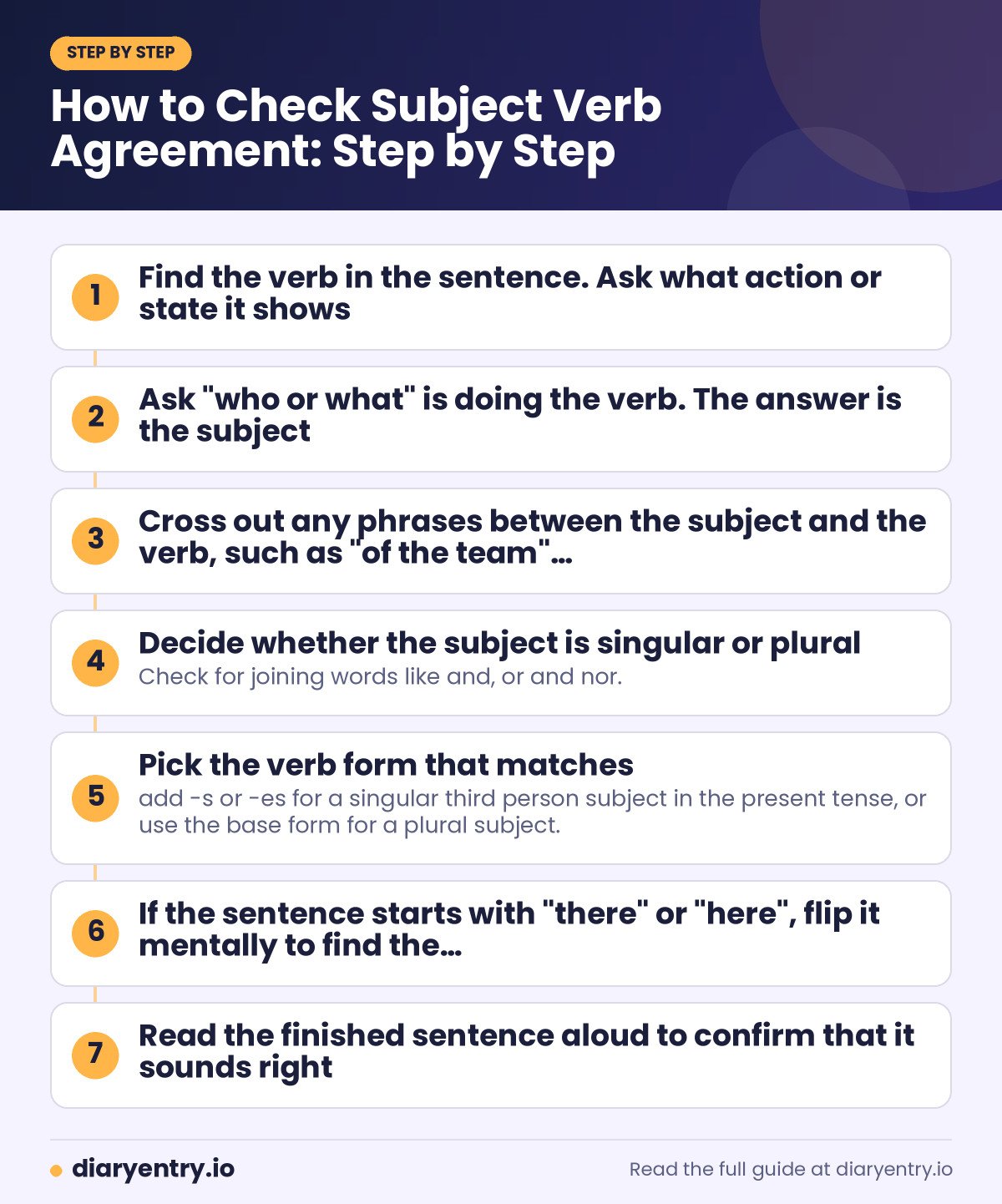
How to Check Subject Verb Agreement: Step by Step
- Find the verb in the sentence. Ask what action or state it shows.
- Ask “who or what” is doing the verb. The answer is the subject.
- Cross out any phrases between the subject and the verb, such as “of the team” or “along with his friends”.
- Decide whether the subject is singular or plural. Check for joining words like and, or and nor.
- Pick the verb form that matches: add -s or -es for a singular third person subject in the present tense, or use the base form for a plural subject.
- If the sentence starts with “there” or “here”, flip it mentally to find the subject.
- Read the finished sentence aloud to confirm that it sounds right.
Common Subject Verb Agreement Mistakes
Being misled by the nearest noun. “The list of items are long” is wrong because the subject is “list”. Write “The list of items is long.”
Treating “each” and “every” as plural. “Each of the boys have a bag” is wrong. Write “Each of the boys has a bag.”
Using the wrong verb after “a number of” and “the number of”. “A number of students are absent” takes a plural verb because it means “several”. “The number of students is small” takes a singular verb because “number” is the subject.
Forgetting that “none” can be either. “None of the water is clean” is singular, while “None of the students were late” is acceptable in plural. Both forms are used, so follow the noun that comes after “of”.
Mixing up “is” and “are” with inverted sentences. “Where is my keys?” should be “Where are my keys?” because “keys” is plural, even though it comes after the verb.
Dropping the -s in the third person. “She walk to school” should be “She walks to school”. This is a common error in speech and in quick writing, so proofread for it.
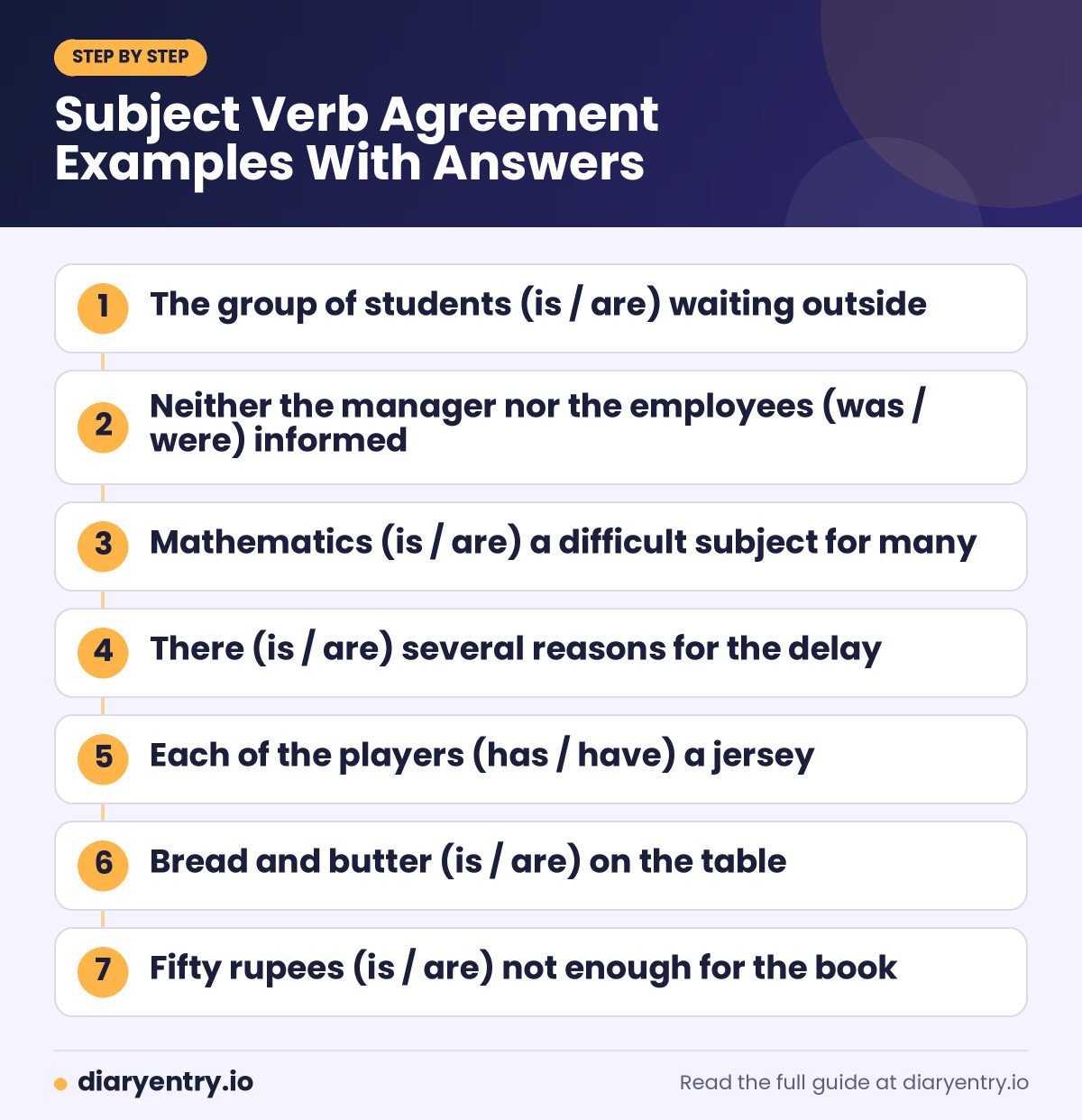
Subject Verb Agreement Examples With Answers
Choose the correct verb in each sentence.
- The group of students (is / are) waiting outside.
- Neither the manager nor the employees (was / were) informed.
- Mathematics (is / are) a difficult subject for many.
- There (is / are) several reasons for the delay.
- Each of the players (has / have) a jersey.
- Bread and butter (is / are) on the table.
- Fifty rupees (is / are) not enough for the book.
- The scissors (is / are) on the shelf.
Answers: 1. is (the subject is “group”); 2. were (the nearer subject “employees” is plural); 3. is (a singular subject); 4. are (the real subject is “reasons”); 5. has (the subject is “each”); 6. is (one combined item); 7. is (an amount of money is one unit); 8. are (scissors is plural).
Error Correction Practice
Correct the mistake in each sentence.
- The books on the shelf is old.
- Everyone have finished the test.
- My friend and classmate are Ria.
- The news are surprising.
- Neither of the answers are right.
Sample answers: 1. The books on the shelf are old. 2. Everyone has finished the test. 3. My friend and classmate is Ria (one person who is both). 4. The news is surprising. 5. Neither of the answers is right.
Why Agreement Matters in Real Writing
Agreement errors are small, but readers notice them quickly. In an exam, a wrong verb can cost marks in a grammar section or in a writing task such as a letter or an article. In a job application, an error can make an otherwise strong message look careless. Regular writing is one of the best ways to develop a natural ear for correct agreement. Keeping a short daily diary lets you test sentences in your own words, and a short daily entry is enough to start.
If you want structured practice, the 4-Week Diary Entry Course builds a daily writing habit, which is a gentle way to see agreement rules at work in your own sentences without drilling worksheets.
Tips to Master Subject Verb Agreement
- Identify the subject first. Always ask who or what is doing the action before choosing the verb.
- Strike out the extra phrases. Remove prepositional phrases mentally to see the core sentence.
- Learn the exceptions as a short list. News, mathematics, scissors and collective nouns cover most surprises.
- Read aloud. Your ear often catches a mismatch that your eye misses.
- Proofread once only for agreement. A dedicated check is more effective than a general read.
Frequently Asked Questions About Subject Verb Agreement
What is subject verb agreement in simple words?
It means the verb in a sentence must match its subject. A singular subject takes a singular verb, and a plural subject takes a plural verb, as in “The cat sleeps” and “The cats sleep”.
What are the main subject verb agreement rules?
The main rules are: ignore phrases between the subject and verb, use plural verbs for subjects joined by “and”, match the nearer subject with “or” and “nor”, and treat words like each, everyone and nobody as singular.
Is “everyone” singular or plural?
Everyone is singular, so use “Everyone is here” and “Everyone has a book”. It refers to a group but is treated as one unit.
Do collective nouns take singular or plural verbs?
Use a singular verb when the group acts as one unit, as in “The team is winning”. Use a plural verb when members act individually, as in “The team are arguing”. The singular is more common in exam writing.
Why is “news” singular?
News ends in -s but names a single body of information, so it takes a singular verb: “The news is good”. Mathematics, physics and economics follow the same pattern.
How do I choose the verb with “either…or” and “neither…nor”?
The verb agrees with the subject nearest to it. In “Neither the boy nor his friends are ready”, the plural verb matches “friends”.
Does “a number of” take a singular or plural verb?
“A number of” takes a plural verb (“A number of students are absent”), while “the number of” takes a singular verb (“The number of students is small”).
Conclusion
Subject verb agreement is one of the most useful grammar skills because it affects almost every sentence you write. Find the true subject, decide whether it is singular or plural, and match the verb to it, ignoring the words in between. Learn the short list of exceptions, check your work with the step-by-step method above, and practise often. If you want to keep building your writing skills, a steady daily habit such as the 4-Week Diary Entry Course is a good next step.