
Quick Answer
Articles a, an, the are the three small words used before nouns in English. “A” and “an” are indefinite articles that mean any one thing, while “the” is the definite article that points to a specific thing. Use “a” before consonant sounds, “an” before vowel sounds, and “the” when the listener knows which noun you mean.
Key Takeaways
- English has two types of articles: indefinite (a, an) and definite (the).
- Choose “a” or “an” by the sound that follows, not by the spelling: “an hour”, “a university”.
- Use “the” for something specific, unique or already mentioned.
- Use no article (the zero article) with plural and uncountable nouns used in a general sense.
- Many fixed patterns, such as names of rivers and languages, follow special article rules.
What Are Articles in English?
Articles are small words that come before a noun to show whether we mean something general or something specific. They are a type of determiner, and in traditional grammar they are often listed as the ninth part of speech or grouped under adjectives. Our guide to determiners with types and examples shows how articles sit alongside words like this, my, some and many.
English has only three articles: a, an and the. Even though they are tiny, they appear in almost every sentence, and mistakes with them are among the most common errors in school and exam writing.
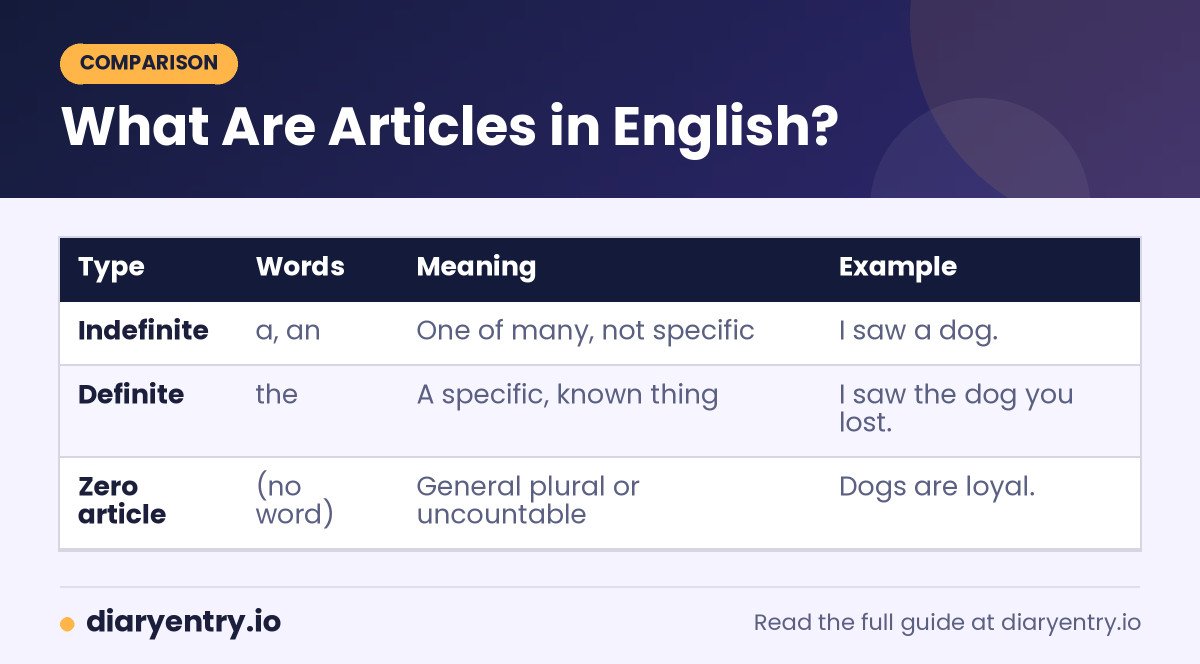
| Type | Words | Meaning | Example |
|---|---|---|---|
| Indefinite | a, an | One of many, not specific | I saw a dog. |
| Definite | the | A specific, known thing | I saw the dog you lost. |
| Zero article | (no word) | General plural or uncountable | Dogs are loyal. |
Indefinite Articles: A and An
“A” and “an” mean “one,” but they are used when the noun is not specific or is being mentioned for the first time. They are used only with singular countable nouns. You cannot say “a water” or “a apples.”
Rule 1: Use “a” before a consonant sound
- a book
- a pencil
- a teacher
- a university (it begins with the sound “yoo”)
- a one-day trip (it begins with the sound “wun”)
Rule 2: Use “an” before a vowel sound
- an apple
- an umbrella
- an hour (the “h” is silent)
- an honest answer
- an MBA (it begins with the sound “em”)
The key idea is that the rule follows the sound, not the first letter. This is the single most important point in any article rules guide.
Rule 3: Use “a” or “an” to introduce something new
When you mention a person or thing for the first time, use “a” or “an.” On the second mention, switch to “the.”
- I bought a notebook and a pen. The notebook was red, and the pen was blue.
Rule 4: Use “a” or “an” with jobs, nationalities and identities
- She is a doctor.
- He is an engineer.
- My neighbour is a Canadian.
Rule 5: Use “a” or “an” for “per” and “one”
- She visits the library twice a week.
- I need an hour to finish this.
The Definite Article: The
“The” points to a specific noun that the speaker and the listener both know about. It can be used with singular, plural and uncountable nouns.
Rule 1: Use “the” for something already mentioned
- I met a girl and a boy. The girl was from Delhi.
Rule 2: Use “the” when only one exists
- the sun, the moon, the sky, the earth, the equator
- the Prime Minister, the President (when talking about the current office-holder in a known context)
Rule 3: Use “the” when the context makes the noun clear
- Please close the door. (We both know which door.)
- The teacher is late. (The teacher of our class.)
Rule 4: Use “the” with superlatives and ordinals
This pattern is covered in more detail in our guide to degrees of comparison with rules and examples.
- She is the tallest girl in the class.
- This is the first chapter.
- It was the best day of my life.
Rule 5: Use “the” with some groups and categories
- the poor, the rich, the elderly
- the French, the Chinese (a nationality as a whole group)
Rule 6: Use “the” with certain geographical names
- Rivers: the Ganges, the Nile, the Yamuna
- Oceans and seas: the Pacific, the Arabian Sea
- Mountain ranges: the Himalayas, the Alps
- Island groups: the Maldives, the Andaman Islands
- Deserts: the Sahara, the Thar
- Countries with plural or “union” names: the United States, the Netherlands, the United Arab Emirates
Rule 7: Use “the” with musical instruments and some inventions
- She plays the guitar.
- The telephone changed communication.
No Article: The Zero Article
Sometimes the correct choice is to use no article at all. Grammarians call this the zero article.
With plural and uncountable nouns in a general sense
- Books are my best friends.
- Water is essential for life.
- Honesty matters.
If you want to know why “water” and “advice” cannot take “a,” see our explanation of countable and uncountable nouns in the guide to types of nouns with definitions and examples.
With names of people, most countries and cities
- Riya lives in India.
- We visited Paris last year.
With languages, subjects and sports
- She speaks French.
- He is good at mathematics.
- They play cricket every weekend.
With meals, days, months and seasons (in general use)
- We have lunch at one o’clock.
- I will see you on Monday.
- Winter starts in December.
With certain institutions when used for their main purpose
Compare these pairs. The first uses the zero article because we are talking about the purpose of the place, and the second uses “the” because we mean the physical building.
- She goes to school every morning. / I went to the school to meet the principal.
- He is in hospital after the accident. / I visited him at the hospital.
- They are at church. / The church was built in 1900.
With “by” and means of transport
- We travelled by train.
- She goes to work by bus.
Quick Rules Chart for Choosing the Right Article
Use this table as a fast checklist when you are not sure.
| Situation | Article | Example |
|---|---|---|
| First mention, singular countable | a / an | I need a laptop. |
| Second mention | the | The laptop is old. |
| Unique thing | the | The sun is bright. |
| Plural, general meaning | none | Cats like milk. |
| Uncountable, general meaning | none | Music relaxes me. |
| Superlative | the | He is the fastest runner. |
| Profession | a / an | She is an architect. |
| River, ocean, mountain range | the | The Ganges is long. |
| Single mountain, lake, country | none | Mount Everest is tall. |
“A” vs “An” Sound Chart
Because the choice depends on pronunciation, some words trick learners. Read the chart carefully.
| Word | Correct article | Reason |
|---|---|---|
| hour | an hour | Silent h, starts with a vowel sound |
| honest | an honest man | Silent h |
| university | a university | Starts with “yoo” |
| European | a European | Starts with “yoo” |
| one-time | a one-time offer | Starts with “wun” |
| umbrella | an umbrella | Starts with a vowel sound |
| MP | an MP | “Em” starts with a vowel sound |
| unicorn | a unicorn | Starts with “yoo” |
| heir | an heir | Silent h |
| hotel | a hotel | The h is pronounced |
Articles with Adjectives and Other Modifiers
When an adjective comes before the noun, the article follows the sound of the adjective, not the noun.
- an old house (not “a old house”)
- a beautiful house
- an unusual idea
- a useful tool
When you describe a noun in detail, you may also use “the” if the description makes the noun specific.
- The red car outside is mine.
- I like the movie we watched yesterday.
If you want to review adjectives themselves, our guide on the parts of speech with definitions and examples places adjectives and articles in the larger picture. For a closer look at adjectives alone, see our guide to types of adjectives with definitions and examples.
Articles with Prepositions
A noun that follows a preposition may need an article, and the right choice depends on the meaning. Our prepositions guide with rules and examples covers these pairings in more detail.
- She is in the garden. (a specific place)
- She is at home. (no article with “home”)
- He went to bed early. (no article, because it refers to the activity of sleeping)
- He sat on the bed. (a specific piece of furniture)
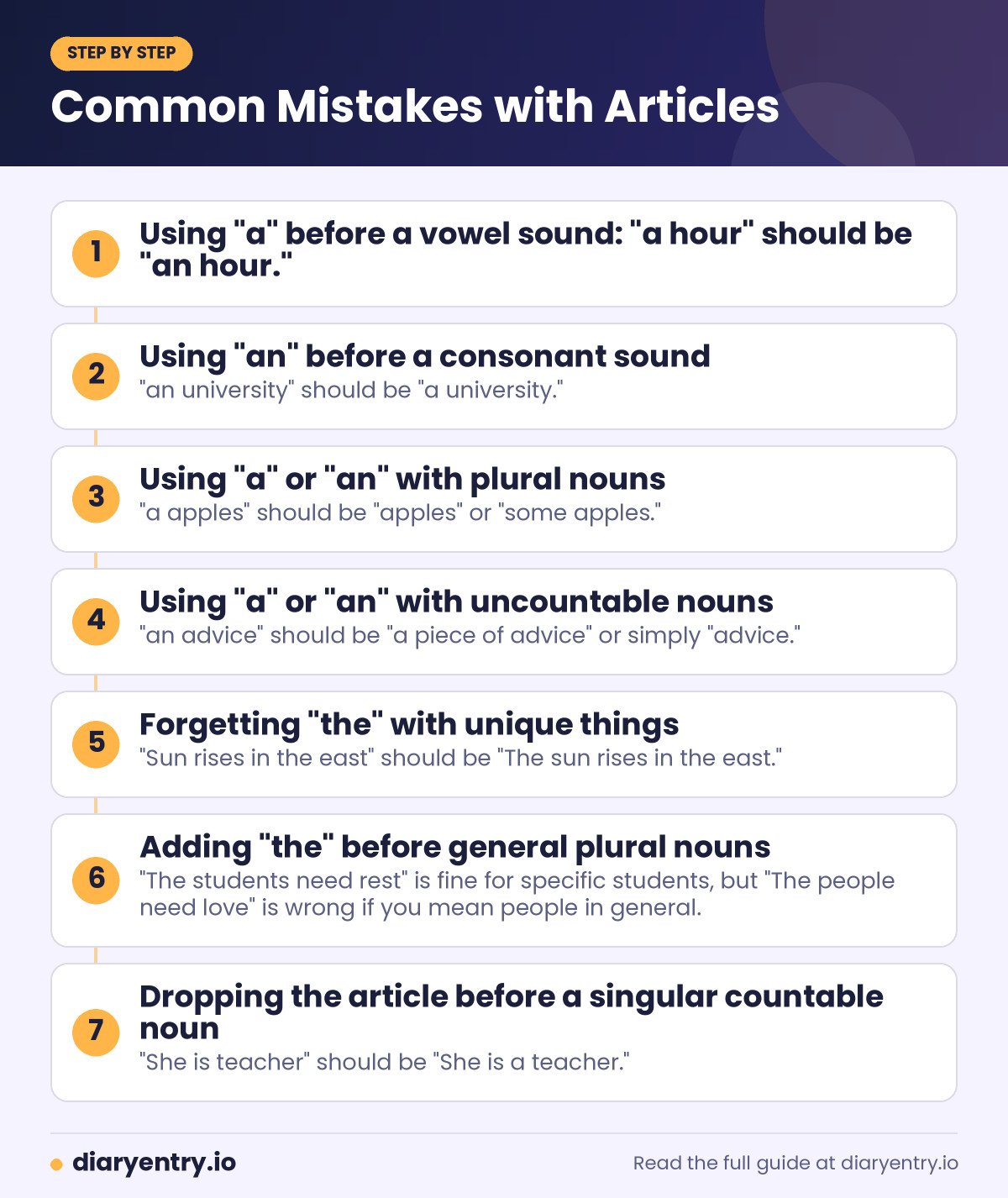
Common Mistakes with Articles
These mistakes appear again and again in student writing. Check your work for them.
- Using “a” before a vowel sound: “a hour” should be “an hour.”
- Using “an” before a consonant sound: “an university” should be “a university.”
- Using “a” or “an” with plural nouns: “a apples” should be “apples” or “some apples.”
- Using “a” or “an” with uncountable nouns: “an advice” should be “a piece of advice” or simply “advice.”
- Forgetting “the” with unique things: “Sun rises in the east” should be “The sun rises in the east.”
- Adding “the” before general plural nouns: “The students need rest” is fine for specific students, but “The people need love” is wrong if you mean people in general.
- Dropping the article before a singular countable noun: “She is teacher” should be “She is a teacher.”
- Adding “the” before most country names: “The India is large” should be “India is large.”
Worked Examples with Explanations
Cover the answer and fill in the blank before you read on.
- “She bought ____ umbrella.” “Umbrella” begins with a vowel sound, so the answer is “an.”
- “He is ____ honest boy.” The “h” is silent, so the answer is “an.”
- “I saw ____ elephant. ____ elephant was huge.” The first mention takes “an,” and the second mention takes “the.”
- “____ Ganges flows through India.” Rivers take “the,” so the answer is “The.”
- “____ gold is a precious metal.” This is an uncountable noun used in a general sense, so no article is needed.
- “My sister plays ____ piano.” Musical instruments usually take “the,” so the answer is “the.”
- “It is ____ best film of the year.” A superlative takes “the,” so the answer is “the.”
- “She works as ____ nurse.” A job takes “a” or “an,” so the answer is “a.”
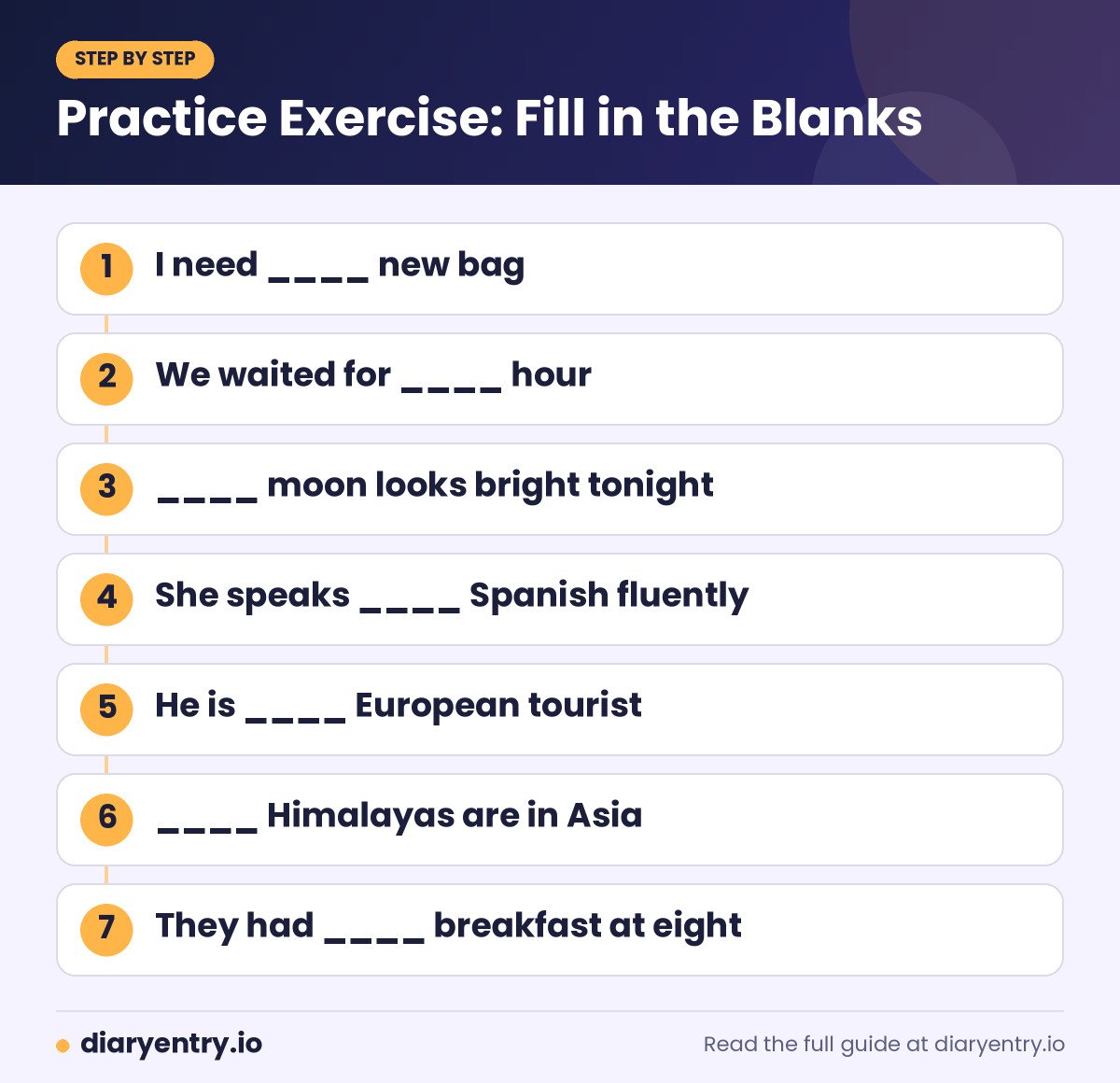
Practice Exercise: Fill in the Blanks
Fill in the blank with a, an, the, or no article (write X). Answers follow the list.
- I need ____ new bag.
- We waited for ____ hour.
- ____ moon looks bright tonight.
- She speaks ____ Spanish fluently.
- He is ____ European tourist.
- ____ Himalayas are in Asia.
- They had ____ breakfast at eight.
- This is ____ most interesting book I have read.
Answers: 1 a; 2 an; 3 The; 4 X; 5 a; 6 The; 7 X; 8 the.
Articles in Everyday Writing
Articles matter in more than grammar tests. In emails, letters and school essays, a missing or wrong article can make your sentence feel unfinished. If you keep a diary or journal, you can use it as a low-pressure place to practise. Try writing three or four sentences about your day, then check each noun and ask: is it singular, plural or uncountable, and is it specific or general?
For example, compare “I read a book today” with “I read the book you recommended today.” The first introduces a new book. The second points to a known book. Noticing that difference in your own writing is the fastest way to build instinct.
If you want a steady routine for this kind of practice, the 4-Week Diary Entry Course gives you a daily structure for writing short, clear entries.
Frequently Asked Questions About Articles
What are articles in English grammar?
Articles are the words a, an and the. They come before nouns and show whether the noun is general (a, an) or specific (the).
What is the difference between “a” and “an”?
Both are indefinite articles. Use “a” before a consonant sound, as in “a book,” and “an” before a vowel sound, as in “an apple.”
When do we use “the”?
Use “the” for a specific or already-mentioned noun, for unique things such as the sun, for superlatives, and for names such as rivers, oceans and mountain ranges.
When do we use no article?
Use no article with plural nouns and uncountable nouns in a general sense, with most names of people, cities and countries, and with languages, sports and meals.
Why is it “an hour” but “a university”?
The choice depends on sound. “Hour” begins with a vowel sound because the “h” is silent, so it takes “an.” “University” begins with the sound “yoo,” a consonant sound, so it takes “a.”
Can we use “a” with uncountable nouns?
No. Words such as water, advice, furniture and information are uncountable and do not take “a” or “an.” Use “some” or a unit such as “a piece of” or “a glass of.”
Do we use “the” before names of countries?
Usually not. We say “India” and “France.” But we use “the” with plural names or names containing a union, such as “the United States” and “the Netherlands.”
Conclusion
Articles a, an, the look small, but they carry a lot of meaning. Remember that “a” and “an” introduce something new, “the” points to something known, and sometimes no article is the right choice. Choose by sound, check whether the noun is countable and specific, and learn the common patterns for places and institutions. With regular practice, the rules become second nature, and your writing will sound clear and natural.