
Quick Answer
Question tags are short questions added to the end of a statement, such as “You like tea, don’t you?” They turn a statement into a request for confirmation or agreement. The basic rule is simple: a positive statement takes a negative tag, and a negative statement takes a positive tag, using the same auxiliary verb.
Key Takeaways
- A question tag is a mini-question made of an auxiliary verb plus a pronoun, added after a comma.
- A positive statement takes a negative tag, and a negative statement takes a positive tag.
- The tag repeats the auxiliary verb of the statement, or uses do, does or did when there is none.
- Falling intonation asks for agreement; rising intonation asks a real question.
- Exceptions such as “I am”, “Let’s” and imperatives have their own fixed tags.
What Are Question Tags?
Question tags, also called tag questions, are small questions attached to the end of a sentence. They are separated from the statement by a comma and always end with a question mark. The speaker uses them to check information, invite agreement or keep a conversation friendly.
Take the sentence “It is a lovely day, isn’t it?” The first part is a statement. The tag “isn’t it” asks the listener to confirm what the speaker already believes. Question tags are common in spoken English and informal writing, and they also appear in school grammar exercises, which is why many students search for question tags rules and examples before an exam.
A tag has only two parts: an auxiliary (helping) verb and a subject pronoun. If you know how to match those two parts to the main sentence, you can form any tag in seconds.
The Basic Rule: Opposite Polarity
The most important rule is called opposite polarity. If the main statement is positive, the tag is negative. If the statement is negative, the tag is positive.
| Statement | Tag | Full sentence |
|---|---|---|
| Positive | Negative | She plays the piano, doesn’t she? |
| Negative | Positive | She doesn’t play the piano, does she? |
| Positive | Negative | They were late, weren’t they? |
| Negative | Positive | They weren’t late, were they? |
Notice that the tag uses a pronoun, not a noun. “Riya is coming, isn’t she?” is correct, while “Riya is coming, isn’t Riya?” is not. If you need a refresher on which pronoun replaces which noun, see our guide to the types of pronouns with definitions and examples.
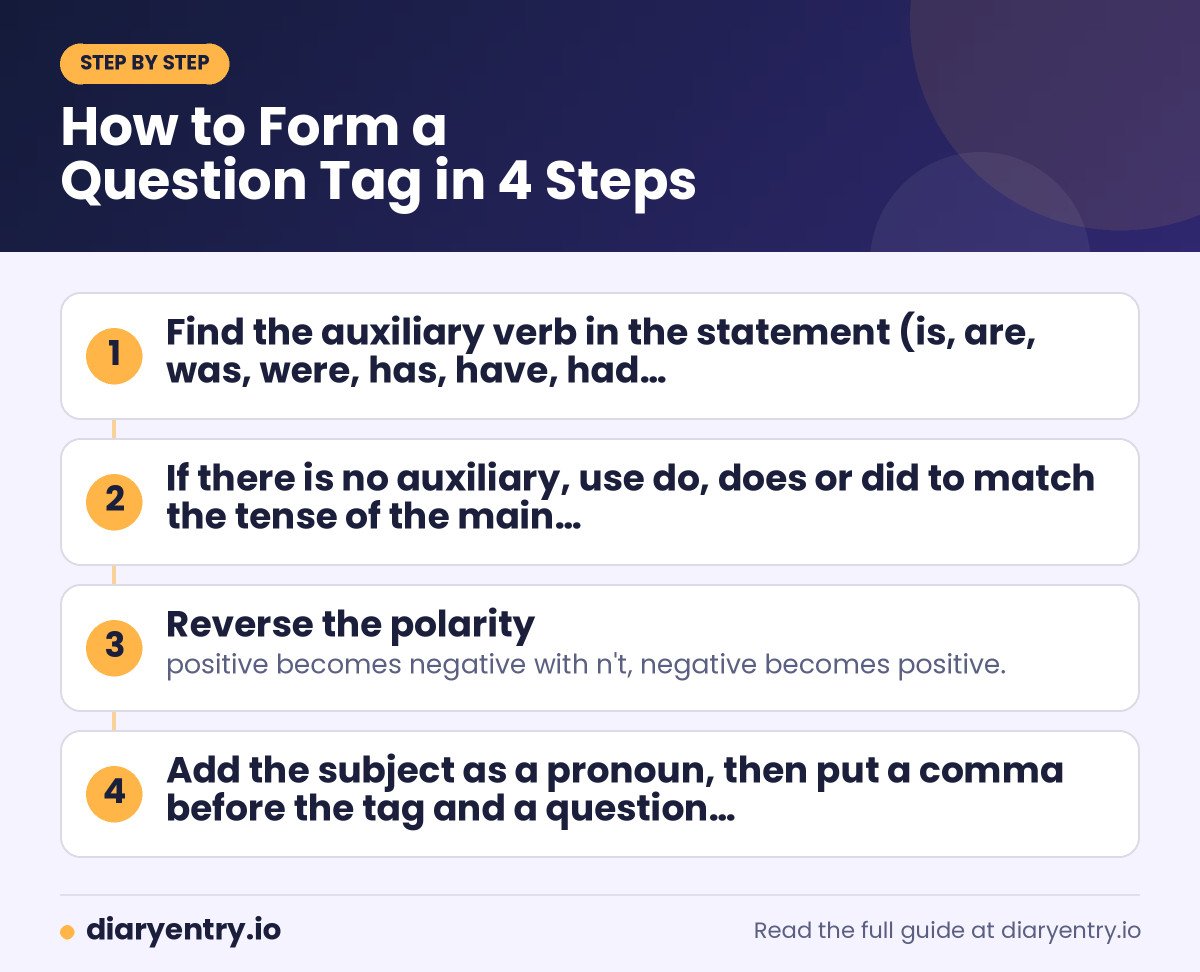
How to Form a Question Tag in 4 Steps
Follow these steps every time and you will rarely make a mistake.
- Find the auxiliary verb in the statement (is, are, was, were, has, have, had, will, would, can, could, shall, should, may, might, must).
- If there is no auxiliary, use do, does or did to match the tense of the main verb.
- Reverse the polarity: positive becomes negative with n’t, negative becomes positive.
- Add the subject as a pronoun, then put a comma before the tag and a question mark after it.
Here is the method on one sentence. “Your brother has finished his homework.” The auxiliary is “has.” The statement is positive, so the tag is negative: “hasn’t.” The subject “your brother” becomes “he.” The result is “Your brother has finished his homework, hasn’t he?”
Question Tags with Different Tenses
The tag always follows the tense of the statement. Because the tag borrows the auxiliary verb, knowing your tenses helps a lot. Our tenses chart covering all 12 tenses is a useful companion while you practise.
Present and past simple
There is no auxiliary in the present simple or past simple, so we use do, does or did.
- You live near the school, don’t you?
- He works late on Fridays, doesn’t he?
- They visited the museum, didn’t they?
- She doesn’t eat meat, does she?
Continuous tenses
The auxiliary is a form of “be,” and the tag repeats it.
- The children are playing outside, aren’t they?
- It was raining this morning, wasn’t it?
- You aren’t leaving yet, are you?
Perfect tenses
The auxiliary is have, has or had.
- We have met before, haven’t we?
- She had already left, hadn’t she?
- You haven’t seen my keys, have you?
Future and modal verbs
Use the same modal verb in the tag.
- They will join us later, won’t they?
- You can swim, can’t you?
- He should apologise, shouldn’t he?
- She would help us, wouldn’t she?
Special Cases You Must Remember
Most tag questions follow the opposite polarity rule, but a handful of patterns are exceptions. These are the ones that cost students marks in exams.
“I am” becomes “aren’t I”
The standard tag for “I am” is “aren’t I,” even though “am not I” sounds odd and “amn’t I” is not standard English.
- I am right, aren’t I?
- I am not late, am I? (the negative statement follows the normal rule)
“Let’s” becomes “shall we”
When someone makes a suggestion with “let’s,” the tag is “shall we.”
- Let’s go for a walk, shall we?
Imperatives
Commands and requests take “will you,” “won’t you,” “would you,” “can you” or “could you.” Positive commands often use “will you” or “won’t you,” and negative commands use “will you.”
- Close the window, will you?
- Please sit down, won’t you?
- Don’t be late, will you?
Statements with “there”
When the sentence begins with “there,” keep “there” in the tag.
- There is a test tomorrow, isn’t there?
- There weren’t any tickets left, were there?
Statements with “this” and “that”
Use “it” in the tag for singular things and “they” for plural things.
- This is your pencil, isn’t it?
- Those are new shoes, aren’t they?
Indefinite pronouns
With “everyone,” “someone,” “anyone” and “no one,” most speakers use “they” in the tag. With “everything,” “something,” “nothing” and “anything,” use “it.”
- Everyone enjoyed the trip, didn’t they?
- Nothing is wrong, is it?
- Someone called you, didn’t they?
Statements that are already negative in meaning
Words such as never, hardly, barely, seldom, rarely, nobody and nothing make a sentence negative in meaning even when there is no “not.” These sentences take a positive tag.
- He never complains, does he?
- You hardly know her, do you?
- Nobody called, did they?
“Have” as a main verb
When “have” shows possession or means “eat,” “take” or “experience,” many speakers use do in the tag. In British English you may also see “have” used as the auxiliary for possession, but the do version is safer and more widely accepted.
- She has a bicycle, doesn’t she?
- They had lunch early, didn’t they?
Intonation: Does the Tag Ask or Confirm?
The same words can mean two different things depending on your voice. This is one of the most overlooked points in written guides.
If your voice falls at the end of the tag, you are almost sure of the answer and you want agreement. “It’s cold today, isn’t it?” with falling intonation is small talk.
If your voice rises at the end of the tag, you are genuinely unsure and want information. “You’ve locked the door, haven’t you?” with rising intonation is a real question.
In writing, the question mark does not show which one you mean, so the context must make it clear. This is why tags feel natural in dialogue and speech. If you write conversations for school, our guide to dialogue writing format with samples and topics shows where tags fit in a natural exchange.
Answering Question Tags
The answer to a tag question depends on the facts, not on the polarity of the tag. This catches many learners out.
- “You like cricket, don’t you?” Yes, I do. (I like cricket.) No, I don’t. (I do not like cricket.)
- “You don’t like cricket, do you?” Yes, I do. (Contrary to your guess, I like it.) No, I don’t. (You are right, I do not.)
If the answer could be confusing, add a full sentence: “No, I don’t like cricket.” That removes any doubt.
Question Tags in Reported Speech
When you report a sentence that contains a tag, the tag usually disappears and the reporting verb carries the meaning of checking or confirming.
- Direct: “You have finished, haven’t you?” he asked.
- Reported: He asked me if I had finished.
Because the tag is not repeated, you only need to change the tense and pronouns of the main statement. Our guide to direct and indirect speech rules with a chart and examples explains these changes step by step.
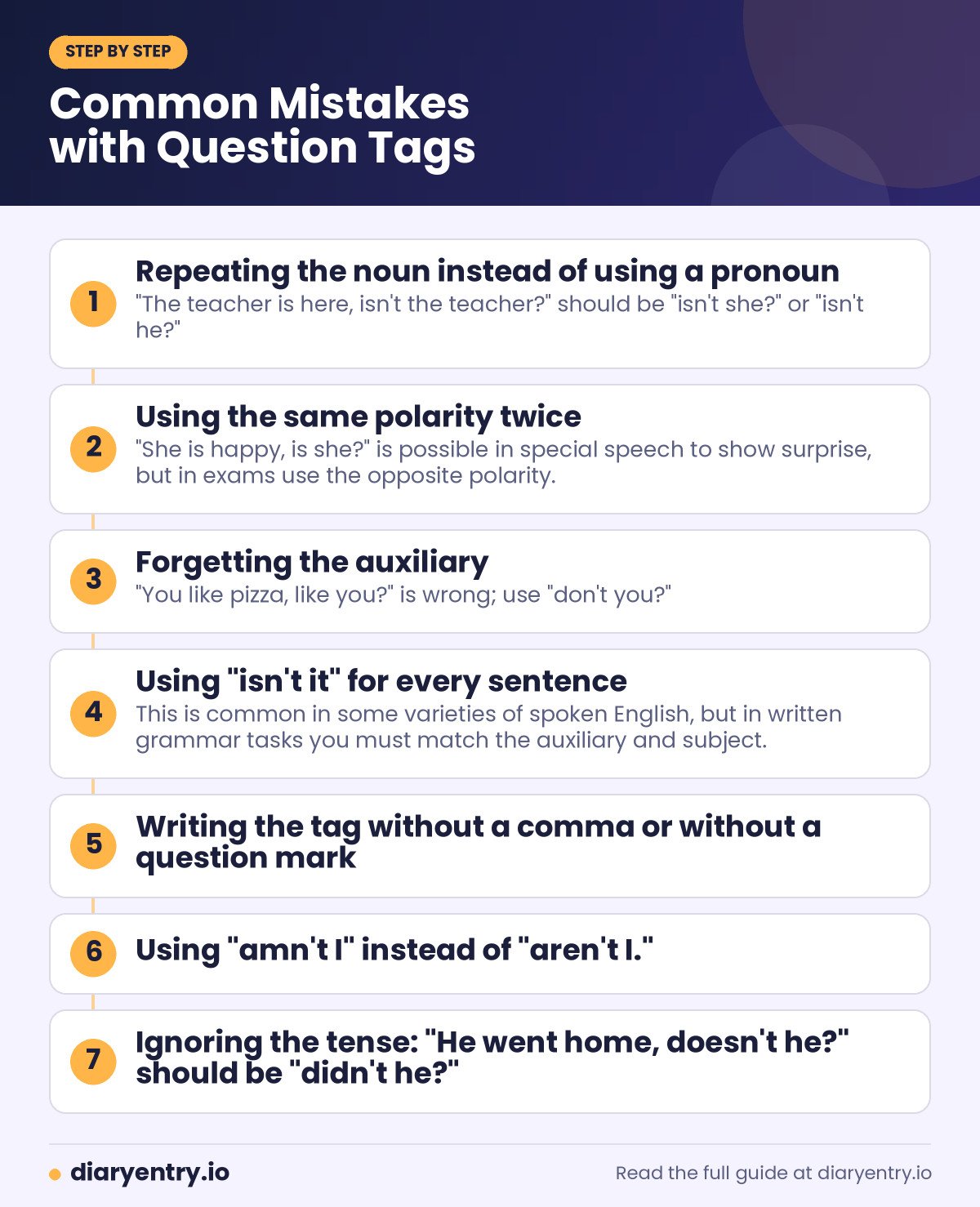
Common Mistakes with Question Tags
Even confident writers slip up on a few patterns. Watch for these.
- Repeating the noun instead of using a pronoun: “The teacher is here, isn’t the teacher?” should be “isn’t she?” or “isn’t he?”
- Using the same polarity twice: “She is happy, is she?” is possible in special speech to show surprise, but in exams use the opposite polarity.
- Forgetting the auxiliary: “You like pizza, like you?” is wrong; use “don’t you?”
- Using “isn’t it” for every sentence. This is common in some varieties of spoken English, but in written grammar tasks you must match the auxiliary and subject.
- Writing the tag without a comma or without a question mark.
- Using “amn’t I” instead of “aren’t I.”
- Ignoring the tense: “He went home, doesn’t he?” should be “didn’t he?”
The tag must agree with the subject and tense, much like a verb must agree with its subject. If you want to strengthen that skill too, read our explanation of subject verb agreement rules and examples.
Worked Examples with Explanations
Study these examples and cover the answers with your hand before reading the explanation.
- “Ananya sings beautifully, ____?” The verb “sings” has no auxiliary, the sentence is positive, and the subject is “she.” The tag is “doesn’t she.”
- “You haven’t eaten yet, ____?” The auxiliary is “have,” the statement is negative, so the tag is positive: “have you.”
- “They will not be late, ____?” The auxiliary is “will,” the statement is negative: “will they.”
- “Open the door, ____?” This is an imperative, so the tag is “will you.”
- “Let us begin, ____?” The tag is “shall we.”
- “She seldom visits, ____?” “Seldom” is negative in meaning, so the tag is positive: “does she.”
- “I am your friend, ____?” The tag is “aren’t I.”
Question Tag Practice Exercise
Fill in the blank with the correct tag. The answers follow the list.
- The match started on time, ____?
- You don’t know the answer, ____?
- He can drive, ____?
- We should leave early, ____?
- Nobody was injured, ____?
- There is some milk left, ____?
- Don’t make noise, ____?
- She had finished the book, ____?
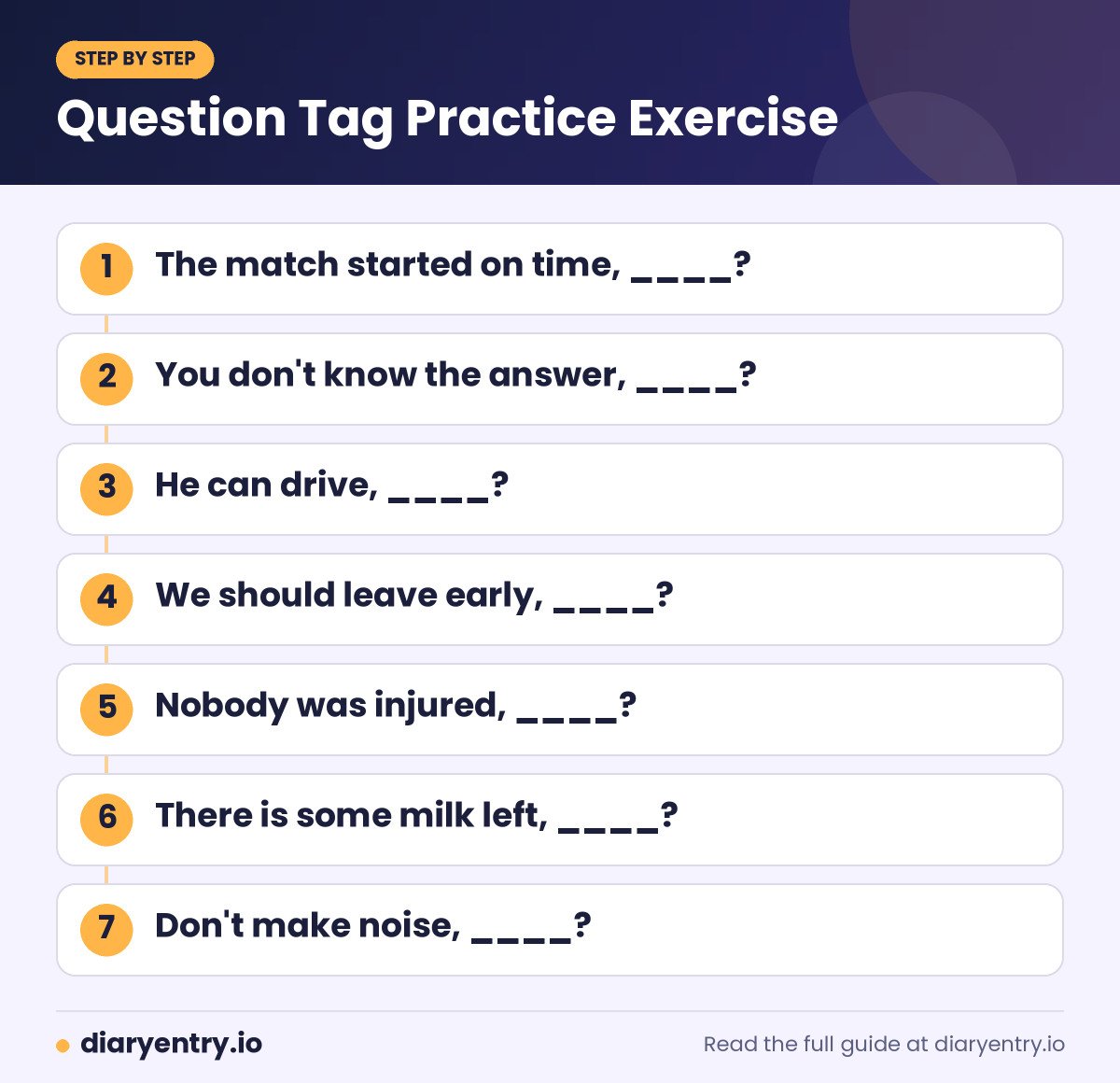
Answers: 1 didn’t it; 2 do you; 3 can’t he; 4 shouldn’t we; 5 were they; 6 isn’t there; 7 will you; 8 hadn’t she.
Question Tags vs Other Question Types
Question tags are one of several question forms in English. Knowing how they differ helps you pick the right form for the task.
| Type | Example | Purpose |
|---|---|---|
| Yes/no question | Do you like tea? | Asks a neutral question |
| Wh- question | What do you like? | Asks for specific information |
| Question tag | You like tea, don’t you? | Seeks confirmation of a belief |
| Echo question | You like tea? | Shows surprise or checks what was said |
If you want to see how question forms fit into the bigger picture of sentence design, the parts of speech guide with definitions and examples is a good place to review auxiliary verbs, pronouns and the other building blocks.
Tips to Master Question Tags
Learning the rule is only the first step. These habits make tags automatic.
- Say the full sentence out loud with the tag. Your ear will catch mismatches faster than your eye.
- Underline the auxiliary verb before writing the tag.
- Practise with your own daily sentences. Writing a short note about your day, with two or three tags in it, is a gentle way to practise grammar inside real writing.
- Keep a short list of the exceptions: aren’t I, shall we, will you, they and it.
- Read short dialogues in books and notice where characters use tags.
If you enjoy building a regular writing habit, the 4-Week Diary Entry Course gives you a daily structure for practising sentences like these in your own words.
Frequently Asked Questions About Question Tags
What is a question tag in English?
A question tag is a short question added to the end of a statement to ask for confirmation or agreement. It consists of an auxiliary verb and a pronoun, for example “isn’t it?” or “don’t you?”
What is the rule for question tags?
Use opposite polarity: a positive statement takes a negative tag, and a negative statement takes a positive tag. The tag repeats the auxiliary verb, or uses do, does or did if there is no auxiliary.
What is the question tag for “I am”?
The question tag for “I am” is “aren’t I.” For example, “I am next, aren’t I?”
What is the question tag for “let’s”?
The question tag for “let’s” is “shall we.” For example, “Let’s start, shall we?”
What are the question tags for imperatives?
Imperative sentences usually take “will you,” “won’t you,” “would you,” “can you” or “could you.” “Don’t” commands take “will you.”
Do question tags need a comma?
Yes. Place a comma between the statement and the tag, and finish the sentence with a question mark.
Are question tags used in formal writing?
Rarely. Question tags belong mostly to spoken English, informal letters, dialogue and exercises. In formal essays and reports they are usually avoided.
Conclusion
Question tags look tricky only until you notice the pattern: find the auxiliary, flip the polarity and add the right pronoun. Learn the handful of exceptions, listen to how intonation changes the meaning, and practise with real sentences. With a little regular practice, question tags rules and examples stop feeling like a list to memorise and start feeling like part of how you speak and write.