
Quick Answer
Figures of speech are expressions that use words in a non-literal way to add emphasis, imagery, or humour. Common figures of speech include simile, metaphor, personification, hyperbole, alliteration, onomatopoeia, irony, and oxymoron. Instead of stating facts plainly, they create pictures and feelings in the reader’s mind.
Key Takeaways
- A figure of speech uses language in a figurative, not literal, sense.
- Similes compare with “like” or “as”, while metaphors state that one thing is another.
- Sound-based figures include alliteration, assonance, and onomatopoeia.
- Figures of speech work best when used sparingly and with fresh images, not worn-out clichés.
- You can spot them by asking whether the words could be taken literally. If not, it is probably a figure of speech.
What Are Figures of Speech?
A figure of speech is a word or phrase that departs from its plain, literal meaning to create a special effect. When someone says “I’m so hungry I could eat a horse”, nobody expects a horse to appear on the plate. The speaker is using exaggeration to show how hungry they are, and every listener understands it at once.
Writers, poets, advertisers, and ordinary speakers use figures of speech all the time. They make writing vivid, help readers remember an idea, and let a writer express feeling without long explanations. Figures of speech are part of a wider idea called figurative language, which is the opposite of literal language. Literal language says exactly what it means. Figurative language says one thing to suggest another.
Many figures of speech depend on grammar, so it helps to know how words work in a sentence. Our guide to parts of speech is a useful companion when you are analysing why a line works.
Why Do Writers Use Figures of Speech?
There are four main reasons. First, they create imagery: “the city was a beehive” is more vivid than “the city was busy”. Second, they add emotion: “my heart was heavy” says more about sadness than a bare statement does. Third, they make ideas memorable, which is why proverbs and advertising slogans are full of them. Fourth, they add style and personality, helping a writer sound distinct.
Main Types of Figures of Speech
Teachers usually group figures of speech by how they work. The three groups below cover the ones students meet most often in school exams and everyday reading.
Figures Based on Comparison
Simile. A simile compares two different things using “like” or “as”. Example: “She is as brave as a lion.” “The baby slept like a log.” The comparison is stated openly, and the reader sees both things.
Metaphor. A metaphor says that one thing is another, with no “like” or “as”. Example: “Time is a thief.” “The classroom was a zoo.” A metaphor is stronger and more direct than a simile because it merges the two ideas.
Personification. Personification gives human qualities to an object, animal, or idea. Example: “The wind whispered through the trees.” “Opportunity knocked at his door.”
Metonymy and synecdoche. In metonymy, something is named by a closely related word: “The crown” for the king or queen, “the pen is mightier than the sword” where pen means writing and sword means force. In synecdoche, a part stands for the whole: “All hands on deck” means all sailors, and “a new set of wheels” means a car.
Figures Based on Emphasis or Contrast
Hyperbole. Deliberate exaggeration for effect: “I have told you a million times.” “This bag weighs a ton.”
Understatement (meiosis). The opposite of hyperbole, it makes something sound smaller than it is: “It’s just a scratch” about a deep cut.
Oxymoron. Two opposite words placed together: “deafening silence”, “bittersweet”, “living dead”.
Paradox. A statement that seems self-contradictory but contains a truth: “The more you learn, the less you know.”
Antithesis. Contrasting ideas set in balanced phrases: “To err is human; to forgive, divine.” “Give me liberty or give me death.”
Irony. Saying the opposite of what is meant, or a situation that turns out the reverse of what was expected. If it pours with rain on a picnic day and you say “What lovely weather!”, that is verbal irony.
Euphemism. A mild word used in place of a harsh one: “passed away” for “died”, “let go” for “fired”.
Figures Based on Sound
Alliteration. Repeating the same starting consonant sound: “Peter Piper picked a peck of pickled peppers.”
Assonance. Repeating vowel sounds inside nearby words: “The rain in Spain stays mainly in the plain.”
Onomatopoeia. Words that imitate the sound they name: buzz, sizzle, splash, thud, bang.
Apostrophe. Speaking directly to someone absent, dead, or to an object or idea: “O Death, where is thy sting?” Do not confuse it with the punctuation mark of the same name.
Figures of Speech at a Glance
| Figure of speech | What it does | Example |
|---|---|---|
| Simile | Compares using like or as | Her smile was as bright as the sun. |
| Metaphor | States one thing is another | The exam was a mountain to climb. |
| Personification | Gives human traits to non-human things | The old house groaned in the storm. |
| Hyperbole | Exaggerates for effect | I’m so tired I could sleep for a week. |
| Oxymoron | Joins opposite words | The room fell into a deafening silence. |
| Alliteration | Repeats starting consonant sounds | The silly snake slid silently. |
| Onomatopoeia | Imitates a sound | The bees buzzed around the flowers. |
| Irony | Means the opposite of what is said | “Great job!” he said after she dropped the tray. |
| Euphemism | Softens a harsh idea | He passed away peacefully. |
Simile vs Metaphor: What Is the Difference?
This is the pair students confuse most. The test is simple. If the sentence contains “like” or “as” to compare two different things, it is a simile. If it says one thing is another, it is a metaphor.
| Feature | Simile | Metaphor |
|---|---|---|
| Signal words | Uses like or as | Uses neither |
| Strength | Softer, openly a comparison | Stronger, direct identification |
| Example | He ran like the wind. | He was the wind on the track. |
Beware one trap: “like” does not always signal a simile. “I like pizza” and “She looks like her mother” are not figures of speech. A simile compares two things that are different in kind, such as a person and a lion.
How to Identify a Figure of Speech: Step by Step
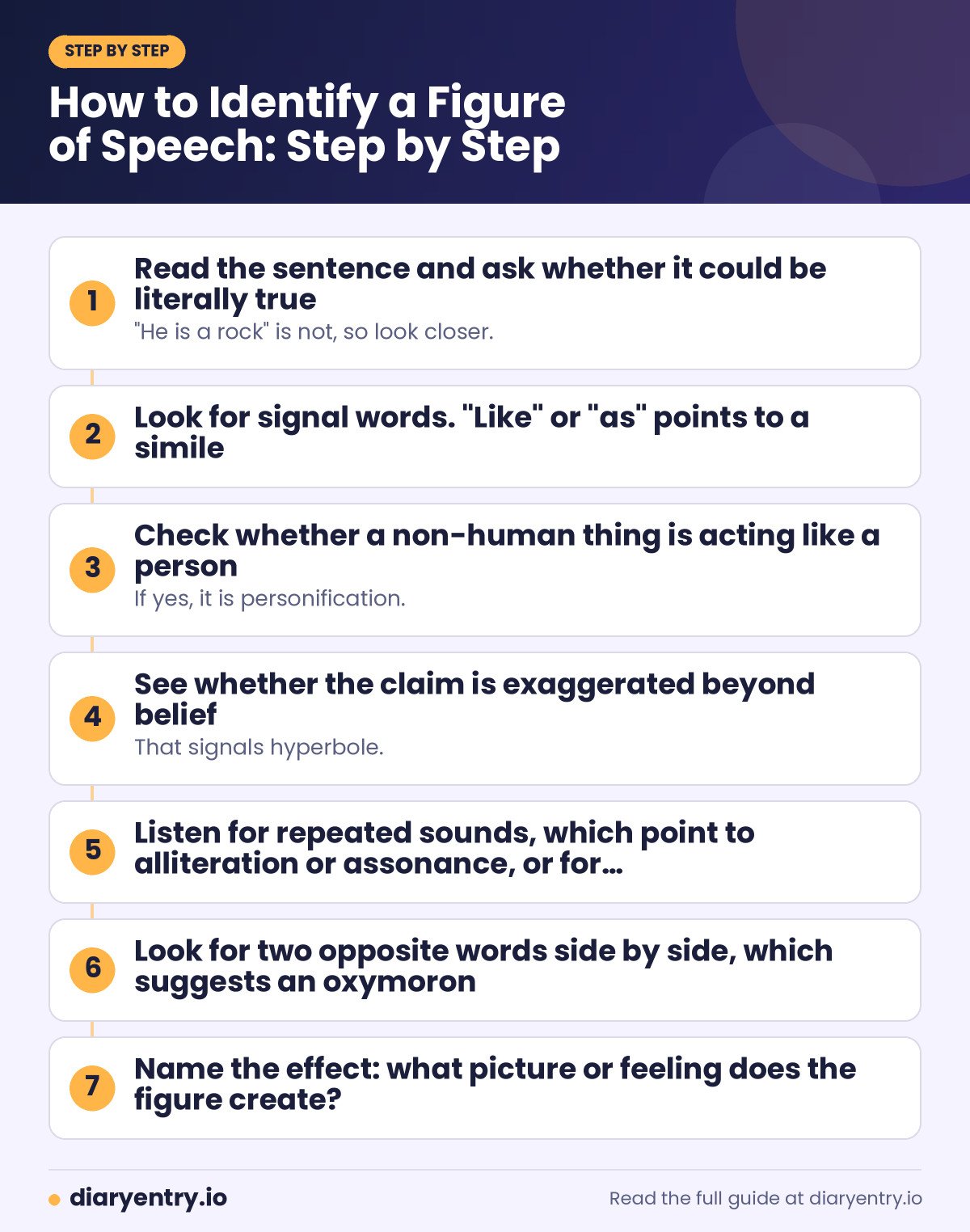
- Read the sentence and ask whether it could be literally true. “He is a rock” is not, so look closer.
- Look for signal words. “Like” or “as” points to a simile.
- Check whether a non-human thing is acting like a person. If yes, it is personification.
- See whether the claim is exaggerated beyond belief. That signals hyperbole.
- Listen for repeated sounds, which point to alliteration or assonance, or for words that mimic noise, which are onomatopoeia.
- Look for two opposite words side by side, which suggests an oxymoron.
- Name the effect: what picture or feeling does the figure create?
Solved Examples
Name the figure of speech in each sentence.
| Sentence | Figure of speech | Reason |
|---|---|---|
| The stars danced in the night sky. | Personification | Stars cannot dance. |
| My brother is a night owl. | Metaphor | Compares a person to an owl without like or as. |
| The coffee was as cold as ice. | Simile | Uses “as…as” to compare. |
| The engine roared and sputtered. | Onomatopoeia | Roared and sputtered imitate sound. |
| I have a ton of homework. | Hyperbole | Exaggerates the amount. |
| It was a pretty ugly dress. | Oxymoron | Pretty and ugly are opposites. |
Practice Questions
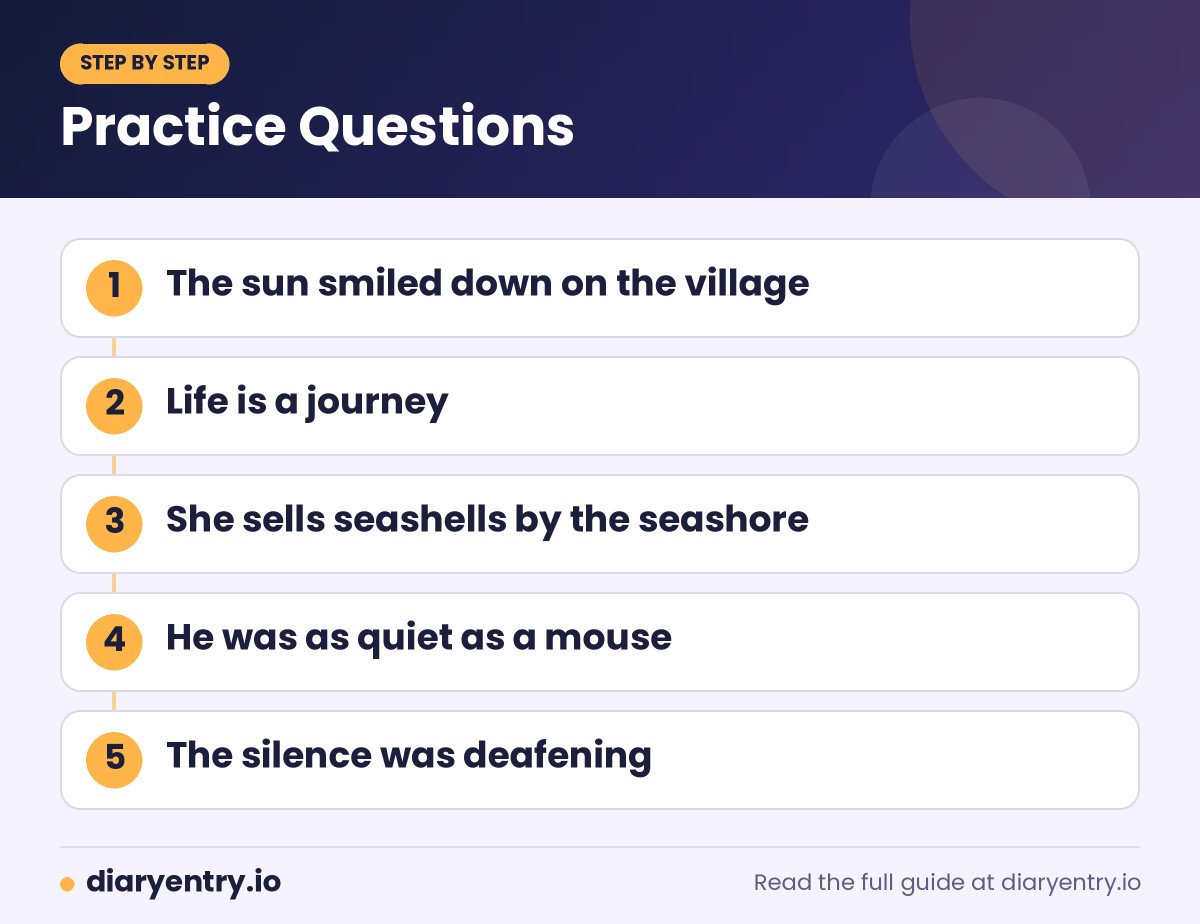
- The sun smiled down on the village.
- Life is a journey.
- She sells seashells by the seashore.
- He was as quiet as a mouse.
- The silence was deafening.
Answers: 1. Personification; 2. Metaphor; 3. Alliteration; 4. Simile; 5. Oxymoron.
Figures of Speech in Everyday Writing
You do not need to wait for an exam to use figures of speech. A diary is a good place to practise, because you are writing for yourself and can experiment freely. Instead of writing “I was nervous”, try “My stomach was a washing machine on full spin.” Instead of “It was a rainy morning”, try “The rain drummed on the window as if it wanted to come in.”
If you are new to journaling, our guide on how to write a diary entry gives you a simple structure to build on, and the diary entry prompts for students give you topics where a good simile or metaphor can lift a plain entry.
Figures of speech also belong in descriptive and narrative work, where imagery matters most. Used well, they turn “the room was messy” into “the room looked as if a storm had passed through it”.
Common Mistakes With Figures of Speech
Mixed metaphors. Combining two images that clash: “We’ll burn that bridge when we come to it.” Pick one image and keep it consistent.
Clichés. Phrases like “cold as ice” or “busy as a bee” are so common that they no longer create pictures. Try a fresh comparison drawn from your own life.
Overuse. A paragraph stuffed with six figures feels forced. One strong image per paragraph is usually enough.
Confusing hyperbole with lying. Hyperbole is clearly exaggerated for effect and nobody takes it literally. If readers could believe it, it is just an inaccurate statement.
Mislabelling a simile. Remember that a simile must compare unlike things. “She is like her sister” is a plain comparison, not a figure of speech.
Tips to Learn Figures of Speech Faster
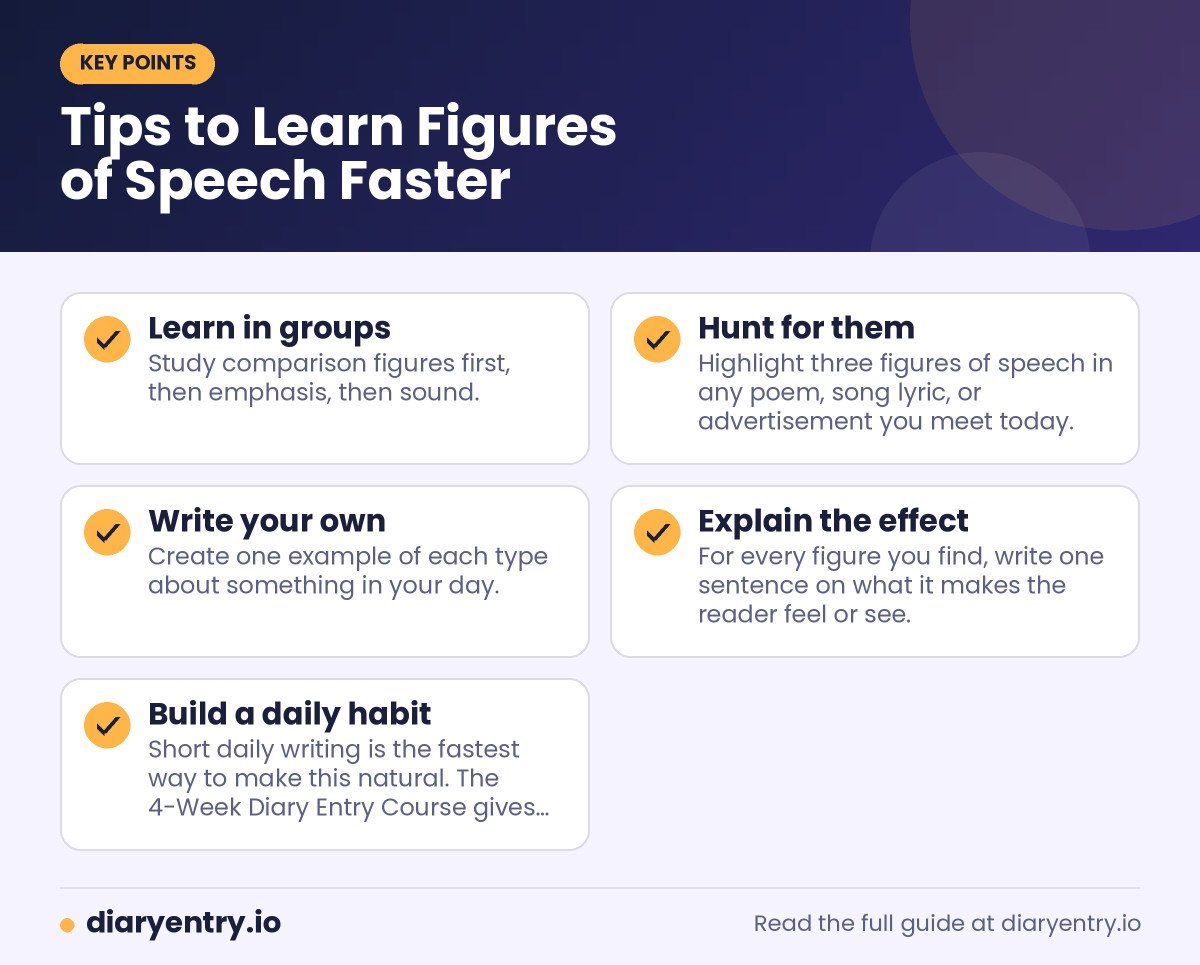
- Learn in groups. Study comparison figures first, then emphasis, then sound.
- Hunt for them. Highlight three figures of speech in any poem, song lyric, or advertisement you meet today.
- Write your own. Create one example of each type about something in your day.
- Explain the effect. For every figure you find, write one sentence on what it makes the reader feel or see.
- Build a daily habit. Short daily writing is the fastest way to make this natural. The 4-Week Diary Entry Course gives you a structure for exactly that.
Frequently Asked Questions About Figures of Speech
What is a figure of speech in simple words?
It is a way of using words so that they mean something different from their literal sense, in order to make writing or speech more colourful, emotional, or memorable.
What are the most common figures of speech?
The most common are simile, metaphor, personification, hyperbole, alliteration, onomatopoeia, irony, and oxymoron. These appear most often in school syllabuses and everyday speech.
What is the difference between a simile and a metaphor?
A simile compares two things using “like” or “as”, while a metaphor says one thing is another directly. “Brave as a lion” is a simile; “He is a lion” is a metaphor.
Is an idiom a figure of speech?
Idioms such as “break the ice” are figurative expressions, so many teachers treat them as a related kind of figurative language. They differ from classic figures because their meaning is fixed by usage and cannot be worked out from the words alone.
Are figures of speech only used in poetry?
No. They appear in news headlines, advertisements, speeches, stories, and daily conversation. Poetry just uses them more densely.
How many figures of speech are there?
There is no single agreed number. Classical rhetoric names hundreds, but students usually need to know between ten and twenty common ones.
How can I use figures of speech in my writing?
Pick one idea per paragraph that you want readers to feel, then express it with a fresh comparison or image. Keep it short, avoid clichés, and read it aloud to test whether it sounds natural.
Conclusion
Figures of speech turn plain statements into pictures, sounds, and feelings. Once you can name the main ones, from simile and metaphor to hyperbole and oxymoron, you will read more closely and write more vividly. Start small: spot one in everything you read, and try one in your own writing each day. If you would like a steady routine for that practice, the 4-Week Diary Entry Course is a friendly place to begin.