

Quick Answer
Idioms and phrases are fixed groups of words whose meaning differs from the literal meaning of the individual words. For example, “break the ice” does not mean to smash frozen water; it means to start a conversation in an awkward situation. Learning them helps you sound natural in speech, writing and exams.
Key Takeaways
- An idiom is a fixed expression whose meaning cannot be worked out from its separate words.
- A phrase is a group of words that works as one unit but may still have a literal meaning.
- Idioms should not be changed: swapping or removing words usually destroys the meaning.
- Learning idioms by theme, with a sentence for each, is more effective than memorising long alphabetical lists.
- Idioms suit informal and semi-formal writing; use them sparingly in formal documents.
- Reading widely and keeping a personal idiom notebook is the most reliable way to remember them.
What Are Idioms and Phrases?
An idiom is an expression that carries a figurative meaning. If you translated each word separately, the sentence would not make sense. When someone says “it is raining cats and dogs,” they mean it is raining very heavily, not that animals are falling from the sky. Every language has thousands of idioms, and English is especially rich in them.
The word phrase is wider. In grammar, a phrase is any group of words acting together without a subject and verb, such as “in the morning” or “very quickly.” In school syllabuses, the heading “idioms and phrases” usually means expressions with a special meaning, including idiomatic phrases, phrasal verbs and common proverbs. This article focuses on the idiomatic meaning, since that is the part that causes the most trouble.
Idioms are valuable because they compress an idea into a vivid image. “He let the cat out of the bag” is shorter and more colourful than “He accidentally revealed a secret.” That is also why they are common in newspapers, stories, interviews and competitive exams.
Idioms vs Phrases vs Phrasal Verbs vs Proverbs
Students often confuse these four terms. The table below separates them.
| Term | What it is | Example | Meaning |
|---|---|---|---|
| Idiom | Fixed figurative expression | Spill the beans | Reveal a secret |
| Phrase | Group of words acting as one unit | Over the moon | Extremely happy |
| Phrasal verb | Verb plus particle with a new meaning | Give up | Stop trying |
| Proverb | Short saying that gives advice or a truth | A stitch in time saves nine | Act early to avoid bigger problems |
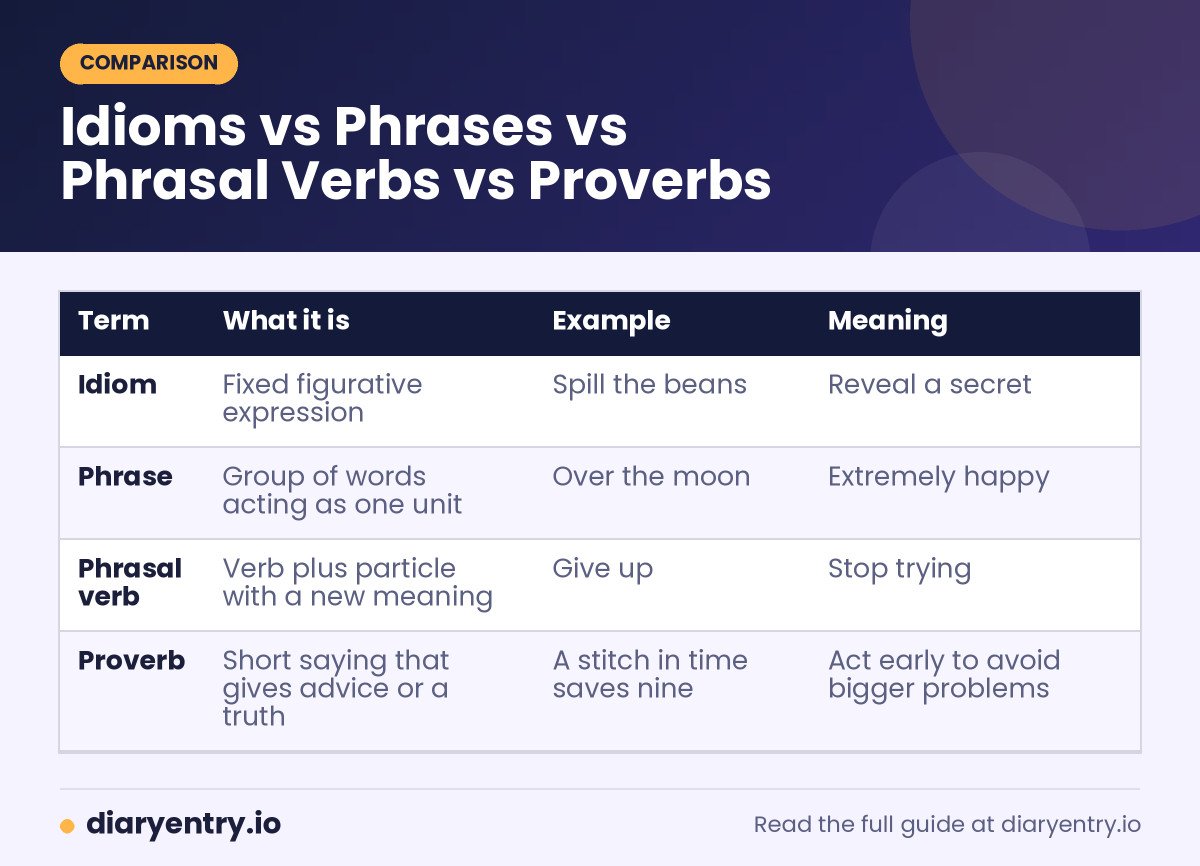
Phrasal verbs form a large family of their own, so we have a separate guide on phrasal verbs with meanings and examples. Idioms also overlap with images such as similes and metaphors, which are covered in our guide to figures of speech.
Common Idioms and Phrases With Meanings
Learning idioms by theme is easier than learning them in alphabetical order, because related images stick together in memory. Each list below gives the idiom, its meaning and a model sentence.
Idioms About Speaking and Secrets
- Break the ice: to start a conversation in a tense or shy situation. “A quick joke helped him break the ice at the meeting.”
- Spill the beans: to reveal a secret by mistake. “Do not spill the beans about the surprise party.”
- Let the cat out of the bag: to reveal a secret accidentally. “She let the cat out of the bag about the new job.”
- Beat around the bush: to avoid talking about the main point. “Stop beating around the bush and tell me the result.”
- Bite your tongue: to stop yourself from saying something. “I had to bite my tongue when he made that comment.”
- Hit the nail on the head: to describe something exactly. “You hit the nail on the head with that explanation.”
Idioms About Work and Effort
- Burn the midnight oil: to work or study late into the night. “She burned the midnight oil before the exam.”
- Hit the books: to study hard. “I have to hit the books this weekend.”
- Call it a day: to stop working for the day. “We were tired, so we called it a day.”
- Get the ball rolling: to start something. “Let us get the ball rolling with the first topic.”
- Go the extra mile: to make more effort than expected. “He always goes the extra mile for his students.”
- Back to square one: to start again after failing. “The plan failed, so we were back to square one.”
Idioms About Feelings
- Over the moon: extremely happy. “He was over the moon after winning the prize.”
- Under the weather: slightly unwell. “I am feeling under the weather today.”
- On cloud nine: very joyful. “She was on cloud nine after the news.”
- Down in the dumps: sad or depressed. “He has been down in the dumps since the match.”
- Butterflies in the stomach: nervous excitement. “I had butterflies in my stomach before the speech.”
- Cry over spilt milk: to regret something that cannot be changed. “There is no use crying over spilt milk.”
Idioms About Money and Value
- Cost an arm and a leg: to be very expensive. “That phone costs an arm and a leg.”
- Break the bank: to cost more than you can afford. “A small gift will not break the bank.”
- Penny wise, pound foolish: careful with small amounts but careless with big ones. “Buying cheap shoes that fall apart is penny wise, pound foolish.”
- A blessing in disguise: something good that seemed bad at first. “Losing that job was a blessing in disguise.”
- Once in a blue moon: very rarely. “We meet only once in a blue moon.”
Idioms About Weather and Nature
- Raining cats and dogs: raining heavily. “We stayed inside because it was raining cats and dogs.”
- Storm in a teacup: a big fuss about something small. “The argument was just a storm in a teacup.”
- Every cloud has a silver lining: there is something good in every bad situation. “Be patient, every cloud has a silver lining.”
- Break the camel’s back: the final small thing that makes a situation unbearable. “One more task was the straw that broke the camel’s back.”
- Barking up the wrong tree: making the wrong choice or accusing the wrong person. “If you blame him, you are barking up the wrong tree.”
Idioms About Luck and Risk
- Piece of cake: something very easy. “The quiz was a piece of cake.”
- Hit the jackpot: to have great success or luck. “The shop hit the jackpot with its new product.”
- Play with fire: to take a dangerous risk. “Ignoring the warning is playing with fire.”
- Kill two birds with one stone: to achieve two things with one action. “Walking to school kills two birds with one stone: exercise and saving money.”
- In the same boat: in the same difficult situation. “We are all in the same boat this term.”
Origins of Some Famous Idioms
Knowing where an idiom comes from can make it easier to remember, but be careful: many popular origin stories are guesses rather than proven history. A few explanations are fairly reliable. “Break the ice” originally referred to ships clearing frozen water so that other boats could pass, which is a natural image for starting an uneasy conversation. “Burn the midnight oil” refers to the days when people worked by oil lamps. “Back to square one” is often linked to board games, though historians are not certain which game.
For many other idioms, such as “raining cats and dogs,” the real origin is uncertain, and several theories exist. When you meet such an idiom, it is safer to learn the meaning than to repeat a story you cannot verify.
How to Learn Idioms and Phrases Step by Step
Memorising a hundred idioms in one evening rarely works. A gentler routine gives much better results over a month.
- Choose a theme, such as feelings or work, and select five idioms from it.
- Write each idiom on one line, with its meaning and a sentence you create yourself.
- Picture the literal image, for example a person actually breaking ice, to anchor the meaning.
- Use each idiom in a short spoken or written sentence within the same day.
- Review the previous day’s idioms before adding new ones.
- Test yourself weekly by covering the meanings and recalling them.
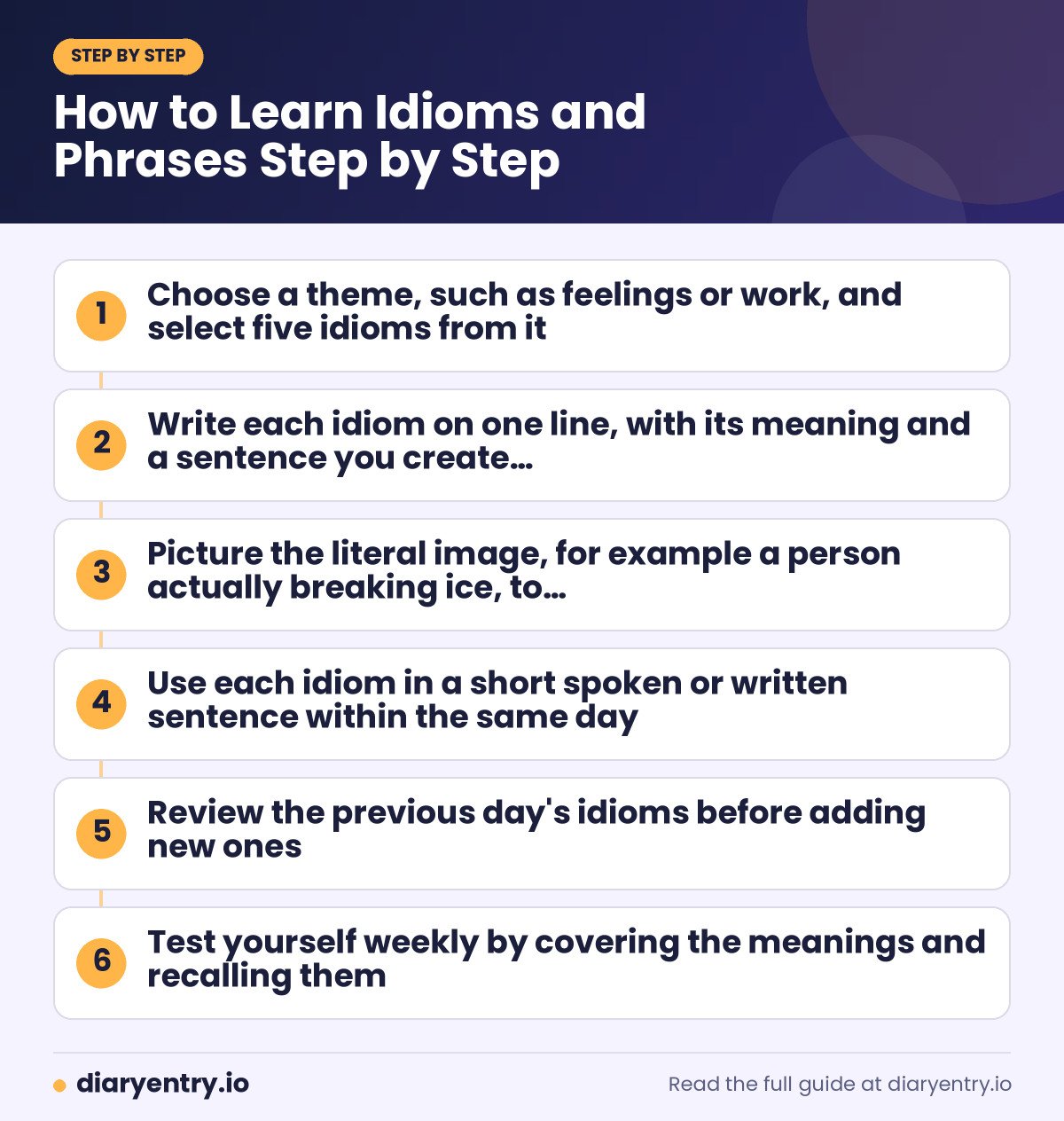
A personal notebook is a natural place to keep these entries. If you are building the habit of daily writing, our guide on how to write a diary entry shows how a few lines each day can include new vocabulary naturally.
How to Use Idioms Correctly in Writing
An idiom adds colour, but only when it fits the sentence and the audience. Keep these guidelines in mind.
- Match the tone. Idioms are natural in stories, informal letters, speeches and diary entries. In formal reports and applications, prefer plain wording or use only common, widely understood idioms.
- Use the exact form. You can change the tense (“he spilled the beans”) but not the words themselves (“he spilled the peas” has no idiomatic meaning).
- Do not mix images. Saying “we will burn that bridge when we come to it” blends two different idioms and confuses the reader.
- Avoid overuse. One or two well-chosen idioms in a paragraph is enough; a cluster of them sounds forced.
- Check that your reader will understand. Idioms can be hard for new learners of English, so avoid them in instructions.
In letter writing for school exams, a friendly idiom can improve an informal letter, but a formal complaint should stay literal. Our guide to the informal letter format shows where an idiom or two fits comfortably.
Common Mistakes With Idioms
Translating literally
Learners often translate an idiom from their own language word by word. The result may sound odd or mean nothing in English. Always check that an English idiom exists in the exact form before using it.
Mixing up similar idioms
“Beat around the bush” and “bark up the wrong tree” are not related, but both involve plants and are often mixed up. Likewise, “spill the beans” and “let the cat out of the bag” mean the same thing, so use only one in a sentence.
Changing the wording
Replacing even one word can break an idiom. The correct form is “a piece of cake,” not “a slice of cake.” The correct form is “hit the nail on the head,” not “hit the nail on the top.”
Wrong tense or agreement
The verb inside an idiom should agree with the rest of the sentence. “She break the ice” is wrong, while “She broke the ice” is correct. Check your tenses before you finalise a sentence.
Practice: Choose the Right Idiom
Fill each blank with the best idiom from the list: piece of cake, under the weather, burn the midnight oil, once in a blue moon, hit the nail on the head.
- Meena has been feeling ______ since yesterday, so she stayed at home.
- We visit our grandparents only ______ because they live far away.
- The maths test was a ______, and I finished early.
- Students often ______ before final exams.
- When you said the plan lacked a budget, you ______.
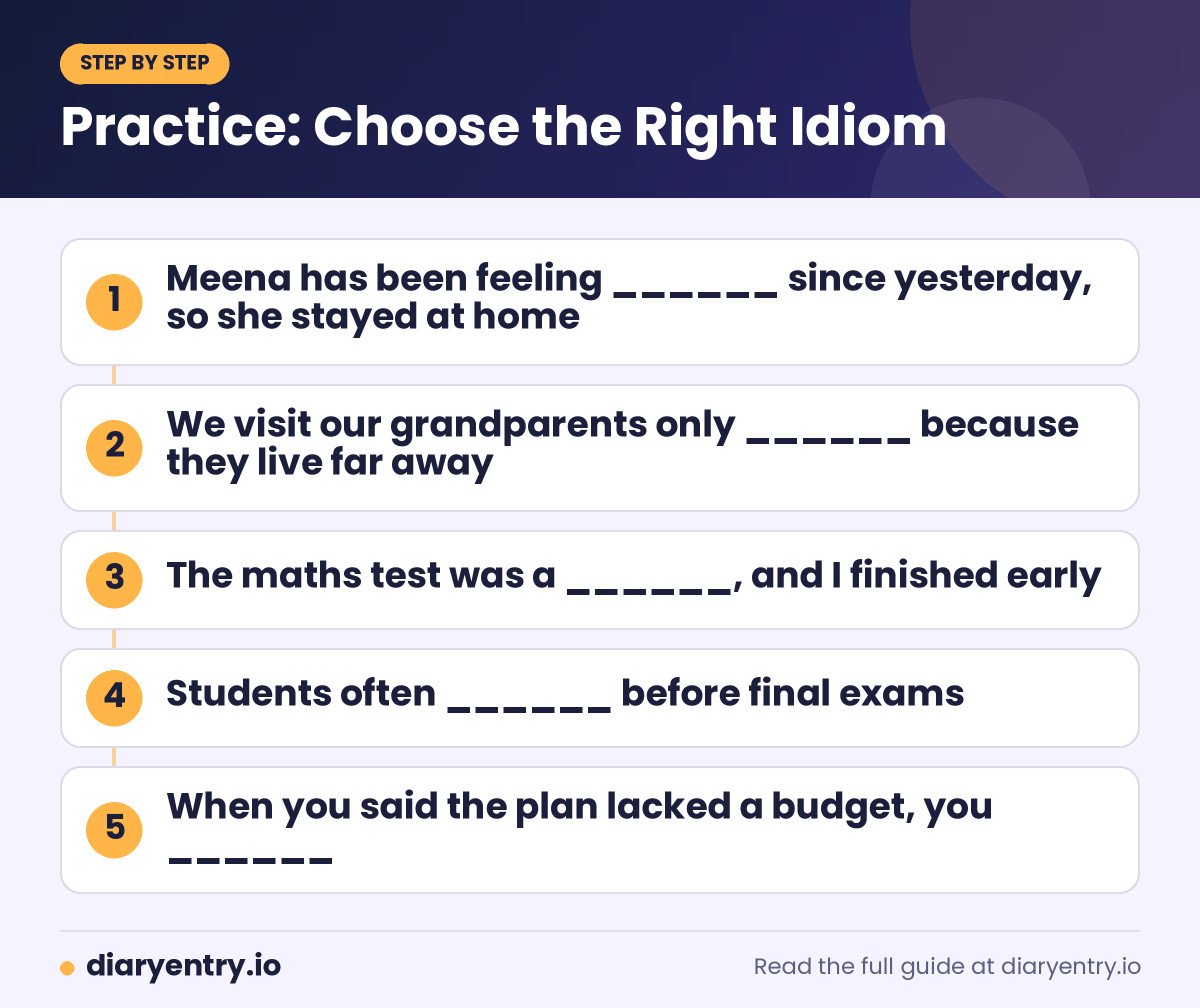
Answers: (1) under the weather; (2) once in a blue moon; (3) piece of cake; (4) burn the midnight oil; (5) hit the nail on the head.
Idioms in Context: A Sample Paragraph
Idioms are easiest to remember when you see them working together in a short passage. Read this example and notice how each expression adds colour without making the paragraph hard to follow.
“Aditi had been burning the midnight oil for a week, and by Friday she was feeling under the weather. Her friends told her not to cry over spilt milk about the one test she had missed, because every cloud has a silver lining. When the results arrived, she was over the moon: the last paper had been a piece of cake, and she had passed with marks to spare.”
That paragraph uses five idioms in about sixty words, which is more than you would normally want. In real writing, spread them out and choose only those that fit the mood. The sample is useful for study because it shows each idiom with a clear meaning supplied by the surrounding sentence.
How Idioms Appear in Exams
School and competitive exams usually test idioms and phrases in a few predictable ways. Knowing the question types helps you prepare more efficiently.
- Meaning questions: you are given an idiom and four options, and you must choose the correct meaning. Eliminate options that match the literal meaning first, because they are usually distractors.
- Fill in the blanks: a sentence has a gap, and you choose the idiom that fits the context. Read the whole sentence for clues about mood and tone.
- Sentence use: you are asked to write your own sentence that shows the meaning of an idiom. Make sure your sentence includes enough context for a reader to guess the meaning.
- Error spotting: a sentence contains an idiom with a changed word, and you must find the mistake.
When writing your own sentence, avoid vague examples such as “He kicked the bucket.” Instead, add a detail that points to the meaning, such as “The old farmer kicked the bucket last winter, and the whole village attended his funeral.” The extra context proves that you understand the idiom rather than simply copying it.
Frequently Asked Questions
What is the difference between an idiom and a phrase?
A phrase is any group of words that works together. An idiom is a special kind of expression whose meaning is figurative and cannot be understood from the individual words alone.
How many idioms should I learn for exams?
There is no fixed number. Most school and competitive exams use common idioms, so learning around fifty to a hundred well, with sentences, is better than skimming five hundred.
Can idioms be used in formal writing?
Occasionally, if they are widely understood and fit the tone. In formal letters, reports and academic essays, plain language is usually safer.
Are proverbs the same as idioms?
No. A proverb is a complete sentence that gives advice or states a truth, such as “Practice makes perfect.” An idiom is usually a part of a sentence that you fit into your own grammar.
Why do idioms not make sense literally?
Idioms grew from images, customs and old situations that people began using figuratively. Over time the figurative meaning became fixed, while the literal image faded.
What is the best way to remember idioms?
Group them by theme, write your own sentence for each one, picture the literal image, and use the idiom in speech or writing within a day of learning it.
Do idioms differ between British and American English?
Some do. For example, “a storm in a teacup” is British, while Americans say “a tempest in a teapot.” Most common idioms are shared, but check usage if you are writing for a specific audience.
Conclusion
Idioms and phrases make English more vivid, and the key to mastering them is steady, themed practice rather than last-minute cramming. Pick five idioms this week, write your own example sentences, and use them in conversation. Over time, you will find yourself choosing the right expression without thinking. A short daily writing routine, such as the 4-Week Diary Entry Course, gives you a comfortable place to try each new idiom in real sentences.