
Quick Answer
Invitation writing format is the structured way of inviting someone to an event, with the sender’s details, date, a greeting, the event details (what, when, where and why), an RSVP line and a closing. Formal invitations use polite third-person wording, while informal ones sound warm and personal.
Key Takeaways
- Every invitation must clearly state the occasion, date, time, venue and the host’s name.
- Formal invitations are written in the third person and are often placed inside a box.
- Informal invitations are written in the first person, like a friendly letter.
- An RSVP line or a contact number tells guests how to confirm their attendance.
- A reply to an invitation should accept or decline politely and repeat the key details.
What Is an Invitation?
An invitation is a written request asking a person or a group to attend an event such as a birthday, wedding, school function, seminar or farewell party. It must give guests every detail they need to plan their visit, and it should also make them feel welcome. In school English papers, students are usually asked to draft an invitation of about 50 words, and sometimes a reply to one, so mastering the invitation writing format is an easy way to secure marks.
Invitations come in two main types. A formal invitation is sent for official or traditional events, and it follows a fixed pattern. An informal invitation goes to friends and family and reads like a short personal letter.
Invitation Writing Format: Elements to Include
No matter which type you write, the following elements make an invitation complete. Missing any of them is the most common reason students lose marks.
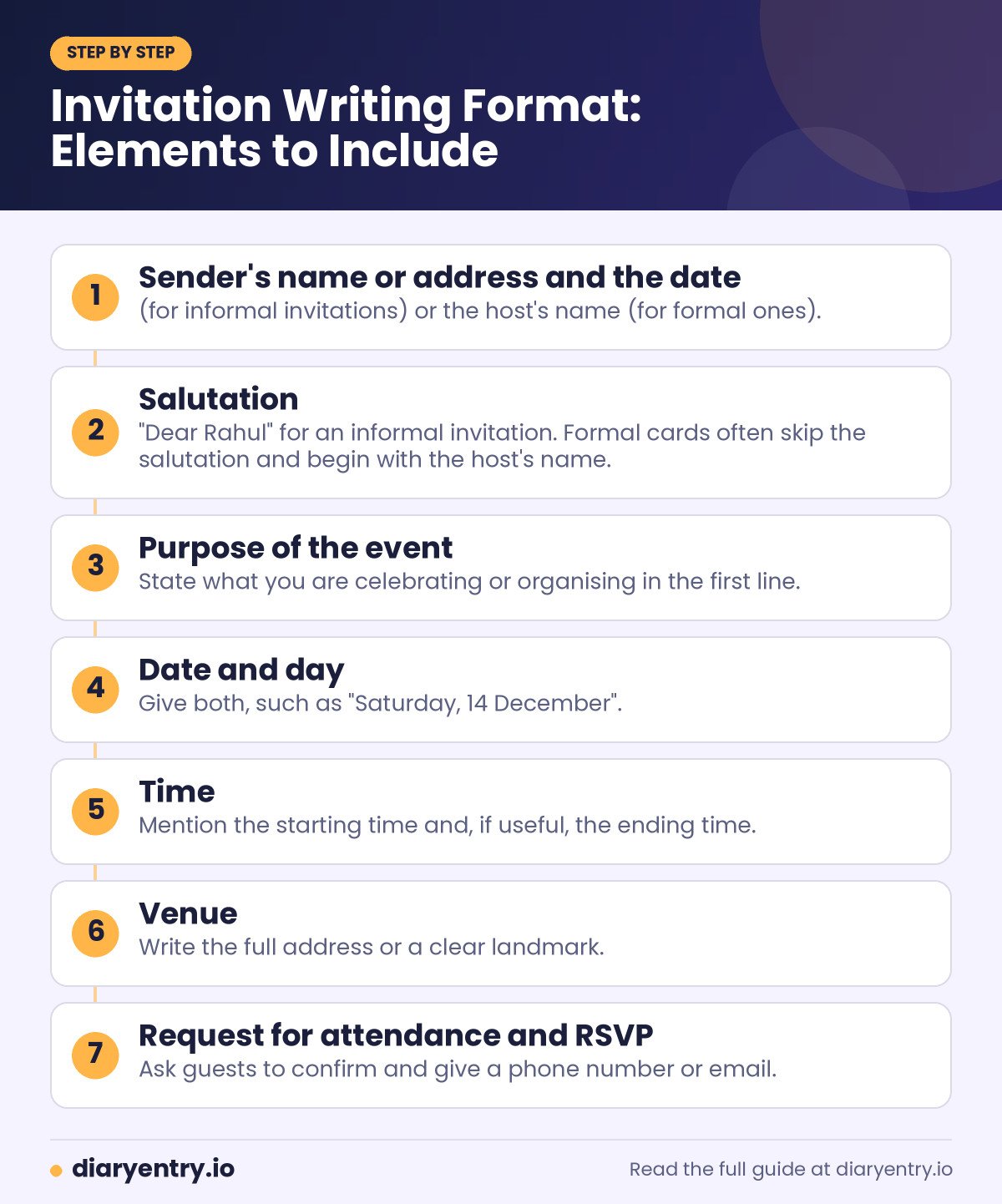
- Sender’s name or address and the date (for informal invitations) or the host’s name (for formal ones).
- Salutation. “Dear Rahul” for an informal invitation. Formal cards often skip the salutation and begin with the host’s name.
- Purpose of the event. State what you are celebrating or organising in the first line.
- Date and day. Give both, such as “Saturday, 14 December”.
- Time. Mention the starting time and, if useful, the ending time.
- Venue. Write the full address or a clear landmark.
- Request for attendance and RSVP. Ask guests to confirm and give a phone number or email.
- Closing. “Yours affectionately” for informal invitations, or a line such as “Your presence will be highly appreciated” for formal ones.
Formal vs Informal Invitations
The table below summarises the main differences so you can choose the right style quickly in an exam.
| Feature | Formal Invitation | Informal Invitation |
|---|---|---|
| Occasion | Weddings, annual days, seminars, inaugurations | Birthdays, house parties, get-togethers |
| Person | Third person (“Mr and Mrs Sharma request…”) | First person (“I would love you to come…”) |
| Layout | Boxed card, centred lines | Letter with address, date and salutation |
| Tone | Polite and respectful | Warm and personal |
| Length | 40 to 50 words | 50 to 80 words |
| Closing | RSVP with contact details | “Yours lovingly” and a name |
For longer personal letters, the informal letter format with samples explains the address, salutation and closing in more detail, and the formal letter format guide covers official correspondence.
Formal Invitation Samples
Sample 1: Annual Day Celebration
You are Ananya Verma, school captain of Sunrise Public School. Draft an invitation to the Annual Day function.
Sunrise Public School, Jaipur
The Principal, teachers and students of Sunrise Public School request the pleasure of your company at the Annual Day Celebration on Saturday, 14 December, at 5:00 p.m. in the school auditorium. The chief guest will be Dr. Meena Kapoor, a renowned educationist. Cultural performances and the prize distribution will follow. Kindly join us and encourage our young performers.
RSVP: Ananya Verma, School Captain, 98XXXXXX01
Sample 2: Wedding Invitation
Mr and Mrs Rakesh Malhotra request the honour of your presence at the wedding ceremony of their daughter, Simran, with Karan, son of Mr and Mrs Anil Chopra, on Sunday, 8 February, at 7:00 p.m. at the Royal Garden Banquet Hall, Sector 18, Noida. Dinner will follow the ceremony. Your blessings will be our greatest gift.
With best compliments from the Malhotra family. RSVP: 98XXXXXX02
Sample 3: Seminar Invitation
The Department of English, Greenfield College, is pleased to invite you to a one-day seminar on “Effective Writing Skills for Students” on Friday, 20 March, from 10:00 a.m. to 1:00 p.m. in Seminar Hall B. Eminent author Mr. Vikram Sethi will deliver the keynote address. Refreshments will be served. Please confirm your participation by 15 March at english@greenfield.example.
Informal Invitation Samples
Sample 4: Birthday Party Invitation
14, Lake View Road
Pune
2 November 2026
Dear Neha,
I hope you are doing well. I am turning sixteen on 15 November, and I am planning a small birthday party at my home on Saturday, 15 November, at 4:00 p.m. There will be music, games and a delicious cake that my mother is baking. It would not feel like a party without you, so please come and bring your brother along. Do let me know by Wednesday if you can make it.
Yours affectionately,
Isha
Sample 5: Housewarming Invitation
Dear Uncle and Aunty,
We are happy to share that we have moved into our new house. We are holding a small puja and lunch on Sunday, 22 February, at 11:00 a.m. at 7, Green Park Colony. Your blessings mean a great deal to us, and the house will feel complete only when you visit. Please come with the whole family.
With love,
Rohit
Replies to Invitations
Many board exams ask students to write a reply to an invitation as well. A reply should be brief, polite and written in the same style as the invitation. Begin by thanking the host, state clearly whether you will attend, and repeat the date, time and venue so there is no confusion.
Reply Accepting an Invitation
Mr and Mrs Kumar thank the Principal and students of Sunrise Public School for the kind invitation to the Annual Day Celebration on Saturday, 14 December, at 5:00 p.m. They are delighted to accept and look forward to attending.
Reply Declining an Invitation
Dear Isha, thank you so much for inviting me to your birthday party on 15 November. I would have loved to come, but I have a family wedding out of town that day. I am very sorry to miss it. Please enjoy yourself, and I will make it up to you with a treat next week.
How to Draft an Invitation in Five Minutes
In an exam you rarely have more than five or six minutes for a short writing task, so a repeatable routine helps. First, identify the type: is the occasion official, or is it a personal celebration? That one decision tells you whether to use a boxed third-person card or a first-person letter.
Second, collect the facts from the question. Underline the occasion, date, time and place, and note the name of the person who is inviting. If any detail is missing, such as the time, choose a sensible one rather than leaving it blank, because the examiner is checking that the invitation is complete. Third, write a one-line opening that states the purpose, add the details in a short sentence or two, and finish with a request to attend and your RSVP.
Finally, re-read for tone. A formal card should never say “come over and have fun”, and a note to a close friend should never say “your gracious presence is solicited”. Reading your answer aloud once usually exposes any mismatch. With practice, this routine becomes automatic, and you will find that most invitation questions feel like variations of the samples you have already studied.
Useful Phrases for Invitations
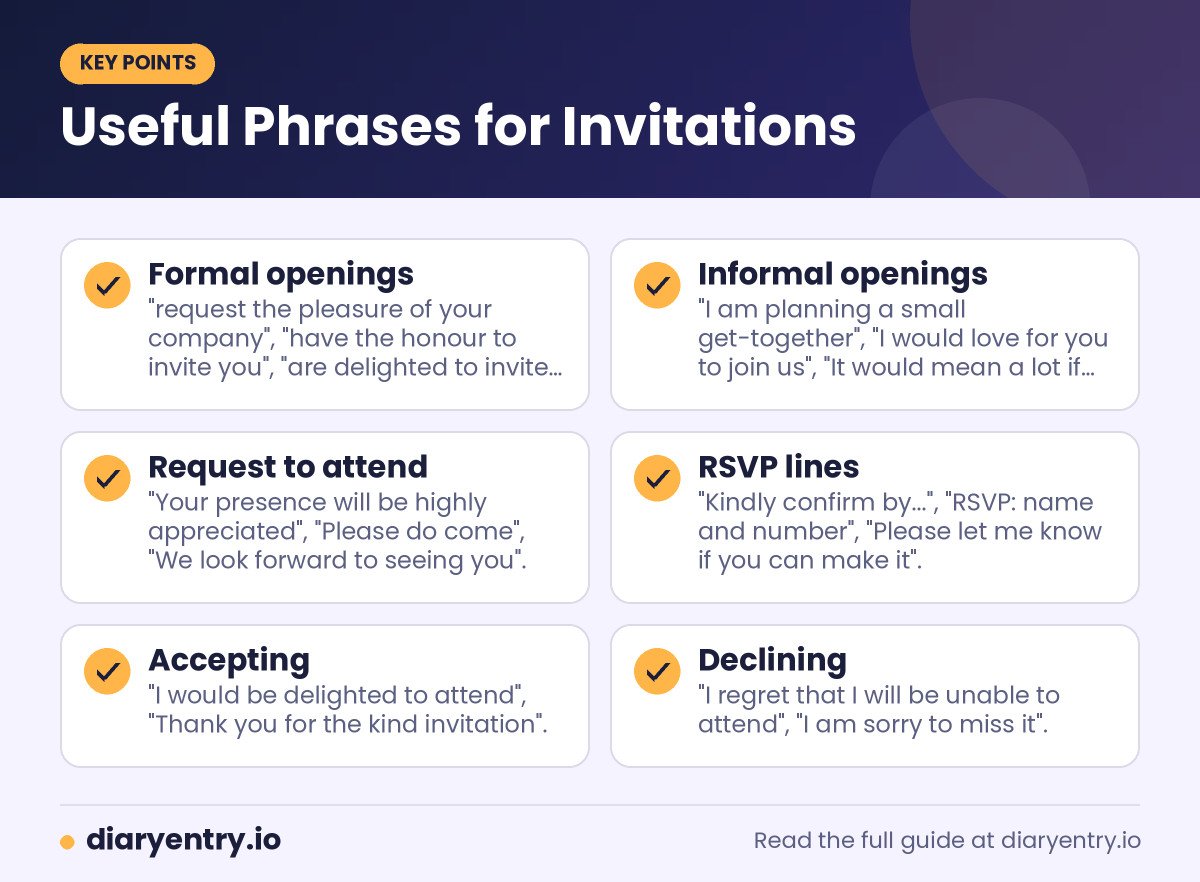
- Formal openings: “request the pleasure of your company”, “have the honour to invite you”, “are delighted to invite you”.
- Informal openings: “I am planning a small get-together”, “I would love for you to join us”, “It would mean a lot if you could come”.
- Request to attend: “Your presence will be highly appreciated”, “Please do come”, “We look forward to seeing you”.
- RSVP lines: “Kindly confirm by…”, “RSVP: name and number”, “Please let me know if you can make it”.
- Accepting: “I would be delighted to attend”, “Thank you for the kind invitation”.
- Declining: “I regret that I will be unable to attend”, “I am sorry to miss it”.
Writing an Invitation by Email or Message
Many invitations today travel by email or a messaging app. The content is the same, but the layout changes. Use a clear subject line such as “Invitation: Farewell Party on 20 March”, open with a short greeting, place the event details in a list or short lines so they are easy to scan, and end with an RSVP request. Our email writing format guide shows the right subject lines, greetings and sign-offs, and the message writing format guide covers short notes when you have only a few lines to work with.
If your invitation is for a school event, you may also need to announce it more widely. A notice for the school board works well for that, while the invitation itself goes to guests personally.
Invitation Wording Ideas by Occasion
The same structure can be reused for many events by changing the opening line and the closing request. For a farewell party, begin with “We are organising a farewell for our beloved seniors” and close with “Please join us in wishing them success”. For a science exhibition, open with “The Science Club proudly presents its annual exhibition” and end with “Your visit will inspire our young scientists”. For a sports day, try “The school invites you to cheer for our athletes” and close with “Your encouragement will make the day special”.
For a cultural festival, you might write “Come and celebrate the colours of our heritage with songs, dance and food”, and for a charity event, “Join us for an evening to support a good cause, where every contribution counts”. Notice that each line states the purpose of the event within the first few words, which is exactly what an examiner looks for. Keep a small bank of such opening and closing lines in your notes and you can assemble a complete invitation within minutes.
Common Mistakes in Invitation Writing
- Leaving out key details. A missing date, time or venue makes the invitation useless.
- Mixing styles. Using casual slang in a formal invitation, or a stiff third-person tone in a note to a friend.
- Exceeding the word limit. Invitations are short, so avoid long introductions.
- Forgetting the RSVP. Without it, the host cannot plan arrangements.
- Writing the date in an unclear way. Spell out the month to avoid confusion between day and month formats.
- Using the wrong person. Formal invitations are in the third person, informal ones in the first.

Invitation Writing Topics for Practice
- Invite your friend to your sister’s engagement ceremony.
- Draft a formal invitation to the inauguration of a school library.
- Invite your classmates to a farewell party for your Class 12 seniors.
- Write an invitation to the parents for a Parent-Teacher Meeting.
- Invite a local doctor to speak at a school health awareness camp.
- Reply to a friend’s invitation to a science exhibition and decline politely.
Tips to Score Full Marks
Read the question twice to decide whether the invitation should be formal or informal, and who the guests are. Then jot down the five core details (occasion, date, time, venue, RSVP) before drafting. Writing the facts first and adding polite phrases second keeps you accurate and quick.
Pay attention to layout. A formal invitation is neat, centred and often boxed, while an informal one needs the sender’s address, the date and a closing with a name. Finally, count your words. Many boards allow 50 words, and a crisp invitation within the limit always looks better than a long one that wanders.
Regular writing practice makes all of this easier. If you want a daily routine that builds fluency in short pieces like these, the 4-Week Diary Entry Course is a friendly place to start.
Frequently Asked Questions
What is the format of an invitation?
An invitation names the host, states the occasion, and gives the date, day, time and venue. It ends with a request to attend and an RSVP. Formal invitations are boxed and in the third person, while informal ones follow a letter layout.
How many words should an invitation be?
Most school papers ask for about 50 words. Check the instruction in your question paper, because some boards allow up to 80 words for informal invitations.
What does RSVP mean?
RSVP comes from a French phrase meaning “please reply”. It asks the guest to confirm whether they will attend, usually with a name and phone number or email to respond to.
Should a formal invitation be in a box?
Yes, in exam answers a formal invitation is usually drawn inside a neat box, with the lines centred. This mimics a printed card and helps the examiner see the format immediately.
How do I reply to an invitation?
Thank the host, say clearly that you accept or regret, repeat the date, time and venue if accepting, and give a short reason if declining. Match the formality of your reply to the invitation.
Is the sender’s address needed in an invitation?
It is needed in an informal invitation written as a letter, where you place your address and the date at the top. In a boxed formal invitation, the host’s name replaces the address.
Conclusion
A good invitation is short, clear and welcoming. Learn the invitation writing format once, remember the five core details, match your tone to the occasion, and you can draft a full-marks answer for any event, from a school function to a family celebration. Practise with the topics above and compare your drafts with the samples to see how close your layout and wording are.